
In the development of critical navigation and guidance systems, the demand for components with exceptional dimensional fidelity, intricate geometry, and high structural integrity is paramount. One such component is the housing for a high-precision gyroscope. The successful production of this part via precision lost wax casting represents a significant achievement in advanced manufacturing. This article details the comprehensive technical journey, from initial analysis to final component validation, undertaken to master the precision lost wax casting of this challenging aluminum alloy part.
I. Component Analysis and Foundry Method Selection
The gyro-housing is a structural cornerstone, and its design imposes severe constraints on the manufacturing process. A detailed analysis revealed its defining characteristics:
- Geometric Complexity: The part features an extremely intricate internal and external geometry with drastic variations in wall thickness, transitioning from sections over 6mm to areas as thin as 1.5mm.
- Surface Finish Requirement: A superior surface finish, equivalent to Ra 3.2 µm or better, is mandatory for functional and assembly purposes.
- Stringent Internal Quality: The casting must be free from cold shuts, cracks, mistruns, and exhibit a maximum porosity level not exceeding Grade 2 per relevant standards.
- Tight Dimensional Tolerances: Critical dimensions must be held to tolerances as tight as ±0.25 mm.
- Mechanical Performance: The material must achieve a minimum tensile strength (σb) of 290 MPa.
Given these constraints, conventional casting methods were evaluated and deemed unsuitable. Die casting was impossible due to the part’s complexity preventing core retraction. While ceramic or plaster mold casting offered potential, the immediate project timeline necessitated a process with an established, high-level domestic capability. Consequently, precision lost wax casting was selected. This process, renowned for its ability to replicate fine details and achieve excellent surface finish on complex shapes, was identified as the most viable path forward. Collaboration was established with a facility possessing state-of-the-art equipment and deep expertise in aerospace investment casting.
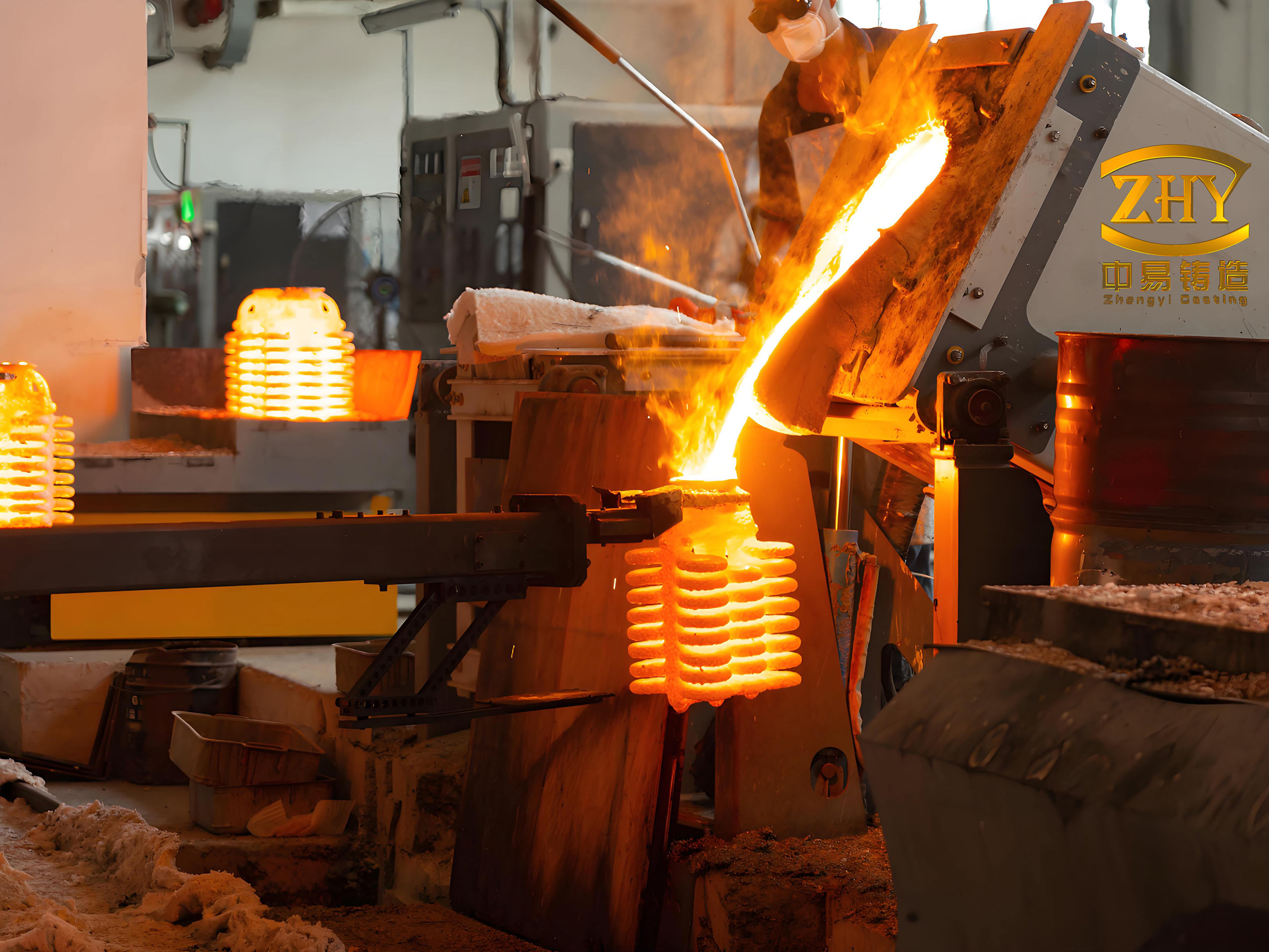
II. Core Process Characteristics and Development
The entire precision lost wax casting workflow was meticulously engineered and controlled. The success hinged on the synergistic optimization of several key stages: pattern production, shell building, dewaxing, firing, alloy treatment, and pouring.
1. Pattern Material Selection and Injection
The foundation of precision lost wax casting is a high-quality pattern. The selected pattern material must satisfy a demanding set of criteria to ensure final casting quality:
| Requirement | Rationale |
|---|---|
| Excellent Fluidity & Replication | To completely fill the complex die cavity and accurately reproduce fine features and sharp corners. |
| Low Linear Shrinkage | To ensure dimensional stability of the pattern, minimize distortion during cooling, and thereby control final casting dimensions. The linear shrinkage, $S_L$, is a critical parameter: $$S_L = \frac{L_{die} – L_{pattern}}{L_{die}} \times 100\%$$ where a lower $S_L$ is preferred. |
| High Strength & Hardness at Room Temperature | To withstand handling, assembly, and shell building processes without deformation or damage. |
| Good Wetting/Coating Characteristics | To allow the refractory slurry to uniformly coat all surfaces, especially in deep recesses and sharp angles, ensuring shell integrity. |
A zero-contraction (low-shrinkage) wax blend was formulated to meet these needs. Its composition and key properties are summarized below:
| Component | Weight % |
|---|---|
| Microcrystalline Wax | 60% |
| Paraffin Wax | 30% |
| Polyethylene | 5% |
| Other Additives (e.g., fillers) | 5% |
| Property | Value / Description |
|---|---|
| Melting Point (Drop Point) | 68 – 72 °C |
| Penetration Hardness | 4.5 mm (at 25°C) |
| Ash Content | < 0.05% |
| Viscosity & Flow | Optimized for thin-section filling |
Patterns were injected using an automated wax injection machine. The process parameters were rigorously controlled and optimized through DOE (Design of Experiments) to balance fill, shrinkage, and surface quality.
| Process Parameter | Setting / Range |
|---|---|
| Injection Temperature | 52 – 55 °C |
| Injection Pressure | 0.4 – 0.7 MPa |
| Die Temperature | 22 – 25 °C |
| Holding/Cooling Time | 90 – 120 seconds |
2. Shell Building: A Multi-Layer Engineering System
For aluminum alloys, particularly thin-walled sections, the ceramic shell must possess a unique combination of properties: a smooth inner surface, adequate high-temperature strength, and, critically, high permeability to allow gases to escape during pouring. A “single-pour, multi-layer” shell system was adopted.
The choice of refractories is pivotal. For the face coat, a zircon flour ($ZrSiO_4$) slurry bonded with colloidal silica was used. Zircon provides a high refractory index, excellent chemical inertness against aluminum, low thermal expansion promoting shell stability, and a high thermal diffusivity ($\alpha$) which promotes directional solidification. The thermal diffusivity is given by: $$\alpha = \frac{k}{\rho c_p}$$ where $k$ is thermal conductivity, $\rho$ is density, and $c_p$ is specific heat capacity. A high $\alpha$ for zircon helps rapidly draw heat from the metal.
The backup coats employed a fused alumina ($Al_2O_3$) and calcined kaolin clay (primarily mullite, $3Al_2O_3 \cdot 2SiO_2$) system, bonded with hydrolyzed ethyl silicate. Kaolin clay, while providing good strength, was selected with a controlled impurity level (Fe2O3 + TiO2 < 2.0%) to ensure adequate shell friability after casting for easier removal. The shell build sequence is detailed below:
| Layer Sequence | Binder | Refractory Flour | Stucco (Grain Size) |
|---|---|---|---|
| Primary (1st & 2nd) | Colloidal Silica | Zircon | Zircon (Fine) |
| Secondary (3rd – 5th) | Hydrolyzed Ethyl Silicate | Calcined Kaolin / Alumina Blend | Alumina / Mullite (Medium) |
| Seal Coat (Final) | Hydrolyzed Ethyl Silicate | Calcined Kaolin / Alumina Blend | N/A (Brush applied) |
The mechanical behavior of the shell is temperature-dependent. The high-temperature strength is crucial to resist metallostatic pressure, while a lower room-temperature strength aids knockout. The relationship between temperature ($T$) and tensile strength ($\sigma_{shell}$) for the backup system can be modeled as a piecewise function, reflecting the binder transformations: $$\sigma_{shell}(T) \approx \begin{cases} \sigma_0 – k_1 T & \text{for } T < 300^\circ C \text{ (gel strength)} \\ \sigma_{min} + A \exp(BT) & \text{for } 300^\circ C < T < 800^\circ C \text{ (sintering)} \\ \sigma_{high} & \text{for } T > 800^\circ C \text{ (ceramic bond)} \end{cases}$$ where $\sigma_0, k_1, \sigma_{min}, A, B, \sigma_{high}$ are material constants. Permeability ($P$), vital for gas escape, generally increases with temperature as micro-cracks form and gases expand: $$P(T) \propto P_0 \cdot (1 + \gamma \Delta T)$$ where $P_0$ is room temp permeability and $\gamma$ is an expansion coefficient.
3. Advanced Dewaxing and Shell Firing
Dewaxing was performed in a high-pressure autoclave using steam. The process followed a “fast pressure rise, controlled hold” principle to rapidly melt and remove the wax without shell cracking. Steam pressure was maintained at 0.65-0.75 MPa for a cycle time of 10-15 minutes. The rapid vaporization of the wax creates an internal pressure; the shell must withstand this stress $\sigma_{dewax}$, which is a function of wax properties and heating rate: $$\sigma_{dewax} \approx \frac{P_{vapor} \cdot r}{2t}$$ where $P_{vapor}$ is the vapor pressure inside the shell, $r$ is an effective cavity radius, and $t$ is the shell thickness.
Following dewaxing, the shell undergoes a pre-firing or baking cycle. This serves to: 1) Remove all residual volatiles and carbonaceous material, 2) Complete the dehydration and polymerization of the silica binders, and 3) Develop the final ceramic bond strength. The firing curve was carefully controlled: heat to $950 \pm 20^\circ C$, hold for 60-90 minutes, then allow to cool to the intended pouring temperature.
4. Alloy Melting, Treatment, and Pouring
The specified alloy was a near-equivalent to ZL114A (A357-type), an Al-Si-Mg alloy renowned for its excellent castability, low hot tearing tendency, and good mechanical properties after heat treatment. The nominal composition is Al-7Si-0.6Mg. The key to quality lies in melt treatment.
Melting was conducted in a resistance crucible furnace under a protective flux cover. The charge consisted of primary aluminum, Al-Si master alloy, and pure magnesium. Critical melt control steps included:
- Degassing & Refining: A rotary impeller degasser was used to introduce high-purity argon or a chlorine-free refining flux. This reduces dissolved hydrogen content [$H$], a primary source of porosity. The efficiency can be related to first-order kinetics: $$[H]_t = [H]_0 \cdot e^{-k_d t}$$ where $k_d$ is a degassing rate constant dependent on gas flow rate and melt surface area.
- Grain Refinement: An Al-Ti-B grain refiner was added to promote a fine, equiaxed grain structure, improving mechanical properties and reducing shrinkage porosity susceptibility.
- Temperature Control: The melt temperature was strictly held below $750^\circ C$ to minimize gas pickup and oxidation. Total melt time from charge to pour was kept under 4 hours.
The pouring operation is the culmination of the precision lost wax casting process. The fired shell was held at a temperature of $450 – 500^\circ C$ to prevent premature chilling of the thin sections. The alloy was poured at a temperature of $700 – 720^\circ C$. The pour was rapid but controlled, aiming to fill the mold in 3-5 seconds to avoid mist runs. The heat transfer during filling and solidification is governed by the Fourier equation and interfacial resistance: $$\rho c_p \frac{\partial T}{\partial t} = \nabla \cdot (k \nabla T)$$ with boundary conditions at the metal-shell interface involving heat transfer coefficient $h$.
5. Post-Casting Operations: Knockout and Heat Treatment
After solidification and cooling, the shell was removed using a combination of mechanical vibration and high-pressure water jetting. Care was taken to avoid direct impact on the fragile casting. The final step was a T6 heat treatment:
- Solution Treatment: $535 \pm 5^\circ C$ for 8-10 hours, followed by rapid quenching in hot water ($60-80^\circ C$) to minimize residual stress and distortion.
- Artificial Aging: $155 \pm 5^\circ C$ for 4-6 hours. This precipitates Mg2Si phases in a finely dispersed form, significantly increasing strength. The strengthening contribution $\Delta \sigma_{ppt}$ from precipitates can be approximated by the Orowan bypass mechanism: $$\Delta \sigma_{ppt} \approx \frac{M G b}{\lambda}$$ where $M$ is the Taylor factor, $G$ is the shear modulus, $b$ is the Burgers vector, and $\lambda$ is the inter-precipitate spacing.
The mechanical properties achieved from separately cast test bars using the same precision lost wax casting process were excellent and met the specification. A comparison with typical sand-cast properties of the same alloy highlights the capability of the process.
| Property | Precision Lost Wax Cast (T6) | Typical Sand Cast (T6) | Notes |
|---|---|---|---|
| Tensile Strength, $\sigma_b$ | 295 – 315 MPa | ~280 – 300 MPa | Wax cast shows ~5-7% improvement |
| Yield Strength, $\sigma_{0.2}$ | 230 – 250 MPa | ~210 – 230 MPa | Consistent improvement |
| Elongation, $\delta$ | 3.5 – 5.0% | ~3.0 – 4.0% | Good ductility maintained |
III. Technical Challenges and Concluding Remarks
The primary challenge encountered was related to shell removal. The high-strength shell system, while necessary for handling and casting integrity, proved excessively resistant to mechanical knockout, leading to some component damage during this phase. This highlights a critical optimization trade-off in precision lost wax casting: achieving sufficient green and fired strength while maintaining adequate “collapsibility” or friability post-cast. Future work involves further tailoring the binder-to-refractory ratio in the backup coats and exploring alternative refractory materials with inherently lower fracture toughness after thermal cycling.
In conclusion, through a systematic, science-based approach to every stage of the precision lost wax casting process—from wax formulation and rheology control, through engineered shell design with tailored permeability and strength profiles, to rigorous melt treatment and thermal process control—it was possible to consistently produce a highly complex, thin-walled aluminum gyro-housing. The process yielded components that met all stringent requirements for dimensional accuracy (achieving a first-pass yield rate near 90%), surface finish, internal soundness, and mechanical performance. This project stands as a testament to the capability of advanced precision lost wax casting to manufacture mission-critical components where geometry, performance, and reliability converge.