
The pursuit of superior wear-resistant materials is a constant in industrial development. Among these, white cast iron stands out for its exceptional hardness, derived primarily from its hard, brittle eutectic carbides. However, the very feature that grants this white cast iron its wear resistance—the continuous network of carbides—also imposes a severe limitation: extreme brittleness and poor impact toughness. This inherent trade-off has long restricted the application of white cast iron, particularly in components subject to impact or significant mechanical shock. The scientific and industrial challenge, therefore, has been to modify the morphology of these carbides—to transform the detrimental continuous network into isolated, spherical particles—while retaining or even enhancing the material’s hardness and wear resistance. This article, from my research perspective, delves into a comprehensive study on achieving precisely this transformation in tungsten-alloyed white cast iron through strategic modification, exploring the underlying mechanisms and the profound effects on mechanical and tribological properties.
The foundation of this work lies in a specific class of material: tungsten-alloyed white cast iron. Tungsten is a potent alloying element that influences the type and morphology of carbides. In high-tungsten variants (around 20 wt.%), carbides tend to be more isolated and blocky, primarily of the M6C type. However, the high cost of tungsten makes such alloys economically unviable for widespread use. Conversely, low-tungsten white cast iron (containing less than 6% W) is cost-effective but suffers from a continuous network of M3C carbides, leading to unacceptable brittleness. My research objective was clear: to develop a method to spheroidize the eutectic carbides in affordable, low-tungsten white cast iron, thereby unlocking its potential for demanding applications.
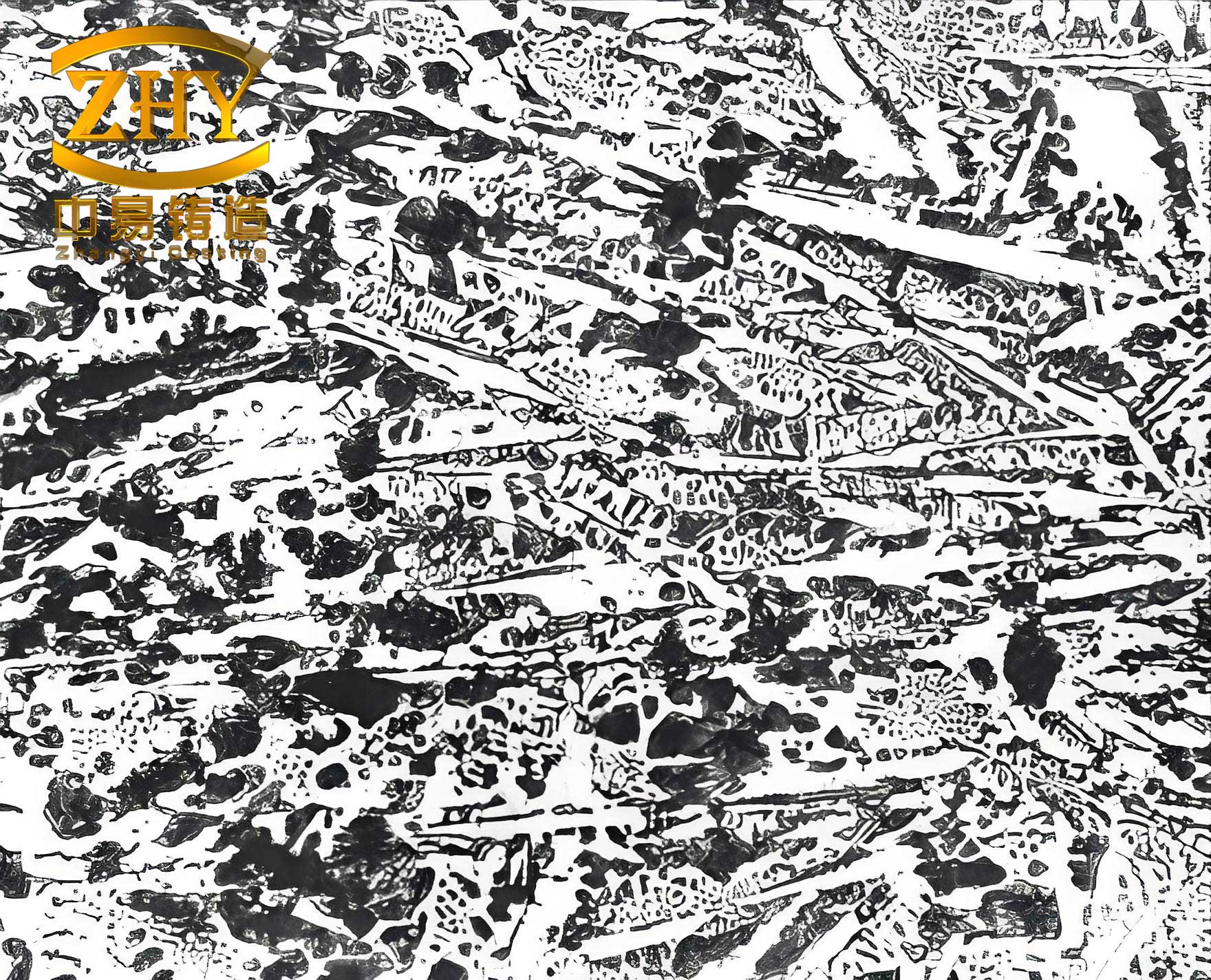
The core of the investigation revolved around a novel composite modification treatment using surface-active elements: Cerium (Ce), Potassium (K), and Sodium (Na). The hypothesis was that these elements could alter the solidification kinetics and interfacial energy, thereby disrupting the typical growth pattern of the carbide network. The base white cast iron chemistry was carefully controlled, as detailed in Table 1.
| Element | C | W | Cr | Mn | Si | P | S |
|---|---|---|---|---|---|---|---|
| Content | 2.8-3.0 | 2.5-3.5 | 1.0-1.5 | 0.5-1.0 | 0.6-0.9 | <0.05 | <0.05 |
The melting was conducted in a medium-frequency induction furnace. At a temperature of 1500 ± 10°C, the melt was tapped, and the modifiers were introduced via the ladle inoculation method. Different combinations were tested to isolate and understand their effects, as summarized in Table 2.
| Sample Designation | Modification Addition (wt.%) |
|---|---|
| W0 | Unmodified (Base white cast iron) |
| W1 | 0.10% Ce |
| W2 | 0.10% K |
| W3 | 0.10% Na |
| W4 | 0.10% Ce – 0.10% K – 0.10% Na |
To quantitatively assess the effectiveness of the modification treatment on the white cast iron’s carbide morphology, a key parameter was introduced: the Circular Degree (C.D.). This parameter mathematically defines the roundness or sphericity of a carbide particle. For any given carbide in the microstructure, it is calculated as:
$$C.D = \frac{\pi D_{max}^2}{4S}$$
where \(D_{max}\) is the maximum diameter of the carbide particle (in µm), and \(S\) is its cross-sectional area (in µm²). A perfect circle has a C.D. value of 1.0. Higher values indicate more irregular, elongated, or networked morphologies. Thus, a successful spheroidization process for the white cast iron carbides would be reflected in a significant reduction of the average C.D. value across the microstructure.
All cast samples were subjected to an identical heat treatment cycle: austenitizing at 980°C for 2 hours followed by air cooling, and tempering at 300°C for 2 hours followed by furnace cooling. This ensured a consistent matrix microstructure of tempered martensite with secondary carbides and some retained austenite, allowing for a direct comparison of the carbide morphology’s isolated effect on properties. The evaluation suite included microstructure analysis (quantified via C.D. measurement), impact toughness testing on unnotched specimens, macro-hardness measurement, and dynamic impact-abrasion wear tests.
The results were striking and systematically demonstrated the power of the modification. In the as-cast state, the unmodified white cast iron (W0) exhibited the classic continuous carbide network, with a high average C.D. value. The addition of any single modifier (Ce, K, or Na) began to disrupt this network, resulting in a discontinuous morphology and a measurable decrease in C.D. However, the composite modification (W4) produced a dramatic improvement, yielding a fragmented network and the lowest C.D. value, signaling a move towards isolated, blocky carbides even in the cast state. This trend was powerfully accentuated after heat treatment, as shown in Table 3. The high-temperature diffusion processes during austenitization further facilitated the spheroidization of the already-refined carbides in the modified white cast iron.
| Sample | Modifier | Carbide Morphology | Average C.D. |
|---|---|---|---|
| W0 | None | Discontinuous Network | 2.381 |
| W1 | Ce | Fragmented Network | 1.805 |
| W2 | K | Fragmented Network | 1.772 |
| W3 | Na | Fragmented Network | 1.719 |
| W4 | Ce-K-Na | Fragmented Network, Granular, Spheroidal | 1.338 |
The mechanism behind this transformation in white cast iron is multifaceted, rooted in the effects of surface-active elements on solidification. Thermal analysis revealed that modification lowered both the primary austenite and eutectic reaction temperatures, indicating an increased undercooling (\(\Delta T\)). According to classical solidification theory, an increase in undercooling enhances the nucleation rate (\(N\)). This relationship can be conceptually linked by equations considering the energy barrier for nucleation:
$$N = K_1 \exp\left(-\frac{\Delta G^*}{k_B T}\right)$$
$$\Delta G^* \propto \frac{\gamma^3}{\Delta G_v^2}$$
where \(\Delta G^*\) is the critical free energy for nucleation, \(\gamma\) is the interfacial energy, \(\Delta G_v\) is the volume free energy change (which increases with undercooling, \(\Delta T\)), \(k_B\) is Boltzmann’s constant, and \(T\) is temperature. The increased undercooling from modification increases \(\Delta G_v\), reducing \(\Delta G^*\) and thus increasing \(N\). A higher nucleation rate for primary austenite leads to a finer grain structure. This finer austenite skeleton more effectively partitions the remaining liquid, physically preventing the formation of a continuous carbide network during the subsequent eutectic reaction in the white cast iron.
Furthermore, elements like Ce, K, and Na are known to be surface-active in iron melts. It is postulated that they selectively adsorb onto the crystallographic facets of the growing eutectic carbide that have the fastest growth velocity, typically along the [010] direction for M3C. This adsorption film creates a kinetic barrier, poisoning these preferred growth sites and reducing the anisotropy of growth. The growth rates in different crystallographic directions become more balanced, leading to a more isotropic, rounded, or “chunky” carbide shape rather than an elongated, networked one in the white cast iron. This adsorption effect can be described by a reduction in the effective interfacial energy (\(\gamma_{eff}\)) on specific facets:
$$\gamma_{eff} = \gamma_0 – \Gamma RT \ln(1 + K a_i)$$
where \(\gamma_0\) is the intrinsic interfacial energy, \(\Gamma\) is adsorption saturation, \(R\) is the gas constant, \(T\) is temperature, \(K\) is an adsorption equilibrium constant, and \(a_i\) is the activity of the adsorbing modifier element (Ce, K, Na). The reduction in \(\gamma_{eff}\) on specific facets alters the Wulff construction, changing the equilibrium shape of the carbide particle during growth within the white cast iron matrix.
The profound improvement in carbide morphology directly translated to exceptional gains in mechanical and tribological performance. The relationship between the carbide circular degree (C.D.) and key properties is summarized in Table 4. The most significant finding was the dramatic increase in impact toughness. The composite-modified white cast iron (W4) exhibited an increase of over 70% compared to the unmodified material. This can be explained through fracture mechanics. In the unmodified white cast iron, the continuous carbide network provides an easy, low-energy path for crack propagation. Spheroidizing the carbides eliminates this network, forcing cracks to navigate through the tougher metallic matrix or to deflect around the isolated, rounded carbides. This significantly increases the fracture surface energy and the material’s resistance to impact.
| Property | Trend with Decreasing C.D. (Improved Spheroidization) | Primary Mechanism | Approx. % Improvement (W4 vs. W0) |
|---|---|---|---|
| Impact Toughness | Strong Increase | Crack deflection and blunting at isolated spheroids; elimination of continuous brittle path. | >70% |
| Abrasion Wear Resistance | Strong Increase | Dense, hard spheroids effectively support load and protect matrix; reduced carbide fracture and pull-out. | ~50% |
| Macro-Hardness | Minor Change | Hardness governed by phase volume fractions (martensite, carbide); morphology has secondary effect. | Negligible |
The wear resistance under impact-abrasion conditions also showed remarkable improvement, increasing by approximately 50%. The mechanism here is also linked to carbide morphology. In a networked white cast iron, abrasive particles can gouge out large, interconnected regions of the relatively softer matrix, and the carbides themselves, being part of a brittle network, are prone to fracture and catastrophic removal. In the spheroidized white cast iron, the hard, rounded carbides are firmly embedded in the matrix. They act as a dense, protective shield, carrying most of the load from the abrasive particles and minimizing direct contact with the matrix. The rounded shape also reduces stress concentration, making them less likely to fracture. The wear resistance (\(W^{-1}\)) can be conceptually related to the mean free path in the matrix (\(\lambda\)) and the carbide contiguity (\(C\)), both of which are drastically improved by spheroidization:
$$W^{-1} \propto \frac{H_{carbide} \cdot f_{carbide}}{\lambda \cdot (1-C)}$$
where \(H_{carbide}\) is carbide hardness, \(f_{carbide}\) is carbide volume fraction, \(\lambda\) is the mean free path between carbides (which decreases with better distribution), and \(C\) is contiguity (which approaches zero for perfectly isolated spheroids). Spheroidization in white cast iron minimizes \(\lambda\) and \(C\), maximizing wear resistance. Notably, the macro-hardness of the white cast iron remained largely unchanged, confirming that the property enhancements were due to morphological changes rather than a fundamental shift in phase constitution.
The ultimate validation of this research on modified white cast iron came from industrial application. Rolls manufactured from the Ce-K-Na composite-modified, low-tungsten white cast iron were tested in the pre-finishing stands of a high-speed wire rod mill. The performance was outstanding. The rolls operated reliably at high speeds without any incidents of spalling or fracture—failures that commonly plague brittle, networked white cast iron rolls. In direct comparison to rolls made from traditional high-chromium cast iron, the modified white cast iron rolls demonstrated a service life extension of over 20%. Furthermore, due to the lower cost of the alloying system (low tungsten versus high chromium), the production cost was reduced by more than 30%. This combination of enhanced performance and lower cost represents a significant technological and economic breakthrough for wear part applications.
In conclusion, this systematic investigation demonstrates that the strategic composite modification of low-tungsten white cast iron with elements like Cerium, Potassium, and Sodium is a highly effective method to achieve eutectic carbide spheroidization. The mechanism operates through increased undercooling, refined austenite structure, and the adsorption-induced alteration of carbide growth anisotropy. The transformation from a continuous brittle network to isolated, rounded carbides fundamentally changes the fracture and wear behavior of the white cast iron. The result is a material that breaks the traditional strength-toughness dichotomy: it retains the high hardness inherent to white cast iron while gaining dramatically improved impact toughness and superior wear resistance under impact conditions. The quantified circular degree (C.D.) parameter provides an effective metric for evaluating this microstructural evolution. The successful industrial deployment of this modified white cast iron, offering longer life and lower cost than premium alternatives, firmly establishes this approach as a viable and superior pathway for engineering high-performance, cost-effective wear-resistant components from white cast iron.