
In my research, I have extensively studied the thermal fatigue behavior of low alloy white cast iron, a material renowned for its high strength, hardness, and wear resistance. White cast iron is widely utilized in demanding applications across mechanical, mining, and power industries, particularly for components subjected to abrasive and impact conditions. However, a critical issue often observed in service is the premature failure of these components due to thermal fatigue, which occurs under cyclic thermal stresses from rapid heating and cooling. This failure mode leads to significant economic losses, underscoring the importance of investigating the thermal fatigue performance of white cast iron. In this article, I present a comprehensive kinetic analysis of thermal fatigue crack propagation in low alloy white cast iron, focusing on temperatures ranging from 560°C to 640°C. I aim to elucidate the mechanisms of crack initiation and growth, derive mathematical models for crack propagation, and estimate the activation energy associated with this process, all while emphasizing the role of microstructural features inherent to white cast iron.
The experimental material was a low alloy white cast iron, melted in a 250 kg medium-frequency induction furnace and cast into sand molds to produce blanks measuring 15 mm × 20 mm × 40 mm. The chemical composition of this white cast iron, determined by mass spectroscopy, is summarized in Table 1. This specific composition is designed to balance hardness and toughness in white cast iron through controlled alloying.
| Element | C | Si | Mn | Cr | P | S |
|---|---|---|---|---|---|---|
| Content | 1.98 | 0.54 | 0.82 | 3.23 | 0.034 | 0.030 |
The as-cast blanks were then machined into thermal fatigue specimens with dimensions of 4 mm × 15 mm × 30 mm. A V-notch (30° angle, 2.5 mm depth) was introduced at the center of one end face to act as a stress concentrator and facilitate controlled crack initiation. Thermal fatigue testing was conducted on a custom-built high-frequency induction thermal fatigue testing machine. The specimen was cyclically heated within an induction coil to an upper temperature limit and then cooled by water spray. The experimental parameters for the thermal fatigue tests are detailed in Table 2. Three different upper temperature limits (560°C, 600°C, and 640°C) were employed to study the temperature dependence of crack propagation in this white cast iron. After a predetermined number of cycles, testing was intermittently paused to observe and measure the crack length emanating from the notch tip using optical microscopy. The reported crack lengths are average values from three identical specimens for each temperature condition. Furthermore, scanning electron microscopy (SEM) was utilized to examine the micro-mechanisms of crack initiation and propagation in the white cast iron microstructure.
| Parameter | Value |
|---|---|
| Upper Temperature (Tmax) | 560°C, 600°C, 640°C |
| Cooling Medium Temperature | ~20°C (Water Spray) |
| Heating Time | 15 s |
| Cooling Time | 15 s |
| Cyclic Period | 30 s |
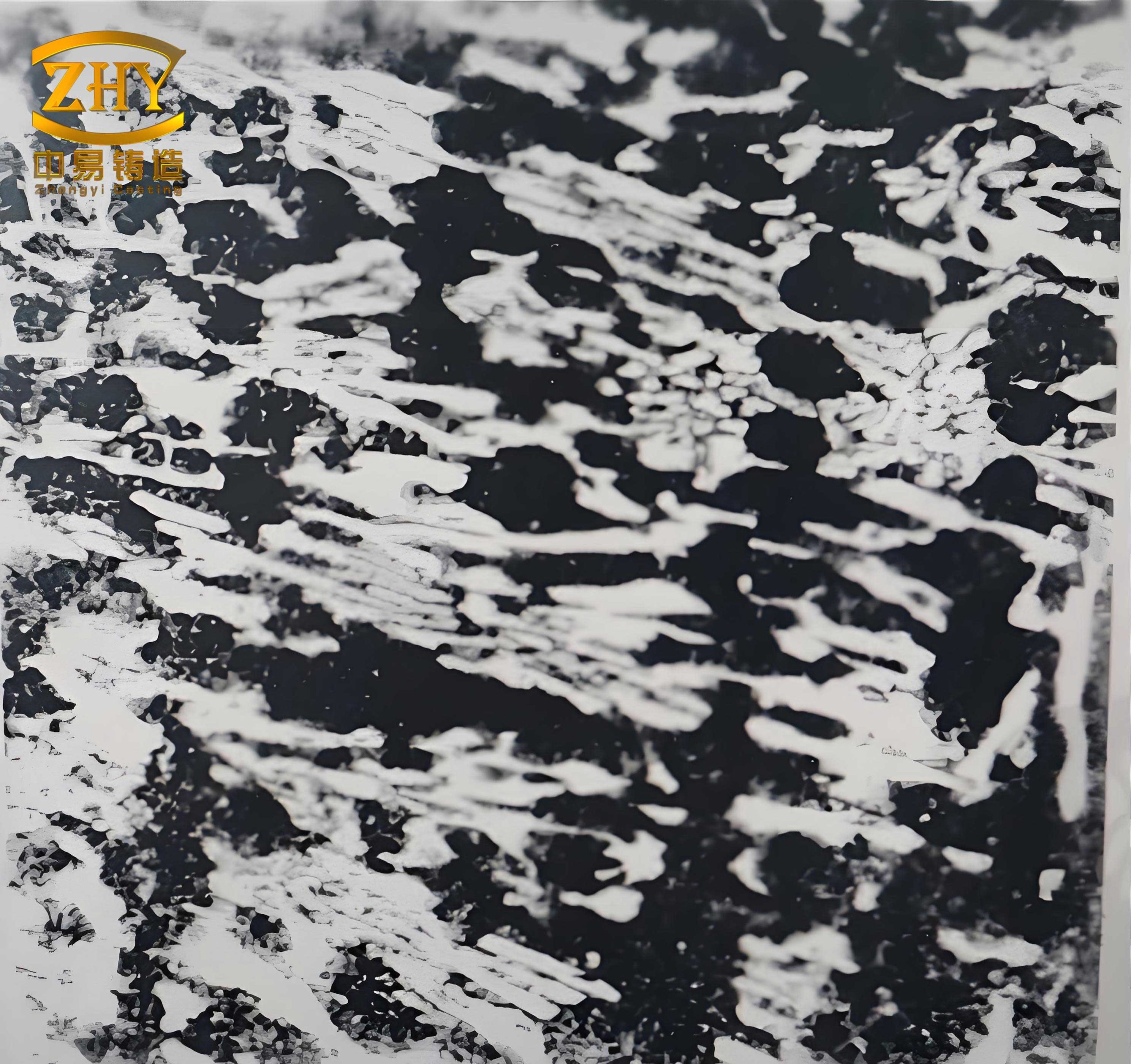
Microstructural observation revealed that thermal fatigue cracks in low alloy white cast iron preferentially initiate at specific sites. Cracks were found to nucleate both within the brittle eutectic carbides and at the interfaces between these carbides and the metallic matrix. This behavior is intrinsically linked to the microstructure of white cast iron, which is characterized by a network of hard carbides embedded in a metallic base. Upon cyclic thermal loading, differential thermal expansion and contraction between the carbides and the matrix generate significant localized stresses. When these stresses exceed the cohesive strength of the carbide-matrix interface or the fracture strength of the carbides themselves, microcracks form. Subsequent crack propagation primarily occurs along the carbide-matrix interfaces, as these paths offer lower resistance compared to traversing the tougher matrix. These microcracks eventually link up to form dominant macroscopic cracks that extend further into the material. The propensity for crack initiation and growth is exacerbated at higher upper temperatures due to increased thermal stresses, a trend clearly observed in our data for white cast iron.
The measured crack length (L) as a function of the number of thermal cycles (N) for the white cast iron specimens at the three different temperatures is presented in Table 3. The data unequivocally shows that for a given number of cycles, the crack length increases with the upper temperature, highlighting the temperature sensitivity of thermal fatigue damage in white cast iron.
| Number of Cycles (N) | Crack Length L at 560°C (mm) | Crack Length L at 600°C (mm) | Crack Length L at 640°C (mm) |
|---|---|---|---|
| 400 | 2.33 | 2.69 | 2.95 |
| 600 | 3.41 | 4.01 | 4.73 |
| 800 | 4.47 | 5.13 | 6.03 |
To model the crack propagation kinetics in this white cast iron, I analyzed the relationship between the logarithm of crack length (lg L) and the logarithm of the number of cycles (lg N). The data points for each temperature condition fell on a straight line, indicating a power-law relationship of the form:
$$ L = b N^a $$
where \( L \) is the crack length, \( N \) is the number of cycles, and \( b \) and \( a \) are material constants dependent on temperature and material properties of the white cast iron. Taking logarithms yields:
$$ \lg L = a \lg N + \lg b $$
Linear regression analysis of the data in the cycle range of 400 to 800 was performed to determine the constants \( a \) and \( b \) for the white cast iron at each temperature. The results are summarized below, with crack length \( L \) in micrometers (µm).
For white cast iron at 560°C:
$$ L_1 = 8.45 N^{0.934} $$
The corresponding crack propagation rate \( v \), defined as \( v = dL/dN \), is derived as:
$$ v_1 = \frac{dL_1}{dN} = 8.45 \times 0.934 \times N^{0.934 – 1} = 7.89 N^{-0.066} \, \mu\text{m/cycle} $$
For white cast iron at 600°C:
$$ L_2 = 9.45 N^{0.969} $$
$$ v_2 = 9.45 \times 0.969 \times N^{0.969 – 1} = 9.16 N^{-0.031} \, \mu\text{m/cycle} $$
For white cast iron at 640°C:
$$ L_3 = 10.05 N^{0.934} $$
$$ v_3 = 10.05 \times 0.934 \times N^{0.934 – 1} = 9.39 N^{-0.066} \, \mu\text{m/cycle} $$
In these equations for white cast iron, the exponent \( a \) is less than 1, which is characteristic of crack growth behavior where the rate often decreases with increasing cycles under certain conditions, potentially due to crack tip blunting or stress redistribution. The pre-factor \( b \) generally increases with temperature, reflecting the greater driving force for crack extension at higher temperatures in white cast iron.
The thermal fatigue crack propagation process in materials like white cast iron is considered a thermally activated process. Therefore, the temperature dependence of crack growth can be described by an Arrhenius-type relationship. I assume the constant \( b \) in the power-law equation has an exponential temperature dependence: \( b = c e^{-Q/(RT)} \), where \( c \) is a constant, \( Q \) is the activation energy for crack propagation, \( R \) is the universal gas constant (8.314 J/mol·K), and \( T \) is the absolute temperature in Kelvin. Substituting this into the crack length equation gives:
$$ L = c N^a e^{-Q/(RT)} = K e^{-Q/(RT)} $$
where \( K = c N^a \) is a constant for a fixed number of cycles \( N \). Taking the natural logarithm:
$$ \ln L = \ln K – \frac{Q}{RT} $$
To estimate the activation energy \( Q \) for thermal fatigue crack propagation in this low alloy white cast iron, I used the crack length data at \( N = 600 \) cycles for the three temperatures. The absolute temperatures are \( T_1 = 560 + 273 = 833 \, K \), \( T_2 = 600 + 273 = 873 \, K \), and \( T_3 = 640 + 273 = 913 \, K \). The corresponding crack lengths \( L \) from Table 3 (converted to µm: 3410 µm, 4010 µm, 4730 µm) are used to compute \( \ln L \). The data for regression is presented in Table 4.
| Upper Temperature (°C) | Absolute Temperature T (K) | 1/T (K-1) | Crack Length L at N=600 (µm) | ln L |
|---|---|---|---|---|
| 560 | 833 | 0.0012005 | 3410 | 8.134 |
| 600 | 873 | 0.0011455 | 4010 | 8.297 |
| 640 | 913 | 0.0010953 | 4730 | 8.462 |
Performing a linear least-squares regression of \( \ln L \) versus \( 1/T \) yields a slope of \( -Q/R \). From the regression analysis, the slope was calculated to be approximately -2946 K. Therefore, the activation energy \( Q \) for thermal fatigue crack propagation in this low alloy white cast iron is:
$$ Q = -\text{slope} \times R = 2946 \, \text{K} \times 8.314 \, \text{J/mol·K} = 24.50 \times 10^3 \, \text{J/mol} = 24.50 \, \text{kJ/mol} $$
This relatively low activation energy suggests that the crack propagation process in white cast iron under thermal fatigue conditions is governed by mechanisms such as interface decohesion or brittle fracture of carbides, which require less thermal energy compared to processes like bulk diffusion or dislocation climb that are common in metallic alloys at high temperatures. The value is consistent with the observed crack path along the carbide-matrix interfaces in white cast iron.
The fundamental reason for the susceptibility of white cast iron to thermal fatigue cracking lies in its microstructure. The eutectic carbides, while providing excellent wear resistance, act as stress concentrators and preferred sites for crack initiation due to their brittleness and the mismatch in thermal expansion coefficients with the matrix. The coefficient of thermal expansion (CTE) for iron carbides is typically lower than that of the ferrous matrix. During heating, the matrix expands more than the carbides, creating tensile stresses in the matrix near the interfaces and compressive stresses within the carbides. Upon rapid cooling, the situation reverses: the matrix contracts more, placing the carbides in tension and the interface regions under shear. This cyclic stress state leads to fatigue damage accumulation. The stress intensity \( \Delta K \) at a crack tip under thermal cycling can be conceptually related to the thermal strain range \( \Delta \epsilon_{th} \) and elastic modulus \( E \), though a precise fracture mechanics analysis for thermal fatigue is complex. A simplified expression for the thermal stress range \( \Delta \sigma \) can be given by:
$$ \Delta \sigma \approx E \cdot \alpha \cdot \Delta T $$
where \( \alpha \) is the effective coefficient of thermal expansion mismatch and \( \Delta T \) is the temperature range of the cycle. For white cast iron, the presence of carbides significantly influences \( \alpha \). The crack growth rate per cycle \( v \) is often empirically related to the stress intensity factor range \( \Delta K \) via the Paris law in isothermal fatigue, but for thermal fatigue, integrating temperature effects leads to relationships like the power-law form we derived for white cast iron: \( v = b a N^{a-1} \).
To further generalize the findings, one can consider the crack growth law in a differential form. Starting from \( L = b N^a \), and recognizing \( b \) is temperature-dependent as \( b = b_0 e^{-Q/(RT)} \), we can write:
$$ L = b_0 e^{-Q/(RT)} N^a $$
Then the instantaneous crack growth rate is:
$$ v(T, N) = \frac{dL}{dN} = a b_0 e^{-Q/(RT)} N^{a-1} $$
This equation encapsulates the dependence of crack propagation rate in white cast iron on both the number of cycles and the temperature. It shows that for a fixed \( N \), the rate increases exponentially with temperature (through the \( e^{-Q/(RT)} \) term), and for a fixed \( T \), the rate decreases with \( N \) when \( a < 1 \), as observed in our white cast iron experiments.
The implications for improving the thermal fatigue resistance of white cast iron are clear. Since the eutectic carbides are the Achilles’ heel, microstructural modifications that alter the morphology, size, and distribution of these carbides can be highly beneficial. For instance, heat treatments or alloying additions that promote the formation of finer, more isolated, or globular carbides rather than a continuous network can reduce stress concentration and impede crack propagation. Alternatively, introducing a more ductile matrix phase through compositional adjustments or processing can enhance the material’s ability to accommodate thermal strains without cracking. These strategies aim to disrupt the preferential crack paths along carbide interfaces in white cast iron.
In summary, my investigation into the thermal fatigue behavior of low alloy white cast iron has yielded significant kinetic insights. The crack propagation in this white cast iron follows a power-law relationship with the number of thermal cycles. The derived equations and the calculated activation energy provide a quantitative framework for predicting thermal fatigue life in white cast iron components under similar service conditions. The central role of eutectic carbides in crack initiation and growth underscores the importance of microstructural engineering in developing more durable grades of white cast iron for applications involving thermal cycling. Future work could involve extending the temperature range, studying the effect of different cooling rates, or exploring the influence of various alloying elements on the thermal fatigue kinetics of white cast iron to further optimize its performance.