
In my extensive research and development work on advanced manufacturing techniques, I have focused on the precision investment casting of titanium alloys for large, thin-wall shell castings. These shell castings are critical components in aerospace applications, such as rocket engine housings, where high strength-to-weight ratio, corrosion resistance, and ability to withstand extreme pressures are paramount. Titanium alloys, particularly ZTC4, offer these advantages, but their high cost and machining difficulties necessitate near-net-shape forming methods like investment casting. This article, written from my first-person perspective as a materials engineer, details the innovative processes developed to produce high-quality titanium alloy shell castings, emphasizing the use of ceramic shells with metal face layers, centrifugal casting, and hot isostatic pressing. Throughout this discussion, I will repeatedly highlight the significance of shell castings in achieving structural integrity and performance.
The core challenge in manufacturing large thin-wall shell castings lies in achieving precise dimensions, smooth surface finishes, and defect-free internal structures, especially for parts that must endure high working pressures. Traditional methods, such as forging and machining, are often inefficient for titanium due to material waste and complexity. My approach involves a tailored investment casting process that integrates several advanced techniques. The key is to design a gating system that ensures proper filling and solidification, coupled with centrifugal forces to enhance metal flow and feeding. For instance, the gating ratio—cross-sectional areas of sprue, runner, and ingate—is optimized to approximately 1:2:7.5, with an ingate length of 50–60 mm, to facilitate anti-feeding for thick sections. This is crucial for shell castings where thin walls can prematurely solidify and isolate thicker regions from liquid metal supply. The centrifugal casting method, with a rotational speed of around 260 rpm, is employed to improve mold filling and reduce defects like shrinkage porosity. The equation for centrifugal force, which aids in pushing molten metal into intricate mold cavities, can be expressed as:
$$ F_c = m \omega^2 r $$
where \( F_c \) is the centrifugal force, \( m \) is the mass of the molten metal, \( \omega \) is the angular velocity, and \( r \) is the radius of rotation. This force ensures that the molten titanium alloy adequately fills the thin-wall sections of the shell castings, resulting in precise replication of the mold geometry.
The process begins with pattern production using a special medium-temperature wax with low ash content and good coating properties. To account for shrinkage during casting, the pattern dimensions are designed with a compensation factor based on comprehensive contraction from wax, shell, and metal. The shrinkage compensation \( S \) is calculated as:
$$ S = \left( \frac{L_{\text{pattern}} – L_{\text{final}}}{L_{\text{pattern}}} \right) \times 100\% $$
where \( L_{\text{pattern}} \) is the pattern dimension and \( L_{\text{final}} \) is the desired casting dimension. For the shell castings discussed, this factor ranges from 1.4% to 2.5%, depending on section thickness and restraint. After pattern fabrication, multiple wax patterns are assembled into clusters with gating and riser systems to form a mold tree.
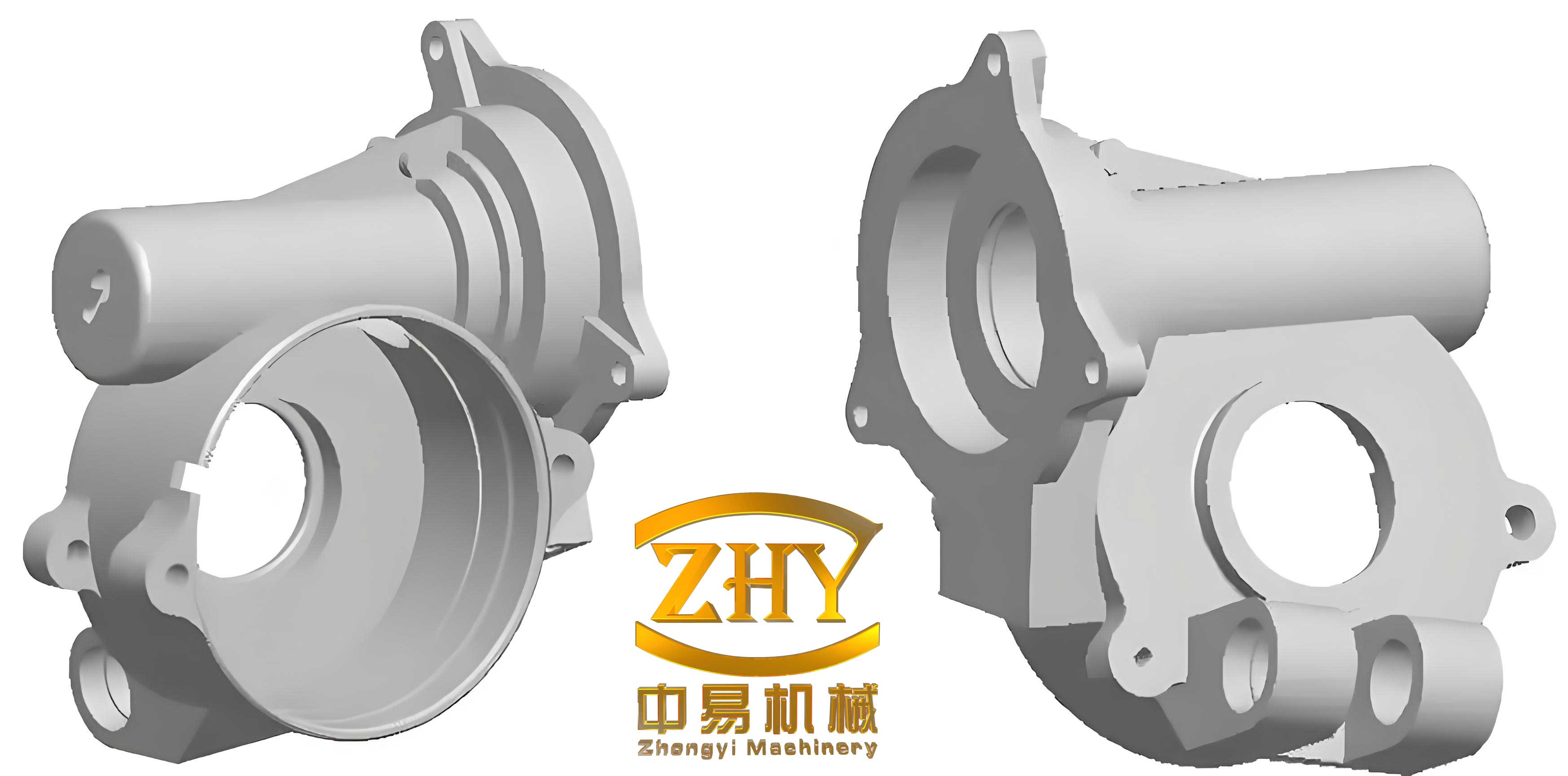
Shell building is a critical step for titanium alloy shell castings due to the high reactivity of molten titanium with most refractories. I utilize a ceramic shell with a metal face layer to minimize reactions and achieve high surface quality. The face layer slurry consists of refractory metal powders combined with a colloidal metal oxide binder, which provides a barrier against titanium interaction. Subsequent backup layers are applied using a slurry of calcined chamotte powder and sand, bonded with hydrolyzed ethyl silicate. The shell is built up to 9 layers, with each layer dried under controlled conditions of 20°C and over 60% humidity for 24 hours to ensure strength and dimensional stability. The table below summarizes the shell-building process parameters:
| Layer Type | Material Composition | Binder | Drying Time | Key Function |
|---|---|---|---|---|
| Face Layer | Refractory metal powders | Colloidal metal oxide | 24 hours | Prevent reaction with Ti |
| Neighboring Layer | Similar to face layer | Colloidal metal oxide | 24 hours | Enhance adhesion |
| Backup Layers (9 total) | Chamotte powder/sand | Hydrolyzed ethyl silicate | 24 hours per layer | Provide structural strength |
After shell construction, dewaxing is performed using an organic solvent vapor in a specialized unit to completely remove wax without damaging the shell. The shell is then subjected to a two-stage firing: low-temperature baking followed by high-temperature sintering in a hydrogen atmosphere at over 1000°C. This transforms the shell into a high-strength ceramic mold capable of withstanding the thermal stresses of titanium casting. The high-temperature firing also reduces any residual oxides, ensuring a clean mold surface for the shell castings.
Melting and casting are conducted in a 50 kg vacuum consumable electrode arc skull furnace, which minimizes contamination from air and crucible materials. The molten titanium alloy, typically ZTC4 with adjusted oxygen content for post-processing performance, is poured into the preheated shells using centrifugal casting. The centrifugal setup, with shells mounted on a rotating plate, enhances metal flow into thin sections and reduces gas entrapment. The filling velocity \( v \) during centrifugal casting can be approximated by:
$$ v = \sqrt{2 g h + (\omega r)^2} $$
where \( g \) is gravitational acceleration, \( h \) is the metal head height, and \( \omega r \) is the tangential velocity from rotation. This ensures that the thin-wall regions of the shell castings are fully filled, leading to accurate dimensions and smooth surfaces. After casting, the shells are removed, and the castings are cut from the gating system, followed by grinding, sandblasting, and pickling to achieve the final finish.
For shell castings intended for high-pressure applications, internal defects like porosity and shrinkage cavities must be eliminated. I employ hot isostatic pressing (HIP) as a post-casting treatment to densify the titanium alloy. HIP involves subjecting the castings to high temperature and pressure in an inert gas medium, which collapses internal voids through plastic deformation and diffusion. The process parameters for ZTC4 shell castings include a temperature of approximately 900–950°C and a pressure of 100–150 MPa, held for over 2 hours. The effectiveness of HIP in pore closure can be modeled using the following equation for pressure-assisted diffusion:
$$ \frac{d r}{d t} = – \frac{D \Omega}{k T} \cdot \frac{P}{r} $$
where \( r \) is the pore radius, \( t \) is time, \( D \) is the diffusion coefficient, \( \Omega \) is the atomic volume, \( k \) is Boltzmann’s constant, \( T \) is absolute temperature, and \( P \) is the applied pressure. This treatment not only removes defects but also homogenizes the microstructure, improving mechanical properties. To prevent carbon contamination from the graphite heating elements in the HIP equipment, protective measures such as encapsulation or coating are implemented. After HIP, the shell castings exhibit no significant contamination, and any thin affected layers are removed during subsequent surface finishing.
The mechanical properties of HIP-treated shell castings are critical for their performance. I have conducted extensive testing to compare as-cast, annealed, and HIP-treated states. The table below presents a summary of tensile properties for ZTC4 alloy from various casting batches, demonstrating that HIP treatment yields properties comparable to the annealed condition while eliminating internal defects:
| Treatment State | Tensile Strength, \( \sigma_b \) (MPa) | Elongation, \( \delta_5 \) (%) | Reduction of Area, \( \psi \) (%) | Key Observation |
|---|---|---|---|---|
| As-Cast | 956–987 | 2.5–8.1 | 8.1–16.7 | Presence of internal defects |
| Annealed | 856–917 | 9.1–11.8 | 18.1–22.1 | Improved ductility |
| HIP-Treated | 876–971 | 10.0–13.1 | 19.6–22.2 | Defect-free, balanced properties |
The chemical composition of the shell castings is tightly controlled to meet specifications. For ZTC4 alloy, elements like aluminum, vanadium, and oxygen are adjusted to ensure post-HIP properties. The table below shows typical chemical analysis results from production batches, all within the required limits:
| Element | Content Range (%) | Specification Limit (%) | Role in Alloy |
|---|---|---|---|
| Aluminum (Al) | 6.25–6.41 | 5.50–6.75 | Strengthener, stabilizer |
| Vanadium (V) | 3.90–4.34 | 3.50–4.50 | Enhances ductility |
| Iron (Fe) | 0.06–0.17 | ≤ 0.30 | Impurity control |
| Oxygen (O) | 0.119–0.170 | ≤ 0.20 | Influences strength |
| Titanium (Ti) | Balance | Balance | Base metal |
In terms of dimensional accuracy, the shell castings produced through this process exhibit minimal deviation from design specifications. For instance, the thin-wall sections of 3 mm thickness are consistently achieved with a tolerance of ±0.2 mm, and surface roughness values are below 3.2 μm Ra. These attributes are vital for shell castings used in aerospace assemblies where tight fits and aerodynamic surfaces are required. The success of this approach is further validated through rigorous testing, including hydrostatic pressure tests where shell castings withstand pressures up to 120% of the design requirement without leakage or plastic deformation. In hot-fire tests for rocket engine applications, the shell castings perform flawlessly, confirming their reliability under operational conditions.
The economic and technical benefits of this precision casting method for titanium alloy shell castings are substantial. By reducing machining allowances and material waste, the process improves material utilization rates by over 50% compared to conventional forging. Additionally, the integration of HIP treatment ensures that shell castings meet the stringent quality standards for critical load-bearing components. From my experience, the key to success lies in the synergistic combination of advanced shell materials, optimized gating design, centrifugal casting dynamics, and post-casting densification. Future work could focus on further refining the shell compositions to reduce costs or extending this methodology to other reactive alloys for shell castings.
In conclusion, the development of titanium alloy precision shell castings for large thin-wall structures represents a significant advancement in aerospace manufacturing. Through the use of metal-faced ceramic shells, centrifugal casting techniques, and hot isostatic pressing, I have demonstrated that high-integrity shell castings can be produced with precise dimensions, excellent surface finishes, and defect-free interiors. These shell castings not only meet the mechanical and chemical specifications but also pass stringent performance tests, making them suitable for replacing forged components in high-pressure applications. The methodologies described here underscore the importance of integrated process control in achieving reliable shell castings, and they pave the way for broader adoption of titanium investment casting in demanding industries.