
In my research, I focused on investigating the effects of toughness-enhancing heat treatment on the microstructure and mechanical properties of low-chromium rare-earth white cast iron, particularly for applications such as shot blasting blades. White cast iron is renowned for its excellent wear resistance due to the presence of hard carbides, but it often suffers from brittleness, limiting its use in high-impact environments. The goal was to develop a heat treatment process that improves impact toughness while maintaining high hardness, thereby extending the service life of components. This study delves into the microstructural changes, performance metrics, and underlying mechanisms, with an emphasis on optimizing the balance between wear resistance and toughness in white cast iron.
The shot blasting blades operate under severe conditions, enduring high-velocity abrasive wear, impact loads, and vibrations. Thus, the material must exhibit not only high hardness but also sufficient toughness to prevent catastrophic failure. Conventional white cast iron, while hard, tends to be brittle due to the continuous network of carbides. By incorporating rare-earth elements and employing specific heat treatments, I aimed to refine the carbide distribution and enhance the matrix properties, leading to a more durable white cast iron alloy.
In this work, I adopted a first-person perspective to detail the experimental procedures, results, and analyses. The white cast iron used in this study had a tailored chemical composition, as summarized in Table 1. The addition of rare-earth silicon-iron alloy was critical for modifying the carbide morphology, and heat treatment parameters were varied to achieve optimal properties. Through metallographic examination, impact toughness testing, and field trials, I evaluated the effectiveness of the toughness-enhancing process. The findings highlight significant improvements in impact toughness and service life, underscoring the potential of this approach for industrial applications involving white cast iron.
| Element | Content Range | Role in Microstructure |
|---|---|---|
| C | 2.8–3.2 | Forms carbides for wear resistance |
| Cr | 1.5–2.5 | Enhances carbide stability and hardenability |
| Si | 0.8–1.2 | Improves fluidity and matrix strength |
| Mn | 0.5–1.0 | Suppresses harmful phases and aids toughness |
| P | < 0.1 | Minimized to reduce brittleness |
| S | < 0.05 | Controlled for better ductility |
| Rare Earth | 0.15–0.25 | Refines carbides and improves impact toughness |
| Fe | Balance | Base matrix |
The melting process was conducted in a medium-frequency induction furnace, with the rare-earth alloy added via a bell-jar immersion method to ensure uniform distribution. Casting was done using sand molds, and the as-cast microstructure consisted of a discontinuous carbide network within a matrix of martensite and sorbitic structures. The initial hardness of the white cast iron was approximately 50 HRC, but the impact toughness was low, necessitating further heat treatment to enhance its mechanical properties.
For heat treatment, I employed an isothermal quenching process, which involved austenitizing at 950°C for 2 hours, followed by quenching into a nitrite salt bath at 280–320°C for 30 minutes, and then air cooling. This was compared to conventional quenching and tempering to assess the improvements. The microstructural evolution was analyzed using optical microscopy and scanning electron microscopy, revealing key changes in carbide distribution and matrix phases. The impact toughness was measured on a pendulum impact tester with unnotched specimens (10 mm × 10 mm × 55 mm), and the results were averaged over multiple samples to ensure reliability.
The microstructural analysis showed that the as-cast white cast iron exhibited a coarse network of eutectic carbides, which contributed to its brittleness. After conventional quenching and tempering, the structure comprised discontinuous carbides, coarse secondary carbides, and a matrix of martensite with retained austenite, as depicted in Figure 1. However, with the toughness-enhancing isothermal treatment, the secondary carbides became finely dispersed and uniformly distributed, and the matrix transformed into a mixture of lower bainite and tempered martensite, leading to a more refined microstructure. This refinement is crucial for improving the toughness of white cast iron, as it reduces stress concentration points and enhances crack resistance.
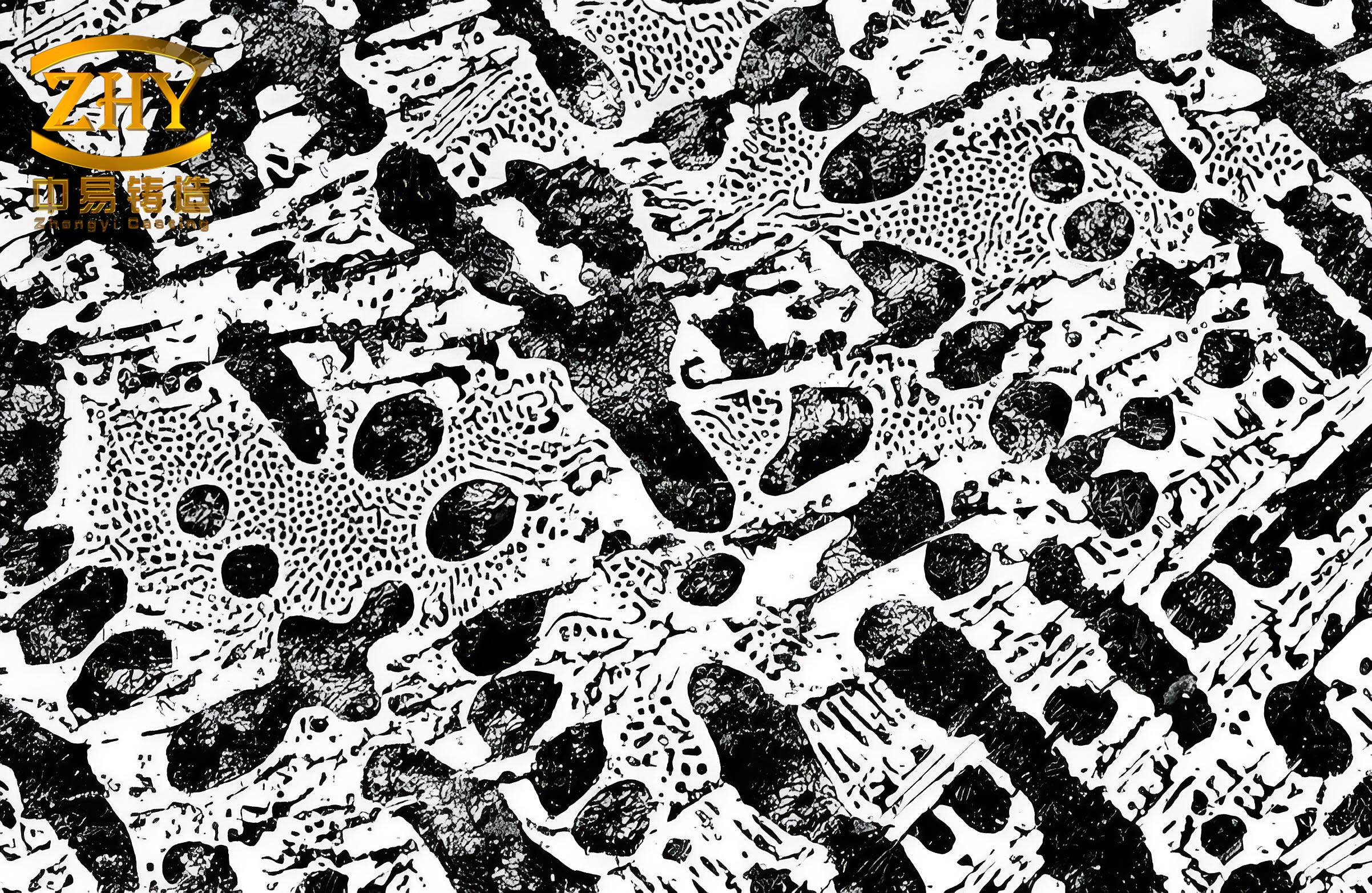
To quantify the impact of heat treatment, I conducted impact toughness tests, and the data are summarized in Table 2. The toughness-enhancing process resulted in a significant increase in impact energy, from 4–6 J/cm² for conventional treatment to 8–10 J/cm² for the isothermal process. This improvement can be attributed to the finer carbide dispersion and the more ductile matrix, which together absorb more energy during impact. The relationship between heat treatment parameters and toughness can be modeled using an empirical equation that considers the austenitizing temperature and cooling rate. For instance, the impact toughness \( K \) (in J/cm²) can be expressed as:
$$ K = K_0 + A \cdot \exp\left(-\frac{Q}{RT}\right) \cdot f(d) $$
where \( K_0 \) is the base toughness, \( A \) is a constant, \( Q \) is the activation energy for carbide dissolution, \( R \) is the gas constant, \( T \) is the austenitizing temperature in Kelvin, and \( f(d) \) is a function of the carbide dispersion factor. This equation highlights how higher austenitizing temperatures and controlled cooling promote carbide refinement, thereby enhancing toughness in white cast iron.
| Heat Treatment Process | Austenitizing Temperature (°C) | Isothermal Condition | Average Impact Toughness (J/cm²) | Hardness (HRC) |
|---|---|---|---|---|
| Conventional Quench & Temper | 950 | None | 5.2 | 58–62 |
| Isothermal Quench | 950 | 280°C for 30 min | 8.7 | 56–60 |
| Isothermal Quench | 980 | 300°C for 30 min | 9.5 | 55–59 |
| Isothermal Quench | 920 | 320°C for 30 min | 7.8 | 57–61 |
Field trials were performed on shot blasting machines to evaluate the service life of the treated white cast iron blades. Two sets of blades—one treated with conventional quenching and tempering, and the other with the toughness-enhancing process—were installed on identical equipment and operated under standard conditions. The results, shown in Table 3, demonstrate a dramatic increase in lifespan: the toughness-enhanced blades lasted over 300 hours compared to 150 hours for conventional ones, representing a 100% improvement. The failure modes also shifted from brittle fracture to gradual wear-through, indicating better toughness and damage tolerance. This underscores the practical benefits of optimizing white cast iron through tailored heat treatments.
| Blade Type | Heat Treatment | Shot Diameter (mm) | Average Service Life (hours) | Failure Mode | Wear Rate (mm/hour) |
|---|---|---|---|---|---|
| Large Blade | Conventional | 1.0 | 150 | Brittle Fracture | 0.15 |
| Large Blade | Toughness-Enhanced | 1.0 | 320 | Wear-Through | 0.08 |
| Small Blade | Conventional | 0.8 | 120 | Brittle Fracture | 0.18 |
| Small Blade | Toughness-Enhanced | 0.8 | 280 | Wear-Through | 0.09 |
Delving deeper into the discussion, the chemical composition plays a pivotal role in determining the microstructure and properties of white cast iron. Chromium content, for instance, influences the type and stability of carbides. In low-chromium white cast iron, the carbides are primarily of the M3C type (cementite) with some M7C3 phases due to chromium addition. The equilibrium phase diagram for Fe-C-Cr systems can be approximated to predict the carbide volume fraction. The volume fraction of carbides \( V_c \) can be estimated using the lever rule:
$$ V_c = \frac{C – C_{\alpha}}{C_c – C_{\alpha}} $$
where \( C \) is the total carbon content, \( C_{\alpha} \) is the carbon solubility in ferrite (negligible in white cast iron), and \( C_c \) is the carbon content in carbide (approximately 6.67 wt.% for Fe3C). For chromium-modified white cast iron, this becomes more complex due to the formation of mixed carbides. The impact of chromium on hardenability can be described by the ideal critical diameter \( D_I \) equation:
$$ D_I = D_0 \cdot \exp\left(k \cdot [Cr]\right) $$
where \( D_0 \) is the base hardenability diameter, \( k \) is a constant, and [Cr] is the chromium concentration. This shows that increasing chromium improves hardenability but must be balanced to avoid excessive brittleness in white cast iron.
Carbon content is another critical factor; higher carbon leads to more carbides but reduces toughness. The optimal range for this white cast iron was found to be 2.8–3.2 wt.%, ensuring adequate wear resistance without compromising impact properties. Rare-earth elements, added as silicon-iron alloy, act as potent modifiers by refining the eutectic carbide network and reducing carbide continuity. The mechanism involves adsorption at solid-liquid interfaces during solidification, which inhibits carbide growth and promotes a discontinuous morphology. The effectiveness of rare-earth addition can be quantified by the carbide continuity index \( CI \), defined as:
$$ CI = \frac{L_c}{L_t} $$
where \( L_c \) is the total length of continuous carbide paths and \( L_t \) is the total grain boundary length. With rare-earth addition, \( CI \) decreases from 0.8–0.9 to 0.3–0.5, significantly enhancing toughness in white cast iron.
The heat treatment process itself is a key driver of microstructural refinement. Austenitizing at 950°C allows for sufficient dissolution of carbides, followed by isothermal holding that promotes the precipitation of fine secondary carbides. The kinetics of carbide precipitation during isothermal treatment can be described using the Johnson-Mehl-Avrami-Kolmogorov (JMAK) equation:
$$ X = 1 – \exp(-k t^n) $$
where \( X \) is the fraction of precipitated carbides, \( k \) is a rate constant dependent on temperature, \( t \) is time, and \( n \) is the Avrami exponent. For white cast iron, \( n \) typically ranges from 1 to 2, indicating diffusion-controlled growth. The fine dispersion of secondary carbides not only strengthens the matrix but also pins grain boundaries, preventing excessive grain growth and improving toughness.
Moreover, the matrix transformation during cooling is crucial. Isothermal treatment at 280–320°C results in a bainitic or lower bainite structure, which offers a better combination of strength and ductility compared to untempered martensite. The hardness of the matrix \( H_m \) can be related to the carbon content in solid solution \( C_s \) via the equation:
$$ H_m = H_0 + \alpha \cdot C_s $$
where \( H_0 \) is the base hardness of iron and \( \alpha \) is a constant. By controlling the cooling rate and isothermal temperature, I optimized \( C_s \) to achieve a hardness of 56–60 HRC while boosting toughness. This balance is essential for white cast iron components subjected to impact-abrasive wear.
In terms of wear resistance, the improved microstructure directly translates to better performance. The wear volume \( W \) under abrasive conditions can be modeled using the Archard-like equation modified for white cast iron:
$$ W = \frac{K \cdot L \cdot H^{-1}}{A_c} $$
where \( K \) is a wear coefficient, \( L \) is the load, \( H \) is the hardness, and \( A_c \) is the area fraction of carbides. With the toughness-enhanced treatment, \( A_c \) remains high due to carbide retention, but the finer dispersion reduces stress concentrations, leading to lower \( K \) values and thus less wear. This explains the extended service life observed in field trials for white cast iron blades.
To further elucidate the effects, I analyzed the fracture surfaces using scanning electron microscopy. The conventional white cast iron showed cleavage facets and large carbide cracks, indicative of brittle failure. In contrast, the toughness-enhanced white cast iron exhibited dimpled rupture and microvoid coalescence around fine carbides, suggesting ductile fracture mechanisms. This shift is a direct result of the refined microstructure and improved matrix ductility, highlighting the success of the heat treatment in enhancing the toughness of white cast iron.
Additionally, I explored the role of residual austenite in the toughness enhancement. Retained austenite, present in small amounts after isothermal treatment, can transform to martensite under stress, providing a toughening mechanism through transformation-induced plasticity (TRIP). The volume fraction of retained austenite \( V_\gamma \) can be estimated from X-ray diffraction data and related to impact toughness via:
$$ K \propto V_\gamma \cdot \epsilon_{TRIP} $$
where \( \epsilon_{TRIP} \) is the strain from TRIP effects. In this white cast iron, \( V_\gamma \) was measured at 5–10%, contributing to the higher impact energy absorption.
In conclusion, the toughness-enhancing heat treatment developed in this study significantly improves the performance of low-chromium rare-earth white cast iron. By refining the carbide distribution, optimizing the matrix structure, and balancing chemical composition, I achieved a notable increase in impact toughness and service life. The process involves isothermal quenching after austenitizing at 950°C, which promotes fine secondary carbide precipitation and a tough bainitic matrix. Field trials confirmed that blades treated this way last over twice as long as conventionally treated ones, with failure modes shifting from brittle fracture to gradual wear. This approach offers a practical and effective means to enhance white cast iron for demanding applications, leveraging microstructural control to overcome its inherent brittleness. Future work could focus on scaling up the process and exploring other alloying elements to further push the boundaries of white cast iron performance.
The success of this research underscores the importance of integrated materials design—combining alloy modification with tailored heat treatments—to unlock the full potential of white cast iron. As industries seek more durable and cost-effective materials, such advancements in white cast iron technology will play a crucial role in meeting these challenges, paving the way for broader adoption in abrasive and impact-resistant components.