
The production of metal castings is a symphony of complex, interrelated processes. From raw material selection and melt preparation to mold design, pouring, and solidification, each stage introduces a multitude of variables. When these variables fall outside an optimal window of control or interact in unforeseen ways, the result is often the manifestation of a metal casting defect. Identifying the root cause of such defects is a classic challenge in foundry engineering, often relying heavily on the experience and intuition of skilled technicians. While qualitative analysis is invaluable, it can sometimes lead to protracted problem-solving cycles or misidentification of the primary contributing factor. This article details my exploration and application of an advanced multi-criteria decision-making tool—the Uncertain or Interval Analytic Hierarchy Process (IAHP)—to bring quantitative rigor to the diagnosis of metal casting defect origins. The core objective is to transform subjective expert judgments into a prioritized list of causative factors, providing a scientific compass for directing corrective actions.
1. The Persistent Challenge of Metal Casting Defects
A metal casting defect is any deviation from the specified geometry, composition, or integrity of a cast component that renders it unsuitable for service. These defects represent significant economic losses due to scrap, rework, and potential warranty claims. Common categories include porosity (gas and shrinkage), inclusions, surface defects (like scars and burns), and dimensional inaccuracies. The complexity arises because a single type of metal casting defect, such as subsurface pinholes, can be triggered by a confluence of factors from different process stages: excessive moisture in molds, high hydrogen content in the melt, improper pouring temperature, or the presence of certain trace elements that promote gas formation. Isolating the dominant cause from a list of suspects is non-trivial.
Traditional analysis often employs defect characterization (location, morphology, chemistry) combined with process audits. However, when several process parameters are simultaneously borderline, assigning quantitative influence becomes guesswork. We require a method that can structure the problem, incorporate expert knowledge despite its inherent uncertainty, and yield a ranked order of factor significance. This is precisely where the Interval AHP offers a powerful framework.
2. Foundational Principles: From Classical AHP to Interval AHP
The Analytic Hierarchy Process (AHP), pioneered by Thomas L. Saaty, is a structured technique for organizing and analyzing complex decisions. It is based on decomposing a problem into a hierarchy of criteria and alternatives, making pairwise comparisons between elements, and using eigenvector calculations to derive priority weights.
The classical AHP uses a discrete 1-9 scale for comparisons, where 1 indicates equal importance and 9 indicates extreme importance of one element over another. This yields a crisp, reciprocal positive matrix $\mathbf{A} = (a_{ij})_{n \times n}$, where $a_{ji} = 1/a_{ij}$ and $a_{ii}=1$. The priority vector $\mathbf{w}$, which represents the relative weights of the elements, is derived from the principal eigenvector of $\mathbf{A}$:
$$\mathbf{A} \mathbf{w} = \lambda_{max} \mathbf{w}$$
where $\lambda_{max}$ is the largest eigenvalue. Consistency of judgments is checked via the Consistency Ratio ($CR$):
$$CR = \frac{(\lambda_{max} – n)/(n-1)}{RI}$$
where $RI$ is the Random Index. A $CR < 0.10$ is generally acceptable.
However, in real-world industrial problem-solving like diagnosing a metal casting defect, experts may be hesitant or unable to provide a single, precise number for a pairwise comparison. Their judgment often lies within a range. For instance, when comparing “high pouring temperature” to “low pouring temperature” as causes for shrinkage porosity, an expert might say, “The first is moderately to strongly more influential than the second.” This linguistic uncertainty is better captured by an interval.
This leads to the Interval AHP (IAHP). Here, the comparison matrix is composed of interval numbers:
$$\mathbf{\tilde{A}} = (\tilde{a}_{ij})_{n \times n}, \quad \text{where } \tilde{a}_{ij} = [a_{ij}^-, a_{ij}^+]$$
with the conditions:
$$0 < a_{ij}^- \le a_{ij}^+, \quad \tilde{a}_{ji} = 1/\tilde{a}_{ij} = [1/a_{ij}^+, 1/a_{ij}^-], \quad \tilde{a}_{ii} = [1, 1]$$
The core challenge is to derive an interval weight vector $\mathbf{\tilde{W}} = [\mathbf{w}^-, \mathbf{w}^+]$ from this interval matrix.
3. Computational Methodology for Interval AHP
Several methods exist to compute interval weights. The approach I employed, based on the work of Arbel and others, is pragmatic and computationally straightforward. It leverages the classical eigenvector method on the boundary matrices of the interval comparison matrix.
Let $\mathbf{\tilde{A}}$ be an $n \times n$ interval reciprocal matrix. We define its lower and upper boundary matrices as:
$$\mathbf{A}^- = (a_{ij}^-)_{n \times n}, \quad \mathbf{A}^+ = (a_{ij}^+)_{n \times n}$$
Both $\mathbf{A}^-$ and $\mathbf{A}^+$ are crisp, positive reciprocal matrices.
Step 1: Calculate Eigenvectors for Boundary Matrices.
Using the standard eigenvector method (or approximation methods like the geometric mean method), we compute the principal eigenvectors $\mathbf{x}^-$ and $\mathbf{x}^+$ for $\mathbf{A}^-$ and $\mathbf{A}^+$, respectively, along with their corresponding maximum eigenvalues $\lambda^-_{max}$ and $\lambda^+_{max}$.
$$\mathbf{A}^- \mathbf{x}^- = \lambda^-_{max} \mathbf{x}^-$$
$$\mathbf{A}^+ \mathbf{x}^+ = \lambda^+_{max} \mathbf{x}^+$$
The vectors $\mathbf{x}^-$ and $\mathbf{x}^+$ are normalized to sum to 1.
Step 2: Calculate Scaling Factors.
We calculate two scaling factors, $k$ and $m$, to adjust these boundary eigenvectors into the final interval weights. These factors are derived from the column sums of the boundary matrices:
$$k = \prod_{j=1}^{n} \left( \sum_{i=1}^{n} a_{ij}^+ \right)^{-1/n}$$
$$m = \prod_{j=1}^{n} \left( \sum_{i=1}^{n} a_{ij}^- \right)^{-1/n}$$
Step 3: Compute Interval Weights.
The final interval weight vector $\mathbf{\tilde{W}}$ for the elements in the current hierarchy level is given by:
$$\mathbf{\tilde{W}} = [k\mathbf{x}^-, m\mathbf{x}^+]$$
This means the weight for element $i$ is the interval $[w_i^-, w_i^+] = [k x_i^-, m x_i^+]$. This interval captures the possible range of its priority given the uncertainty in the original judgments.
Step 4: Consistency Estimation for Interval Judgments.
A rigorous check for the consistency of an interval matrix is an area of ongoing research. Based on the Perron-Frobenius theorem for non-negative matrices, we can propose a pragmatic estimate. Since $\mathbf{A}^+ \ge \mathbf{A}^-$ (element-wise), it follows that $\lambda^+_{max} \ge \lambda^-_{max}$. Therefore, the Consistency Ratios for the boundary matrices are:
$$CR^- = \frac{(\lambda^-_{max} – n)/(n-1)}{RI}, \quad CR^+ = \frac{(\lambda^+_{max} – n)/(n-1)}{RI}$$
The interval $[CR^-, CR^+]$ provides an estimate for the consistency of the interval judgments $\mathbf{\tilde{A}}$. While a strict threshold is less defined, the goal is for $CR^+$ to remain within an acceptable bound (e.g., < 0.20 or < 0.30) to indicate that the expert’s uncertain judgments are not wildly inconsistent. This estimation method expands the applicability of the consistency concept from crisp to interval judgments.
4. Structuring the Metal Casting Defect Analysis Problem
The first and most critical step in applying IAHP is to construct a hierarchical model that accurately reflects the problem. For a metal casting defect, this involves breaking down the defect into its potential root causes, which are often grouped by process stage. A generic hierarchy can be visualized as follows:
| Level 0 (Goal) | Level 1 (Main Cause Categories) | Level 2 (Specific Factors) |
|---|---|---|
| Identify Root Cause of [Specific Metal Casting Defect] | Melt-Related Factors (A1) | Composition (C1: High Gas Content, C2: Excessive Oxides, C3: Inoculant Issues) |
| Temperature (C4: Low Pouring Temp, C5: High Superheat) | ||
| Mold-Related Factors (A2) | Moisture (C6: High Sand Moisture, C7: Inadequate Core Drying) | |
| Coating/Permeability (C8) | ||
| Gating & Feeding System (A3) | Design (C9: Turbulent Flow, C10: Poor Feeding) | |
| Process Control (A4) | Timing (C11: Long Mold Closing Time) | |
| Atmospheric Conditions (C12: High Humidity) |
The specific hierarchy must be tailored to the observed characteristics of the metal casting defect and the particulars of the foundry process. For the analysis of the engine block casting defect, which presented as subsurface pinholes resembling a reaction-type gas defect, a detailed hierarchy was constructed through collaboration with process engineers and metallurgists. This model explicitly considered the two primary suspected reaction mechanisms: FeO-C reaction and slag-metal reaction.
5. Case Study: Analyzing Subsurface Gas Defects in Iron Castings
The subject was a high-strength gray iron (HT300) component—a lathe chuck—produced in a high-volume foundry using a cupola melting and machine molding process. The primary metal casting defect observed during humid summer months was a significant rise in scrap due to subsurface porosity. Defect analysis identified it as a “reaction-type gas defect” or “subsurface pinhole,” characterized by small, interconnected pores located 3-5mm beneath the upper casting surface. This specific metal casting defect is notoriously linked to multiple interacting factors.
5.1 Building the IAHP Model
Based on the defect morphology and process knowledge, the hierarchy model focused on gas-forming reaction pathways. The goal was “Identify Primary Cause of Subsurface Pinhole Defect.” The main criteria were the two reaction types: “FeO-C Reaction (B1)” and “Slag-Metal Reaction (B2).” Sub-criteria (specific process factors) were linked to each:
- FeO-C Reaction (B1): High Molten Metal Oxidation (C1), Inadequate Mold Drying (C2), Low Pouring Temperature (C3).
- Slag-Metal Reaction (B2): Low Pouring Temperature (C3), High Manganese Content (C4), High Sulfur Content (C5), Wet Ladle/Wet Charge (C6), Turbulent Pouring (C7).
Note that “Low Pouring Temperature (C3)” appears under both main criteria, as it exacerbates both reaction mechanisms. This is a common feature in AHP hierarchies—factors can influence multiple pathways.
5.2 Eliciting Interval Judgments and Constructing Matrices
Experts (metallurgists and senior foundry engineers) were interviewed separately. Instead of asking for a single number, they were asked to provide a range representing their confidence interval for the relative importance of one factor over another. For example, comparing “High Molten Metal Oxidation (C1)” to “Inadequate Mold Drying (C2)” under the FeO-C reaction criterion, an expert might state, “C1 is definitely more important. I’d say it’s between 5 and 6 times more influential.” This yields the interval $[5, 6]$.
The aggregated and synthesized judgments formed the interval comparison matrices. For the “FeO-C Reaction (B1)” criterion, the matrix $\mathbf{\tilde{A}_1}$ for its three sub-criteria was constructed:
| B1 | C1 | C2 | C3 |
|---|---|---|---|
| C1 | [1, 1] | [5, 6] | [6, 7] |
| C2 | [1/6, 1/5] | [1, 1] | [2, 3] |
| C3 | [1/7, 1/6] | [1/3, 1/2] | [1, 1] |
Similarly, the matrix $\mathbf{\tilde{A}_2}$ for the five sub-criteria under “Slag-Metal Reaction (B2)” was built. A separate matrix was also created to compare the two main criteria B1 and B2 against the overall goal, yielding their interval weights, which were determined to be dominant for B1: $[0.9, 0.9]$ for B1 and $[0.1, 0.1]$ for B2, indicating overwhelming expert belief that the FeO-C reaction was the primary mechanism for this specific metal casting defect under the prevailing conditions.
5.3 Calculations and Results
Applying the computational steps outlined in Section 3:
For Matrix $\mathbf{\tilde{A}_1}$:
Boundary matrices: $\mathbf{A}_1^-$ with elements {1,5,6; 1/6,1,2; 1/7,1/3,1} and $\mathbf{A}_1^+$ with elements {1,6,7; 1/5,1,3; 1/6,1/2,1}.
Eigenvectors: $\mathbf{x}^- = [0.7463, 0.1666, 0.0871]^T$, $\mathbf{x}^+ = [0.7308, 0.1773, 0.0919]^T$.
Scaling factors: $k_1 \approx 0.9766$, $m_1 \approx 1.0161$.
Interval Local Weights: $\mathbf{\tilde{W}_1} = [k_1\mathbf{x}^-, m_1\mathbf{x}^+] = $
For C1: $[0.7296, 0.7425]$
For C2: $[0.1629, 0.1801]$
For C3: $[0.0851, 0.0933]$
Consistency Estimate: $\lambda^-_{max}=3.054$, $\lambda^+_{max}=3.335$, $CR^- \approx -0.15$, $CR^+ \approx 0.29$.
For Matrix $\mathbf{\tilde{A}_2}$:
A similar calculation for the 5×5 matrix yielded interval local weights for its factors C3, C4, C5, C6, C7.
5.4 Synthesizing Global Priorities
The final step is to combine the local weights with the weights of their parent criteria to obtain global priority intervals for each specific factor relative to the overall goal of defect cause identification. This is a weighted sum.
| Specific Factor | Local Weight under B1 ($W_{B1}=[0.9,0.9]$) | Local Weight under B2 ($W_{B2}=[0.1,0.1]$) | Global Priority Interval | Interpretation (Rank) |
|---|---|---|---|---|
| C1: High Molten Metal Oxidation | [0.7296, 0.7425] | 0 | [0.6566, 0.6683] | 1 (Most Significant) |
| C2: Inadequate Mold Drying | [0.1629, 0.1801] | 0 | [0.1466, 0.1621] | 2 |
| C3: Low Pouring Temperature | [0.0851, 0.0933] | [0.4337, 0.4672] | [0.1199, 0.1293]* | 3 |
| C4: High Mn Content | 0 | [0.1592, 0.1967] | [0.0159, 0.0197] | 4 |
| C5: High S Content | 0 | [0.1829, 0.2260] | [0.0183, 0.0226] | 5 |
| C6: Wet Ladle/Charge | 0 | [0.0535, 0.0593] | [0.0054, 0.0059] | 6 |
| C7: Turbulent Pouring | 0 | [0.0919, 0.1184]** | [0.0092, 0.0118] | 7 |
* $Global(C3) = 0.9*[0.0851, 0.0933] + 0.1*[0.4337, 0.4672] = [0.1199, 0.1293]$
** Note: The local weight for C7 under B2 was calculated as [0.0919, 0.1184] from the full $\mathbf{\tilde{A}_2}$ matrix calculation.
The ranking is strikingly clear. The IAHP model quantified that high molten metal oxidation was the overwhelmingly dominant cause, followed by inadequate mold drying and low pouring temperature. The factors related to the slag-metal reaction mechanism (Mn, S, etc.) had negligible global influence. This directly guided the investigation: the root cause was traced to the seasonal high humidity. Humid intake air for the cupola and damp charge materials significantly increased the dissolved oxygen content in the iron melt, promoting the FeO-C reaction. Secondary contributors were extended mold closing times allowing cores to absorb atmospheric moisture and subtle drops in achievable pouring temperature due to the energy consumed in evaporating moisture in the charge. Corrective actions—pre-drying charge materials more rigorously, slightly increasing the coke charge, and strictly controlling mold closing times—were implemented based on this prioritized list, leading to a substantial reduction in the scrap rate for this metal casting defect.
6. Expanding the Framework: Other Metal Casting Defects
The IAHP framework is not limited to gas defects. It can be adapted to analyze various metal casting defect types by constructing an appropriate hierarchy. For instance, analyzing shrinkage porosity would involve criteria like Feeding Efficiency, Solidification Character, and Temperature Gradient, with sub-factors like riser size, chilling practice, and pouring temperature. The following table outlines how hierarchies might differ for common defects.
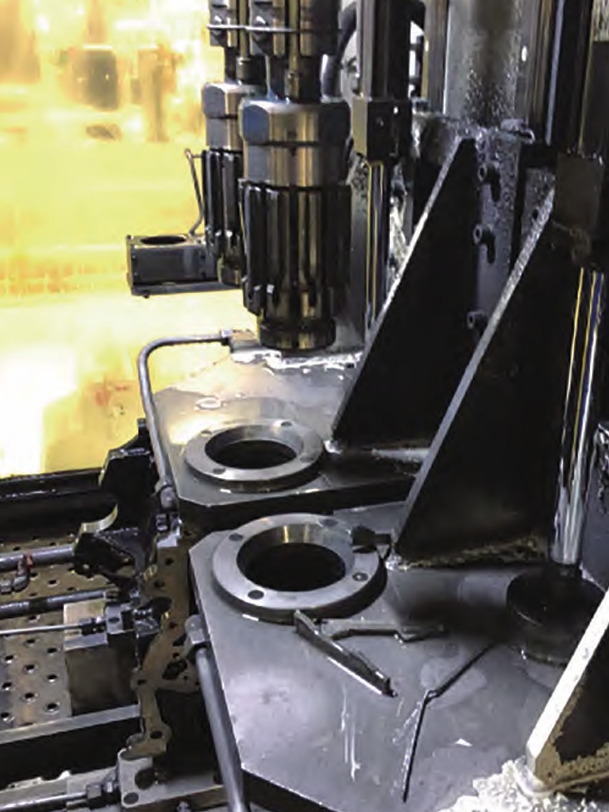
The engine cylinder block shown here is a classic example of a complex casting susceptible to a range of metal casting defect types, from thermal fatigue-related cracks in the thin wall sections to core shift in the cylinder bores. Applying IAHP to such a component would require a carefully constructed model that accounts for the specific geometry and process used.
| Type of Metal Casting Defect | Potential Level 1 Criteria | Example Level 2 Factors | Key Relationships to Model |
|---|---|---|---|
| Shrinkage Cavity/Porosity | Feeding & Risering, Solidification Path, Thermal Parameters | Riser Volume/Contact, Chills, Pouring Temp, Alloy Shrinkage | Interdependence of riser efficacy and solidification mode. |
| Sand Inclusion/Cut | Mold Strength, Metal Flow, Mold/Metal Interface | Sand Bond Strength, Green Hardness, Pouring Velocity, Gating Design | Trade-off between erosion resistance (high strength) and collapsibility. |
| Cold Shut/Misrun | Fluidity, Thermal Loss, Mold Fill | Pouring Temp, Section Thickness, Mold Material, Inoculation | Fluidity as a function of temp, composition, and surface tension. |
| Dimensional Inaccuracy | Pattern/Mold Geometry, Solidification Contraction, Process Stability | Pattern Allowance, Mold Rigidity, Shakeout Practice | Non-linear contraction and its dependence on geometry. |
The mathematical formulation for synthesizing weights in these more complex hierarchies remains the same. The global weight $\tilde{W}_j$ of a sub-criterion $j$ is given by:
$$\tilde{W}_j = \sum_{i=1}^{k} \tilde{V}_i \cdot \tilde{w}_{j}^{(i)}$$
where $\tilde{V}_i$ is the global weight of parent criterion $i$, and $\tilde{w}_{j}^{(i)}$ is the local weight of sub-criterion $j$ under parent $i$. The multiplication and addition of intervals follow interval arithmetic rules, propagating uncertainty through the hierarchy.
7. Discussion: Advantages, Limitations, and Practical Considerations
The application of Interval AHP to metal casting defect analysis offers distinct advantages over purely qualitative methods:
- Quantification of Expert Judgment: It captures the nuanced, often uncertain knowledge of experienced personnel in a structured, mathematical form.
- Explicit Prioritization: It provides a clear, ranked list of causative factors, moving discussions from “what might be wrong” to “what is most likely wrong.”
- Transparency and Documentation: The hierarchy and comparison matrices document the rationale behind the diagnosis, which is valuable for knowledge retention and training.
- Focus on Critical Factors: By identifying the top 2-3 contributors, it allows for efficient allocation of resources for process improvement, preventing “shotgun” approaches that adjust many parameters at once.
However, the method is not a silver bullet and has limitations:
- Model Dependency: The results are only as good as the hierarchical model. Omitting a key factor or misplacing it in the hierarchy invalidates the outcome. The model must be carefully tailored to the specific metal casting defect and process.
- Interpretation of Intervals: The final output is a range of possible weights. Decisions must be made based on these intervals (e.g., looking at midpoints or the upper bound of the top-ranked factor). The ranking is robust if the intervals of the top factors do not overlap significantly with those of lower-ranked ones.
- Approximate Nature: It provides a relative priority order, not an absolute measure of causation. It cannot, by itself, predict the exact quantitative reduction in defect rate from fixing a factor.
- Expert Bias: The input judgments are subjective. It is crucial to involve multiple experts and discuss discrepancies to arrive at a consensus interval matrix that represents collective knowledge.
For successful implementation, I recommend the following practice:
- Cross-functional Team: Involve experts from melting, molding, process engineering, and quality control to build a comprehensive hierarchy.
- Calibration: Start by applying the method to a well-understood, historical metal casting defect to calibrate the approach and build confidence in the team.
- Dynamic Updating: The hierarchy and judgments are not static. As process controls change (e.g., a new sand system is installed), the model should be reviewed and updated.
- Use as a Guide, Not a Gospel: The IAHP output should inform, not replace, physical verification through controlled trials and metallographic analysis.
8. Conclusion
The analysis and mitigation of metal casting defect is a core challenge in foundry operations, directly impacting cost, quality, and delivery. The Interval Analytic Hierarchy Process provides a powerful, formal methodology to augment traditional qualitative analysis. By structuring the problem hierarchically and accommodating the inherent uncertainty in expert judgment through interval comparisons, IAHP transforms subjective assessments into a quantitative prioritization of potential root causes.
The case study on subsurface pinhole defects in iron castings demonstrates its practical utility. The model clearly quantified that molten metal oxidation, exacerbated by seasonal humidity, was the primary driver, enabling targeted and effective countermeasures. While care must be taken in model construction and interpretation of results, the IAHP serves as a rational decision-support tool that brings clarity and focus to the often-murky task of metal casting defect diagnosis. By integrating this mathematical framework with deep process knowledge, foundry engineers can move towards a more predictive and less reactive quality control paradigm, systematically reducing the occurrence and impact of these costly production anomalies.