
In my extensive experience within the foundry and manufacturing sector, I have frequently employed abrasion-resistant white cast iron grades as specified in the national standard GB8263-87. This standard outlines ten primary grades of white cast iron, each formulated to combat severe wear in demanding industrial environments. The strategic alloying in these white cast iron compositions is pivotal for achieving the necessary balance of hardness, toughness, and淬透性. This article will delve into a detailed analysis of the chemical composition and the metallurgical roles of key alloying elements in these abrasion-resistant white cast iron materials. The persistent use of white cast iron across mining, cement, power generation, and machinery underscores its critical importance.
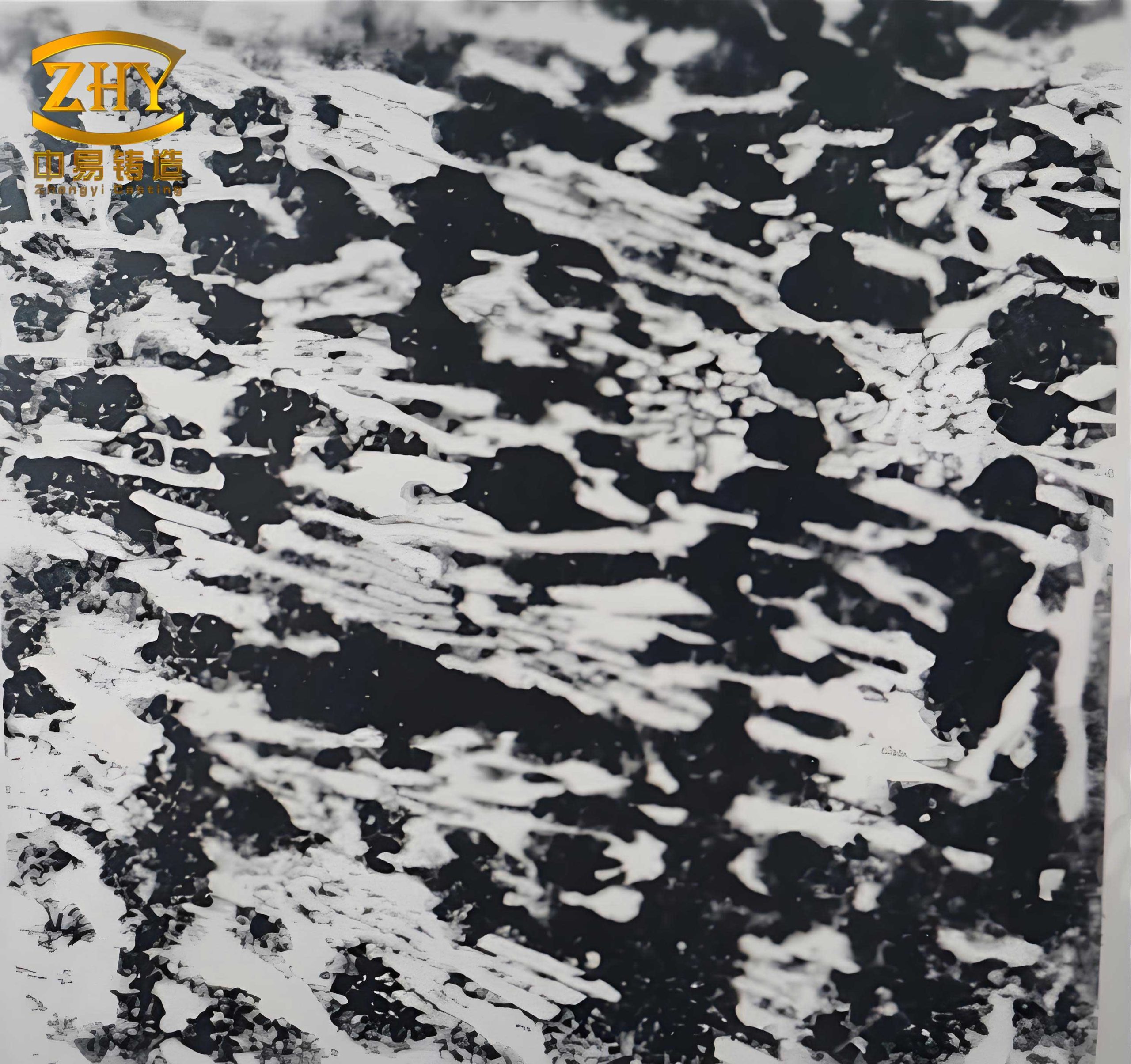
The cornerstone of material selection lies in the precise chemical composition. The table below summarizes the ten grades of abrasion-resistant white cast iron from GB8263-87. Analyzing this data is the first step in understanding the behavior of each white cast iron grade.
| Serial No. | Grade Designation | C (%) | Si (%) | Mn (%) | Cr (%) | Mo (%) | Ni (%) | Cu (%) | W (%) |
|---|---|---|---|---|---|---|---|---|---|
| 1 | KmTBMn5W3 | 3.0–3.5 | 0.8–1.3 | 4.0–6.0 | — | — | — | — | 2.5–3.5 |
| 2 | KmTBW5Cr4 | 2.5–3.5 | 0.5–1.0 | 0.5–1.0 | 3.5–4.5 | — | — | — | 4.5–5.5 |
| 3 | KmTBNi4Cr2-DT | 2.7–3.2 | 0.3–0.8 | 0.3–0.8 | 2.0–3.0 | 0–1.0 | 3.0–5.0 | — | — |
| 4 | KmTBNi4Cr2-GT | 3.2–3.6 | 0.3–0.8 | 0.3–0.8 | 2.0–3.0 | 0–1.0 | 3.0–5.0 | — | — |
| 5 | KmTBCr9Ni5Si2 | 2.5–3.6 | 1.5–2.2 | 0.3–0.8 | 8.0–10.0 | 0–1.0 | 4.5–6.5 | — | — |
| 6 | KmTBCr2Mo1Cu1 | 2.4–3.6 | ≤1.0 | 1.0–2.0 | 2.0–3.0 | 0.5–1.0 | — | 0.8–1.2 | — |
| 7 | KmTBCr15Mo2-DT | 2.0–2.8 | ≤1.0 | 0.5–1.0 | 13.0–18.0 | 0.5–2.5 | 0–1.0 | 0–1.2 | — |
| 8 | KmTBCr15Mo2-GT | 2.8–3.5 | ≤1.0 | 0.5–1.0 | 13.0–18.0 | 0.5–3.0 | 0–1.0 | 0–1.2 | — |
| 9 | KmTBCr20Mo2Cu1 | 2.0–3.0 | ≤1.0 | 0.5–1.0 | 18.0–22.0 | 1.5–2.5 | 0–1.5 | 0.8–1.2 | — |
| 10 | KmTBCr26 | 2.3–3.0 | ≤1.0 | 0.5–1.0 | 23.0–28.0 | 0–1.0 | 0–1.5 | 0–2.0 | — |
Note: “DT” denotes “Low Carbon” and “GT” denotes “High Carbon” in the grade designation.
From this comprehensive table, it is evident that chromium is a nearly ubiquitous alloying element in these white cast iron grades, with the sole exception of Grade 1. The role of chromium, along with other elements, is multifaceted and determines the final microstructure and properties of the white cast iron. To systematically understand this, we can classify these white cast iron grades based on chromium content and analyze the underlying metallurgical principles.
1. Chromium and Its Pivotal Role in White Cast Iron
Chromium is the cornerstone alloying element for most abrasion-resistant white cast iron varieties. Its primary function is to combine with carbon to form hard carbides, thereby enhancing wear resistance. However, the type of carbide formed—which drastically influences toughness and abrasion resistance—is critically dependent on the chromium-to-carbon ratio. This relationship can be conceptually represented by a stability diagram for carbides in white cast iron. A simplified empirical condition for the predominant formation of the desirable M7C3 carbide over M3C is often given by:
$$ \frac{\%Cr}{\%C} > 5 $$
For a white cast iron with lower ratios, the less hard and more continuous M3C carbide tends to form, impairing toughness. At very high ratios, other carbides like M23C6 may appear. The ten grades can be divided into three distinct categories of white cast iron based on chromium content.
Category I: Chromium-Free White Cast Iron (Grade 1)
Grade 1, KmTBMn5W3, is a unique, chromium-free white cast iron that relies on tungsten and manganese for its properties. The high tungsten content leads to the formation of extremely hard tungsten carbides, granting this white cast iron a high as-cast hardness, typically in the range of 50-60 HRC. The absence of chromium makes this grade a cost-effective option in certain contexts, but the microstructure, dominated by brittle carbides, results in low impact toughness. Therefore, this type of white cast iron is suitable only for components subject to minimal impact loading.
Category II: Medium-Chromium White Cast Iron (Grades 2-6)
This group encompasses white cast iron grades with chromium content above 2% but not exceeding 10%. Grades 3, 4, and 5 are analogous to the internationally recognized “Ni-Hard” family of white cast iron. In these grades, chromium’s role is to modify the carbide from Fe3C (cementite) to (Fe,Cr)3C, increasing its hardness. Nickel is added primarily to enhance淬透性 and promote a martensitic matrix upon heat treatment. For Grades 3 and 4, the nickel-to-chromium ratio is designed to be approximately 2:1 to stabilize the carbides effectively. Excessive nickel, however, can lead to high levels of retained austenite, reducing the hardness of the white cast iron.
Grade 5, KmTBCr9Ni5Si2, represents an enhanced version of nickel-chromium white cast iron. The higher chromium (8-10%) and nickel (4.5-6.5%) contents, coupled with elevated silicon (1.5-2.2%), facilitate several improvements. The higher chromium promotes the formation of the harder and more discontinuous M7C3-type carbides according to the ratio principle mentioned earlier. Silicon plays a specific role here: it raises the martensite start temperature (Ms), which can be expressed as:
$$ M_s (^\circ C) \approx 539 – 423C – 30.4Mn – 17.7Ni – 12.1Cr – 7.5Mo + 10Si $$
This formula, while approximate for complex alloys, illustrates how silicon positively influences Ms, aiding in achieving a martensitic matrix in this white cast iron and countering the austenite-stabilizing effect of nickel.
Category III: High-Chromium White Cast Iron (Grades 7-10)
This is the most performance-critical category, where chromium content exceeds 13%. These high-chromium white cast iron grades are renowned for their exceptional wear resistance, primarily due to the high volume fraction of M7C3 carbides. The铬碳比 (Cr/C ratio) is the master parameter for designing these white cast iron alloys. For instance, comparing Grade 7 (DT, low carbon) and Grade 8 (GT, high carbon) of the KmTBCr15Mo2 series highlights a fundamental trade-off. The carbon content directly influences the volume fraction of carbides (Vc), which can be estimated for a white cast iron using the lever rule in a simplified binary Fe-C system, though in reality it’s more complex:
$$ V_c \propto \frac{C – C_{\alpha}}{C_{carbide} – C_{\alpha}} $$
where \( C \) is the total carbon content, \( C_{\alpha} \) is the carbon solubility in ferrite, and \( C_{carbide} \) is the carbon content in the carbide. Increasing carbon (as in Grade 8 GT) increases Vc, thereby enhancing abrasion resistance but at the expense of reduced toughness in the white cast iron. The higher alloy content in Grades 9 and 10 further pushes the performance envelope, with chromium contents up to 28%, making them suitable for the most severe abrasive conditions.
2. The Synergistic Effects of Other Alloying Elements in White Cast Iron
While chromium is dominant, the optimized performance of modern abrasion-resistant white cast iron is achieved through a careful balance of several other elements. Their individual and interactive effects are crucial.
Molybdenum (Mo)
Molybdenum is a potent alloying addition in white cast iron. It partitions between the carbide phase and the austenite/martensite matrix. The portion dissolved in austenite significantly enhances the淬透性 of the white cast iron, allowing thicker sections to be heat treated to a martensitic structure. This effect is often quantified using multiplying factors in淬透性 calculations like the Ideal Critical Diameter (DI). The contribution of molybdenum, in conjunction with other elements, is critical for the hardenability of grades like KmTBCr15Mo2 and KmTBCr20Mo2Cu1. In fact, for a white cast iron like Grade 8, increasing molybdenum to the upper limit (3.0%) can enable through-hardening of sections up to 150 mm.
Copper (Cu)
Copper functions similarly to nickel in white cast iron, acting as an austenite stabilizer and improving淬透性, though its effect is less potent per unit weight. A critical constraint is its limited solubility in ferrite (approximately 2%). To avoid the detrimental precipitation of free copper at grain boundaries, which embrittles the white cast iron, its content is generally restricted to below 1.5% in most specifications. This is reflected in the GB8263-87 white cast iron grades, where copper appears in five grades, never exceeding 2.0%.
Manganese (Mn)
Manganese is a universal presence in all ten grades of this white cast iron standard. It serves multiple purposes. Like molybdenum, it enhances淬透性, especially when used in combination. Mn also dissolves in carbides, slightly increasing their hardness. Perhaps more importantly, an appropriate manganese content (typically in the 0.5-2.0% range for these white cast iron grades) helps refine the eutectic carbide network at grain boundaries. This refinement improves both the ambient and low-temperature toughness of the white cast iron, a vital property for components exposed to impact.
Silicon (Si)
Silicon has a dual and often contradictory role in white cast iron. On one hand, it is a ferrite stabilizer and reduces淬透性. More critically, it is a strong graphitizer, which is highly undesirable in a white cast iron where the retention of carbon in combined form as carbides is essential. Therefore, in nine out of the ten grades, silicon is kept low (≤1.3%). The notable exception is Grade 5, where the high nickel and chromium contents effectively suppress graphitization, allowing a higher silicon content (1.5-2.2%). As previously mentioned via the Ms formula, silicon’s positive role here is to elevate the martensite start temperature, counteracting nickel’s effect and promoting a martensitic matrix in this specific nickel-chromium white cast iron.
Nickel (Ni)
Nickel is exclusively an austenite stabilizer in white cast iron; it does not enter carbide phases. Its primary purpose is to increase淬透性 and ensure the formation of a martensitic or martensitic-austenitic matrix upon cooling. However, its use requires careful control. In grades where淬透性 is the main goal but graphite formation must be avoided (like Grades 6, 7, 8, 9, 10), nickel content is kept low (≤1.5%). In the dedicated “Ni-Hard” type white cast iron (Grades 3, 4, 5), nickel is a primary alloy (3-6.5%). Excessive nickel (>3% outside the Ni-Hard system) can lead to excessive retained austenite, lowering hardness and wear resistance of the white cast iron, and it also promotes graphitization.
3. Microstructural Engineering and Property Relationships in White Cast Iron
The ultimate properties of any white cast iron are a direct consequence of its microstructure—the type, morphology, and distribution of hard carbides within the metallic matrix. The chemical compositions shown in the table are the recipe for engineering this microstructure. The volume fraction of carbides (\(f_c\)) is primarily a function of carbon content, but the carbide type is controlled by the铬碳比. The hardness of the white cast iron (\(H_{total}\)) can be approximated by a rule-of-mixtures model between the carbide hardness (\(H_c\)) and the matrix hardness (\(H_m\)):
$$ H_{total} \approx f_c \cdot H_c + (1 – f_c) \cdot H_m $$
For M3C, \(H_c\) is approximately 840-1100 HV, while for M7C3, it is significantly higher at 1200-1800 HV. This clearly shows why high-chromium white cast iron, with its M7C3 carbides, offers superior abrasion resistance. The matrix hardness \(H_m\) is determined by the heat treatment and the alloying elements that affect淬透性 and transformation behavior. Achieving a high-hardness martensitic matrix (with hardness often >700 HV) is the goal for most heat-treated abrasion-resistant white cast iron components.
淬透性, the ability to form martensite throughout a section, is perhaps the most critical processing property for thick-section white cast iron castings. It can be estimated using formulas that incorporate the effects of alloying elements. One common approach is to calculate a Carbon Equivalent (CE) for hardenability, different from the CE for weldability. For white cast iron, an idealized formula might look like:
$$ CE_{Hardenability} = C + \frac{Mn}{6} + \frac{Cr + Mo + V}{5} + \frac{Ni + Cu}{15} $$
A higher \( CE_{Hardenability} \) value indicates greater淬透性. This elucidates why grades like KmTBCr15Mo2-GT, with significant amounts of Cr and Mo, are specified for large, heavy-section wear parts like grinding roll shells in vertical mills—a direct application from my own field observations with this white cast iron.
4. Application-Specific Selection of White Cast Iron Grades
Selecting the appropriate grade of white cast iron requires matching the material’s properties to the service conditions: the type and size of abrasive particles, the presence of impact, and the required component life. The following table provides a generalized guideline for application areas, though detailed engineering assessment is always necessary.
| White Cast Iron Category | Typical Grades (Examples) | Key Characteristics | Suggested Applications |
|---|---|---|---|
| Chromium-Free | KmTBMn5W3 | High hardness, low toughness, cost-effective | Slurry pump parts for fine abrasives, liners with low impact. |
| Medium-Chromium (Ni-Hard Type) | KmTBNi4Cr2-DT/GT, KmTBCr9Ni5Si2 | Good hardenability, moderate toughness, excellent wear resistance against small-to-medium abrasives. | Pump casings, impellers, classifier wear parts, ball mill liners. |
| High-Chromium | KmTBCr15Mo2, KmTBCr20Mo2Cu1, KmTBCr26 | Superior wear resistance due to M7C3 carbides, good淬透性, toughness improves with lower carbon. | Cement mill liners, grinding balls and rolls, pulverizer hammers and tips, blow bars for impact crushers. |
The progression from medium-chromium to high-chromium white cast iron generally represents an increase in alloy cost but also a significant leap in performance under severe abrasion. The high-chromium white cast iron, particularly the 15-26% Cr varieties, has become the industry benchmark for the most demanding mineral processing and milling operations.
5. Advanced Considerations and the Future of White Cast Iron Metallurgy
The development of abrasion-resistant white cast iron is not static. Ongoing research focuses on further optimizing the balance between carbide volume, matrix toughness, and淬透性. Additions of micro-alloying elements like vanadium, titanium, and niobium are being explored to refine the as-cast structure of white cast iron, forming even harder primary carbides or modifying the morphology of eutectic carbides. Furthermore, computational thermodynamics using software like Thermo-Calc allows for precise prediction of phase equilibria in these multi-component white cast iron systems, enabling the design of novel compositions.
Another critical area is the heat treatment of white cast iron. The process typically involves destabilization heating in the range of 950-1050°C, where secondary carbides precipitate from the austenite, followed by quenching and often a tempering step. The kinetics of this process can be modeled using time-temperature-transformation (TTT) diagrams specific to each white cast iron grade. The precipitation of secondary carbides during destabilization enriches the matrix with alloying elements and increases its Ms temperature, facilitating the subsequent martensitic transformation. The final microstructure is a complex interplay of primary M7C3 carbides, secondary carbides, and a martensitic matrix possibly containing some retained austenite. Controlling the amount of retained austenite is vital, as it can provide a degree of toughness through transformation-induced plasticity (TRIP) effects under stress, but too much compromises hardness.
In conclusion, the GB8263-87 standard encapsulates a well-engineered family of abrasion-resistant white cast iron materials. Each grade represents a specific solution to a wear problem, formulated through careful control of chromium, carbon, and other alloying elements. The enduring utility of white cast iron in combating wear is a testament to the profound understanding of the relationships between composition, processing, microstructure, and performance. As industrial demands grow more severe, the evolution of white cast iron chemistry and processing will continue, ensuring its place as a material of choice for extreme abrasion resistance.