
In the production of ductile iron castings, the occurrence of shrinkage defects remains a persistent and critical challenge. These defects, manifesting as dispersed micro-porosity or larger cavities, significantly compromise the mechanical integrity, pressure tightness, and overall reliability of cast components. The drive towards lightweight, high-performance components in sectors such as automotive, heavy machinery, and energy further intensifies the demand for defect-free castings. This article, from our perspective as foundry researchers and engineers, systematically explores the intricate formation mechanisms of shrinkage in casting, analyzes the multifaceted influencing factors, and synthesizes a comprehensive strategy for its control, leveraging solidification theory, numerical simulation, and empirical validation.
1. Introduction: The Significance of the Problem
The pursuit of superior casting quality is fundamentally linked to mastering the phenomena of solidification shrinkage. In ductile iron, the problem is uniquely complex due to the competing effects of liquid/solidification contraction and graphite expansion. When the delicate balance between these volumetric changes is disrupted, localized regions of inadequate feeding result in shrinkage porosity. This defect not only acts as a stress concentrator, reducing fatigue life and tensile strength, but also creates leakage paths in pressure-retaining components. The economic impact is substantial, encompassing scrap costs, rework, and potential field failures. Therefore, a deep understanding of the science behind shrinkage in casting is not merely an academic exercise but a vital industrial necessity for enhancing yield, ensuring performance, and advancing sustainable manufacturing practices.
2. Solidification Characteristics and the Genesis of Shrinkage
The unique solidification behavior of ductile iron sets the stage for its shrinkage propensity. Unlike many other alloys, its solidification involves a quasi-eutectic reaction where graphite spheroids precipitate from the liquid, enveloped by austenite shells.
2.1 Volumetric Evolution During Solidification
The total volume change from pouring to room temperature can be decomposed into three distinct stages, each critical for understanding feeding requirements. The net effect dictates the susceptibility to shrinkage in casting.
Stage 1: Liquid Contraction. This occurs as the metal cools from the pouring temperature ($T_{pour}$) down to the liquidus temperature ($T_L$). The volume change is primarily a function of thermal contraction and can be approximated by:
$$\Delta V_{liquid} = V_0 \cdot \alpha_l \cdot (T_{pour} – T_L)$$
where $V_0$ is the initial volume and $\alpha_l$ is the coefficient of liquid thermal expansion (negative for contraction). Typically, this contraction accounts for a 1.5% to 2.0% reduction in volume.
Stage 2: Solidification Contraction/Expansion. This is the most critical phase for defect formation, spanning from $T_L$ to the solidus temperature ($T_S$). The net volume change here is the sum of two opposing phenomena:
1. Contraction due to the phase change from liquid to solid austenite/graphite.
2. Expansion due to graphite precipitation, as graphite has a lower density (approx. 2.25 g/cm³) than the liquid metal.
The net solidification shrinkage ($\varepsilon_{s}$) can be expressed conceptually as:
$$\varepsilon_{s} = \varepsilon_{phase-change} – \varepsilon_{graphite-expansion}$$
For ductile iron, $\varepsilon_{phase-change}$ is typically around 3-4%, while $\varepsilon_{graphite-expansion}$ can be 3-5%. The balance, therefore, is a small net contraction of approximately 0.5% to 1.5%. This small net value is deceptive; if the expansive force is not effectively harnessed to feed the remaining liquid contraction, or if feeding paths are blocked, shrinkage in casting occurs.
Stage 3: Solid State Contraction. After complete solidification, the casting contracts thermally down to room temperature, contributing an additional ~3-4% linear shrinkage, which is accommodated by pattern allowances and does not directly cause porosity.
2.2 Classification of Shrinkage Defects
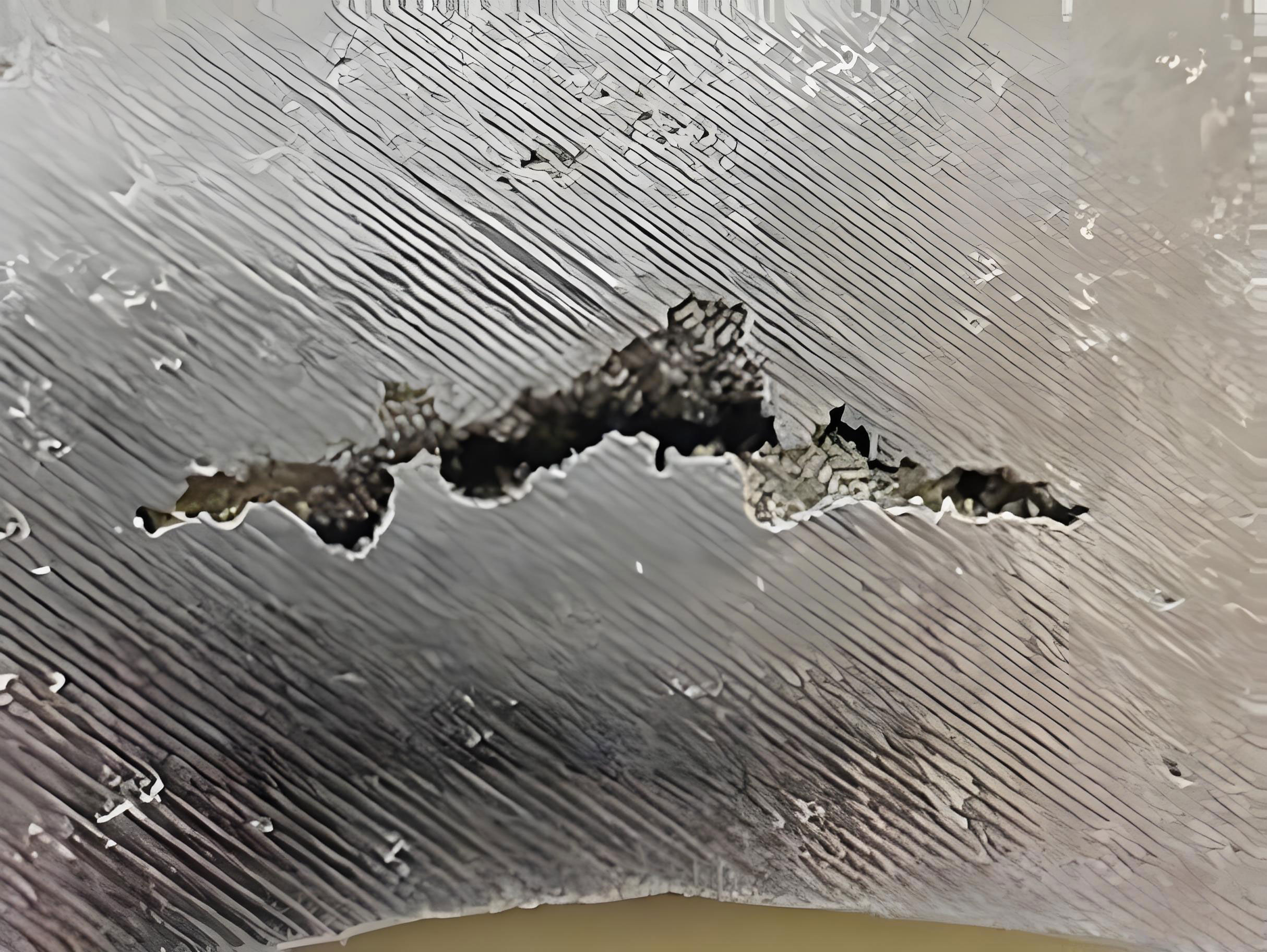
Shrinkage defects are categorized based on their morphology, size, and distribution, which are direct consequences of the solidification mode.
| Classification Basis | Type | Characteristics | Typical Cause & Solidification Context |
|---|---|---|---|
| Scale/Observability | Macro-shrinkage | Visible cavities (>1 mm), often interconnected, located in thermal centers or hot spots. | Inadequate bulk feeding, often in heavy sections; associated with a large, continuous liquid pool that collapses. |
| Micro-shrinkage | Dispersed pores (<0.5 mm), visible only under microscopy, found in interdendritic or inter-eutectic cell regions. | Interdendritic feeding failure during the pasty (mushy) solidification stage, characteristic of wide freezing range alloys like ductile iron. | |
| Morphology & Distribution | Concentrated Shrinkage Cavity | Single, large, irregular cavity, often connected to the surface via a pipe. Common in pure metals or narrow-freezing-range alloys. | Classic “piping” in directional solidification where a clear feeding channel exists until the last moment. |
| Dispersed Shrinkage Porosity | Numerous small, isolated pores scattered throughout a region. The primary defect mode in ductile iron. | Pasty solidification where multiple isolated liquid pools form and shrink independently after feeding paths are blocked by dendrites. |
2.3 Core Formation Mechanisms
The formation of shrinkage in casting is not a single-event failure but a process governed by interplaying mechanisms.
2.3.1 Interdendritic Feeding Impediment. Ductile iron solidifies with a wide mushy zone. As dendrites and eutectic cells grow, they create a tortuous network of liquid channels. For feeding to occur, liquid must flow through these channels to compensate for shrinkage. The pressure drop ($\Delta P$) required for this flow, described simplistically by a Darcy-like law for flow in a porous medium, is:
$$\Delta P = \frac{\mu \cdot v \cdot L}{\kappa}$$
where $\mu$ is liquid viscosity, $v$ is flow velocity, $L$ is the feeding distance, and $\kappa$ is the permeability of the mushy zone. Permeability decreases drastically as the solid fraction ($f_s$) increases. When $\Delta P$ exceeds the available feeding pressure (from risers or graphite expansion), flow ceases, and the isolated liquid pockets shrink to form microporosity—the essence of dispersed shrinkage in casting.
2.3.2 The Dual Role of Graphite Expansion. Graphite precipitation provides an internal “self-feeding” mechanism. The expansion generates a pressure that can push residual liquid into shrinking areas. However, this benefit is contingent on mold rigidity. If the mold wall yields (mold wall movement), the expansive force is dissipated without performing useful feeding work, effectively worsening the net shrinkage. The effectiveness of graphite expansion ($P_{exp}$) in countering shrinkage pressure ($P_{sh}$) can be modeled as:
$$P_{net} = P_{exp} – P_{sh} = \eta \cdot E_{graphite} \cdot \dot{G} – \beta \cdot \frac{d f_s}{dt}$$
where $\eta$ is an efficiency factor dependent on mold stiffness, $E_{graphite}$ is the volumetric expansion coefficient of graphite, $\dot{G}$ is the graphite growth rate, $\beta$ is the shrinkage coefficient, and $df_s/dt$ is the solidification rate. For sound castings, $P_{net} > 0$ must be maintained in critical regions.
2.3.3 Solidification Sequence and Thermal Gradient. A steep thermal gradient ($\nabla T$) promotes directional solidification, where remote areas solidify first, establishing a clear, open feeding path toward the riser. A shallow $\nabla T$ leads to simultaneous or pasty solidification over a broad region, rapidly isolating liquid pools and making external feeding ineffective. The Niyama criterion, a widely used indicator for shrinkage prediction, incorporates this gradient and the cooling rate ($\dot{T}$):
$$N_y = \frac{\nabla T}{\sqrt{\dot{T}}}$$
Lower $N_y$ values in simulation results indicate a higher propensity for shrinkage in casting, as they signify conditions of low gradient and/or high cooling rate that favor pasty zone formation.
3. Multifactorial Analysis of Influencing Parameters
The propensity for shrinkage in casting is governed by a complex matrix of material and process variables.
3.1 Material and Metallurgical Factors
| Factor | Optimal Range/Effect | Mechanism & Impact on Shrinkage |
|---|---|---|
| Carbon Equivalent (CE = C% + 0.33*(Si%+P%)) | ~4.3 – 4.7% (near eutectic) | High CE increases graphite potential and expansion, enhancing self-feeding. Excessively high CE extends freezing range, promoting pasty solidification and segregating low-melting-point constituents to grain boundaries, worsening feeding. Low CE reduces expansion, increasing net shrinkage. |
| Magnesium Residual (Mgres) | 0.03 – 0.05% (typical) | Essential for spheroidization. Excessive Mg increases chilling tendency (carbides), suppresses graphite formation, reduces expansion, and raises shrinkage tendency. It also increases surface tension, potentially impairing liquid metal flow in thin channels. |
| Trace Elements (Sb, Sn, etc.) | Precise, minute additions | Antimony (Sb): Promotes pearlite and refines graphite structure. In controlled amounts (<0.01%), it can improve nodule count and distribution, aiding uniform expansion. Over-addition promotes chunky graphite. Tin (Sn): Powerful pearlite stabilizer. Similar to excess Mg, it promotes carbides and can suppress graphite expansion, increasing risk of shrinkage in casting. |
| Phosphorus (P) | < 0.04% (ideally < 0.03%) | Forms a low-melting-point phosphide eutectic (Steadite) that segregates to cell boundaries. It remains liquid until very late in solidification, disrupting final-stage feeding and creating localized micro-shrinkage and brittleness. |
3.2 Process and Design Factors
| Factor | Guidelines & Optimization | Impact on Feeding and Shrinkage |
|---|---|---|
| Pouring Temperature ($T_{pour}$) | Balance: High enough for fluidity, low enough to minimize liquid contraction. Often ~1350-1420°C. | Excessive $T_{pour}$ increases total liquid contraction volume and can enlarge the mushy zone, extending the time of interdendritic feeding difficulty. Too low $T_{pour}$ risks mistruns and premature freezing of feeding channels. |
| Riser Design (Size, Location) | Riser must solidify after the casting section it feeds. Modulus method: $M_{riser} > 1.2 \times M_{casting}$. Located on thermal center or hot spot. | The primary source of external feeding pressure. Inadequate riser size or misplaced location fails to supply liquid to the critical last-to-freeze zone, directly causing shrinkage in casting. Insulated/Exothermic risers extend feeding duration. |
| Chill Design | Used to create directional solidification, modify local cooling rate, and eliminate isolated hot spots. | Chills increase local $\nabla T$, promoting directional solidification towards a riser. They refine microstructure but must be sized correctly. Over-chilling can create sharp thermal stresses and cracks; under-chilling fails to redirect the solidification front. |
| Mold Rigidity | High strength, low deformability molding materials (e.g., resin-bonded sand with high binder level, rigid molding boxes). | Critical for harnessing graphite expansion. A rigid mold resists wall movement, allowing the internal expansive pressure to effectively compress and feed liquid into shrinking areas. Soft molds absorb this energy, negating self-feeding. |
| Gating System Design | Design for rapid, quiescent filling with minimal temperature loss. Often uses a pressurized system for ductile iron. | Influences initial temperature distribution. A poorly designed system can create “hot spots” or excessive superheat in wrong areas, disrupting the intended solidification sequence and creating new sites for shrinkage in casting. |
4. Integrated Control Strategy for Shrinkage Mitigation
Effective control of shrinkage in casting requires a holistic, system-based approach that synchronizes material science, process engineering, and predictive technology.
4.1 Alloy Design and Metallurgical Control
4.1.1 Precise CE and Composition Management. The goal is to tailor the alloy’s solidification path. This involves targeting a CE that provides adequate fluidity and graphite expansion without excessively widening the mushy zone. Simultaneous control of Si, Mn, and trace elements is crucial. For critical sections, the concept of “Differential Carbon Equivalent” can be applied—designing the chemistry to yield slightly higher CE in heavy sections prone to shrinkage, compensating via faster cooling or chills. This can be guided by the relationship between section modulus (M) and target CE:
$$CE_{target} = k_1 – k_2 \cdot \log(M)$$
where $k_1$ and $k_2$ are constants derived from empirical data for a specific casting geometry and process.
4.1.2 Enhancement with Rare Earth (RE) Elements. Additions of Cerium (Ce) or Lanthanum (La) are powerful tools. They act as:
1. Desulfurizers and Deoxidizers: Cleaner metal has improved fluidity for feeding.
2. Graphite Morphology Modifiers: They counteract deleterious trace elements like Pb, Bi, and Ti that promote degenerate graphite. This results in a higher, more uniform nodule count.
3. Inoculation Enhancers: They promote a finer eutectic cell structure.
The combined effect is a more uniform and earlier onset of graphite expansion, improving the synchronization between shrinkage demand and internal feeding supply, thereby reducing shrinkage in casting. The optimal RE addition is typically a small fraction of the Mg treatment.
4.2 Advanced Process Design and Optimization
4.2.1 Simulation-Driven Riser and Chill Optimization. Modern casting simulation software (e.g., MAGMASOFT®, ProCAST, NovaFlow&Solid) is indispensable. It allows for virtual experimentation to:
* Predict the last-to-freeze regions and thermal centers.
* Calculate feeding distances and optimize riser placement and size using criteria like Niyama or the new G/X criterion for ductile iron.
* Design effective chill layouts to enforce directional solidification.
This virtual prototyping minimizes trial-and-error, leading to a first-time-right process design that inherently minimizes shrinkage in casting.
4.2.2 Controlled Cooling and Solidification. Beyond simple chills, active cooling strategies can be employed. For thick-section castings, the use of internally-cored cooling channels or strategic placement of high-conductivity mold materials (e.g., chromite sand inserts, copper chills) can dramatically alter the local solidification time ($t_f$), approximated by Chvorinov’s rule:
$$t_f = k \cdot \left( \frac{V}{A} \right)^n = k \cdot M^n$$
where $V$ is volume, $A$ is cooling surface area, $M$ is the modulus, and $k$ and $n$ are constants dependent on mold material. By manipulating $M$ locally with inserts, the solidification sequence is controlled to always point toward an active feeder.
4.2.3 Pressurized Solidification Techniques. For high-integrity castings, applying external pressure during solidification can virtually eliminate shrinkage in casting. Methods include:
* Pressure-Riser Process: Applying a controlled gas pressure on the riser surface during solidification.
* Squeeze Casting/Compound Casting: Solidifying under high mechanical pressure in a die.
The applied pressure ($P_{applied}$) directly increases the feeding pressure, supplementing graphite expansion and riser pressure. The condition for soundness becomes:
$$P_{riser} + P_{exp} + P_{applied} > P_{sh} + P_{atm} + \Delta P_{flow}$$
This technique is highly effective but adds equipment complexity and cost.
4.3 The Integrated Control Matrix
The most robust strategy integrates all levels of control, as summarized below:
| Control Level | Primary Objectives | Specific Actions & Tools |
|---|---|---|
| Metallurgical | Optimize self-feeding capacity and solidification range. | Target CE near eutectic; control Mgres and RE; minimize P & detrimental traces; use effective inoculation. |
| Mold Design | Ensure rigidity and create favorable thermal gradients. | Use high-strength molding sand/process; design rigid flask/clamping; apply chills/insulators strategically. |
| Feeding System Design | Provide adequate and timely external liquid feed. | Simulation-based riser design (size, location, type); optimized gating for thermal distribution. |
| Process Parameter Control | Execute the designed thermal history consistently. | Control $T_{pour}$, pouring time; consider pressurized solidification for critical parts. |
| Monitoring & Feedback | Validate and continuously improve. | Use NDT (X-ray, UT) on sample castings; correlate simulation predictions with actual results; employ statistical process control (SPC). |
5. Conclusion and Future Perspectives
The challenge of shrinkage in ductile iron castings is a multi-scale problem, spanning from atomic-level graphite precipitation to meter-scale thermal management in a casting. Its successful mitigation hinges on understanding that it is a feeding failure occurring in the final stages of solidification. The competing volumetric effects—contraction and expansion—must be managed through a synergistic blend of alloy chemistry, robust and rigid mold design, scientifically-sized feeding systems, and precise process control. Numerical simulation has evolved from a post-mortem analysis tool to a frontline design platform, enabling the proactive creation of processes that inherently resist the formation of shrinkage in casting.
Future advancements will likely focus on even greater integration and intelligence. The use of real-time sensor data (e.g., temperature monitoring within the mold) coupled with adaptive process controls and machine learning algorithms promises a shift from static process recipes to dynamic solidification management. Furthermore, the development of new inoculants and alloying strategies that provide more predictable and potent graphite expansion, alongside advances in high-stiffness mold materials, will continue to push the boundaries of what is possible in producing sound, heavy-section, and geometrically complex ductile iron castings entirely free from shrinkage defects.