
In my extensive research on advanced manufacturing techniques for aerospace components, I have focused on the vacuum investment casting process for producing large, intricate shell castings, specifically the kerosene pump low-pressure housing used in liquid oxygen-kerosene engines. This component is critical due to its complex geometry, high-performance material requirements, and stringent quality standards. Traditional casting methods often fall short in meeting these demands, necessitating the development of a robust vacuum investment casting methodology. Through iterative process experiments and systematic analysis, I have addressed key technical challenges in shell mold preparation, material selection, and process optimization, ultimately establishing a reliable approach for manufacturing such shell castings. This article details my first-person perspective on this research, emphasizing the importance of shell castings throughout the process.
The kerosene pump low-pressure housing is a prime example of a challenging shell casting, with overall dimensions of 345 mm × 300 mm × 280 mm. Its intricate internal cavities, varying wall thicknesses from 6 mm to 45 mm, and high dimensional accuracy requirements make it prone to defects like cracks, shrinkage, and cold shuts. The vacuum investment casting process, which involves creating a ceramic shell mold around a wax pattern, is ideal for such shell castings as it allows for excellent surface finish and complex shapes. My study aimed to refine every step, from pattern making to final heat treatment, ensuring the integrity of these shell castings.
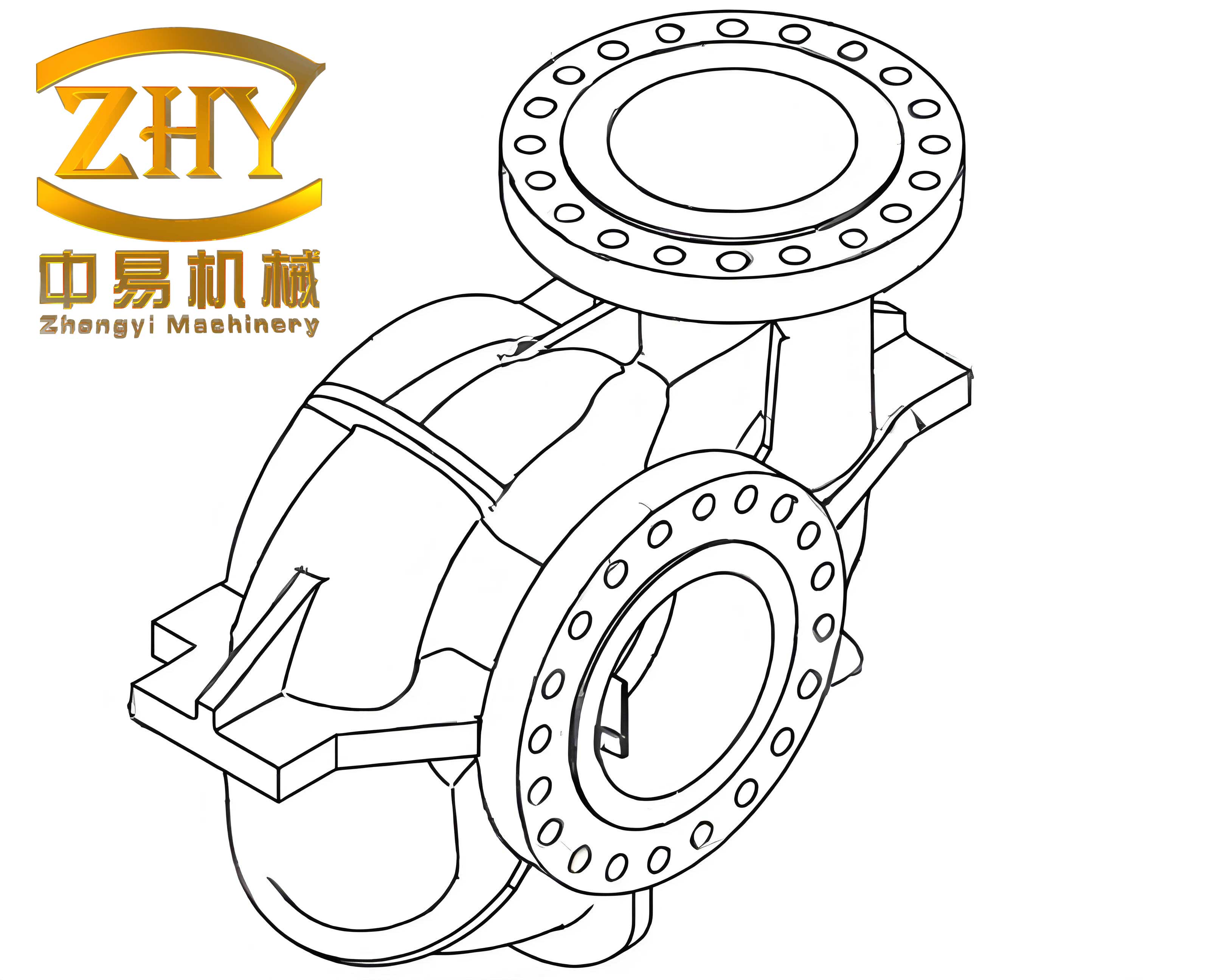
In the initial phase, I prioritized wax pattern fabrication. Given the component’s size and complexity, and the need for flexibility during development, I opted for rapid prototyping using an AFS machine instead of traditional metal dies. The CAD model was converted into STL format, and layers were sintered from thermoplastic powder to form the pattern. After dewaxing and precision finishing, the wax pattern achieved the required dimensions and surface smoothness, crucial for subsequent shell mold formation. This step is foundational for producing high-quality shell castings, as any imperfections in the pattern directly affect the final ceramic shell.
Determining the optimal process scheme was central to my research. I designed two gating system layouts, as summarized in Table 1, to compare filling behavior and solidification characteristics for these shell castings. Scheme A employed a combination of bottom and top gating with risers to ensure smooth metal flow and feeding, while Scheme B used side gating to improve shell mold coating accessibility. Both aimed to minimize turbulence and shrinkage in the shell castings.
| Scheme | Gating Configuration | Key Features | Application for Shell Castings |
|---|---|---|---|
| A | Bottom + Top Gating with Riser | Promotes directional solidification, reduces splash | Suitable for complex cavities in shell castings |
| B | Side Gating with Horizontal Runner | Enhances shell coating uniformity, avoids thin sections | Ideal for large shell castings with deep recesses |
The shell mold building process is critical for the dimensional accuracy and surface quality of shell castings. I utilized silica sol binder systems for both prime and backup layers. The slurry parameters were optimized through trials, as detailed in Table 2, to achieve adequate viscosity and coating adhesion. The stuccoing sequence involved graded zircon and chamotte sands to balance shell strength and permeability, essential for preventing shell cracking during pouring.
| Layer | Slurry Powder-to-Liquid Ratio | Stucco Material and Grit Size | Drying Time (hours) | Impact on Shell Castings |
|---|---|---|---|---|
| 1 (Prime) | 3.1 – 3.3 | Zircon sand, 70/140 mesh | >12 | Determines surface finish of shell castings |
| 2 | 3.0 – 3.1 | Chamotte sand, 60/80 mesh | >12 | Enhances adhesion for shell castings |
| 3-4 | 2.7 – 3.0 | Chamotte sand, 20/40 mesh | >12 | Builds intermediate strength in shell castings |
| 5-6 | 2.7 – 3.0 | Chamotte sand, 8/10 mesh | >12 | Improves thermal resistance of shell castings |
| 7-9 | 2.7 – 3.0 | Chamotte sand, 3/5 mesh | >12 | Provides bulk strength for shell castings |
| 10 (Seal) | 3.0 – 3.1 | Seal coat only | >12 | Final consolidation for shell castings |
Material selection played a pivotal role in my study. For the alloy, I collaborated with specialists to develop a high-strength stainless steel tailored for vacuum melting, ensuring compliance with mechanical property targets. For non-metallic materials, I sourced high-purity zircon flour and sand (with ZrO₂ content exceeding 65%), along with silica sol from reputable suppliers, to guarantee the shell mold’s integrity. The quality of these materials directly influences the defect formation in shell castings, particularly regarding inclusions and surface roughness.
The melting and pouring parameters were rigorously tested, as variations significantly affect the internal quality of shell castings. I conducted experiments under different vacuum levels, refining times, and pouring temperatures, as outlined in Table 3. The goal was to minimize gas porosity and oxide inclusions in the shell castings by optimizing these factors.
| Experiment Set | Vacuum Level (Pa) | Refining Time (min) | Pouring Temperature (°C) | Observed Effect on Shell Castings |
|---|---|---|---|---|
| 1 | 1 | 10 | 1580 | Reduced porosity but risk of shell mold reaction |
| 2 | 5 | 15 | 1550 | Balanced cleanliness and mold stability for shell castings |
| 3 | 1 | 20 | 1550 | Improved inclusion removal but longer cycle time |
The overall process flow I established is: Pattern Making → Finishing → Shell Mold Building → Dewaxing → Low-Temperature Firing → Molding → High-Temperature Firing → Pouring → Cleaning → X-ray Inspection → Hot Isostatic Pressing (HIP) → X-ray Inspection → Fluorescent Inspection → Heat Treatment → Final Inspection. Each step is crucial for ensuring the reliability of shell castings, with HIP specifically used to heal internal voids in complex shell castings.
During shell mold building, I controlled environmental conditions strictly at 21–25°C and 50–70% humidity. Slurry fluidity was measured using a flow cup, with targets of 100–130 s for layers 1-2, 70–90 s for layers 3-4, and 60–80 s for layers 5-10, ensuring uniform coating on the wax patterns for consistent shell castings. Drying times exceeded 12 hours per layer, with forced air circulation to enhance moisture removal, a key factor in preventing shell mold cracks during dewaxing.
Firing of the shell molds involved two stages: low-temperature firing at 1000°C to develop green strength, and high-temperature firing at 1100°C with intermediate holds at 350°C, 550°C, 750°C, and 950°C to eliminate binders and achieve thermal stability. The firing schedule can be modeled using a kinetic equation for binder removal: $$ \frac{d\alpha}{dt} = k(1-\alpha)^n $$ where $\alpha$ is the conversion fraction, $k$ is the rate constant, $n$ is the reaction order, and $t$ is time. This ensures the shell mold can withstand the thermal shock during pouring, critical for large shell castings.
Melting was conducted in a vacuum induction furnace (model ZGJB 1.4-250-2.5). I maintained precise control over power input during refining, typically at 60–80 kW, to achieve superheating without excessive turbulence. The pouring process was completed within 60 seconds, followed by a 20-minute hold to allow gradual solidification, reducing stresses in the shell castings. The solidification time for such shell castings can be estimated using Chvorinov’s rule: $$ t_s = B \left( \frac{V}{A} \right)^2 $$ where $t_s$ is solidification time, $B$ is a mold constant, $V$ is volume, and $A$ is surface area. For the housing, with its varying wall thickness, this rule highlights the need for tailored cooling in different sections of the shell castings.
Post-casting, I subjected the shell castings to non-destructive testing, including visual inspection, X-ray radiography, and fluorescent penetrant inspection, per class I-A standards. Mechanical properties were evaluated using test bars cut from the gating system, with results exceeding specifications, as shown in Table 4. HIP treatment at high pressure and temperature effectively closed microporosity, enhancing the fatigue life of these shell castings.
| Property | Requirement | Achieved Value | Remarks for Shell Castings |
|---|---|---|---|
| Tensile Strength (MPa) | > 850 | 920 ± 15 | Consistent across multiple shell castings |
| Yield Strength (MPa) | > 700 | 760 ± 20 | Excellent for high-stress shell castings |
| Elongation (%) | > 10 | 14 ± 2 | Indicates good ductility in shell castings |
| Impact Toughness (J) | > 40 | 52 ± 5 | Critical for aerospace shell castings |
Analysis of the results revealed that surface quality of the shell castings was excellent, attributed to the fine prime coat and controlled shell mold building. However, internal defects such as scattered porosity and occasional inclusions were observed, primarily due to suboptimal vacuum levels during melting (often above 5 Pa in practice) and inconsistent temperature control. This underscores the sensitivity of shell castings to process parameters. I derived a relationship for defect probability $P_d$ in shell castings based on vacuum pressure $p$ and pouring temperature $T$: $$ P_d = C_1 e^{-k_1 p} + C_2 (T – T_{\text{opt}})^2 $$ where $C_1$, $C_2$, $k_1$, and $T_{\text{opt}}$ are constants. Minimizing $P_d$ requires tight control over $p$ and $T$, essential for premium shell castings.
Comparing the two gating schemes, Scheme A yielded better feeding for thick sections in the shell castings, but Scheme B facilitated easier shell mold production. For future iterations, I recommend a hybrid approach for such shell castings. The shell mold’s mechanical strength during pouring can be approximated by the formula: $$ \sigma_s = \sigma_0 \exp\left(-\frac{E}{RT}\right) $$ where $\sigma_s$ is the shell strength, $\sigma_0$ is a reference strength, $E$ is activation energy, $R$ is the gas constant, and $T$ is temperature. This explains why high-temperature firing is vital for robust shell castings.
In conclusion, my research demonstrates that producing high-integrity shell castings like the kerosene pump housing requires a holistic approach. Key factors include precise shell mold engineering, high-quality materials, and stringent control over vacuum melting parameters. The shell castings produced through this method exhibit superior mechanical properties and dimensional accuracy, validating the vacuum investment casting process. However, equipment limitations, particularly in maintaining high vacuum and accurate temperature measurement, posed challenges, suggesting areas for further improvement. Future work should focus on real-time monitoring systems and advanced simulation tools to predict solidification patterns in shell castings, ultimately reducing trial-and-error. This study lays a foundation for manufacturing large, complex shell castings for aerospace applications, emphasizing that success hinges on integrating material science, process engineering, and rigorous quality assurance for every shell casting produced.
To summarize the critical parameters for shell castings, I have compiled Table 5, which serves as a guideline for process optimization. These parameters are interdependent, and adjustments must be made holistically to achieve defect-free shell castings.
| Process Stage | Key Parameter | Optimal Range | Effect on Shell Castings |
|---|---|---|---|
| Shell Mold Building | Slurry Viscosity | 60–130 s (flow cup) | Determines coating uniformity on shell castings |
| Shell Mold Drying | Relative Humidity | 50–70% | Prevents cracks and ensures strength for shell castings |
| Shell Mold Firing | Peak Temperature | 1100°C | Enhances thermal stability of shell castings |
| Vacuum Melting | Pressure | < 5 Pa | Reduces gas porosity in shell castings |
| Pouring | Temperature | 1550–1580°C | Balances fluidity and solidification for shell castings |
| Solidification | Cooling Rate | Controlled by mold design | Minimizes shrinkage in shell castings |
The mathematical modeling of heat transfer during solidification of shell castings can be expressed using the Fourier equation: $$ \frac{\partial T}{\partial t} = \alpha \nabla^2 T $$ where $T$ is temperature, $t$ is time, and $\alpha$ is thermal diffusivity. Solving this with boundary conditions specific to the shell mold geometry helps predict hot spots and optimize riser placement for shell castings. Additionally, the quality index $Q$ for shell castings can be defined as: $$ Q = \frac{\sigma_y \cdot \epsilon}{\rho_d} $$ where $\sigma_y$ is yield strength, $\epsilon$ is elongation, and $\rho_d$ is defect density. Maximizing $Q$ is the ultimate goal in producing reliable shell castings for critical applications.
Throughout this study, the term “shell castings” has been central, reflecting the importance of the ceramic shell mold in defining the final component’s attributes. By advancing this vacuum investment casting process, I have contributed to the capability to manufacture large, complex shell castings with consistent performance. The integration of rapid prototyping, optimized shell systems, and controlled melting environments paves the way for future innovations in shell castings, particularly for next-generation aerospace engines where lightweight and high-strength shell castings are indispensable.