
In the realm of precision engineering, the longevity and accuracy of machine tools heavily rely on the properties of their cast components. As an experienced researcher in material science, I have extensively studied how vermicular graphite iron (VGI) can revolutionize machine tool castings by outperforming traditional gray iron. The critical factors for precision retention in machine tool castings—wear resistance, rigidity, and damping capacity—are exceptionally well-served by VGI. This article delves into the comprehensive advantages of VGI, supported by empirical data, formulas, and tables, to underscore its potential as the premier material for high-performance machine tool castings. Through detailed analysis, I will demonstrate that VGI not only enhances the durability and stability of machine tool castings but also enables innovative design approaches, such as wall thickness reduction, without compromising performance.
The foundation of precision in machine tool castings lies in their ability to maintain dimensional stability under operational stresses. Traditional materials like gray iron have been the standard for decades, but VGI offers a superior combination of properties. For instance, the graphite morphology in VGI—characterized by interconnected, worm-like structures—provides a unique balance between strength and vibration damping. This is crucial for machine tool castings that undergo cyclic loads and require minimal deformation. In my evaluation, I will systematically compare VGI with gray iron across key performance metrics, using data from various tests and real-world applications. The integration of formulas and tables will help quantify these advantages, providing a clear rationale for adopting VGI in critical machine tool castings.
Wear resistance is paramount for machine tool castings, especially in components like guideways and slides that experience lubricated friction. Based on multiple studies, VGI exhibits remarkable wear performance due to its refined microstructure and reinforced matrix. For example, in rolling wear tests conducted on an Amsler-type machine, VGI showed significantly lower wear loss compared to gray iron. The relative wear ratio, which I define as the ratio of wear loss between materials, highlights VGI’s superiority. This can be expressed mathematically as:
$$ R_w = \frac{W_g}{W_v} $$
where \( R_w \) is the relative wear ratio, \( W_g \) is the wear loss of gray iron, and \( W_v \) is the wear loss of vermicular iron. Values greater than 1 indicate better wear resistance for VGI. Table 1 summarizes the results from such tests, illustrating that VGI’s wear resistance is up to 2.55 times higher than that of HT300 gray iron. This enhancement is attributed to the strengthening of the matrix by rare earth elements, which cause lattice distortions and impede dislocation movement, thereby increasing hardness and reducing wear.
| Cast Iron Type | Average Wear Loss after 400,000 Revolutions (mg) | Relative Wear Ratio |
|---|---|---|
| HT200 Gray Iron | 6.05 | 3.27 |
| HT300 Gray Iron | 4.725 | 2.55 |
| Antimony Cast Iron | 2.15 | 1.16 |
| High-Phosphorus Cast Iron | 1.975 | 1.06 |
| Rare Earth Vermicular Iron | 1.7–2.0 | 1.0 |
In lubricated sliding wear tests, VGI again demonstrates superior performance, with wear resistance up to 3.72 times that of high-phosphorus cast iron. This is critical for machine tool castings operating in environments where oil lubrication is used. The wear mechanism involves the dissipation of energy through micro-slip at graphite interfaces, and VGI’s graphite morphology optimizes this process. Table 2 provides data from reciprocating test machines, showing that VGI has the lowest wear loss among the materials tested. Such results confirm that VGI can significantly extend the service life of machine tool castings, reducing maintenance costs and downtime.
| Cast Iron Type | Average Wear Loss (mg) | Relative Wear Ratio |
|---|---|---|
| Phosphorus-Copper-Titanium Cast Iron | 1.25 | 1.28 |
| Antimony Cast Iron | 2.82 | 2.88 |
| High-Phosphorus Cast Iron | 3.65 | 3.72 |
| Rare Earth Vermicular Iron | 0.98 | 1.0 |
Rigidity, or stiffness, is another vital attribute for machine tool castings, as it directly influences static deflection under load. The elastic modulus (\( E \)) of a material determines its rigidity, and VGI boasts values between 120,000 and 160,000 MPa, which is substantially higher than gray iron’s range of 83,300 to 137,200 MPa. This can be modeled using Hooke’s law:
$$ \sigma = E \epsilon $$
where \( \sigma \) is stress and \( \epsilon \) is strain. In practical terms, higher \( E \) means less deformation for the same load, enhancing the precision of machine tool castings. For example, static stiffness tests on simulated bed castings revealed that VGI components exhibited up to 49% less deformation than HT300 gray iron castings. Table 3 presents data from these tests, highlighting how VGI improves rigidity, allowing for lighter designs without sacrificing performance. This is particularly beneficial for large machine tool castings, where weight reduction can lead to cost savings in transportation and installation.
| Test Structure | Measurement Method | Cast Iron Type | Average Deformation (mm or μ strain) | Reduction in Deformation for VGI (%) |
|---|---|---|---|---|
| First Structure | Talyver | HT300 Gray Iron | 0.113 mm | 44.2 |
| Vermicular Iron | 0.063 mm | |||
| Strain Gauge | HT300 Gray Iron | 49 μ strain | 44.9 | |
| Vermicular Iron | 27 μ strain | |||
| Second Structure | Talyver | HT300 Gray Iron | 85 μ strain | 49.0 |
| Vermicular Iron | 43.5 μ strain |
Damping capacity, or the ability to dissipate vibrational energy, is essential for dynamic stability in machine tool castings. VGI’s graphite structure provides intermediate damping between gray iron and ductile iron, making it ideal for applications requiring both strength and vibration absorption. The relative damping capacity is often quantified as the ratio of energy dissipated per cycle, and VGI typically shows values around 0.647, compared to 1.00 for HT200 gray iron and 0.549 for HT300 gray iron. This property is influenced by carbon equivalent (CE) and wall thickness, as shown in Table 4. The relationship can be approximated by:
$$ D = k \cdot \text{CE} + c \cdot t $$
where \( D \) is damping capacity, \( k \) and \( c \) are constants, CE is carbon equivalent, and \( t \) is wall thickness. For machine tool castings, higher damping reduces resonant amplitudes, improving surface finish and tool life.
| Carbon Equivalent (%) | Wall Thickness (mm) | Damping Capacity (×10^{-4}) |
|---|---|---|
| 4.0 | 15 | 4.0 |
| 4.3 | 30 | 4.3 |
| 4.6 | 53 | 44.5 |
| 5.0 | 200 | 7.3 |
The manufacturing advantages of VGI further support its use in machine tool castings. Fluidity, for instance, is superior to gray iron, as evidenced by Archimedes spiral tests where VGI achieved lengths of 710 mm at 1280°C, compared to 105 mm for HT200 gray iron. This enhanced fluidity reduces casting defects like cold shuts and misruns, ensuring sounder machine tool castings. Table 5 compares fluidity data, demonstrating VGI’s ease of casting complex geometries common in machine tool components.
| Cast Iron Type | Pouring Temperature (°C) | Spiral Length (mm) |
|---|---|---|
| Vermicular Iron | 1280 | 710 |
| HT200 Gray Iron | 1270 | 105 |
| HT300 Gray Iron | 1270 | 980 |
Section sensitivity, or hardness uniformity across varying wall thicknesses, is another strength of VGI. As shown in Table 6, VGI maintains consistent hardness with a variation of only 11 HB between 20 mm and 80 mm sections, whereas gray iron shows a 23 HB difference. This uniformity ensures predictable performance in machine tool castings with complex geometries, reducing the risk of stress concentrations and fatigue failures. The hardness \( H \) can be related to microstructure by:
$$ H = H_0 + \alpha \cdot P + \beta \cdot V_f $$
where \( H_0 \) is base hardness, \( \alpha \) and \( \beta \) are coefficients, \( P \) is pearlite content, and \( V_f \) is vermicularity. For VGI, the refined graphite and strengthened matrix contribute to this consistency.
| Section Thickness (mm) | Copper-Inoculated Gray Iron (HB) | Vermicular Iron (HB) |
|---|---|---|
| 20 | 230 | 183 |
| 40 | 217 | 179 |
| 60 | 210 | 174 |
| 80 | 207 | 172 |
| Hardness Variation (HB) | 23 | 11 |
Internal stress is a critical concern for machine tool castings, as residual stresses can cause distortion during machining or operation. VGI exhibits internal stress values that are lower than ductile iron and comparable to high-grade gray iron, depending on vermicularity. Table 7 outlines these values, showing that VGI with vermicularity above 50% has average stresses around 111.7 MPa, whereas gray iron averages 100 MPa. This reduction minimizes post-casting distortions, enhancing the accuracy of machine tool castings. The stress \( \sigma_i \) can be estimated using:
$$ \sigma_i = \frac{E \cdot \Delta T \cdot \alpha}{1 – \nu} $$
where \( \Delta T \) is temperature change, \( \alpha \) is thermal expansion coefficient, and \( \nu \) is Poisson’s ratio. VGI’s lower thermal expansion contributes to its favorable stress profile.
| Cast Iron Type | Vermicularity Range | Internal Stress (MPa) |
|---|---|---|
| Vermicular Iron | >50% | 80.5–130 (avg 111.7) |
| Vermicular Iron | <50% | 131–135 (avg 133) |
| Vermicular Iron | <20% | 147 |
| Nodular Iron | N/A | 142–179 (avg 159.7) |
| Gray Iron | N/A | 100 |
The mechanical properties of VGI make it an enabling material for lightweighting machine tool castings. For example, its tensile strength ranges from 350 to 450 MPa, with elongation of 1–4%, allowing for wall thickness reductions of up to 15% without compromising rigidity. This aligns with sustainable manufacturing goals, as lighter machine tool castings reduce material usage and energy consumption. The comprehensive property comparison in Table 8 highlights VGI’s superiority over gray iron, supporting its adoption in high-stress applications like CNC machining centers and precision lathes.
| Property | Vermicular Iron (Pearlite + Ferrite Matrix) | High-Grade Gray Iron (Pearlite Matrix) |
|---|---|---|
| Tensile Strength (MPa) | 350–450 | 200–400 |
| Yield Strength (MPa) | 250–350 | ≈0 |
| Flexural Strength (MPa) | 700–1000 | 400–680 |
| Compressive Strength (MPa) | 600–1200 | 500–1400 |
| Elongation (%) | 1–4 | 0.0–0.5 |
| Deflection (mm) | 4–17 | 2.5–3.5 |
| Hardness (HBS) | 150–220 | 187–269 |
| Impact Toughness (J/cm²) | 11–20 | 9–11 |
| Elastic Modulus (MPa) | 120,000–160,000 | 83,300–137,200 |
| Fatigue Strength (MPa) | >170 | <140 |
Despite these advantages, the widespread adoption of VGI in machine tool castings faces barriers, primarily due to a lack of awareness among designers about its benefits. For instance, historical attempts to use double-layer casting—combining VGI for wear surfaces with gray iron for damping—often failed because of inadequate fusion or mixing, leading to inconsistent properties. This underscores the need for education on VGI’s capabilities. Moreover, the initial higher cost of VGI production, involving specialized inoculants and process controls, can be offset by longer service life and reduced maintenance for machine tool castings.
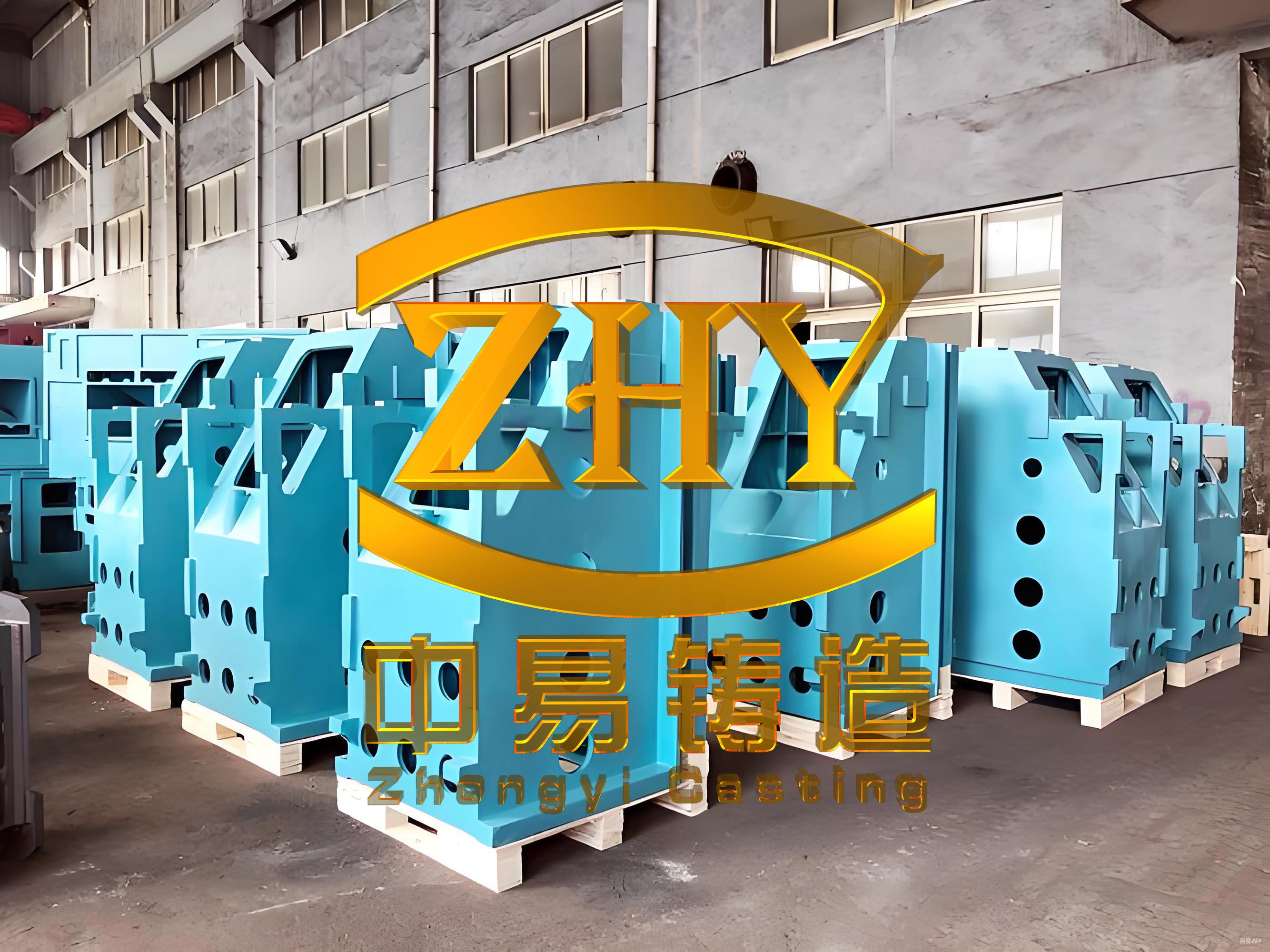
In conclusion, vermicular graphite iron represents a transformative material for machine tool castings, offering an optimal balance of wear resistance, rigidity, and damping capacity. Its superior mechanical properties enable lightweight designs and enhanced precision retention, making it ideal for modern CNC systems and high-accuracy applications. The key to its broader implementation lies in educating machine tool designers about VGI’s advantages, fostering a shift from conventional gray iron. As industries pursue higher efficiency and sustainability, VGI stands out as a critical enabler for next-generation machine tool castings, ensuring long-term performance and reliability. Through continued research and collaboration, VGI can redefine standards in the casting industry, paving the way for innovative machine tool solutions.