
In modern manufacturing, the presence of residual stresses in components such as machine tool castings is a critical concern. These stresses arise during processes like casting, forging, and welding due to factors including mechanical forces, temperature fluctuations, and geometric constraints. Residual stresses can severely compromise the performance of machine tool castings by reducing mechanical strength, accelerating fatigue failure, promoting stress corrosion, and causing dimensional inaccuracies through deformation. Traditional methods to mitigate these issues, such as natural aging and heat aging, are often impractical—natural aging requires extended time periods, while heat aging is energy-intensive and costly. As a result, vibration aging has emerged as an efficient alternative, first adopted internationally in the 1970s and gaining traction in various industries since the 1980s. This article explores the application of vibration aging to machine tool castings from a first-person perspective, detailing the mechanisms, parameter selection, and economic benefits based on our factory’s experiences. We will incorporate formulas and tables to summarize key concepts, emphasizing the importance of process optimization for enhancing the stability and longevity of machine tool castings.
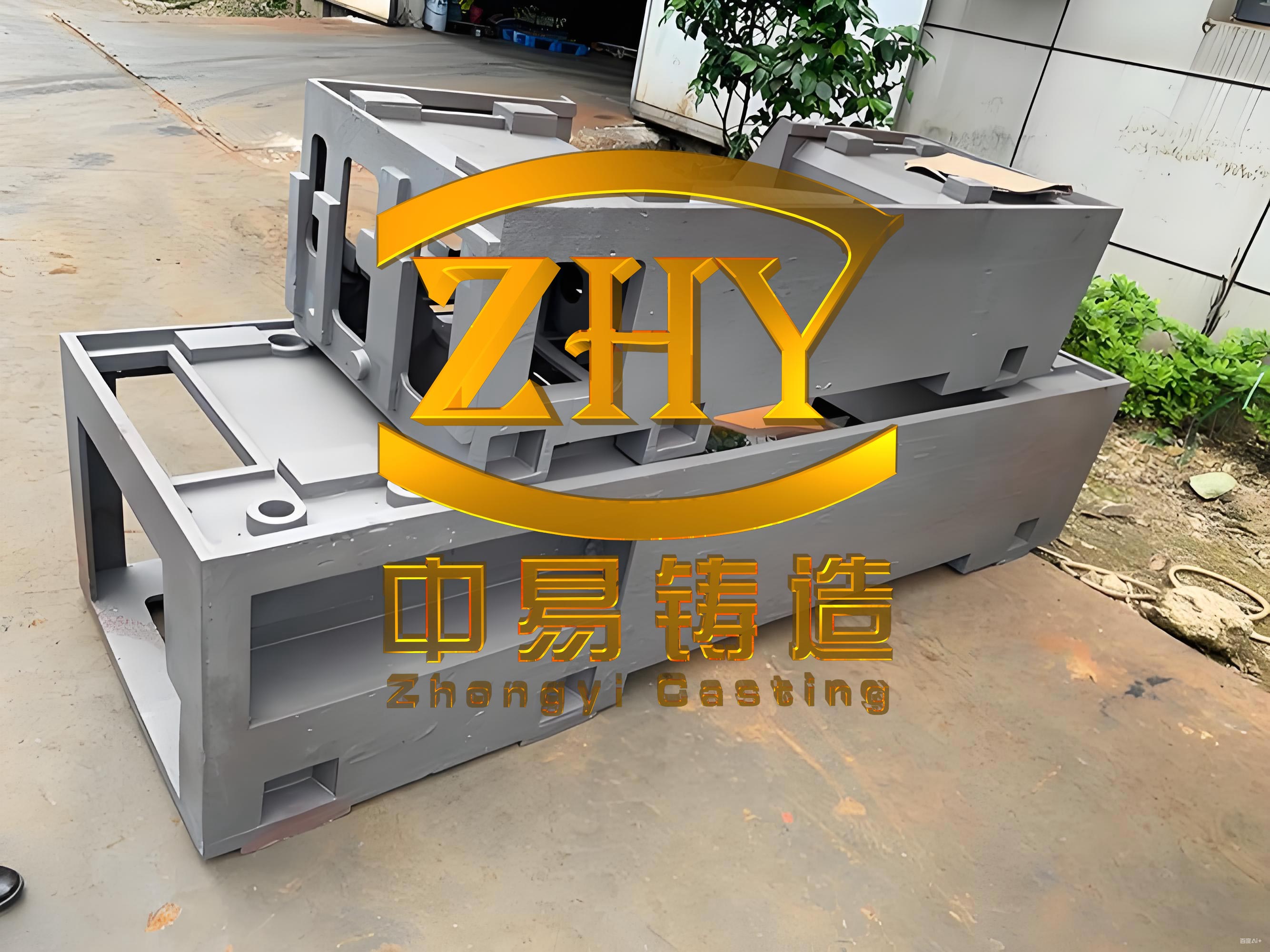
The fundamental mechanism of vibration aging involves subjecting a workpiece to resonant conditions using an exciter that generates periodic external forces. For machine tool castings, this process induces alternating stresses that superimpose with existing residual stresses, leading to localized yielding and micro-plastic deformation. This phenomenon reduces and redistributes residual stresses, thereby improving dimensional stability and resistance to external loads. The combined effect mirrors that of heat and natural aging but achieves it more efficiently. The stress superposition can be modeled mathematically. Let $\sigma_{\text{residual}}$ represent the residual stress in a machine tool casting, and $\sigma_{\text{dynamic}}$ denote the dynamic stress from vibration. The total stress $\sigma_{\text{total}}$ is given by:
$$\sigma_{\text{total}} = \sigma_{\text{residual}} + \sigma_{\text{dynamic}}$$
When $\sigma_{\text{total}}$ exceeds the material’s yield strength $\sigma_y$, plastic deformation occurs, effectively lowering residual stresses. This relationship highlights the importance of selecting appropriate dynamic stress levels for machine tool castings. Additionally, the vibration process enhances the relaxation stiffness of the casting, which can be expressed as an increase in the effective modulus $E_{\text{eff}}$ under cyclic loading:
$$E_{\text{eff}} = E_0 + \Delta E(\sigma, t)$$
where $E_0$ is the initial Young’s modulus, and $\Delta E$ represents the change due to stress relaxation over time $t$. Proper support of the workpiece is crucial; we use elastic materials like wood to position supports near nodal lines, minimizing noise and ensuring stable vibration. The exciter must be installed at the first-order natural frequency peak, typically at the midpoint of the casting, to maximize resonance effects. This approach has proven effective for various machine tool castings in our operations, particularly for guideway-type components that demand high precision.
Selecting the right equipment and parameters is essential for successful vibration aging of machine tool castings. In our factory, we employ a mechanical vibration aging device with a maximum frequency of 15000 rpm, which suffices for most geometries except spherical or cubic shapes. The device features microcomputer control for precise frequency stabilization and includes instrumentation for real-time monitoring. Key parameters include vibration frequency, dynamic stress, and processing time, which vary based on the specific machine tool casting. For instance, the resonance frequency $f_r$ for a workpiece can be approximated using the formula:
$$f_r = \frac{1}{2\pi} \sqrt{\frac{k}{m}}$$
where $k$ is the stiffness and $m$ is the mass of the machine tool casting. We adjust the exciter’s motor speed to achieve resonance in the sub-resonance region, ensuring optimal amplitude without causing damage. Dynamic stress selection follows the principle that higher values within the yield limit lead to better stress reduction. The eccentricity $e$ of the exciter’s wheel is modified to control dynamic stress, as shown in the equation for force $F$:
$$F = m_e \omega^2 e$$
where $m_e$ is the eccentric mass and $\omega$ is the angular velocity. This allows customization for different machine tool castings. Processing time is determined by monitoring changes in natural frequency and amplitude; typically, residual stress reduction stabilizes within 30 minutes for many components. The table below summarizes typical vibration parameters for a slide sleeve casting, a common machine tool casting in our inventory:
| Parameter | Value |
|---|---|
| Voltage (V) | 220 |
| Current (A) | 0.8 |
| Frequency (Hz) | 105 |
| Acceleration (m/s²) | 120 |
| Time (min) | 30 |
To evaluate the effectiveness of vibration aging for machine tool castings, we conducted comparative studies using magnetic stress measurements. The results indicate that both vibration aging and heat aging reduce residual stresses, with heat aging showing slightly superior stress reduction. However, vibration aging excels in minimizing deformation over time. For example, the deformation data for slide sleeve castings—a type of machine tool casting—are presented in the following table, which compares unaged, heat-aged, and vibration-aged components over one-month and six-month periods:
| Treatment Type | Max Deformation in One Month (mm) | Cumulative Max Deformation in Six Months (mm) |
|---|---|---|
| Unaged | 0.15 | 0.90 |
| Heat Aging | 0.08 | 0.45 |
| Vibration Aging | 0.07 | 0.40 |
This data demonstrates that vibration aging provides comparable or slightly better dimensional stability than heat aging for machine tool castings, with deformation reduced by approximately half compared to unaged components. The stress reduction efficiency $\eta$ can be quantified as:
$$\eta = \frac{\sigma_{\text{initial}} – \sigma_{\text{final}}}{\sigma_{\text{initial}}} \times 100\%$$
where $\sigma_{\text{initial}}$ and $\sigma_{\text{final}}$ are the residual stresses before and after treatment. In our tests, vibration aging achieved $\eta$ values of 40-60% for various machine tool castings, underscoring its efficacy.
The economic advantages of vibration aging for machine tool castings are substantial. Firstly, the initial investment is low; our vibration equipment cost a fraction of what a traditional annealing furnace would require. Secondly, energy consumption is drastically reduced—vibration aging uses a 180W DC motor, whereas heat aging might demand over 100 kW of power, resulting in energy savings exceeding 90%. This aligns with global sustainability goals and reduces operational costs. Thirdly, the process is highly efficient, with cycles completed in about 30 minutes compared to several days for heat aging, thus increasing throughput for machine tool castings production. The overall cost-benefit analysis can be represented by the formula for total savings $S$:
$$S = C_{\text{heat}} – C_{\text{vib}} + E_{\text{savings}} \times t$$
where $C_{\text{heat}}$ and $C_{\text{vib}}$ are the costs of heat and vibration aging, $E_{\text{savings}}$ is the energy savings per unit time, and $t$ is the operational period. For high-volume production of machine tool castings, these savings accumulate significantly.
In conclusion, vibration aging has proven to be a highly effective method for enhancing the performance of machine tool castings in our factory. It not only reduces residual stresses and improves dimensional stability but also offers remarkable economic benefits through lower costs and energy usage. The process involves careful parameter selection, such as frequency and dynamic stress, tailored to each machine tool casting. While it requires specific setups for different geometries, making it ideal for batch processing, the overall outcomes justify its adoption. We continue to refine our approaches for machine tool castings, leveraging vibration aging to achieve superior quality and efficiency in manufacturing. Future work may focus on optimizing parameters for complex shapes and integrating real-time feedback systems to further enhance the treatment of machine tool castings.