
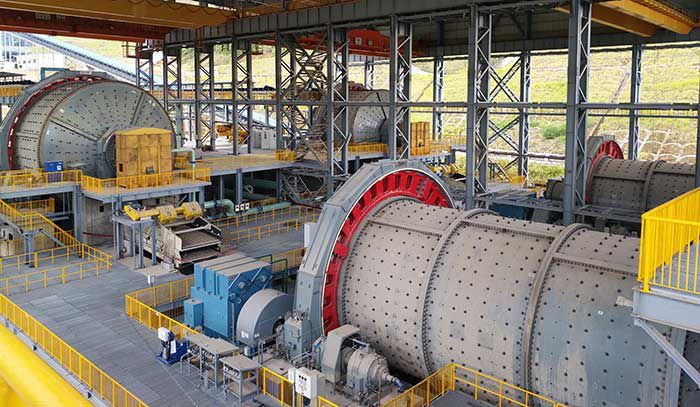
The ball mill serves as critical energy-intensive equipment in petrochemical, mining, metallurgical, and construction industries, enabling fine material processing after initial crushing. Global energy constraints and demands for diversified raw material processing amplify its significance. Traditional configurations suffer from mechanical transmission losses and maintenance challenges, achieving ≈82% efficiency. The emergence of permanent magnet direct-drive (PMDD) systems eliminates gears and couplings, boosting efficiency beyond 90% while enhancing reliability and spatial economy. However, integrated rotor-drum designs exacerbate mechanical complexities like eccentricity. The absence of stator-rotor support structures compromises air-gap uniformity, intensifying vibration risks in ball mill systems. This study investigates electromagnetic forces in PMDD ball mill motors through magnetic field simulations, modal analysis, and vibration assessments to mitigate operational instability.
Research Evolution in Ball Mill Technology
Historical ball mill designs relied on asynchronous motors coupled with gear reducers (Fig. 1), introducing vibration sources through meshing forces and alignment errors. Semi-direct-drive permanent magnet synchronous motors (PMSMs) later replaced reducers, improving efficiency yet retaining partial gearing vulnerabilities. France pioneered gearless ball mill technology in the 1960s, with ABB commercializing PMDD systems in 1992. PMDD PMSMs integrate low-speed high-torque rotors directly with drums, utilizing fractional-slot windings to minimize size and material use. Fritiz’s 1921 discovery linked radial electromagnetic forces to motor vibration. Subsequent scholars like S.J. Yang employed analytical methods, while Professor Zhu improved spatial force-wave modeling. Finite element analysis (FEA) now dominates precision research, as demonstrated by Professor Yu Shenbo’s field-circuit coupling models correlating current harmonics with radial force spatial orders and time frequencies. Vibration suppression strategies include:
- Winding optimization to cancel harmonic oscillations
- Rotor auxiliary slots or stepped skewing to disrupt force waves
- Air-gap adjustments and pole-slot matching to reduce mechanical excitation
Electromagnetic Force Dynamics
Current flow through stator windings generates magnetic fields interacting with rotor magnets, producing electromagnetic forces. Radial components dominate vibration excitation, particularly when force frequencies approach structural natural frequencies. Eccentricity—classified as static, dynamic, or mixed—distorts air-gap symmetry. Governing equations include:
Static Eccentricity Angular Velocity:
$$ \omega_s = 0 $$
Dynamic Eccentricity Angular Velocity:
$$ \omega_d = \omega_r $$
where $\omega_r$ = rotor rotational speed. Mixed eccentricity combines both effects. For a 210 kW PMSM ball mill motor, radial air-gap flux density ($B_r$) and electromagnetic force density ($F_r$) were simulated in ANSYS Maxwell under 0%, 5%, and 10% static eccentricity. Key harmonic components are compared below:
| Harmonic Order | 0% Eccentricity | 5% Eccentricity | 10% Eccentricity |
|---|---|---|---|
| 3 | 0.055 | 0.061 | 0.067 |
| 5 | 0.047 | 0.059 | 0.062 |
| 7 | 0.035 | 0.036 | 0.038 |
| 9 | 0.048 | 0.047 | 0.049 |
| 11 | 0.018 | 0.041 | 0.064 |
| Harmonic Order | 0% Eccentricity | 5% Eccentricity | 10% Eccentricity |
|---|---|---|---|
| 2 | 0.00026 | 0.0028 | 0.1081 |
| 4 | 0.00047 | 0.1576 | 0.0015 |
| 6 | 0.00038 | 0.3318 | 0.1635 |
| 8 | 0.00027 | 0.0013 | 0.5534 |
| 10 | 0.00036 | 0.3009 | 0.0541 |
Eccentricity excites even-order harmonics absent in symmetric conditions. Radial force density spectra (Fig. 6–8) reveal dominant 2× electrical frequency (2f) components, amplifying with eccentricity severity:
$$ F_r \propto B_r^2 $$
Dynamic eccentricity induces pronounced 4th, 6th, and 8th harmonics (Fig. 10), while mixed eccentricity combines static/dynamic force signatures (Fig. 12–13), with peak amplitudes at 2f.
Modal and Vibration Response
Stator and rotor modal frequencies were simulated in ANSYS Workbench to avoid resonance with electromagnetic force waves. Natural frequencies ($f_n$) for circumferential modes follow:
$$ f_n = \frac{1}{2\pi} \sqrt{\frac{k_n}{m}} $$
where $k_n$ = modal stiffness and $m$ = component mass. Results confirm sufficient separation (>10%) between structural modes and dominant 2f excitations (50–100 Hz range):
| Mode Order | Stator Frequency (Hz) | Rotor Frequency (Hz) | Separation (%) |
|---|---|---|---|
| 2 | 721.32 | 496.47 | 31 |
| 3 | 524.35 | 634.78 | 24 |
| 4 | 949.78 | 816.54 | 15 |
| 5 | 1178.54 | 954.56 | 18 |
Vibration accelerations along orthogonal axes (X,Y,Z) were assessed under static eccentricity (Fig. 16–18). Acceleration magnitudes scale nonlinearly with eccentricity, exhibiting axis-dependent sensitivity:
| Eccentricity | X-axis | Y-axis | Z-axis |
|---|---|---|---|
| 0% | 0.12 | 0.08 | 0.15 |
| 5% | 0.35 | 0.27 | 0.42 |
| 10% | 0.81 | 0.63 | 0.97 |
Mixed eccentricity induces highest accelerations, followed by dynamic and static types. Dominant spectral peaks correlate with 2f, 4f, and 6f electromagnetic force components.
Conclusions
This work establishes a vibration analysis framework for PMDD ball mill systems through electromagnetic-structural simulations. Key findings include:
- Eccentricity (>5%) significantly amplifies even-order air-gap flux harmonics (2nd, 4th, 6th) and radial force densities, peaking at twice electrical frequency (2f).
- Modal analysis confirms avoidance of resonance between dominant electromagnetic excitations (50–100 Hz) and structural natural frequencies (>496 Hz).
- Vibration accelerations increase nonlinearly with eccentricity severity, with mixed eccentricity causing highest amplitudes.
For ball mill stability, designers should prioritize: 1) Manufacturing tolerances to minimize inherent eccentricity, 2) Stiffened support structures to maintain air-gap uniformity, and 3) Force-harmonic suppression via pole-slot optimization. This methodology provides a foundation for enhancing ball mill reliability while reducing energy consumption and mechanical failures.