
The pursuit of advanced engineering materials that combine superior mechanical properties with economic viability is a constant driver in modern manufacturing. Among these, spheroidal graphite iron, commonly known as ductile iron, stands out for its excellent castability, good machinability, and favorable balance of strength and ductility derived from its unique microstructure featuring spherical graphite nodules embedded within a metallic matrix. Traditionally, the attainment of high strength (e.g., 800 MPa tensile strength) in spheroidal graphite iron often came at the expense of ductility, requiring subsequent heat treatments like quenching and tempering or austempering. These processes, while effective, add significant cost, energy consumption, and environmental footprint. Consequently, developing a grade of spheroidal graphite iron that achieves a high-strength, high-toughness combination directly in the as-cast state presents a compelling technological and economic advantage. This work focuses on the development and, critically, the systematic evaluation of the sliding wear resistance of such an as-cast, high-performance spheroidal graphite iron, designated as QT800-5, under varying tribological conditions.
Material Design and Processing of As-Cast Spheroidal Graphite Iron
The foundation for achieving high performance in the as-cast state lies in precise compositional design and rigorous processing control. The target was to produce a spheroidal graphite iron with a tensile strength exceeding 800 MPa and an elongation over 5% without any post-casting heat treatment. This was accomplished through a multi-pronged strategy of composite alloying and intensified inoculation.
The base chemical composition was carefully formulated. A high carbon equivalent promotes graphitization but must be balanced against the risk of carbide formation. Silicon is a potent graphitizer and ferrite strengthener. Key to the strategy was the addition of multiple alloying elements—copper (Cu), nickel (Ni), molybdenum (Mo), and tin (Sn)—each playing a specific role. Copper and nickel promote pearlite formation, solid-solution strengthen the matrix, and improve hardenability without adversely affecting graphitization. Molybdenum is a strong carbide former and refines the pearlite lamellar spacing, significantly enhancing strength. Tin is an extremely potent pearlite promoter, but its addition must be meticulously controlled to minute levels (below 0.025%) to avoid embrittlement. The synergy of these elements allows for the stabilization of a fine, strong matrix.
| Element | Content (wt.%) |
|---|---|
| C | 3.4 – 3.8 |
| Si | 2.3 – 2.8 |
| Mn | < 0.3 |
| P | < 0.04 |
| S | < 0.02 |
| Cu | 0.5 – 1.2 |
| Ni | 0.5 – 1.0 |
| Mo | < 0.25 |
| Sn | < 0.025 |
| Fe | Balance |
The melting was conducted in a medium-frequency induction furnace using high-purity raw materials. After superheating to approximately 1600°C and holding, the treatment process was critical. A preliminary inoculation was performed in the ladle. This was followed by a wire-feeding method for simultaneous nodularization and inoculation, ensuring a high nodule count and spherical shape. A second inoculation in the transfer ladle and a final stream inoculation during pouring constituted the intensified inoculation practice, crucial for achieving a fine and uniform microstructure with a high nodule count, which contributes to both strength and toughness through the “crack-arresting” effect of the graphite nodules.
Microstructural and Mechanical Characterization
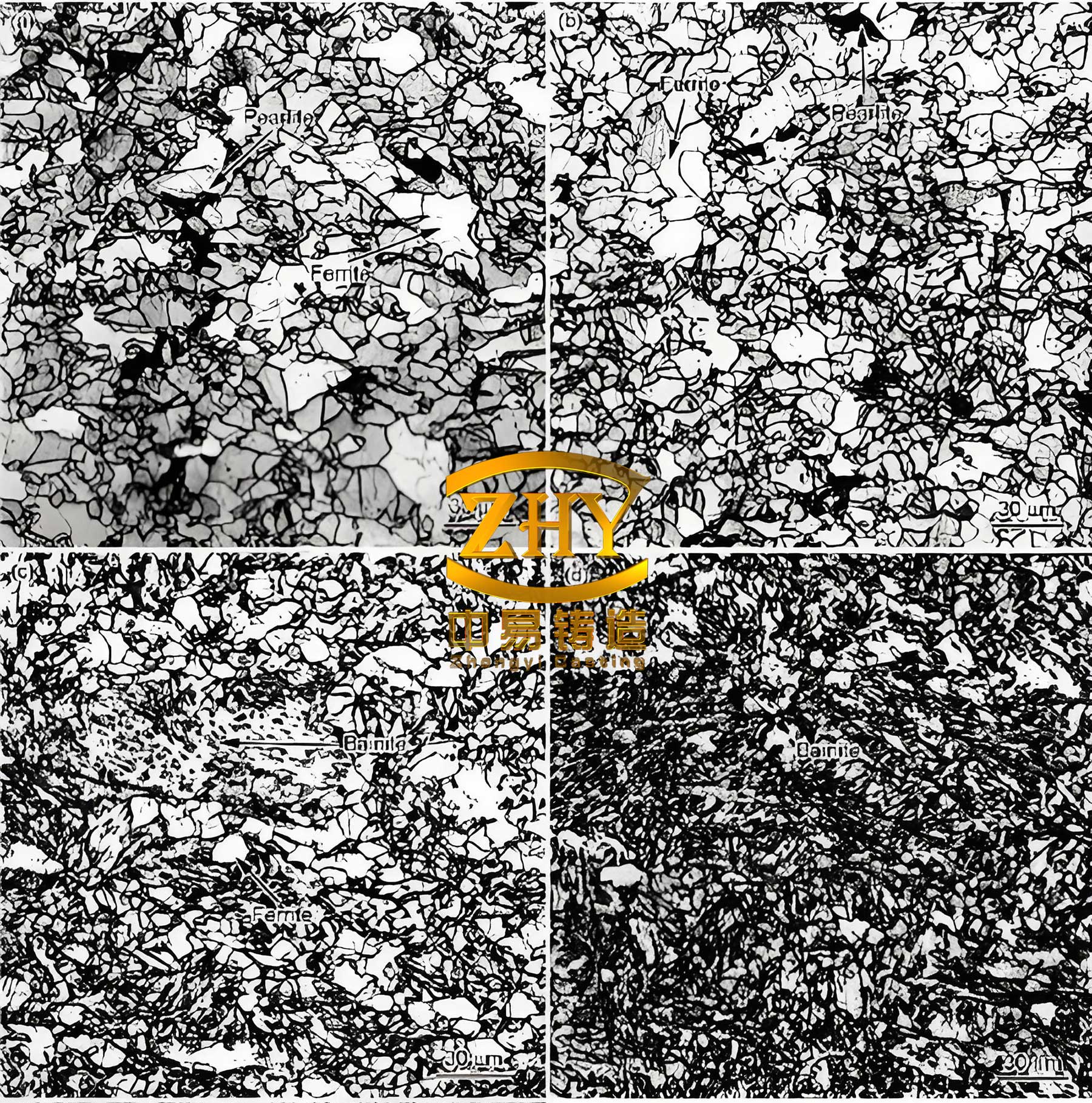
The resultant microstructure of this engineered spheroidal graphite iron is exemplary. The graphite morphology is characterized by well-formed, spherical nodules with a high nodularity rating exceeding 92%. The average nodule diameter was refined to approximately 15.3 µm, with a nodule count as high as 420 nodules per mm². This fine and populous graphite structure is beneficial for mechanical properties. The matrix is predominantly pearlitic, with a measured pearlite content of around 88%, complemented by approximately 12% ferrite. Notably, the interlamellar spacing within the pearlite colonies is very fine, measured at about 0.28 µm. This fine spacing is a direct consequence of the molybdenum addition and rapid cooling, contributing substantially to the strength of the material.
The mechanical properties, summarized in the table below, confirm the success of the design. The as-cast spheroidal graphite iron meets the QT800-5 grade specification, exhibiting high strength coupled with appreciable ductility. This property profile is attributed to the optimized pearlite/ferrite ratio, solid-solution strengthening from alloying elements (Si, Cu, Ni, Mo), and grain refinement from the intense inoculation.
| Property | Value |
|---|---|
| Tensile Strength (Rm) | 843 MPa |
| Yield Strength (Rp0.2) | 577 MPa |
| Elongation (A) | 6.3 % |
| Hardness | 263 HB |
Systematic Investigation of Sliding Wear Behavior
The wear resistance of this advanced as-cast spheroidal graphite iron was evaluated using a ball-on-disk configuration on a high-temperature tribometer. An Al2O3 ball (6 mm diameter) served as the counterface. The tests were conducted under dry sliding conditions, systematically varying three key parameters: normal load, sliding speed, and ambient temperature. The wear volume loss was calculated from the measured wear track dimensions, and the wear rate (W) was determined using the standard formula:
$$ W = \frac{V}{L} $$
where \( V \) is the wear volume in mm³ and \( L \) is the total sliding distance in meters. Wear mechanisms were elucidated through detailed examination of the wear tracks using scanning electron microscopy (SEM) and 3D optical profilometry.
Effect of Normal Load
The influence of applied normal load (5 N to 20 N) on the wear rate of the spheroidal graphite iron was studied at room temperature and a constant sliding speed. The results, plotted and tabulated below, show a clear trend of increasing wear rate with increasing load.
| Normal Load (N) | Wear Rate (×10⁻⁶ mm³/m) |
|---|---|
| 5 | ~4.5 |
| 10 | ~6.8 |
| 15 | ~8.1 |
| 20 | 16.25 |
The increase is particularly pronounced between 15 N and 20 N, where the wear rate nearly doubles. The initial contact stress for a spherical contact can be estimated using the Hertzian contact theory:
$$ \sigma_{max} = 0.388 \sqrt[3]{P E^{*2}} $$
and the relative displacement (approach) is given by:
$$ \delta = 1.231 \sqrt[3]{\frac{P^2}{E^{*2} R}} $$
where \( P \) is the normal load, \( R \) is the ball radius, and \( E^{*} \) is the reduced elastic modulus. Despite the high calculated contact stresses (e.g., ~1.57 GPa at 20 N), the wear rates remain in the mild wear regime for loads up to 15 N, showcasing the good inherent wear resistance of this spheroidal graphite iron. SEM analysis revealed that at lower loads (5-10 N), the wear track was relatively smooth with minor adhesive pits and short grooves. The graphite nodules within the track remained largely intact. At higher loads (15-20 N), adhesive material transfer became more severe, leading to larger and more numerous delamination pits and significant deformation of the graphite nodules. The primary wear mechanism under varying normal load is identified as adhesive wear.
Effect of Sliding Speed
The sliding speed was varied from 0.1 m/s to 0.4 m/s under a constant normal load of 15 N at room temperature. The wear rate showed a general increasing trend with speed.
| Sliding Speed (m/s) | Wear Rate (×10⁻⁶ mm³/m) |
|---|---|
| 0.1 | ~7.5 |
| 0.2 | ~8.1 |
| 0.3 | ~12.9 |
| 0.4 | 19.23 |
The most significant jump occurred between 0.2 m/s and 0.3 m/s. At the lowest speed (0.1 m/s), the wear surface exhibited clear grooves and pits. As speed increased to 0.3 m/s, the surface appeared smoother but with more adhesive pits, and small patches of adhered material began to appear. At the highest speed of 0.4 m/s, extensive adhesive layers and oxidized regions were observed. The increase in frictional heating with sliding speed softens the near-surface material, reducing its shear strength and promoting adhesive transfer. Furthermore, the generation and compaction of fine wear debris can form tribo-layers that temporarily protect the surface. The wear mechanism transitions from primarily adhesive wear at lower speeds to a combination of adhesive wear and oxidative wear at higher speeds.
Effect of Ambient Temperature
Elevated ambient temperature (25°C to 100°C) had the most dramatic effect on the wear performance of the as-cast spheroidal graphite iron, tested at 15 N and 0.2 m/s.
| Ambient Temperature (°C) | Wear Rate (×10⁻⁶ mm³/m) |
|---|---|
| 25 | 7.27 |
| 50 | 32.77 |
| 100 | 55.54 |
The wear rate increased by an order of magnitude at 100°C compared to room temperature. This drastic reduction in wear resistance is attributed to the thermal softening of the metallic matrix, which lowers its hardness and strength. SEM micrographs at 50°C and 100°C revealed deep, coarse grooves, continuous delamination pits, and large, plateau-like adhesive/oxidative layers. At elevated temperatures, oxidation is accelerated. While oxide layers (primarily Fe2O3) can act as a protective glaze, their constant fracture and regeneration produce hard abrasive particles that plough into the softened surface. Therefore, the wear mechanism under elevated temperature is a complex interplay of severe adhesive wear, oxidative wear, and abrasive wear.
Comprehensive Wear Mechanism Analysis
The wear behavior of this high-performance spheroidal graphite iron can be synthesized based on the parametric study. The dominant mechanisms shift depending on the prevailing tribological condition, as conceptualized below:
1. Under Mechanical Load Dominance (Varying Normal Load & Speed at 25°C): The primary driver is the mechanical interaction at the asperity level. High contact pressure increases real contact area and adhesion. When the adhesive bonds are stronger than the cohesive strength of the near-surface material, shearing occurs within the softer counterpart (the spheroidal graphite iron), leading to material transfer and the formation of adhesive pits or delamination cracks under cyclic loading. The wear rate follows a relationship often modeled as proportional to the load and sliding distance, though the sharp increase beyond a critical load (15 N in this case) suggests a transition in the severity of adhesive interaction.
2. Under Thermo-Mechanical Dominance (Elevated Ambient Temperature): Here, thermal effects override purely mechanical ones. The combined effect of frictional heating and elevated ambient temperature significantly reduces the flow stress of the material. This thermal softening exacerbates adhesive wear. Concurrently, high temperatures promote rapid oxidation of the fresh metallic surfaces exposed by wear. The formation, fracture, and re-formation of brittle oxide layers introduce a third-body abrasion component. The wear rate in this regime increases exponentially with temperature, described roughly by an Arrhenius-type relationship where wear is a function of thermally activated processes like oxidation and diffusion-assisted adhesion.
$$ W \propto \exp\left(-\frac{Q}{RT}\right) $$
where \( Q \) is an apparent activation energy for the wear process, \( R \) is the gas constant, and \( T \) is the absolute temperature.
In all conditions, the graphite nodules play a dual role. They can act as solid lubricants when smeared onto the surface, potentially reducing friction and wear. However, under severe conditions, they can be sites for crack initiation or be plucked out, contributing to material loss.
Conclusions
This investigation successfully demonstrates the development and tribological assessment of a high-strength, high-toughness grade of spheroidal graphite iron achieved directly in the as-cast state through composite alloying and intensified inoculation. The material exhibits a fine microstructure of spherical graphite in a matrix of fine pearlite with some ferrite, delivering a tensile strength of 843 MPa and 6.3% elongation.
The sliding wear resistance of this as-cast spheroidal graphite iron is highly condition-dependent. It shows excellent wear performance under mild conditions—specifically at room temperature (25°C) with relatively low normal loads (≤15 N) and sliding speeds (≤0.2 m/s), where wear rates are minimal. The primary wear mechanism under these mechanically-dominated conditions is adhesive wear.
However, wear resistance degrades significantly with increasing severity of tribological parameters. Higher sliding speeds promote adhesive and oxidative wear due to frictional heating. Elevated ambient temperature has the most detrimental effect, causing an order-of-magnitude increase in wear rate due to matrix softening, which leads to a complex wear mechanism involving severe adhesion, oxidation, and abrasion.
These findings provide crucial design guidelines for the application of this advanced as-cast spheroidal graphite iron. It is optimally suited for components operating under moderate mechanical and thermal loads where its combination of high strength, good toughness, and good wear resistance can be fully utilized, offering a cost-effective and sustainable alternative to heat-treated grades.