
The service life and reliability of excavator hinge components are critically dependent on the performance of their sleeve bearings. Operating in harsh, abrasive environments with significant dynamic and shock loads, these sleeves require a unique combination of high strength, exceptional wear resistance, and good toughness. Traditional materials, such as quenched carbon steels, often exhibit premature failure through mechanisms like adhesive wear and surface spalling, leading to frequent maintenance downtime and increased operational costs. This analysis explores the application of advanced spheroidal graphite cast iron, specifically austempered ductile iron (ADI), processed via centrifugal casting, as a superior alternative for such demanding applications. The focus is on elucidating the microstructure-property relationships that confer outstanding friction and wear characteristics, including a pronounced self-lubricating effect.
1. Introduction to Material and Process Selection
The quest for improved durability in construction machinery components has driven the exploration of advanced ferrous alloys. Spheroidal graphite cast iron, renowned for its castability and good mechanical properties, serves as an excellent base material. Its potential, however, is fully unlocked through a specific heat treatment known as austempering. The resulting material, Austempered Ductile Iron (ADI), possesses a microstructure that imparts an exceptional balance of strength and ductility, often surpassing that of many forged or cast steels. For cylindrical components like sleeves, centrifugal casting is the optimal forming technique. It ensures a dense, homogeneous casting free from shrinkage defects and promotes a uniform distribution of the spheroidal graphite particles, which is fundamental to achieving consistent properties. This combination—centrifugal casting of spheroidal graphite cast iron followed by austempering—forms the core of this investigation into producing high-performance excavator sleeves.
2. Material Preparation and Processing Methodology
The foundation of high-performance ADI components lies in precise control over composition and processing. The chemical composition of the spheroidal graphite cast iron used in this study is designed to facilitate both sound casting and subsequent heat treatment.
| Element | C | Si | Mn | Cu | S | P | Fe |
|---|---|---|---|---|---|---|---|
| Content (wt.%) | 3.5 | 1.9 | 0.9 | 0.5 | <0.04 | <0.04 | Bal. |
Copper (Cu) plays a multifaceted role: it enhances the hardenability of the spheroidal graphite cast iron, refines the matrix structure after heat treatment, and improves the stability of the austenite phase during the austempering process. The manufacturing sequence involved:
- Melting and Treatment: The iron was melted in a medium-frequency induction furnace. After reaching a superheat temperature, it was transferred to a pre-heated ladle where nodularization (using a rare-earth magnesium alloy) and inoculation (using ferrosilicon) were performed to ensure a high nodule count and count of spherical graphite particles in the final spheroidal graphite cast iron.
- Centrifugal Casting: The treated molten metal was poured into a rotating cylindrical mold. The centrifugal force ($F_c = m \omega^2 r$) pushes the denser metal against the mold wall while concentrating less dense impurities and gases towards the inner bore, which is later machined away. This yields a sleeve preform with exceptional density and structural integrity. The process parameters—mold rotation speed, pouring temperature, and cooling rate—were carefully controlled.
- Austempering Heat Treatment: The cast sleeves underwent a two-stage thermal cycle:
- Austenitization: Heating to 900°C and holding to achieve a fully austenitic matrix saturated with carbon ($\gamma$-Fe(C)).
- Austempering: Rapid quenching into a salt bath maintained at 260°C, followed by an isothermal hold for 100 minutes. During this hold, the carbon-saturated austenite ($\gamma_{high-C}$) transforms into acicular ferrite (α) and high-carbon retained austenite ($\gamma_{stable}$) in a reaction often simplified as: $$\gamma_{high-C} \rightarrow \alpha + \gamma_{stable}$$
3. Mechanical Properties of the Austempered Spheroidal Graphite Cast Iron
The austempering treatment dramatically enhances the mechanical properties of the base spheroidal graphite cast iron. The results from standardized tests on multiple specimens are summarized below:
| Specimen | Tensile Strength (MPa) | Reduction of Area (%) | Hardness (HRC) |
|---|---|---|---|
| 1 | 1150 | 0.61 | 52 |
| 2 | 1068 | 0.44 | 54 |
| 3 | 1123 | 0.58 | 57 |
| 4 | 1053 | 0.38 | 49 |
| 5 | 1169 | 0.55 | 55 |
| 6 | 1034 | 0.47 | 50 |
| Average Values: ~1099 MPa, ~0.5%, ~52.8 HRC | |||
The high tensile strength (exceeding 1 GPa) combined with a measurable, albeit low, ductility and a high bulk hardness indicates a material capable of resisting deformation under load. This property set forms the foundation for good wear resistance, as hardness often correlates with a material’s ability to resist abrasive penetration. However, the unique wear behavior of this austempered spheroidal graphite cast iron stems from its specific microstructure, not just its bulk hardness.
4. Microstructural Characterization and Its Significance
The superior properties are a direct consequence of the microstructure developed during the austempering of the spheroidal graphite cast iron. Microscopic examination reveals a complex, multi-phase matrix:
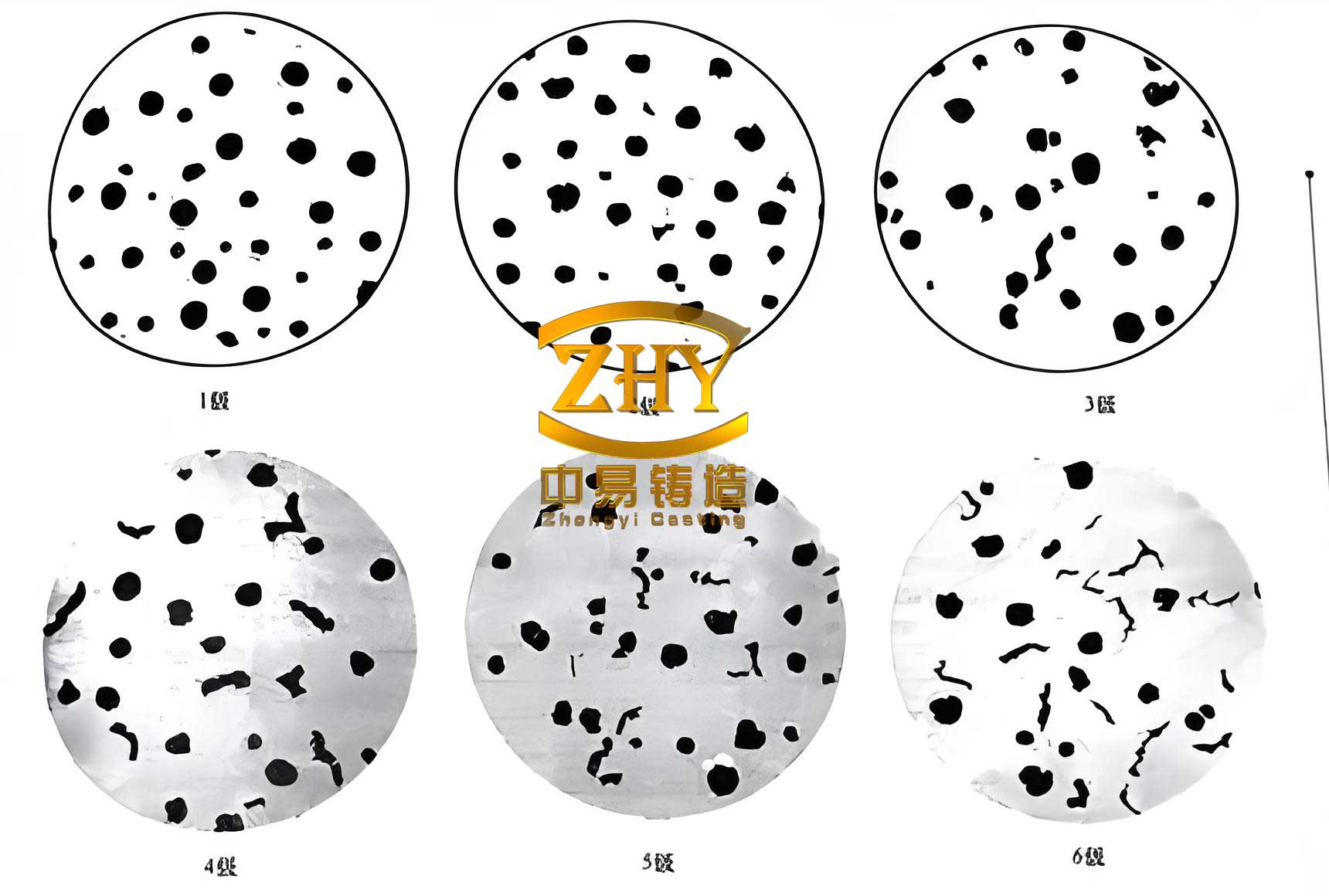
- Spheroidal Graphite: Well-dispersed, nearly spherical graphite nodules are the hallmark of this spheroidal graphite cast iron. Their uniform distribution, a result of effective inoculation and centrifugal casting, is critical. These nodules act as natural reservoirs for solid lubrication and sites for stress concentration relief.
- Acicular Ferrite (Lower Bainite): The matrix is predominantly composed of fine, needle-like crystals of ferrite. This bainitic structure provides high strength and good toughness. The fine scale of these needles impedes dislocation movement, contributing to the material’s strength.
- Retained Austenite ($\gamma_{stable}$): A significant volume fraction of carbon-stabilized austenite is interlaced with the bainitic ferrite. This phase is metastable and possesses high toughness. Its presence is a key differentiator between ADI and conventional quenched steels.
- Minor Constituents: Small amounts of martensite or other transformation products may be present depending on the precise cooling path.
The synergy between these phases defines the material’s behavior. The hard bainitic matrix resists deformation, while the softer, ductile retained austenite can absorb energy and undergo strain-induced transformation. The graphite nodules play a pivotal role in the tribological performance of this spheroidal graphite cast iron.
5. Friction and Wear Performance Analysis
The wear resistance of the austempered spheroidal graphite cast iron was evaluated under both dry sliding and oil-lubricated conditions, with normalized 45 steel as a benchmark. The friction coefficient ($\mu$) was monitored over time, and the specific wear rate was calculated from mass loss measurements.
5.1 Friction Behavior
The evolution of the friction coefficient reveals fundamental differences in tribological mechanisms. Under dry sliding:
- 45 Steel: Exhibited a high and unstable friction coefficient, averaging approximately $\mu_{dry,45} \approx 0.58$. This is characteristic of severe metallic contact and adhesive wear.
- Austempered Spheroidal Graphite Cast Iron (ADI): Showed a significantly lower and more stable friction coefficient, averaging $\mu_{dry,ADI} \approx 0.38$. This represents a reduction of about 35% compared to the steel.
Under oil-lubricated conditions, the benefit was even more dramatic:
- 45 Steel: The friction coefficient reduced to $\mu_{oil,45} \approx 0.45$, indicating boundary lubrication where metal-to-metal contact still occurs.
- Austempered Spheroidal Graphite Cast Iron (ADI): Achieved an exceptionally low friction coefficient of $\mu_{oil,ADI} \approx 0.12$, indicative of a much more effective mixed or hydrodynamic lubrication regime. This is roughly one-quarter of the friction of the lubricated steel.
The drastic reduction in friction for the ADI, especially under lubrication, points to mechanisms beyond simple surface hardness.
5.2 Wear Rate Quantification
The wear performance was quantified by measuring the mass loss and calculating a wear rate. The results starkly contrast the two materials.
| Condition | Material | Initial Mass (mg) | Final Mass (mg) | Wear Rate (Mass Loss %) |
|---|---|---|---|---|
| Dry Sliding | 45 Steel | 3218 | 2516 | 21.8% |
| Austempered S.G. Iron | 3235 | 3119 | 3.59% | |
| Oil Lubricated | 45 Steel | 3241 | 2951 | 8.95% |
| Austempered S.G. Iron | 3223 | 3141 | 0.82% |
These values can be related to the Archard wear equation: $$ V = K \frac{N \cdot s}{H} $$ where $V$ is the wear volume, $K$ is the wear coefficient, $N$ is the normal load, $s$ is the sliding distance, and $H$ is the hardness. While both materials have high hardness, the wear coefficient $K$ for the austempered spheroidal graphite cast iron is orders of magnitude lower due to its unique wear mechanisms. In dry conditions, the ADI’s wear was only about 1/6th that of the steel. Under lubrication, its wear was reduced to less than 1/10th, demonstrating an extraordinary synergy between the material’s inherent structure and the lubricant.
6. Mechanisms of Enhanced Wear Resistance and Self-Lubrication
The exceptional tribological performance of the centrifugally cast and austempered spheroidal graphite cast iron can be attributed to several interconnected mechanisms:
6.1 The Self-Lubricating Effect of Graphite
This is the most distinctive feature. During sliding contact, the spheroidal graphite nodules at or near the surface can be smeared out or released as discrete particles. Graphite, with its layered hexagonal crystal structure, has very low shear strength between its basal planes. These free graphite particles interpose themselves between the sliding surfaces, acting as a solid lubricant film. This drastically reduces adhesive metal-to-metal contact, lowers the friction coefficient, and minimizes wear. The effectiveness of this mechanism is amplified in the spheroidal graphite cast iron because the centrifugal casting process ensures a high and uniform population of these lubricant reservoirs throughout the sleeve wall.
6.2 In-Situ Surface Hardening (Transformation-Induced Plasticity)
The metastable retained austenite in the ADI microstructure plays a crucial role. Under the localized high stresses and strains at the asperity contacts of the wearing surface, this austenite can transform into hard, strain-induced martensite. This leads to the formation of a work-hardened “shell” or “white layer” on the surface. The hardness of this layer ($H_{surface}$) can exceed the original bulk hardness ($H_{bulk}$), providing exceptional resistance to further deformation and abrasion. This can be conceptually described as: $$ \gamma_{stable} \xrightarrow[\text{Strain}]{} \alpha’ (Martensite) $$ resulting in $H_{surface} > H_{bulk}$.
6.3 Synergy with Fluid Lubrication
Under oil-lubricated service, the benefits multiply. The cavities left behind by liberated graphite nodules act as micro-reservoirs that trap and retain lubricating oil. This ensures a continuous supply of lubricant to the contact interface, even under conditions that might otherwise starve it. Furthermore, the solid graphite film and the oil work in concert, establishing a highly effective mixed lubrication regime that drastically reduces both friction and wear. This explains the tenfold improvement in wear resistance over steel when oil is present.
6.4 Tough, Wear-Resistant Matrix
The fine, acicular lower bainite matrix provides a strong, tough background that supports the surface and resists plastic deformation and crack propagation. The good toughness prevents the brittle fracture and spalling commonly seen in overly hard, but brittle, materials. The combination of this tough matrix with the self-lubricating and surface-hardening features creates a wear-resistant system that is far more robust than any single mechanism alone.
7. Implications for Engineering Application
The transition from traditional quenched steel to centrifugally cast austempered spheroidal graphite cast iron for excavator sleeves represents a significant engineering advancement. The performance data indicates that ADI sleeves can withstand the severe service conditions—high loads, impact, abrasive dust, and intermittent lubrication—much more effectively. The dramatic reduction in wear rate translates directly into extended service intervals, reduced downtime for maintenance, and lower total cost of ownership. Furthermore, the self-lubricating characteristic provides a safety margin in cases of temporary lubricant failure, preventing catastrophic galling or seizure. The centrifugal casting process is well-suited for high-volume production of such symmetric parts, ensuring consistency and quality. Therefore, the implementation of austempered spheroidal graphite cast iron via centrifugal casting presents a viable and superior solution for enhancing the durability and reliability of pivotal connections in construction machinery and other heavy-duty applications.
8. Conclusion
This comprehensive analysis demonstrates that spheroidal graphite cast iron, when processed through the synergistic route of centrifugal casting followed by austempering heat treatment, evolves into a material (ADI) with exceptional suitability for high-wear components like excavator sleeves. The microstructure, comprising a fine lower bainitic ferrite matrix, a substantial amount of carbon-stabilized retained austenite, and uniformly dispersed spheroidal graphite nodules, is the source of its outstanding properties. The material exhibits high strength and hardness, providing a baseline resistance to deformation. Its standout feature is a multi-faceted wear resistance mechanism dominated by a powerful self-lubricating effect from the graphite, augmented by in-situ surface hardening via strain-induced transformation of retained austenite. Under both dry and lubricated sliding conditions, the austempered spheroidal graphite cast iron outperforms conventional 45 steel by a wide margin, showing significantly lower friction coefficients and wear rates. This combination of manufacturability, mechanical strength, and innate tribological advantages makes centrifugally cast and austempered spheroidal graphite cast iron a premier candidate for advancing the performance and longevity of critical wear parts in demanding industrial applications.