
In the field of construction machinery, particularly for excavators, the durability and performance of components such as sleeves are critical due to harsh operational environments. These sleeves, which connect pivotal points like the bucket, arm, and boom, endure significant loads, lateral compression, impacts, and wear. Traditionally, materials like carbon structural steels have been employed, but they often exhibit premature wear, leading to frequent maintenance and replacement cycles. This not only increases downtime but also escalates operational costs. To address these challenges, advanced materials and processing techniques are being explored. One promising candidate is austempered nodular cast iron, commonly referred to as ADI. This material, derived from nodular cast iron through a specific heat treatment process, offers a unique combination of high strength, excellent wear resistance, good toughness, and fatigue resistance. In this article, I will delve into the development and evaluation of centrifugally cast and austempered nodular cast iron sleeves, focusing on their microstructure, mechanical properties, and particularly their wear performance under various conditions. The goal is to demonstrate how this material can revolutionize the longevity and reliability of excavator components, paving the way for more efficient and cost-effective machinery.
The foundation of this study lies in the inherent properties of nodular cast iron. Nodular cast iron, also known as ductile iron, is characterized by its spheroidal graphite inclusions within a ferritic or pearlitic matrix. This structure imparts superior ductility and toughness compared to other cast irons. However, through austempering—a heat treatment involving austenitization followed by isothermal quenching—the matrix transforms into a fine mixture of bainitic ferrite and retained austenite. This microstructure, often referred to as ausferrite, is key to the enhanced performance of ADI. The process not only refines the grain structure but also introduces residual stresses that improve wear resistance. Moreover, the presence of graphite nodules provides self-lubricating properties, which can significantly reduce friction and wear in sliding applications. This makes nodular cast iron an ideal base material for components subjected to repetitive motion and high loads, such as sleeves in excavators.
To begin, let’s consider the material composition used in this study. The nodular cast iron was formulated with specific alloying elements to optimize its properties for centrifugal casting and subsequent austempering. The chemical composition is detailed in Table 1. Notably, copper was added to enhance density, promote graphite spheroidization, and improve overall mechanical performance. Copper also stabilizes austenite, facilitating the formation of bainite during heat treatment. Other elements like silicon and manganese were controlled to ensure proper casting fluidity and hardenability. This careful balance is crucial for achieving consistent results in industrial applications.
| Element | C | Si | Mn | Cu | S | P | Fe |
|---|---|---|---|---|---|---|---|
| Content | 3.5 | 1.9 | 0.9 | 0.5 | <0.04 | <0.04 | Bal. |
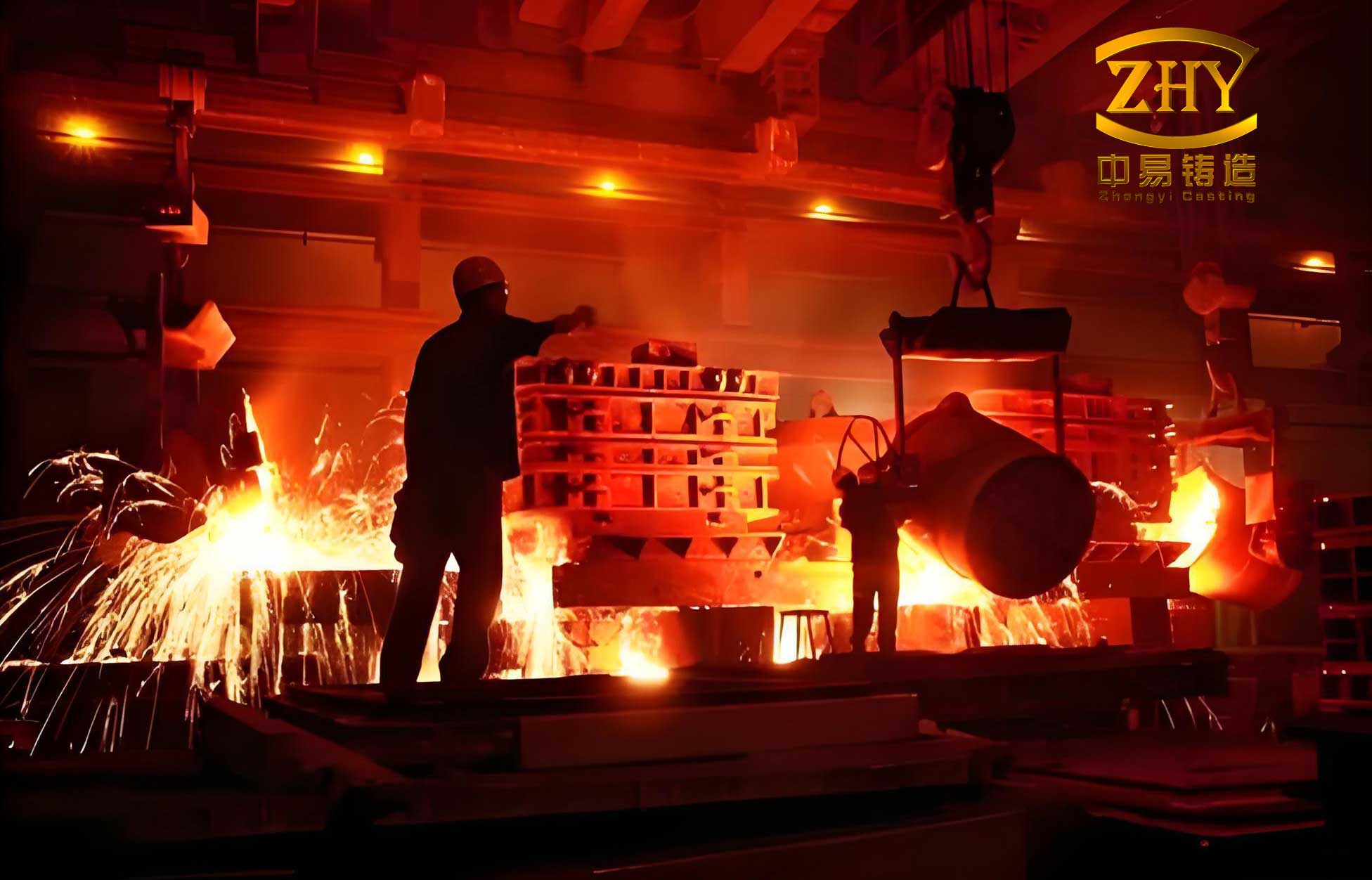
The manufacturing process involved centrifugal casting, which is highly suitable for producing cylindrical components like sleeves. Centrifugal casting utilizes rotational forces to distribute molten metal evenly against the mold wall, resulting in a dense, homogeneous structure with minimal porosity. For this study, the sleeves were designed with an outer diameter of 95 mm, inner diameter of 80 mm, and height of 70 mm. The casting was performed using a medium-frequency induction furnace, with the molten metal treated for nodularization and inoculation to ensure high graphite nodule count and sphericity. The pouring temperature was maintained between 1540°C and 1560°C, and the mold was preheated to over 500°C to prevent thermal shock. After casting, the sleeves were cooled with water spray to solidify the structure rapidly. This step is critical for preventing graphite degeneration and maintaining the desired microstructure. Following casting, the sleeves underwent machining to achieve precise dimensions before heat treatment.
The heat treatment process, known as austempering, was carried out to transform the as-cast microstructure into the superior ADI structure. The sleeves were first austenitized at 900°C for 1.5 hours to dissolve carbon and alloying elements into solid solution. They were then quenched into oil at 100°C to rapidly cool to the isothermal transformation temperature range of 230°C to 280°C. Subsequently, they were transferred to an isothermal furnace at 260°C and held for 100 minutes. This allowed for the formation of fine needle-like lower bainite, along with retained austenite and spherical graphite. The isothermal holding time was optimized based on prior studies to maximize the volume fraction of bainite while minimizing the formation of undesirable phases like martensite. After isothermal treatment, the sleeves were air-cooled to room temperature. This heat treatment cycle is essential for achieving the unique properties of nodular cast iron in its austempered state.
To evaluate the material, several tests were conducted. Microstructural analysis was performed using optical microscopy on polished and etched samples. The microstructure revealed a fine dispersion of spherical graphite nodules within a matrix of acicular bainite and retained austenite. The graphite nodules were uniformly distributed and exhibited high sphericity, which is indicative of effective nodularization during casting. The bainitic ferrite needles were ultrafine, contributing to high hardness and strength. Additionally, the retained austenite, which is thermodynamically stable at room temperature, provides ductility and toughness. This combination is what gives ADI its exceptional mechanical profile. The volume fractions of these phases can be estimated using image analysis software, but qualitatively, the structure appeared homogeneous and free of major defects.
Mechanical properties were assessed through tensile testing and hardness measurements. Six samples were extracted from different sleeves to ensure statistical reliability. The results are summarized in Table 2. The tensile strength averaged around 1099 MPa, with a range indicating consistent processing. The reduction of area, a measure of ductility, was relatively low at an average of 0.5%, which is typical for high-strength nodular cast iron due to its brittle matrix. However, the hardness values, measured on the Rockwell C scale, averaged 52.8 HRC, demonstrating significant surface resistance to indentation. This high hardness is directly linked to wear resistance, as harder materials tend to resist abrasive and adhesive wear better. The relationship between hardness and wear resistance can be expressed by an empirical formula: $$ \text{Wear Resistance} \propto H^n $$ where $H$ is hardness and $n$ is an exponent typically between 1 and 2 for many materials. For nodular cast iron, $n$ is often close to 1.5 due to its composite nature.
| Sample | Tensile Strength (MPa) | Reduction of Area (%) | Hardness (HRC) |
|---|---|---|---|
| 1 | 1150 | 0.61 | 52 |
| 2 | 1068 | 0.44 | 54 |
| 3 | 1123 | 0.58 | 57 |
| 4 | 1053 | 0.38 | 49 |
| 5 | 1169 | 0.55 | 55 |
| 6 | 1034 | 0.47 | 50 |
| Average | 1099.5 | 0.505 | 52.8 |
Wear performance was evaluated using a ball-on-disk tribometer under both dry and oil-lubricated conditions. The counter material was a GCr15 steel ball, and the tests were conducted at a load of 30 N, sliding speed of 10 mm/s, and total sliding distance calculated over 1800 seconds. The friction coefficient was recorded in real-time, and mass loss was measured post-test to calculate wear rate. For comparison, samples of 45 steel, a common material for sleeves, were tested under identical conditions. The results are presented in Table 3 and graphically in subsequent analysis. The friction coefficient trends showed that ADI had lower and more stable values compared to 45 steel, especially under lubrication. This can be attributed to the self-lubricating effect of graphite nodules in nodular cast iron. As wear progresses, graphite particles are released from the matrix and act as solid lubricants, reducing direct metal-to-metal contact.
| Condition | Material | Test Duration (h) | Load (N) | Initial Mass (mg) | Final Mass (mg) | Mass Loss (mg) | Wear Rate (%) |
|---|---|---|---|---|---|---|---|
| Dry Friction | ADI | 0.5 | 20 | 3235 | 3119 | 116 | 3.59 |
| Dry Friction | 45 Steel | 0.5 | 20 | 3218 | 2516 | 702 | 21.8 |
| Oil Lubrication | ADI | 0.5 | 20 | 3223 | 3141 | 82 | 0.82 |
| Oil Lubrication | 45 Steel | 0.5 | 20 | 3241 | 2951 | 290 | 8.95 |
The wear rate is defined as the percentage mass loss relative to the initial mass: $$ \text{Wear Rate} = \frac{m_i – m_f}{m_i} \times 100\% $$ where $m_i$ is initial mass and $m_f$ is final mass. For ADI under dry friction, the wear rate was 3.59%, significantly lower than 21.8% for 45 steel. Under oil lubrication, ADI’s wear rate dropped to 0.82%, while 45 steel’s was 8.95%. This dramatic improvement highlights the synergistic effect of lubrication and the inherent properties of nodular cast iron. The friction coefficient data, plotted over time, showed that ADI started with a lower coefficient and maintained stability, whereas 45 steel exhibited higher initial spikes and variability. The average friction coefficients are summarized in Table 4. These values reinforce the superiority of ADI in reducing frictional losses, which is crucial for energy efficiency in machinery.
| Condition | ADI Average Friction Coefficient | 45 Steel Average Friction Coefficient | Ratio (ADI/45 Steel) |
|---|---|---|---|
| Dry Friction | 0.38 | 0.58 | 0.66 |
| Oil Lubrication | 0.12 | 0.48 | 0.25 |
To understand the underlying mechanisms, let’s delve into the microstructural aspects during wear. The bainitic matrix of ADI provides high hardness and strength, resisting plastic deformation and abrasive wear. The retained austenite, under applied stress, can undergo strain-induced transformation to martensite, a phenomenon known as transformation-induced plasticity (TRIP). This results in surface hardening, often referred to as a “shell” effect, which further enhances wear resistance. The transformation can be described by the equation: $$ \gamma \rightarrow \alpha’ + \text{carbon} $$ where $\gamma$ is austenite and $\alpha’$ is martensite. This process absorbs energy and delays crack initiation. Additionally, the spherical graphite nodules play a dual role. First, they act as stress concentrators, but in a beneficial way by blunting crack tips due to their soft nature. Second, as mentioned, they provide lubrication. When graphite is exposed at the surface, it smears and forms a tribofilm that reduces friction. Under oil lubrication, this effect is amplified as oil penetrates the pores left by graphite detachment, creating a reservoir for continuous lubrication.
The centrifugal casting process itself contributes to the performance. By using rotational forces, the microstructure becomes more uniform, with fewer casting defects like shrinkage cavities or inclusions. This uniformity ensures consistent properties throughout the sleeve, which is vital for load-bearing applications. The density of the nodular cast iron can be calculated using the rule of mixtures, considering the phases present. For ADI, the approximate density is: $$ \rho_{\text{ADI}} = f_g \rho_g + f_b \rho_b + f_{\gamma} \rho_{\gamma} $$ where $f$ represents volume fraction and $\rho$ density for graphite ($g$), bainite ($b$), and retained austenite ($\gamma$). Typically, graphite has a lower density, so its presence reduces overall density but improves damping capacity. However, in wear applications, the key is the hardness-to-toughness balance, which ADI achieves excellently.
Comparing ADI to other materials, such as through-hardened steels or white cast irons, ADI offers a better combination of properties. For instance, white cast irons are very hard but brittle, leading to catastrophic failure under impact. ADI, with its nodular cast iron base, retains some ductility while achieving high hardness. This is quantified by the quality index often used for nodular cast iron: $$ Q = \frac{\sigma_u \cdot \delta}{100} $$ where $\sigma_u$ is tensile strength and $\delta$ is elongation. For ADI, $Q$ is relatively high due to the strength contribution from bainite and the ductility from retained austenite. In practical terms, this means sleeves made from ADI can withstand the dynamic loads in excavators without sudden fracture.
The economic implications are also significant. By extending service life from months to potentially years, maintenance intervals are reduced, lowering operational costs. The centrifugal casting process, while requiring initial investment, is scalable and efficient for mass production of cylindrical parts. Moreover, the heat treatment for nodular cast iron is less energy-intensive compared to forging or extensive machining of steels. The overall lifecycle cost of ADI sleeves is likely lower, making them an attractive alternative for construction machinery manufacturers.
Future research directions could include optimizing the alloy composition of nodular cast iron for even better wear resistance. For example, adding elements like nickel or molybdenum might enhance hardenability and stability of austenite. Additionally, surface engineering techniques like shot peening or coatings could be combined with ADI to further improve performance. Computational modeling, such as finite element analysis, could predict wear patterns and optimize sleeve geometry. The fundamental wear mechanisms in nodular cast iron deserve deeper study, particularly the role of graphite size and distribution. Equations like the Archard wear equation: $$ V = k \frac{F \cdot s}{H} $$ where $V$ is wear volume, $k$ is wear coefficient, $F$ is load, $s$ is sliding distance, and $H$ is hardness, can be calibrated for ADI to predict wear in service.
In conclusion, centrifugally cast and austempered nodular cast iron sleeves exhibit outstanding wear resistance and self-lubricating properties, making them superior to traditional materials like 45 steel for excavator applications. The fine microstructure of bainite and retained austenite, combined with spherical graphite, provides a unique combination of hardness, toughness, and low friction. Under both dry and lubricated conditions, ADI showed significantly lower wear rates and friction coefficients. This material not only meets but exceeds the performance requirements for heavy-duty sleeves, offering a promising solution to extend service life and reduce maintenance in construction machinery. The success of this study underscores the potential of nodular cast iron in advancing industrial components through innovative processing techniques.
To further quantify the benefits, let’s consider the wear volume per unit distance. Using the data from Table 3, the specific wear rate can be calculated as: $$ \text{Specific Wear Rate} = \frac{\Delta m}{\rho \cdot s} $$ where $\Delta m$ is mass loss, $\rho$ is density (approximately 7.1 g/cm³ for nodular cast iron), and $s$ is sliding distance (10 mm/s × 1800 s = 18,000 mm = 1800 cm). For ADI under dry friction: $$ \text{Specific Wear Rate} = \frac{0.116 \text{ g}}{7.1 \text{ g/cm³} \times 1800 \text{ cm}} \approx 9.1 \times 10^{-6} \text{ cm}^3/\text{cm} $$ This value is an order of magnitude lower than that for 45 steel, highlighting the efficiency of ADI. Such metrics are crucial for engineers designing durable components.
In summary, the integration of centrifugal casting and austempering for nodular cast iron results in a material paradigm shift for wear-resistant applications. The key takeaways are the enhanced microstructure, superior mechanical properties, and exceptional wear performance. As machinery continues to evolve towards higher efficiency and longer lifespan, materials like ADI will play a pivotal role. I encourage further exploration and adoption of this technology in various industrial sectors beyond construction, such as automotive, mining, and aerospace, where nodular cast iron can deliver similar benefits.