
In my extensive experience within the heavy machinery maintenance and repair sector, addressing metal casting defect issues is a frequent and critical task. One particularly challenging case involved the repair of a large gray cast iron plunger, which exhibited a significant metal casting defect due to poor fluidity during the casting process, leading to sand inclusion and porosity. This metal casting defect measured approximately 80 mm by 100 mm and was located centrally in the plunger body, posing substantial risks to structural integrity and functionality. The successful repair of such metal casting defect instances requires a deep understanding of material properties, welding metallurgy, and meticulous process control. This article details the methodology, analysis, and execution of the repair, emphasizing the use of advanced techniques to overcome the inherent difficulties associated with welding gray cast iron.
Gray cast iron, specifically grade HT200, is characterized by its high carbon content, typically ranging from 2.5% to 4.0%, and the presence of impurities such as sulfur and phosphorus. These factors contribute to its low tensile strength, negligible ductility, and poor weldability. The formation of brittle phases like cementite and the tendency to develop hard, unmachinable white iron structures in the heat-affected zone (HAZ) during welding are primary concerns. When a metal casting defect of substantial size is present, the welding process induces significant thermal stresses due to the restraint imposed by the massive casting body. The differential expansion and contraction can lead to cracking, particularly at the fusion line, potentially causing weld metal剥离. Therefore, any repair strategy must meticulously control heat input, minimize dilution, and manage residual stresses to restore the component without introducing new failures.
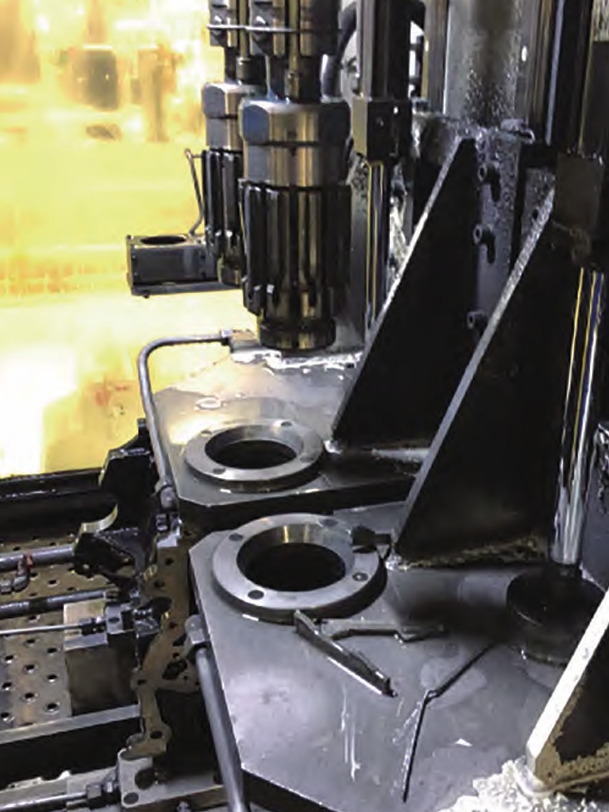
The initial step in addressing any metal casting defect is a thorough defect analysis. For the plunger, the defect was identified as a combination of sand inclusion and shrinkage porosity, common metal casting defect types resulting from inadequate molten metal flow or improper gating design. The location mid-body meant the repair zone would be subjected to complex stress states during welding. The high carbon equivalent (CE) of gray cast iron, calculated using the formula: $$CE = C + \frac{Si}{4} + \frac{P}{2}$$, often exceeds 4.3%, indicating severe susceptibility to cracking. For HT200, typical composition yields a CE above 4.0, underscoring the weldability challenge. The thermal cycle during welding can promote the formation of martensite and carbides in the HAZ, reducing toughness and impairing machinability. Thus, the repair objective was not merely to fill the cavity but to ensure the repaired zone could withstand operational loads and allow for subsequent machining, all while mitigating the risks associated with this metal casting defect.
To quantify the material challenges, the table below summarizes key properties of HT200 gray cast iron relevant to welding repair:
| Property | Value or Range | Implication for Welding |
|---|---|---|
| Carbon Content | 3.0 – 3.5% | High risk of carbide formation, low ductility |
| Tensile Strength | 200 MPa (min) | Low strength, prone to cracking under stress |
| Elongation | < 1% | Negligible plastic deformation capacity |
| Hardness (as-cast) | 180 – 220 HB | HAZ can become excessively hard (> 400 HB) |
| Cracking Susceptibility Index* | High | Requires strict preheat and post-heat control |
*A qualitative measure based on composition and section thickness.
Given these constraints, conventional hot welding (preheating the entire casting to 600-650°C) was impractical due to the plunger’s large mass (wall thickness ~35 mm) and the localized nature of the metal casting defect. Cold welding techniques, while avoiding bulk heating, risk rapid cooling and白口 formation. Therefore, a hybrid approach was adopted: the stud welding method combined with a nickel-base buttering layer followed by structural buildup using low-hydrogen steel electrodes. This strategy aimed to distribute welding stresses and provide a ductile buffer zone to accommodate the shrinkage strains inherent in repairing a metal casting defect.
Preparation is paramount in welding repair of any metal casting defect. The defective area was completely excavated using angle grinders until sound, clean metal with metallic luster was revealed. This ensured no residual inclusions or oxides remained, which could act as stress concentrators. Subsequently, an array of M10 low-carbon steel bolts was installed within the cavity. Holes were drilled and tapped at approximately 20 mm intervals, with a depth of 15 mm, and bolts were screwed in leaving 3-4 mm protruding above the base metal surface. This studding pattern creates a mechanical interlock, transferring a significant portion of the welding and service loads from the brittle cast iron to the more ductile steel studs, thereby reducing the propensity for weld metal剥离. The stud arrangement effectively transforms the repair into a composite structure, enhancing overall integrity when addressing a large metal casting defect.
The welding process was meticulously sequenced into six layers. The first two layers served as a buttering or transition layer using Z408 nickel-iron electrodes (AWS ENiFe-CI). Nickel-base alloys exhibit excellent compatibility with cast iron: they have lower melting points, reduce dilution of carbon from the base metal, and their austenitic structure can absorb carbon without forming brittle phases. This minimizes the width of the hard, unmachinable zone at the fusion boundary. The subsequent four layers were deposited using J506 (AWS E7016) low-hydrogen electrodes for economic reasons and to build up the necessary thickness and strength. The table below details the welding parameters and sequence:
| Welding Layer | Electrode Type | Diameter (mm) | Current (A) | Polarity | Key Technique |
|---|---|---|---|---|---|
| 1-2 (Transition) | Z408 (Ni-Fe) | 3.2 | 100-110 | DCEN | Short beads, immediate peening |
| 3-6 (Build-up) | J506 (E7016) | 3.2 | 95-105 | DCEP | Stringer beads, controlled interpass temp |
The transition layer welding commenced by depositing small, discontinuous beads. The technique adhered strictly to the principles of cold welding for cast iron: each bead was kept short (20-40 mm), with no continuous welding to limit heat concentration. The interpass temperature was monitored and maintained below 60°C using intermittent cooling. Crucially, immediately after extinguishing the arc while the bead was still in a plastic state, it was vigorously peened using a round-nose hammer. Peening induces compressive stresses, counteracting the tensile thermal shrinkage stresses, described by the relation: $$\sigma_{thermal} = E \cdot \alpha \cdot \Delta T$$ where \(E\) is Young’s modulus, \(\alpha\) is the coefficient of thermal expansion, and \(\Delta T\) is the temperature change. For gray cast iron, with low \(E\) (~110 GPa) but high \(\alpha\) (~12×10⁻⁶/°C), rapid cooling generates high tensile stress. Peening plastically deforms the weld metal, reducing net stress. The studs were welded first to the base metal, followed by filling between studs, ensuring each segment was peened before proceeding.
Upon completing the transition layer, a thorough inspection was conducted to detect any cracks, porosity, or lack of fusion. Only after verification were the build-up layers applied using J506 electrodes. The same disciplined approach of short, scattered beads and strict interpass temperature control was maintained. The welding sequence for the build-up layers followed a staggered pattern to distribute heat input evenly, minimizing distortion and stress concentration. The heat input for each pass was calculated and controlled: $$Q = \frac{60 \cdot V \cdot I}{1000 \cdot S}$$ where \(Q\) is heat input (kJ/mm), \(V\) is voltage (V), \(I\) is current (A), and \(S\) is travel speed (mm/min). Maintaining a low heat input (< 1.5 kJ/mm) was essential to restrict the size of the HAZ and prevent excessive hardening. After completing all six layers, the repaired area was ground flush, leaving a 1-1.5 mm allowance for final machining, ensuring the surface met dimensional and finish requirements.
The effectiveness of this repair methodology for a severe metal casting defect was validated through both non-destructive testing and long-term service. Dye penetrant inspection revealed no surface cracks, and ultrasonic testing indicated sound fusion without internal discontinuities. The repaired plunger was successfully machined, demonstrating that the HAZ remained sufficiently soft and free from continuous carbide networks. The strategic use of studs and the nickel buttering layer effectively mitigated the key failure modes: weld metal剥离 and HAZ cracking. The component has been in continuous operation for over two years without any signs of degradation, attesting to the robustness of the repair. This case underscores that even extensive metal casting defect in challenging materials like gray iron can be reliably restored with a systematic, metallurgically-informed approach.
Expanding on this experience, the principles applied here are relevant to a broader range of metal casting defect scenarios. For instance, other cast iron grades (e.g., ductile iron) or steel castings with defects require tailored strategies based on their specific weldability and service demands. The studding technique is particularly advantageous for thick-section repairs where restraint is high. Furthermore, the selection of filler metals can be optimized using thermodynamic models to predict phase formation. The susceptibility to白口 can be assessed via the equivalent carbon content and cooling rate calculations. The cooling rate in the HAZ, \( \frac{dT}{dt} \), can be approximated using Rosenthal’s equation for a moving heat source: $$\frac{dT}{dt} = -\frac{2 \pi k (T – T_0)^2}{Q}$$ where \(k\) is thermal conductivity, \(T_0\) is preheat temperature, and \(Q\) is heat input. Controlling this rate through preheat or interpass temperature is vital to avoid martensite formation.
In conclusion, repairing a significant metal casting defect in gray cast iron demands a holistic strategy that addresses material limitations, thermal stress management, and economic practicality. The hybrid method combining mechanical fastening (studs), metallurgical buffering (nickel buttering), and controlled deposition (low-hydrogen steel build-up) proved highly effective. This approach not only salvaged a critical component but also provided a framework for addressing similar metal casting defect challenges across industries. Continuous innovation in filler metals, such as advanced nickel-based or specialized ferro-alloy electrodes, along with precision in process execution, will further enhance the reliability of such repairs, turning a problematic metal casting defect into a testament of engineering resilience.