
In our foundry, we have extensively researched and implemented the integral casting of large bottom rollers for dredging equipment, specifically focusing on high manganese steel casting. Traditionally, these components were designed as split castings welded together, but due to the poor weldability of high manganese steel, numerous issues arose, such as脆性 temperature intervals during welding, performance discrepancies from filler metals, and premature failure at weld joints. To overcome these challenges, we developed a holistic approach to整体铸造, which has proven successful for producing massive high manganese steel castings like the 450-liter dredge bottom roller. This article details our first-person perspective on the工艺 analysis, design, and execution, emphasizing key aspects through formulas and tables to encapsulate our methodology.
The shift to integral casting for high manganese steel casting components was driven by the need for enhanced durability and performance. The bottom roller, with a轮廓尺寸 of Φ2390 mm × 1324 mm and a rough weight of 14 tons, features a complex structure comprising an inner hub, outer rim, and intermediate连接 sections with ribs and webs. This design introduces significant thermal stresses during solidification due to varying wall thicknesses and散热 conditions. The material, ZGMn13Cr2, exhibits intermediate solidification characteristics with high carbon and manganese content, leading to substantial linear shrinkage and low thermal conductivity. These factors predispose the casting to defects like hot tearing in thick sections and冷裂 in thin areas, necessitating meticulous工艺 controls.
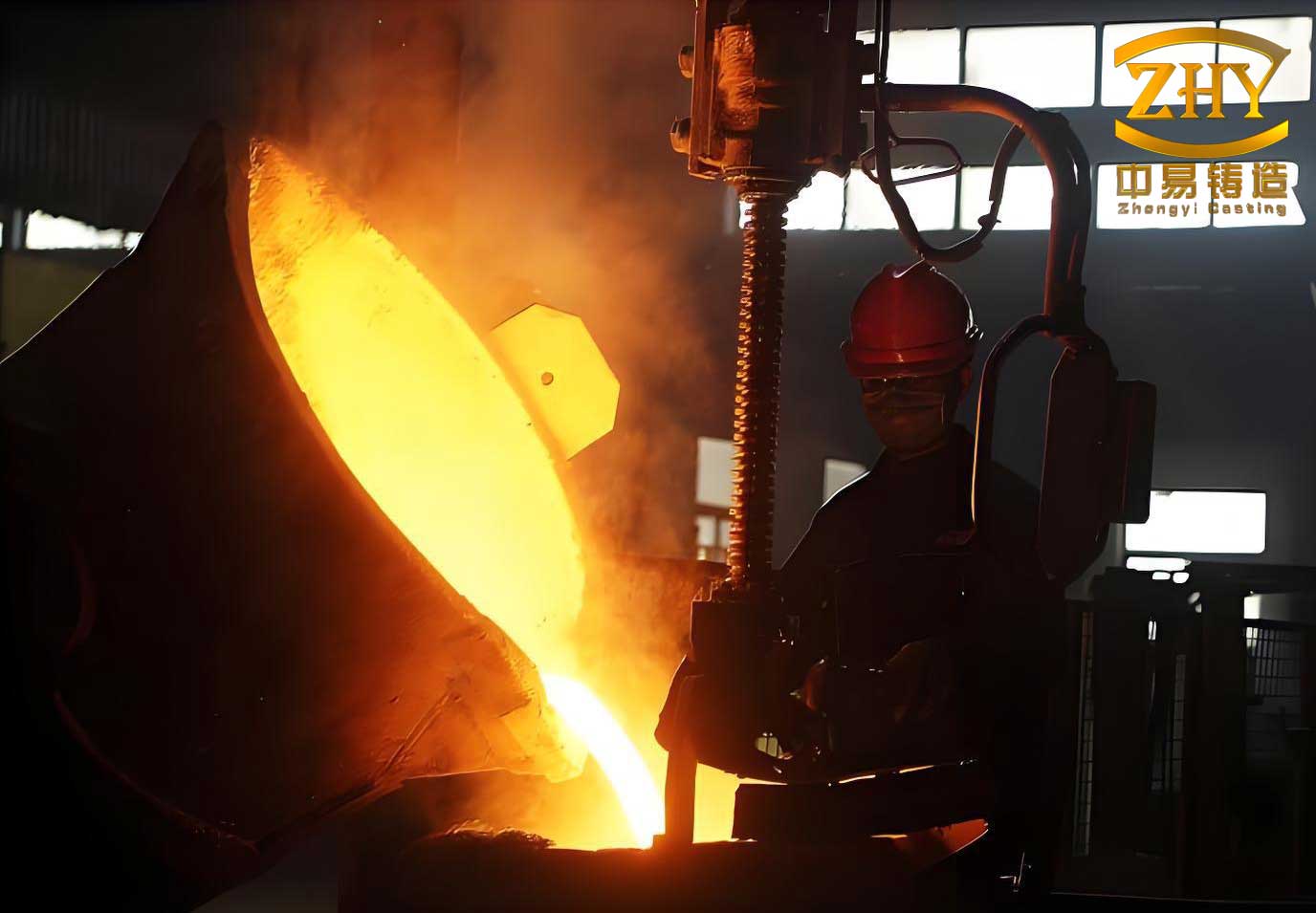
Our铸造工艺 analysis centered on minimizing thermal and收缩 stresses while ensuring soundness. We adhered to the principle of均衡凝固, employing low-temperature rapid pouring to reduce temperature gradients. The use of high-耐火度 molding materials, such as water-glass olivine sand coated with magnesite-based alcohol涂料, prevented sand sticking and improved surface finish. To manage shrinkage, we prioritized excellent mold and core退让性, utilizing shell cores for complex internal geometries and filling hollow sections with dry sand. Key considerations included controlling cooling rates with external chills and selecting工艺 parameters to prevent cracking in this demanding high manganese steel casting.
In designing the铸造工艺, we adopted a core assembly method with two parting planes. This involved sequentially placing cores, checking dimensions with templates, and ensuring circularity within 3 mm for critical dimensions like Φ1800 mm. The工艺 parameters were carefully chosen: machining allowances were set at 6 mm for the Φ420 mm inner孔 and 3 mm for the outer磨损面 to accommodate work hardening, while a linear shrinkage rate of 2.5% was applied. Rounds at热节 locations were increased to R30 mm to mitigate stress concentration. Below is a summary of the key工艺 parameters for this high manganese steel casting:
| Parameter | Value | Remarks |
|---|---|---|
| Machining Allowance (Inner孔) | 6 mm | Ensures assembly fit |
| Machining Allowance (Outer Surface) | 3 mm | Accounts for work hardening |
| Linear Shrinkage Rate | 2.5% | Standard for high manganese steel |
| Core Negative/Head Clearance | 2 mm | Facilitates core placement |
| Fillet Radius at Hot Spots | R30 mm | Reduces stress concentration |
The浇注系统 was designed based on simultaneous solidification principles to achieve fast filling. We used a 25-ton ladle with two nozzles for侧浇式. The浇注时间 t was calculated to ensure a minimum metal rise速度 V_l exceeding 20 mm/s, critical for this high manganese steel casting. The formulas are as follows:
浇注时间: $$ t = \frac{G}{n V_{\text{包}}} $$ where \( G = 14000 \, \text{kg} \) (casting weight), \( n = 2 \) (number of nozzles), and \( V_{\text{包}} = 120 \, \text{kg/s} \) (pouring rate for Φ70 mm nozzle). Substituting values: $$ t = \frac{14000}{2 \times 120} = 58.33 \, \text{s} \approx 58 \, \text{s} $$
Metal rise速度: $$ V_{\text{液}} = \frac{h}{t} $$ where \( h = 1324 \, \text{mm} \) (casting height). Thus: $$ V_{\text{液}} = \frac{1324}{58} = 22.83 \, \text{mm/s} > 20 \, \text{mm/s} $$ This meets the design requirement for rapid充型.
An open浇注系统 was employed with截面积 ratios per industry standards: $$ \sum F_{\text{包}} : \sum F_{\text{直}} : \sum F_{\text{横}} : \sum F_{\text{内}} = 1 : (1.8 \sim 2.0) : (1.8 \sim 2.0) : (2.0 \sim 2.5) $$ Based on this, we designed two直浇道 of Φ100 mm, symmetrical横浇道 of 80 mm × 70 mm, and three layers of内浇道: upper and lower layers with eight 60 mm × 40 mm gates each, and a middle layer with eight Φ50 mm gates, all evenly distributed circumferentially to promote uniform filling in this high manganese steel casting.
冒口 design focused on补缩 for the轮缘 and轮毂. Their模数 M were calculated as 5.1 and 4.2, respectively. We installed eight insulating冒口 (240 mm × 360 mm × 500 mm) on the轮缘 with a模数 M_{\text{冒}} of 5.9, and three on the轮毂 (200 mm × 300 mm × 460 mm) with M_{\text{冒}} of 5.易割缩颈 were used to facilitate removal, ensuring the ratio: $$ M_{\text{件}} : M_{\text{颈}} : M_{\text{冒}} = 1 : (1 \sim 1.2) : (1.1 \sim 1.3) $$ Additionally, three 150 mm × 80 mm补缩通道 acted as拉筋 and vents between sections. External冷铁 were strategically placed in cores to enhance cooling at hot spots, replacing internal冷铁 to avoid cracking risks during heat treatment.
浇注 parameters were tightly controlled. After argon stirring and a 3–5 minute镇静 period, the pouring temperature was maintained at 1430–1450°C, optimal for high manganese steel casting to prevent defects. Post-casting, the component was cooled in the mold for 240 hours to below 300°C before shakeout to minimize thermal stress. Cleaning was done cautiously to avoid impact-induced cracks.冒口 cutting was performed after水韧处理, with the casting submerged in water to expose only the冒口 for gas cutting, leaving a 10 mm allowance for grinding.
The success of this工艺 is evident from the production of five integral bottom rollers since 1998, all meeting dimensional and quality standards. Non-destructive testing like ultrasonic and dye penetrant inspection confirmed integrity at热节 locations. This achievement underscores the viability of整体铸造 for large高锰钢铸件, offering significant advantages over split designs. Below, a table summarizes the comparative benefits of integral高锰钢铸件:
| Aspect | Integral Casting | Split Casting with Welding |
|---|---|---|
| Production Cycle | Shorter | Longer due to welding steps |
| Weld Defects | Eliminated | Prone to脆性 zones and failures |
| Service Life | Over twice as long | Limited by weld integrity |
| Cost Efficiency | Savings on welding and repairs | Higher maintenance expenses |
| Structural Homogeneity | Improved, with no weak joints | Inhomogeneous from filler metals |
Our experience demonstrates that high manganese steel casting can be extended to超大型复杂铸件 with proper工艺设计. The integral approach not only enhances performance but also reduces lifecycle costs, garnering positive feedback from international clients. Key formulas used in designing such castings are consolidated below for reference:
General solidification control in high manganese steel casting often involves calculating the温度 gradient ΔT to assess thermal stress: $$ \Delta T = \frac{q \cdot L}{k} $$ where \( q \) is heat flux, \( L \) is characteristic length, and \( k \) is thermal conductivity of high manganese steel (typically low, around 12–15 W/m·K). This highlights the need for controlled cooling.
For浇注系统 design, the浇注重量速度 \( V_{\text{包}} \) can be derived from nozzle diameter d (in mm) using empirical relations: $$ V_{\text{包}} = C \cdot d^2 $$ with \( C \) as a material constant. In our case, for Φ70 mm nozzle and high manganese steel, \( C \approx 0.0245 \, \text{kg/(s·mm}^2) \), giving: $$ V_{\text{包}} = 0.0245 \times 70^2 = 120 \, \text{kg/s} $$
冒口 sizing relies on模数 theory, where模数 M is volume-to-cooling surface area ratio: $$ M = \frac{V}{A} $$ For cylindrical冒口, if radius r and height H are known, \( M_{\text{冒}} \) can be approximated as \( \frac{r \cdot H}{2(H + r)} \) for design checks. We ensured \( M_{\text{冒}} > M_{\text{件}} \) by at least 10–30% for effective补缩 in high manganese steel casting.
In terms of material properties, high manganese steel casting exhibits unique behaviors due to its composition. The following table outlines key characteristics influencing our工艺 decisions:
| Property | Value for ZGMn13Cr2 | Impact on Casting |
|---|---|---|
| Carbon Content | ~1.2% | Increases hardness but risk of carbides |
| Manganese Content | ~13% | Enhances toughness and work hardening |
| Thermal Conductivity | Low (~13 W/m·K) | Promotes thermal stress and slow cooling |
| Linear Shrinkage | 2.2–2.8% | Requires generous allowances and退让性 |
| Solidification Range | Intermediate | Needs balanced feeding and chilling |
Throughout the process, we emphasized the importance of低温快浇 for high manganese steel casting to minimize temperature differentials. The浇注温度 range of 1430–1450°C was derived from years of实践, ensuring adequate fluidity without excessive grain growth. Post-casting heat treatment involved水韧处理 at 1050–1100°C followed by rapid quenching to retain austenitic structure and toughness, critical for wear resistance in applications like dredging rollers.
The整体铸造 technique has opened new horizons for high manganese steel casting, enabling the production of components previously deemed too large or complex. By integrating均衡凝固 principles, advanced molding materials, and precise工艺 controls, we have achieved consistent quality in超大型铸件. This approach not only mitigates焊接-related issues but also extends service life, as evidenced by our rollers operating flawlessly for over three years in demanding environments.
Looking ahead, we continue to refine our methods for high manganese steel casting, exploring innovations in冷铁 design and digital simulation to optimize cooling patterns. The success of this project validates that高锰钢铸件 can thrive in modern foundry practices, offering a robust alternative for heavy machinery components. We believe that sharing these insights will foster further advancements in the field, reinforcing the relevance of high manganese steel casting in industrial applications.