
From my perspective as a practitioner deeply involved in the evolution of manufacturing technologies, the integration of 3D printing, or additive manufacturing, into the foundry industry represents one of the most transformative developments in recent decades. This technology fundamentally redefines the pathway from digital design to physical metal component, particularly for complex geometries. At its core, 3D printing of sand molds enables the direct production of molds and cores from CAD data, eliminating the need for traditional patterns, core boxes, and tooling. This shift is not merely incremental; it is disruptive, offering unparalleled flexibility and speed, especially crucial for prototyping and low-volume production of intricate parts. The implications for sectors demanding high complexity and rapid innovation, such as aerospace castings, are profound.
The Foundational Principle: Binder Jetting for Sand
The predominant technology for 3D printing sand molds is binder jetting. The process is elegantly systematic, building molds layer by layer with precision. The workflow can be encapsulated in the following sequence, which also defines the primary cycle time ($t_{cycle}$) for a single layer:
1. Powder Deposition: A recoating mechanism spreads a thin, uniform layer of specially formulated sand, typically silica or zircon, mixed with a latent catalyst, across the build platform. The layer thickness ($z$) is a critical parameter, typically ranging from 0.2 mm to 0.3 mm, directly influencing surface finish and build time.
2. Selective Binder Application: A print head, analogous to an inkjet printer, traverses the powder bed and selectively deposits a liquid binding agent (usually a furan or phenolic resin) according to the cross-sectional data sliced from the 3D CAD model. The bonding reaction is catalyzed by the material in the sand, causing immediate localized solidification.
3. Layer Bonding and Platform Descent: Once a layer is printed, the build platform lowers by exactly one layer height ($\Delta z$). The process repeats, with each new layer bonding to the previous one, gradually building the complete sand mold or core assembly in a monolithic fashion.
4. Post-Processing: After completion, the “green” sand mold, surrounded by loose, unbound support powder, is excavated. The unbound sand, which provided crucial support during printing, is easily removed and can often be recycled. The mold may then undergo a post-curing process to achieve final strength before being ready for pouring.
The entire process can be visualized as a digital layering function. If we define the mold volume as $V_m$ and the print area as $A$, the theoretical minimum build time ($T_{build}$) excluding setup and post-processing is governed by:
$$ T_{build} = \frac{V_m}{A \cdot z} \cdot t_{cycle} $$
where $t_{cycle}$ is the time to deposit and print one layer.
The absence of tooling constraints means that designers are liberated. Undercuts, negative drafts, internal channels, and complex contours that are impossible or prohibitively expensive to produce with traditional core boxes become feasible. This is the key enabler for next-generation aerospace castings, which frequently integrate cooling passages, lightweight lattices, and topology-optimized structures directly into the mold design.
A Quantitative Comparison: Traditional vs. Additive Casting Pathways
The impact of 3D printing is best understood through a direct comparison with conventional high-volume sand casting processes, such as those using automated lines with matchplate patterns. The contrast in workflow, timeline, and economic drivers is stark, as summarized in the table below.
| Aspect | Traditional High-Volume Casting | 3D Printed Sand Mold Casting |
|---|---|---|
| Primary Driver | Economies of scale; Low cost-per-part at high volumes. | Economies of scope; Agility, complexity, and zero tooling cost for low volumes. |
| Lead Time to First Casting | Very long (12-20 weeks). Dominated by design, patternmaking, and tooling fabrication. | Very short (1-3 weeks). Dominated by CAD preparation and machine print time. |
| Design Flexibility & Complexity | Limited by draft angles, parting lines, and core box manufacturability. | Extremely high. True design freedom for organic shapes, integrated cores, and conformal channels. |
| Change Implementation Cost | Very high. Requires physical modification or replacement of expensive tooling. | Very low. Requires only a modification to the digital CAD file. |
| Optimal Production Volume | High to very high volume (>10,000 parts). | Prototyping, bridge production, and low-to-medium volume (<1,000 parts). |
| Parting Lines & Flash | Inherent to the process; requires manual or robotic finishing. | Minimal to non-existent on cores; significant reduction in cleanup effort. |
| Key Cost Equation | $$ C_{part} = \frac{C_{tooling}}{N} + C_{molding} + C_{finishing} $$ Where $C_{tooling}$ is high and $N$ is volume. |
$$ C_{part} = C_{CAD} + \frac{C_{machine} \cdot T_{build}}{N} + C_{material} + C_{post} $$ Where $C_{machine}$ and $C_{material}$ dominate. |
The formulas in the table highlight the fundamental economic shift. Traditional casting amortizes high initial tooling costs ($C_{tooling}$) over a large number of parts ($N$). In contrast, 3D printing has near-zero fixed “tooling” cost ($C_{CAD}$ is the digital model), but the variable cost per part is driven by machine time ($T_{build}$) and material usage, which are relatively high. Therefore, the cost curves intersect, defining the break-even point for volume.
Applications and Technical Advantages in Practice
The practical benefits of 3D printed sand molds manifest across multiple industries, accelerating development cycles and enabling new designs.
1. Rapid Prototyping for Automotive and Heavy Machinery: For components like engine blocks, transmission housings, or axle carriers, traditional prototyping involves months of lead time for tooling. With 3D printing, a fully assembled core package for a complex V6 engine block can be printed as a single, monolithic piece or a few key segments within days. This not only slashes development time from months to weeks but also produces castings with superior dimensional accuracy and minimal core shift. The reduction in parting lines and flash drastically decreases cleaning and machining time for the prototype, yielding a net-shaped part faster. The ability to test form, fit, and function with actual cast metal parts early in the design cycle is invaluable.
2. Production of Complex, Low-Volume Components: This is where the technology transitions from prototyping to manufacturing. Parts for legacy systems, specialized industrial equipment, or high-performance racing applications, where volumes are in the tens or hundreds, are economically unviable with hard tooling. 3D printing provides a cost-effective and fast manufacturing route. A prime example is in the pump and valve industry, where complex internal volutes and impellers can be cast with integral cores that would be impossible to extract from a traditional core box.
3. The Frontier: Enabling Advanced Aerospace Castings
The most demanding application lies in aerospace. Modern jet engines and airframe components push the limits of materials and geometries. Turbine housings, structural brackets, and manifold systems require:
- Extreme Complexity: Internal cooling channels that follow airfoil contours, thin-walled sections for weight reduction, and intricate lattice structures for stiffness.
- High Integrity: Excellent surface finish to reduce stress concentrators, and precise dimensional control to minimize subsequent machining of expensive superalloys.
- Integrated Functionality: Cast-in features for sensors, mounts, and fluid paths.
Traditional investment casting or conventional sand casting often falls short. 3D printed sand molds excel here. Designers can create monolithic sand molds that incorporate the core, the shell, and even cavities for strategic placement of chaplets or chills. The dimensional precision (±0.2 mm is typical) ensures tight tolerances. The following table outlines specific attributes of aerospace castings enabled by this technology:
| Challenge in Aerospace | 3D Printing Solution | Technical Benefit |
|---|---|---|
| Conformal Cooling Channels | Printing of intricate, curved core channels that follow the part profile. | Optimal thermal management, improved part life, and reduced cooling fluid pressure drop. |
| Weight Reduction via Topology Optimization | Direct printing of organic, lightweight structures designed by AI algorithms. | Significant mass savings without compromising strength, impossible with traditional tooling. |
| Integrated Assemblies | Consolidation of multiple parts into a single casting with printed internal passages. | Reduced part count, improved reliability, elimination of joints and seals. |
| Rapid Design Iteration for R&D | Quick turnaround of new mold designs for experimental engine components. | Accelerated research and development cycles for next-generation propulsion systems. |
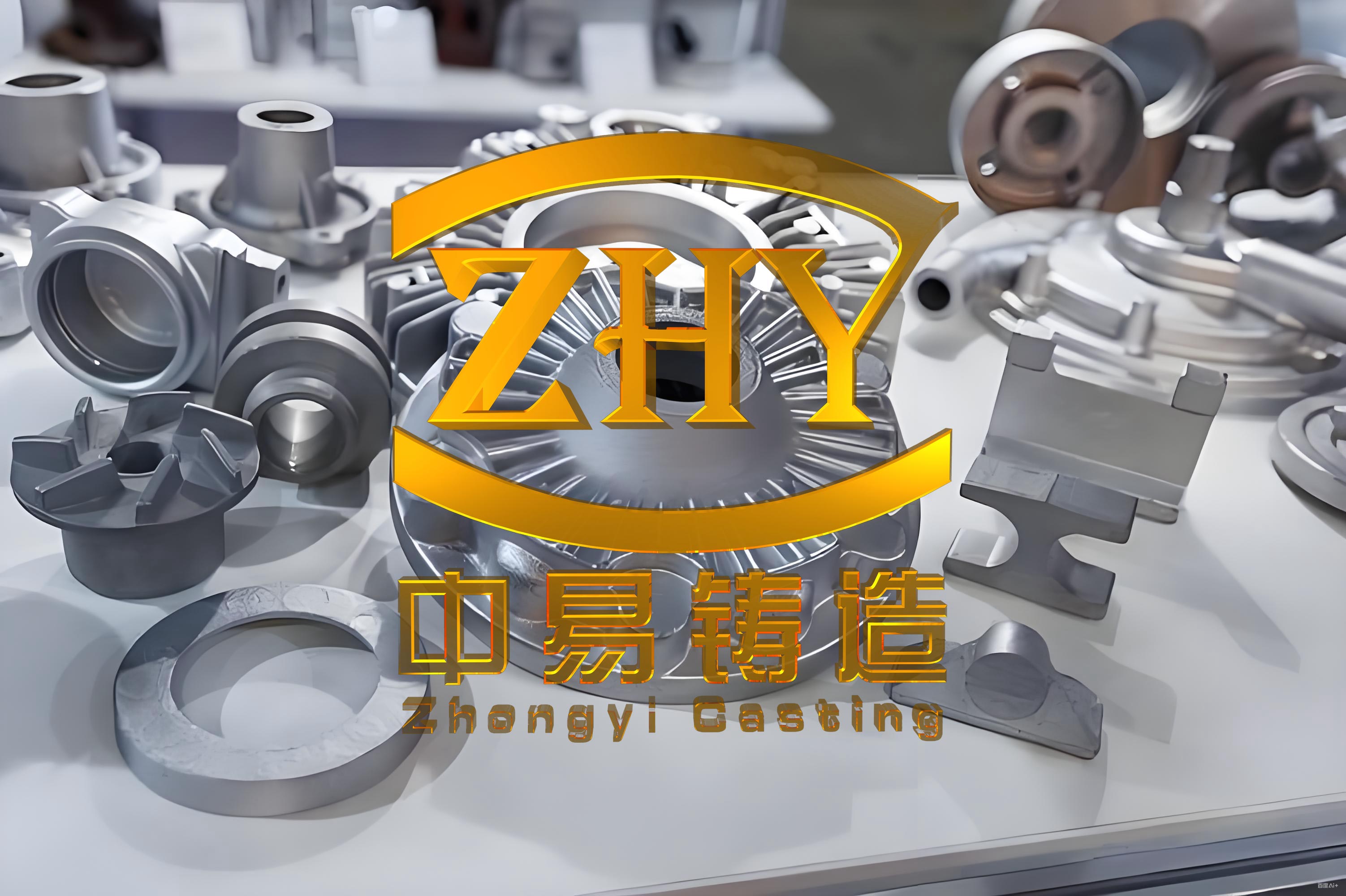
The visual above exemplifies the kind of intricate, high-performance components that are now feasible. The ability to produce such parts reliably underscores why 3D printed sand molds are becoming indispensable in the development and limited production of critical aerospace castings.
Technical Considerations and Material Science
The performance of a 3D printed sand mold is governed by the interplay of material properties and process parameters. Key relationships can be expressed mathematically.
1. Mold Strength and Binder Kinetics: The strength of the bonded sand is a function of binder type, catalyst concentration, and curing parameters. A simplified model for ultimate tensile strength ($\sigma_t$) might consider binder saturation ($S_b$), layer thickness ($z$), and post-cure time/temperature ($T_{cure}, t_{cure}$):
$$ \sigma_t \propto f(S_b, z^{-1}, \int_{0}^{t_{cure}} k(T_{cure}) \, dt) $$
where $k(T)$ is a temperature-dependent reaction rate constant following an Arrhenius equation: $k(T) = A e^{-E_a/(RT)}$.
2. Dimensional Accuracy and Surface Roughness: The staircase effect inherent to layer-based manufacturing dictates surface quality. The theoretical peak-to-valley surface roughness ($R_t$) is related to the layer thickness ($z$) and the surface angle ($\theta$) relative to the build plane:
$$ R_t \approx z \cdot |\cos \theta| \quad \text{for} \quad \theta \neq 90^\circ $$
For vertical walls ($\theta = 90^\circ$), $R_t$ is determined by the binder droplet penetration and powder granularity. Optimizing print resolution, recoating, and binder drop size minimizes this effect, which is critical for the as-cast surface finish of aerospace castings.
3. Gas Evolution and Permeability: Unlike traditional chemically-bonded sands, 3D printed molds can have different gas evolution characteristics due to the binder system. The mold must possess sufficient permeability ($\Pi$) to allow gases to escape during pouring to prevent defects. This is a function of grain size distribution and packing density, which are carefully controlled in the printing process to satisfy the condition:
$$ \frac{dP_{gas}}{dt} \cdot V_{mold} < \Pi \cdot A_{vent} \cdot \frac{\Delta P}{\mu \cdot L} $$
where $dP_{gas}/dt$ is the gas generation rate, $V_{mold}$ is mold volume, $A_{vent}$ is vent area, $\Delta P$ is pressure differential, $\mu$ is gas viscosity, and $L$ is flow path length.
Economic Model and Strategic Positioning
While the technical advantages are clear, the economic reality defines its strategic role. The total cost ($C_{total}$) for producing a batch of $N$ castings via 3D printed molds can be modeled as:
$$ C_{total} = C_{fixed} + N \cdot (C_{sand} + C_{binder} + C_{energy} + C_{labor}) $$
where $C_{fixed}$ includes machine depreciation and CAD preparation, which is low relative to hard tooling. The variable costs (sand, binder, energy per part) are the dominant factors. This creates a linear cost vs. volume relationship, contrasting with the decaying exponential curve of traditional casting.
Therefore, 3D printing is not a wholesale replacement for high-volume sand casting. It is a powerful complementary technology that fills critical gaps:
1. The Prototyping and Development Niche: It is unrivaled for speed and design iteration.
2. The Complexity-Over-Volume Niche: It is the only feasible method for parts where complexity makes tooling impossible or astronomically expensive.
3. The Bridge Production Niche: It supplies parts for market testing, initial production, or servicing legacy systems while permanent tooling is being manufactured.
For conventional foundries, integrating 3D printing as a coreless sand production unit creates a hybrid and highly responsive manufacturing capability. It allows them to serve a wider market, from mass production to bespoke, complex orders, including those for prototyping next-generation aerospace castings.
Future Trajectory and Concluding Synthesis
The trajectory of 3D sand printing points toward increased speed, larger build volumes, enhanced material properties, and multi-material printing (e.g., integrating insulating or exothermic materials into specific mold regions). Research into advanced binder systems aims to improve collapsibility and surface finish further.
In conclusion, 3D printing of sand molds represents a fundamental paradigm shift in casting technology. It decouples geometric complexity from manufacturing cost, democratizing access to highly intricate metal parts. Its value proposition is strongest where time-to-market, design flexibility, and handling extreme complexity are paramount. While currently positioned as a complementary technology due to economic factors for high-volume runs, its role is strategic and expanding. It is the key that unlocks new frontiers in engineering design, most visibly and impactfully in the realm of advanced aerospace castings, where it enables the lightweight, strong, and thermally efficient components that define the future of flight. The foundry of the future will likely be a synergistic blend of high-speed traditional lines for volume and agile, digital 3D printing cells for complexity and rapid response.