
In recent years, we have witnessed a transformative shift in manufacturing, driven by the integration of additive manufacturing, commonly known as 3D printing, with traditional industries. As researchers and practitioners in this field, we believe that the fusion of 3D printing with sand casting is particularly significant, offering new avenues for producing high-quality sand casting products with enhanced efficiency and flexibility. This paper delves into a detailed comparison of two primary 3D printing technologies used for directly manufacturing sand casting molds: Selective Laser Sintering (SLS) and Three-Dimensional Printing (3DP). Our analysis is grounded in firsthand experience and industry observations, aiming to provide insights that can guide the adoption of these technologies in producing sand casting products.
Sand casting remains a cornerstone of metal part production, accounting for over 90% of all cast components. The process involves creating molds from sand, typically bonded with resins, into which molten metal is poured to form sand casting products. Traditionally, this required skilled labor and time-consuming pattern-making, often limiting the complexity and speed of production. However, with the advent of 3D printing, we can now directly fabricate sand molds from digital models, bypassing many traditional constraints. This direct manufacturing approach not only accelerates prototyping but also enables the creation of intricate geometries that were previously unattainable, thus revolutionizing the way we produce sand casting products.
The necessity for this integration stems from broader industrial trends. As outlined in initiatives like “Industry 4.0” and various national manufacturing strategies, there is a pressing need to modernize traditional sectors. We have observed that 3D printing offers a pathway to address challenges such as labor shortages, high costs for small batches, and the demand for customized sand casting products. By leveraging additive manufacturing, foundries can enhance their responsiveness and innovation capacity, ultimately leading to more competitive sand casting products in global markets.
In this context, we focus on two dominant 3D printing methods for sand mold fabrication: SLS and 3DP. Both techniques utilize powder materials, such as resin-coated sands or furan sands, but differ fundamentally in their binding mechanisms. Through our research, we have analyzed their characteristics, advantages, and limitations, with the goal of optimizing their application for sand casting products. Below, we present a detailed comparison, supported by tables and mathematical models, to elucidate these technologies.
Technical Principles of Sand Mold 3D Printing
From our perspective, understanding the core principles of SLS and 3DP is essential for selecting the appropriate technology for sand casting products. Both processes operate on a layer-by-layer additive approach, but their methodologies vary significantly.
Selective Laser Sintering (SLS) for Sand Casting Products
In SLS, we use a laser to selectively sinter powder particles. The process begins with spreading a thin layer of sand powder in a build chamber. A laser beam, guided by scanning mirrors, irradiates the powder according to the cross-sectional data of the digital model. The laser’s energy causes the resin binder within the sand to melt and fuse, bonding the particles together to form a solid layer. This cycle repeats until the entire sand mold is completed. We have found that SLS offers high precision due to the focused laser spot, typically with a diameter ranging from 0.1 to 0.6 mm. The energy density delivered by the laser is a critical parameter, which can be expressed by the following formula:
$$ E = \frac{P}{v \cdot d} $$
Where \( E \) is the energy density (in J/mm²), \( P \) is the laser power (in W), \( v \) is the scanning speed (in mm/s), and \( d \) is the laser spot diameter (in mm). This equation highlights how we can control sintering quality by adjusting these variables. Higher energy density ensures proper bonding but must be balanced to avoid thermal distortion. For sand casting products requiring fine details, such as engine blocks or complex aerospace components, SLS provides excellent dimensional accuracy. However, the process is relatively slow, with scanning speeds often below 5 m/s, and requires precise temperature control—typically preheating to 60–70°C and gradual cooling to prevent stress. The equipment cost is also high, largely due to the laser and scanning systems.
Three-Dimensional Printing (3DP) for Sand Casting Products
In contrast, 3DP employs a binder jetting mechanism. Similar to SLS, a layer of sand powder is spread, but instead of a laser, a print head deposits a liquid binder, such as phenolic or furan resin, onto the powder bed. The binder reacts with the sand’s coating to form a bond. This process is akin to inkjet printing, where multiple print heads with arrayed nozzles can cover large areas quickly, making it faster than SLS. We have observed that 3DP operates at room temperature, eliminating the need for extensive heating, but it requires regular maintenance to prevent nozzle clogging. The binding strength can be modeled using a penetration depth formula for the binder:
$$ h = \sqrt{\frac{2 \gamma \cos \theta \cdot t}{\mu}} $$
Where \( h \) is the penetration depth (in mm), \( \gamma \) is the surface tension of the binder (in N/m), \( \theta \) is the contact angle, \( t \) is the time (in s), and \( \mu \) is the viscosity (in Pa·s). This equation helps us understand how binder properties affect the consolidation of sand layers. After printing, the sand mold undergoes a curing process, often with heat, to enhance its strength for producing durable sand casting products. While 3DP offers high speed and lower equipment costs, its precision is generally lower than SLS, making it suitable for larger or批量生产 of sand casting products.
Comparative Analysis of SLS and 3DP
Based on our hands-on experience, we have compiled a comprehensive comparison of SLS and 3DP technologies for fabricating sand molds. The table below summarizes key aspects:
| Parameter | Selective Laser Sintering (SLS) | Three-Dimensional Printing (3DP) |
|---|---|---|
| Binding Mechanism | Laser sintering of resin in sand | Binder jetting with chemical reaction |
| Printing Speed | Slow (point-by-point scanning) | Fast (area-based jetting) |
| Precision | High (up to ±0.1 mm) | Moderate (up to ±0.3 mm) |
| Equipment Cost | High (due to laser components) | Lower (simpler print heads) |
| Temperature Control | Required (preheating and cooling) | Not required during printing |
| Maintenance | Low (laser system durability) | High (nozzle cleaning needed) |
| Best For | High-precision, low-volume sand casting products | Small-batch, rapid production of sand casting products |
From this comparison, we conclude that SLS is ideal for applications where accuracy is paramount, such as prototyping complex sand casting products like turbine blades or medical device components. Conversely, 3DP excels in scenarios requiring quick turnaround for medium-sized runs, such as automotive parts or architectural fittings. Both technologies contribute to the advancement of sand casting products by reducing lead times and enabling design freedom.
To further illustrate the efficiency of these methods, we can model the total production time \( T \) for a sand mold using the following formula:
$$ T = N \cdot \left( t_{\text{layer}} + t_{\text{processing}} \right) $$
Where \( N \) is the number of layers, \( t_{\text{layer}} \) is the time per layer (including powder spreading and binding), and \( t_{\text{processing}} \) is post-processing time (e.g., curing). For SLS, \( t_{\text{layer}} \) is dominated by laser scanning, which scales with the area, while for 3DP, it depends on binder jetting speed. In our experiments, we have found that for large sand casting products, 3DP often outperforms SLS in terms of throughput, but SLS yields finer surface finishes.
Applications in Producing Sand Casting Products
We have seen numerous successful implementations of 3D-printed sand molds across industries, highlighting their versatility for sand casting products. In aerospace, for instance, companies utilize SLS to create lightweight, complex molds for engine components, resulting in sand casting products with improved performance. The automotive sector leverages 3DP for rapid prototyping of cylinder heads and brake calipers, accelerating the development cycle for new sand casting products. Additionally, the medical field benefits from customized implants produced via these methods, where precision is critical.
One notable example is the production of door hinge parts for aircraft, where 3D-printed sand molds enable the casting of intricate geometries that reduce weight and enhance strength. Similarly, in the automotive industry, engine blocks are being trial-produced using 3DP sand molds, leading to sand casting products that meet stringent quality standards. We believe that as technology matures, the range of sand casting products manufacturable through 3D printing will expand, including large-scale industrial equipment and artistic sculptures.
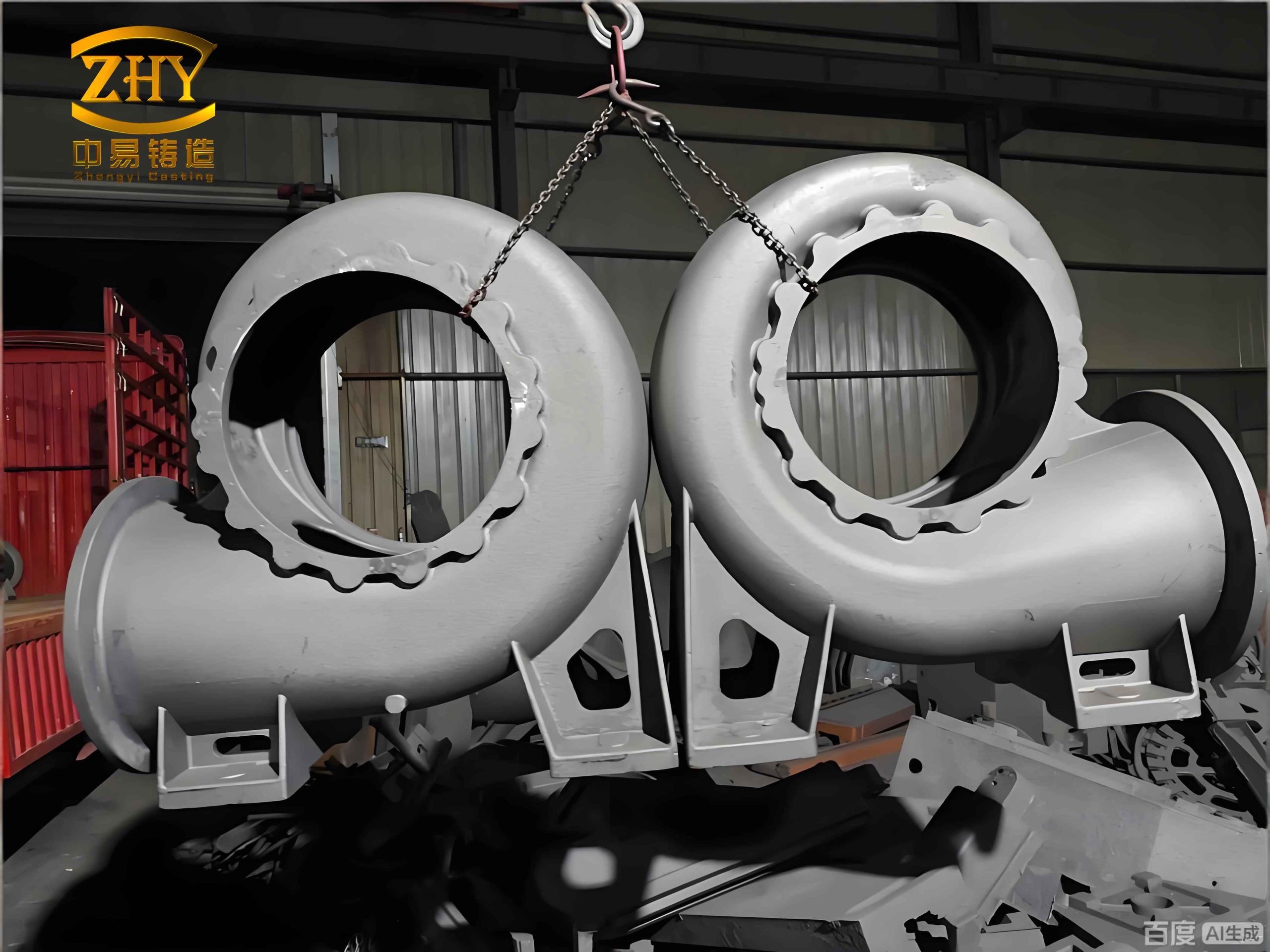
The image above showcases typical sand casting products, emphasizing how 3D printing can facilitate their creation. By integrating digital design with additive manufacturing, we can produce these items with greater efficiency and customization, driving innovation in the sand casting industry.
Future Prospects and Hybrid Approaches
Looking ahead, we anticipate that 3D printing for sand casting products will evolve through hybridization with other manufacturing techniques. A promising direction is hybrid machining, which combines additive and subtractive processes. In this approach, we use 3D printing to create near-net-shape sand molds, then employ CNC machining to achieve final dimensions and surface quality. This synergy can be described by a cost-benefit model:
$$ C_{\text{total}} = C_{\text{print}} + C_{\text{machine}} + C_{\text{material}} $$
Where \( C_{\text{total}} \) is the total cost, \( C_{\text{print}} \) is the 3D printing cost, \( C_{\text{machine}} \) is the machining cost, and \( C_{\text{material}} \) is the material cost. By optimizing this combination, we can reduce waste and improve accuracy for sand casting products, especially for high-value applications. Furthermore, advancements in materials science may lead to new sand composites with enhanced properties, such as higher thermal stability or better recyclability, further benefiting the production of sand casting products.
We also foresee increased adoption of artificial intelligence and machine learning to optimize printing parameters. For instance, predictive models could adjust laser power or binder flow in real-time, minimizing defects in sand casting products. Our research suggests that these innovations will make 3D printing more accessible to small and medium-sized enterprises, democratizing the production of sand casting products.
Conclusion
In summary, our analysis confirms that both SLS and 3DP technologies offer distinct advantages for manufacturing sand casting products. SLS provides superior precision and is well-suited for low-volume, high-detail sand casting products, while 3DP delivers faster production speeds ideal for small batches. As we continue to explore these methods, we recommend that manufacturers consider their specific needs—whether for prototyping or mass customization—when choosing between them. The integration of 3D printing into sand casting not only enhances operational efficiency but also opens new design possibilities, ensuring that sand casting products remain vital in the modern manufacturing landscape. Through ongoing innovation and collaboration, we believe that 3D printing will play an increasingly pivotal role in shaping the future of sand casting products worldwide.