
Over the past decades, the foundry industry has faced increasing pressure to adapt to new market demands, environmental regulations, and labor shortages. As a professional who has been deeply involved in casting process research and the industrial application of additive manufacturing, I have witnessed how 3D printing sand casting has evolved from a laboratory curiosity into a viable production technology. In this article, I will share my perspective on the current state, key benefits, and future potential of 3D printing sand casting, with particular emphasis on the way it reshapes the workflow for complex, high-quality, and small-batch castings.
The term 3d printing sand casting refers to the use of binder jetting technology to produce sand molds and cores directly from digital CAD data, without the need for physical tooling. This approach is fundamentally different from conventional sand casting, where a pattern or core box must be manufactured before any sand mold can be formed. By eliminating the pattern-making step, 3d printing sand casting offers a radical simplification of the entire production chain. Moreover, the digital nature of the process enables rapid design iterations, geometric freedom, and distributed manufacturing strategies that were previously impossible or economically unfeasible.
In my daily work, I have seen how traditional foundries struggle with multi-variety and small-batch orders. The conventional tooling-based approach requires a significant upfront investment in patterns, core boxes, and storage space. When a product is discontinued, those tools become obsolete, leading to enormous waste of materials, capital, and factory floor space. Meanwhile, customization and personalization have become mainstream trends, forcing foundries to answer a simple question: how can we produce complex castings quickly, accurately, and cost-effectively in small quantities? The answer increasingly lies in 3d printing sand casting.
1. The Fundamental Challenges of Traditional Sand Casting
To fully appreciate the impact of 3d printing sand casting, one must first understand the structural problems that have long plagued the conventional sand casting industry. These challenges are not merely technical; they are deeply connected to human resources, product lifecycle management, and environmental sustainability.
1.1 Labor Intensity and Unattractive Working Environment
Traditional sand molding and core making are among the most labor-intensive and physically demanding operations in the manufacturing world. Workers need to handle heavy sand batches, operate vibrating compactors, manually set cores, and execute numerous repetitive motions. The working environment is often noisy, dusty, and sometimes hot. Young people increasingly avoid such jobs, preferring cleaner, more intellectually stimulating positions. As a result, many foundries report chronic labor shortages, high turnover, and difficulty in retaining skilled operators. 3d printing sand casting offers a way out by automating the entire mold-building process inside an enclosed chamber. The operator interacts primarily with computers and robotic systems, rather than with bulk sand and resin. This dramatically improves workplace conditions and helps attract a new generation of digital-savvy technicians.
1.2 Product Structure Shift Toward Customization
Another major issue is the changing structure of product demand. In the past, mass production of identical components was the dominant model. Today, however, customers request tailored solutions, small series, and even single-piece production. This shift is especially visible in automotive prototyping, aerospace components, energy equipment, and high-end machinery. For such requirements, conventional casting with hard tooling becomes extremely inefficient. The cost of a pattern or die can only be amortized if the production volume is sufficiently high. When the order quantity is one or two pieces, the tooling cost dominates the total price, making traditional foundries uncompetitive. This is exactly where 3d printing sand casting excels: it does not require any dedicated tooling, so the marginal cost per unique part remains low.
1.3 Environmental Pressures
Drawing on my experience, I have noticed that foundries have become a key target for environmental regulators. Traditional sand molding often involves volatile organic compounds, resin binders, and coating chemicals. Dust generation during sand handling is also a major concern. Many foundries have invested heavily in end-of-pipe pollution control equipment, but this approach is inherently reactive and expensive. Cleaner production is the only sustainable path. 3d printing sand casting is inherently cleaner because the sand is spread and bonded in a closed system, minimizing dust emissions and reducing chemical exposure. The binder is applied only where needed, and unused sand can be recycled and reused. This aligns well with the global pressure to reduce industrial carbon footprints and waste generation.
| Challenge | Conventional Sand Casting | 3D Printing Sand Casting |
|---|---|---|
| Tooling requirement | Pattern/core box required | No physical tooling |
| Lead time for first part | Weeks to months (tool making) | Days (direct printing) |
| Complexity capability | Limited by draft angles and core pulling | Unrestricted geometry |
| Design iterations | Expensive and slow | Rapid and inexpensive |
| Labor intensity | High manual work | Automated, enclosed process |
| Environmental impact | Dust, fumes, chemical waste | Low emissions, recyclable sand |
| Storage and inventory | Large tool storage | Digital files only |
2. Why 3D Printing Sand Casting Is a Game Changer
In my analysis, the term 3d printing sand casting encapsulates a set of advantages that go far beyond simple process automation. These advantages touch on every aspect of casting production, from product design to final delivery. I will elaborate on these benefits in depth.
2.1 Elimination of Pattern and Core Box Tooling
The most obvious benefit is the removal of pattern-making from the workflow. In conventional casting, producing a new mold requires a pattern, a core box, or both. Depending on the size and complexity, the tooling can take several weeks or months to manufacture and may cost tens of thousands of dollars. By contrast, 3d printing sand casting directly builds the mold cavity and core from sand and binder. The digital model is sliced into layers, and the printer selectively binds fine sand particles layer-by-layer. This means that a new casting design can be realized within days, often in less than a day for small and medium molds. The elimination of tooling also removes the risk of tool wear, tool storage, and tool maintenance.
2.2 Enhanced Design Freedom and Functional Integration
Because the mold is built layer by layer, there is no need to remove a pattern from the sand. Therefore, the conventional constraints of draft angles and undercuts disappear. Cooling channels, conformal cooling lines, and complex internal passages can be incorporated directly into the sand mold. For example, in high-pressure die casting, conformal cooling is known to reduce cycle time and improve casting quality. In sand casting, 3d printing sand casting allows similar conformal channels to be placed inside the mold, enabling better thermal management during solidification. This can lead to refined microstructures, fewer shrinkage defects, and improved mechanical properties.
Moreover, the design of the casting itself can be optimized for topology and weight reduction without worrying about the ability to withdraw a pattern. Components with bionic structures, lattice cores, or intricate rib patterns become easier to cast. In many cases, several separate parts can be consolidated into a single casting, reducing assembly time and the risk of leakage or joint failure. This functional integration is particularly valuable in the manufacture of manifolds, valve bodies, and structural components.
2.3 Accelerated Prototyping and Product Development
From my perspective, one of the most compelling reasons to adopt 3d printing sand casting is its ability to compress the development cycle. New product development often requires multiple iterations to achieve the desired quality. With conventional tooling, every iteration means modifying or rebuilding the pattern, which is expensive and time-consuming. With 3d printing sand casting, changes are made directly in the CAD file. A new version of the mold can be printed overnight, and a test casting can be poured the next day. This rapid iteration loop enables engineers to validate their designs empirically, accumulate data quickly, and converge on a final solution with far fewer resources.
The time savings can be expressed mathematically. Let \(T_{conv}\) be the lead time for conventional method, which includes pattern making time \(T_{pattern}\), molding time \(T_{mold}\), and post-processing time \(T_{post}\). Thus
\[
T_{conv} = T_{pattern} + T_{mold} + T_{post}
\]
For 3d printing sand casting, there is no pattern making stage, but there is a printing time \(T_{print}\). The total lead time becomes
\[
T_{3DP} = T_{print} + T_{post}
\]
Since \(T_{pattern}\) is often several weeks, while \(T_{print}\) is usually a few days, the ratio is:
\[
\frac{T_{3DP}}{T_{conv}} = \frac{T_{print}+T_{post}}{T_{pattern}+T_{mold}+T_{post}} \ll 1
\]
In practice, this ratio often falls between 0.2 and 0.5, representing a 50% to 80% reduction in lead time.
2.4 Cost Reduction for Low-to-Medium Volume Production
The cost structure of 3d printing sand casting is dominated by machine hours, sand consumption, binder consumption, and energy cost. The fixed tooling cost is zero. Let \(C_{pattern}\) be the tooling cost, \(Q\) the production quantity, and \(C_{unit}\) the variable cost per casting. For conventional casting, the total cost per part can be modeled as
\[
C_{conv}(Q) = \frac{C_{pattern}}{Q} + C_{unit, conv}
\]
For 3d printing sand casting, the cost per part is
\[
C_{3DP}(Q) = C_{unit, 3DP}
\]
In the break-even analysis, the two become equal when
\[
\frac{C_{pattern}}{Q} = C_{unit, 3DP} – C_{unit, conv}
\]
Let \(Q^*\) be the break-even quantity. Since \(C_{pattern}\) is large and the variable cost difference is not huge, \(Q^*\) is generally quite low, often less than 10. Therefore, for single-piece or small-batch production, 3d printing sand casting is almost always the more economical choice. Even for larger quantities, a hybrid strategy may be adopted: use 3d printing sand casting for initial validation and then switch to permanent tooling once the design is frozen.
| Production Quantity | Conventional Casting Total Cost | 3D Printing Sand Casting Total Cost | Recommendation |
|---|---|---|---|
| 1 | Very high (tooling dominates) | Fixed and low | 3D printing |
| 10 | High | Low | 3D printing |
| 100 | Moderate | Moderate | Break-even zone |
| 1000 | Low | High | Conventional tooling |
2.5 Improvement of Dimensional Accuracy and Quality Consistency
Another important aspect that makes 3d printing sand casting attractive is the high dimensional accuracy of the printed molds. Modern industrial printers can achieve a layer thickness of 140–400 μm, and the dimensional tolerance of the resulting sand mold is typically within ±0.1 mm to ±0.3 mm depending on the machine and sand type. Since the process is fully digital, there is no manual molding variation. This leads to excellent repeatability from one mold to the next. In conventional molding, the human factor can result in variations in mold hardness, sand compaction, and core positioning, which directly affects casting dimensions. 3d printing sand casting eliminates most of these variables, allowing foundries to deliver castings with more consistent quality.
Furthermore, the improved dimensional control allows designers to reduce machining allowances. Since the casting shape is closer to the final geometry, less material needs to be removed in subsequent machining, saving both time and material. This is particularly beneficial for expensive alloys. The relationship between machining allowance and total cost can be expressed as
\[
C_{machining} = \rho V_{removed} c_{machining}
\]
where \(\rho\) is the material density, \(V_{removed}\) is the volume of material removed, and \(c_{machining}\) is the unit machining cost. By minimizing \(V_{removed}\), 3d printing sand casting directly lowers the total manufacturing cost.
2.6 Reduction of Core Assemblies
In conventional sand casting, complex internal geometries often require multiple cores that must be produced separately and then assembled in the mold. Every joint between cores is a potential source of misalignment, flash, and sand inclusion defects. With 3d printing sand casting, complex cores can often be printed as a single piece, eliminating the need for core assembly. For example, an engine cylinder head may have intricate water jackets and ports. Traditionally, these are made of several sand cores that must be glued or clamped together. With 3d printing sand casting, the entire coring package can be printed as one integrated assembly, improving positional accuracy and reducing assembly labor. In my experience, this leads to a significant drop in scrap rates and a corresponding increase in productivity.
3. Application Case Studies in Various Sectors
To illustrate the practical impact of 3d printing sand casting, I will discuss several examples drawn from real industrial projects. These cases highlight how the technology addresses specific pain points in different casting segments.
3.1 Automotive Steering Castings
Automotive steering components are characterized by complex shapes, numerous machining bosses, and high strength requirements. One example is a steering gear housing weighing approximately 34 kg. In the traditional process, investment casting was used for prototyping. The investment casting route includes wax pattern injection, pattern assembly, shell building, wax removal, and pouring. The shell building alone may require three to five layers of ceramic slurry, each needing time to dry. A full investment casting cycle can take several weeks, which is unacceptable during the product development phase when design changes are frequent. In contrast, 3d printing sand casting allowed the team to produce sand molds directly from the CAD model. The entire process was reduced to design check, sand printing, pouring, and post-processing. The digital file enabled rapid modifications whenever the product geometry or gating system needed to be changed. This agility is impossible with investment casting tooling. The steering gear housing was successfully produced with the required mechanical properties, and the development time was shortened by more than 60%.
3.2 Engine Components with High Dimensional Requirements
Engine components often demand high precision and structurally optimized thin walls. In one project, an automotive engine part had complex internal geometries and multiple weight-reducing sections. The conventional process used metal pattern equipment with hot-box core making. The metal tooling cost for such a component ranged from $200,000 to $500,000, and the manufacturing time was about two months. Once the tool was made, any design modification would require expensive rework or completely new tooling. During the prototyping phase, the team adopted 3d printing sand casting to produce all molds and cores. The absence of tooling costs meant that every design iteration could be completed within a few days. Only after the design was fully validated and the geometry was frozen did the company invest in permanent tooling for mass production. This hybrid strategy successfully reduced the total development budget while ensuring a smooth transition to high-volume manufacturing.
3.3 Motor Housings with Numerous Cooling Fins
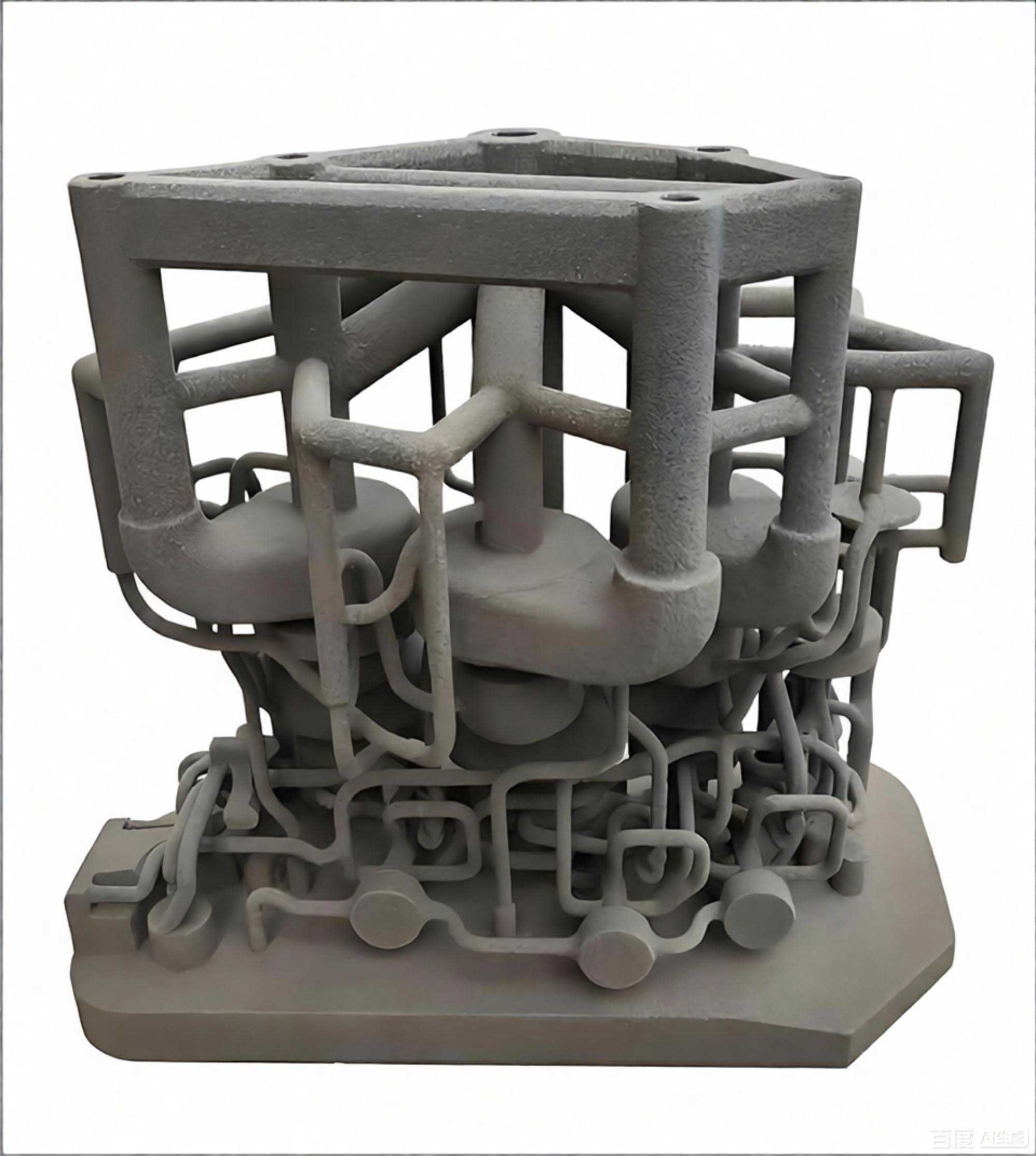
Electric motor housings represent an excellent use case for 3d printing sand casting because of their repetitive external fins. A typical motor housing may have between 40 and 100 cooling fins, each 100–120 mm deep, 4–8 mm thick, and spaced 5–6 mm apart. In traditional sand molding, these fins require separate segments to be assembled into the pattern. If the housing has 50 fins, the pattern maker must create 50 independent inserts. During mold extraction, each insert must be removed carefully without damaging the sand. This process is slow, labor-intensive, and prone to defects. If a single fin is damaged during withdrawal, the whole mold may be scrapped. 3d printing sand casting completely avoids this problem. Since the mold is printed additively, the sand structure is built in a way that includes the fins as part of the continuous geometry. There is no pattern withdrawal, no draft angle limitation, and no risk of damaging fragile sand sections during extraction. The fins can be printed with accurate thickness and spacing, guaranteeing the desired cooling performance of the final motor housing.
4. Technical Comparison with Conventional Processes
To provide a more rigorous understanding of the differences, I have compiled the following table comparing various aspects of conventional sand casting and 3d printing sand casting.
| Aspect | Conventional Sand Casting | 3D Printing Sand Casting |
|---|---|---|
| Pattern / tooling | Required (wood, plastic, metal) | Not required |
| Minimum quantity | Usually > 20 due to tooling amortization | 1 is viable |
| Maximum complexity | Limited by draft, undercuts, core assembly | Almost unlimited |
| Typical lead time | 6–12 weeks for tooling + 2 weeks for molding | 3–10 days |
| Dimensional tolerance | ±0.5 mm to ±1.0 mm | ±0.15 mm to ±0.3 mm |
| Surface finish | Rough, depends on sand and compaction | Good, consistent |
| Core handling | Multiple cores, manual assembly | Integrated cores, fewer or no assembly |
| Design change cost | High (tool modification) | Very low (file edit) |
| Sand reuse | Moderate | High with proper recycling |
| Automation level | Manual or semi-automatic | Fully automated digital workflow |
| Workforce requirement | Skilled molders | Engineers and machine operators |
From the table, it is clear that 3d printing sand casting excels in every dimension that matters for small-batch, high-value, complex components. However, I must also point out the limitations. The speed of printing is lower than the speed of a conventional molding machine on a per-part basis for simple geometries. For example, making a simple open sand mold with a conventional jolt-squeeze machine and a pattern may take only a minute, while a 3D printer may need several hours to complete the same mold. Therefore, for highly repetitive, simple parts with enormous production volumes, conventional molding remains more productive. 3d printing sand casting is more suitable for parts that are big, complex, or required in low volumes.
5. Process Details and Material Systems
Understanding the material and process parameters is essential for successful implementation. In binder jetting based 3d printing sand casting, the key inputs are:
- Sand media: silica sand, silica-free ceramic sand, chromite sand, or synthetic mullite sand.
- Particle size distribution: typically 0.1–0.2 mm average grain size, with roundness selected based on desired surface finish and binder uptake.
- Binder system: phenolic resin-based, furan-based, or inorganic binders such as sodium silicate.
- Hardener or activator: added to the sand before printing or sprayed together with the binder to initiate curing.
- Recoating system: precisely levels each new sand layer.
- Print head: jetting binder droplets onto the sand bed according to the slice pattern.
After printing, the sand mold or core must be cleaned to remove the loose, unbound sand. This is a crucial step, because any remaining loose sand inside cavities will contaminate the mold and lead to casting defects. The molds are then typically coated with a refractory wash to improve surface finish and prevent metal penetration. Finally, the molds are assembled, and molten metal is poured.
5.1 Sand Properties and Their Influence
The choice of sand affects the strength, permeability, and thermal conductivity of the mold. A commonly used sand for 3d printing sand casting is a round, thermal-reclamation-friendly silica sand with an AFM (American Foundry Society) grain fineness number around 70–90. The binder content is typically between 1.5% and 2.5%, much lower than some conventional no-bake systems. Because the sand is not mechanically rammed, the mold strength relies on the binder bridges between sand grains. The strength of the printed sand matrix can be characterized by the modulus of rupture (\(MOR\)). It is influenced by binder fraction \(b\), particle packing fraction \(\phi\), and curing degree \(\alpha\):
\[
MOR = k \cdot b^{\alpha} \cdot \phi^{\beta}
\]
where \(k\), \(\alpha\), \(\beta\) are empirical constants. In practice, a \(MOR\) of 1.5–3.0 MPa is sufficient for many casting applications.
| Sand Type | Advantages | Disadvantages | Application |
|---|---|---|---|
| Silica sand | Low cost, abundant | Thermal expansion, low refractoriness | Common for iron and steel |
| Chromite sand | High thermal conductivity, low expansion | Expensive, darker | Special steel, large castings |
| Ceramic sand | High refractoriness, round shape | Higher cost | Precision castings, high temperature |
| Inorganic bonded sand | No harmful fumes, easy reclamation | Lower strength, humidity sensitivity | Aerospace, automotive |
5.2 Binder Systems and Curing Chemistry
There are two main routes in 3d printing sand casting: furan-based and phenolic-based. Furan-based binders use furfuryl alcohol resin cured by an acid catalyst. This system is widely used in conventional no-bake sand casting and has been adapted for 3D printing. The acid is mixed into the sand before printing, and the resin is selectively jetted. After printing, the mold needs some time to reach adequate strength. Phenolic-bound systems, on the other hand, often use a two-part approach: a phenolic resin and a liquid ester activator. The activator is jetted by the print head onto the sand layer where the resin was pre-mixed. This system provides faster curing and is less sensitive to humidity. Inorganic binders based on sodium silicate are also gaining interest because they do not emit volatile organic compounds. However, inorganic binders tend to give lower tensile strength and poorer collapsibility after pouring, which can affect the shakeout process.
The curing reaction can be described simplistically as polymer crosslinking. The degree of crosslink formation \(X\) depends on time \(t\) and temperature \(T\) according to an Arrhenius-type kinetics:
\[
\frac{dX}{dt} = A \exp\left(-\frac{E_a}{RT}\right) f(X)
\]
where \(A\) is the pre-exponential factor, \(E_a\) is the activation energy, and \(R\) is the gas constant. In practice, the post-pouring thermal exposure can further cure the mold, which may increase strength but also reduce gas permeability.
6. Integration with Digital Manufacturing and Industry 4.0
One of the most exciting prospects for 3d printing sand casting is its natural compatibility with the broader digitalization of manufacturing. In a smart foundry, the entire workflow can be represented in the digital twin space. The process begins with a 3D solid model of the casting, generated by the customer or designed in-house. Then, casting simulation software calculates the optimal gating system, riser dimensions, and cooling channels. These are integrated into the mold design. The resulting mold CAD model is then sliced into layers, and the print job is generated automatically. Sensors on the printer monitor sand moisture, layer thickness, binder quantities, and environmental conditions. The resulting quality data can be stored for each mold, enabling full traceability of every casting.
This digital thread connects the casting supplier with the casting user. If the customer requests a design change, the new file can be transmitted over the internet, and a new mold can be printed at any location with a suitable printer. This enables distributed manufacturing, where molds are produced near the pouring facility, reducing shipping costs and lead times. It also allows for rapid response to unexpected failures or rush orders.
6.1 Generative Design Optimization
With the infinite design freedom offered by 3d printing sand casting, generative design algorithms can explore thousands of topology variations to find the lightest or strongest structure. The resulting geometry is often organic and highly complex, impossible to cast with traditional tooling but perfectly feasible with 3d printing sand casting. For example, a bracket component can be optimized to achieve a 40% weight reduction while maintaining the same stiffness. This is critical in aerospace and automotive industries, where every kilogram saved contributes to lower fuel consumption and emissions.
The optimization loop can be formulated as
\[
\min_{\mathbf{x}} V(\mathbf{x}) \quad \text{subject to} \quad \sigma_{max}(\mathbf{x}) \leq \sigma_{allow}, \quad u_{max}(\mathbf{x}) \leq u_{allow}
\]
where \(\mathbf{x}\) represents the design variables, \(V\) is the volume, \(\sigma_{max}\) and \(u_{max}\) are the maximum stress and displacement. Because 3d printing sand casting removes tooling constraints, the solution space is much larger, leading to better results.
7. Economic and Productivity Analysis
Let me present a more formal economic model to highlight the effectiveness of 3d printing sand casting. Consider a foundry that receives an order for \(N\) castings of a new component. The total cost under conventional sand casting is:
\[
C_{tot,conv} = C_{tool} + N \left( c_{mold} + c_{pour} + c_{finish} \right)
\]
where \(C_{tool}\) is the pattern and core box cost, \(c_{mold}\) is the molding cost per unit, \(c_{pour}\) is the melting and pouring cost per unit, and \(c_{finish}\) is the finishing cost per unit. Under 3d printing sand casting, the total cost is:
\[
C_{tot,3DP} = N \left( c_{print} + c_{pour} + c_{finish} \right) + C_{set}
\]
where \(c_{print}\) is the cost of printing the mold and \(C_{set}\) is the set-up cost (e.g., digital preparation, calibration). Because \(C_{tool}\) is often many times larger than \(C_{set}\), the conventional route is much more expensive for low \(N\). The crossover point \(N^*\) can be obtained by equating the two expressions:
\[
N^* = \frac{C_{tool} – C_{set}}{c_{print} – c_{mold}}
\]
Given that \(c_{print}\) may be higher than \(c_{mold}\), the denominator is positive but relatively small. If \(C_{tool} = \$30000\) and \(c_{print} – c_{mold} = \$200\), then \(N^* = 150\). This means that for production volumes below 150 pieces, 3d printing sand casting is cheaper. The exact number will vary, but the trend is clear: for many custom components, 3d printing sand casting is economically superior over a broad range of quantities.
| Cost Component | Conventional Sand Casting | 3D Printing Sand Casting |
|---|---|---|
| Front investment | High tooling cost ($10k–$500k) | Low set-up cost (digital) |
| Variable cost per mold | Low (sand + labor) | Higher (machine time + binder) |
| Post-processing | More manual finishing | Less flash, less variation |
| Scalability | Excellent for mass production | Excellent for mass customization |
8. Sustainability and Environmental Benefits
Sustainability is no longer an option; it is a necessity. Traditional sand casting has been criticized for its resource intensity and emissions. 3d printing sand casting contributes to sustainability in several distinct ways.
8.1 Waste Reduction
In conventional casting, the production of pattern tooling consumes wood, plastic, metal, and significant energy. Once the tooling is obsolete, it becomes scrap. 3d printing sand casting eliminates tooling waste entirely. Moreover, during the printing process, only the binder and a thin layer of sand are used to form the mold. The unmolded sand in the build box can be sieved and recycled with a high recovery rate, typically above 95%. This drastically reduces the amount of waste sand sent to landfill.
In conventional no-bake molding, the sand is mixed with binder and hardener, and after pouring, the used sand must be thermally or mechanically reclaimed. The lost sand can be 10–15%. In 3d printing sand casting, the unused sand in the build box is untouched by binder, so it can be directly reused. Only the printed part contains binder, and even that can be reclaimed using mechanical and thermal methods. This improves the overall material efficiency.
8.2 Lower Emissions
Binder jetting machines are closed systems. During sand spreading and binder jetting, the potential dust and chemical vapor emissions are contained and filtered. This is a major improvement over open bench molding operations where workers are exposed to silica dust and resin fumes. The reduction of volatile organic compound (VOC) emissions can be quantified. Let \(E_{voc}\) be the total VOC emission during mold making:
\[
E_{voc} = \sum_{i} m_i \cdot e_i
\]
where \(m_i\) is the mass of material \(i\) and \(e_i\) is the emission factor. Because 3d printing sand casting uses binders more efficiently and in a sealed environment, the overall \(E_{voc}\) is significantly lower.
8.3 Energy Consumption in Tooling Avoidance
The production of a large metal pattern machine or die consumes substantial energy from steelmaking, machining, and heat treatment. For a typical pattern, the embedded energy can be several MWh. By avoiding tooling entirely, 3d printing sand casting saves that energy. The energy used in printing is mainly for machine motion, binder drying, and possibly heating the build chamber. Modern printers are optimized to minimize energy consumption. Life cycle assessments show that for small batches, the energy footprint of 3d printing sand casting is lower than conventional casting, especially when tooling amortization is included.
9. Future Directions and Emerging Trends
The future of 3d printing sand casting is bright. I have identified several trends that will further advance the technology in the coming years.
9.1 Continuous Inkjet and Multi-Agent Printing
Current 3d printing sand casting systems use piezo or thermal drop-on-demand print heads. Future machines may use continuous inkjet arrays with hundreds of nozzles, enabling faster printing of larger sand molds. The print speed is currently limited by the number of passes the head must make over the sand bed. Multi-head or arrayed systems can increase productivity by a factor of 10. Additionally, hybrid printers that combine binder jetting with milling or laser scanning can eliminate the need for a separate CNC finishing operation, further reducing lead time.
9.2 In-Situ Process Monitoring and AI Control
The integration of sensors and artificial intelligence will make 3d printing sand casting a fully self-optimizing process. Machine learning algorithms can predict if a certain mold geometry is likely to crack or deform during printing or pouring, and they can automatically adjust the binder content, layer thickness, or path planning to avoid defects. In-situ cameras and infrared cameras can detect anomalies before they propagate. This will increase the reliability and consistency of printed molds to levels comparable to high-precision machining.
9.3 High-Temperature and Functionalized Materials
Research is underway to develop sand materials with even better thermal performance, such as zircon-based sands or synthetic ceramic spheres, which reduce metal penetration and improve the surface finish of high-temperature alloys. Another trend is the use of recycled or bio-based binders to minimize environmental impact. There is also work on hybrid materials, where the mold is printed with layers of different binders to create gradients in strength or permeability. For instance, the face layer of a mold could use a high-strength binder, while the backup layer uses a low-strength, high-permeability binder for efficient gas removal. This level of control is simply impossible in conventional molding.
9.4 Standardization and Qualification
For 3d printing sand casting to become a mainstream process, industry standards need to be developed. Many industries, especially aerospace and automotive safety-critical components, require rigorous qualification of new manufacturing processes. The casting community is working on standards that define acceptable defect levels, mechanical property validation, and inspection methods for 3d printed sand molds. Once these standards become widely accepted, adoption will accelerate significantly.
10. Practical Implementation Advice for Foundries
From my own experience, I would like to share some practical advice for foundries considering the transition to 3d printing sand casting.
10.1 Start with a Pilot Project
Select a component that is complex, currently difficult to cast, and needed in small volumes. Print its mold using a service bureau or an in-house printer. Compare the quality, lead time, and total cost with the conventional process. Use the data to build a business case. Do not start with a simple flat plate; the technology shines where complexity is high.
10.2 Invest in Design and Simulation Capabilities
The success of 3d printing sand casting is not just about the printer. It is about the digital mindset. Your engineers must be trained in casting simulation, generative design, and additive manufacturing design rules. Without simulation, you risk printing a mold with gating problems that will lead to rejects. The beauty of the digital workflow is that you can simulate the filling, solidification, and even residual stress for each unique design. This is a huge advantage over conventional trial-and-error.
10.3 Use a Hybrid Production Strategy
For components that will eventually enter mass production, I recommend using 3d printing sand casting during the development and pilot production phases. Once the design is stable and the process window is validated, invest in permanent tooling for high-volume manufacturing. This approach minimizes risk and avoids paying enormous tooling costs for an unproven design. It also allows for market feedback and engineering changes before the final commitment to expensive tools.
10.4 Integrate the Digital Thread
Connect the 3d printing sand casting machine with your ERP, MES, and quality management systems. Automate the file transfer, traceability, and reporting. Each printed mold can be identified with a unique QR code or embedded RFID tag, allowing the foundry to trace every mold, core, heat, and casting result. This level of traceability is increasingly demanded by customers and regulators.
11. Conclusion and Outlook
In conclusion, I firmly believe that 3d printing sand casting is not just a niche technique but a fundamental enabler of the modern foundry. The technology addresses the most pressing issues of the industry: high tooling costs, long lead times, labor shortages, complex geometries, and environmental concerns. By enabling tool-less manufacturing, digital design iterations, and distributed production, 3d printing sand casting provides a clear path toward the smart and sustainable foundry of the future.
The examples from steering components, engine parts, and motor housings demonstrate that the technology is already mature enough for industrial use. The economic models show that it is beneficial for small to medium production volumes and for any situation where design flexibility is critical. The environmental advantages are increasingly important as stricter regulations come into force. And the ongoing developments in machine speed, material choices, and digital integration promise even greater capabilities in the near future.
When we look at the global manufacturing landscape, the industries that will thrive are those that can respond quickly to customer needs, produce customizable products, and operate responsibly. 3d printing sand casting is perfectly aligned with these requirements. I expect that in the next five years, the adoption of 3d printing sand casting will grow exponentially, and it will become a standard tool in every progressive foundry. The road ahead is not without challenges, but the potential is enormous. For anyone in the casting industry, now is the time to explore what 3d printing sand casting can do for your products and your business. The digital revolution has reached the foundry floor, and it is embodied in the remarkable technology of 3d printing sand casting.
| Parameter | Traditional Casting | 3D Printing Sand Casting | Improvement |
|---|---|---|---|
| Average prototyping time (weeks) | 6–10 | 1–2 | 70–85% reduction |
| Tooling cost ($) | 20,000–200,000 | 0–2,000 | Almost eliminated |
| Minimum order quantity | 10–50 | 1 | Maximum flexibility |
| Complexity penalty | High | Negligible | Mold cost independent of shape |
| Modification time | Weeks | Hours to days | Rapid iterations |
| Overall scrap rate | 5–10% | 2–5% | Improved yield |
As a practitioner in the field, I have seen the excitement and skepticism surrounding every new manufacturing method. The skeptics once said that 3d printing sand casting would never be fast enough or strong enough for production. Yet today, the evidence is overwhelming: thousands of sand molds and cores are produced daily around the world using this technology. The evolution from rapid prototyping to rapid manufacturing is already happening, and 3d printing sand casting is at the heart of that transformation. It is not merely an alternative to conventional molding; it is a new paradigm that redefines what is possible in casting. I invite everyone in the foundry industry to seriously evaluate the benefits of 3d printing sand casting and to consider how this technology can be integrated into their specific process chains. The future belongs to those who embrace innovation, and 3d printing sand casting is undeniably the future of metal component manufacturing.