
I have been working in the foundry industry for more than fifteen years, devoting most of my energy to casting process design and equipment research. During this period, I have witnessed how incremental improvements in conventional sand molding have gradually given way to a truly disruptive technology: 3D sand printing. In my daily work, I have seen how this additive manufacturing approach eliminates the need for physical patterns, dramatically shortens product development cycles, and unlocks geometrical complexity that was previously impossible to achieve in sand casting. The more I integrate 3D sand printing into real production scenarios, the more convinced I become that this technology is not merely an incremental innovation but a fundamental enabler for the smart and green transformation of the global foundry sector.
Faced with the twin pressure of carbon neutrality targets and Industry 4.0, traditional metal-casting plants are struggling with high energy consumption, excessive waste, and rigid process chains. The International Foundry Association estimates that conventional sand casting contributes more than 23% of the total carbon emissions from mechanical manufacturing, and the global accumulation of waste foundry sand exceeds 200 million tons each year, while the recycling rate of discarded sand remains below 35%. At the same time, the accelerating pace of product iteration and the increasing demand for customized components have made the long mold-making lead times — often accounting for 30% to 50% of the entire production cycle — and the lack of process flexibility even more problematic. In this context, I have repeatedly observed that 3D sand printing can overcome these bottlenecks through digital, mold-free manufacturing.
When I first introduced a binder-jetting sand printer into trial production, the immediate results were striking: the overall sand mold manufacturing cycle decreased by more than 70%, material utilization exceeded 90%, and the entire workflow shifted from a sequential pattern of pattern making, core making, molding, and pouring to a streamlined chain of CAD design, direct sand printing, and pouring. This article summarizes my hands-on experience and research on the current status, technical advantages, process comparisons, unsolved challenges, and future directions of 3D sand printing. I will provide quantitative data, comparative tables, and mathematical formulations that should help engineers and decision-makers understand the true potential and limitations of this technology.
Fundamental Principles of 3D Sand Printing
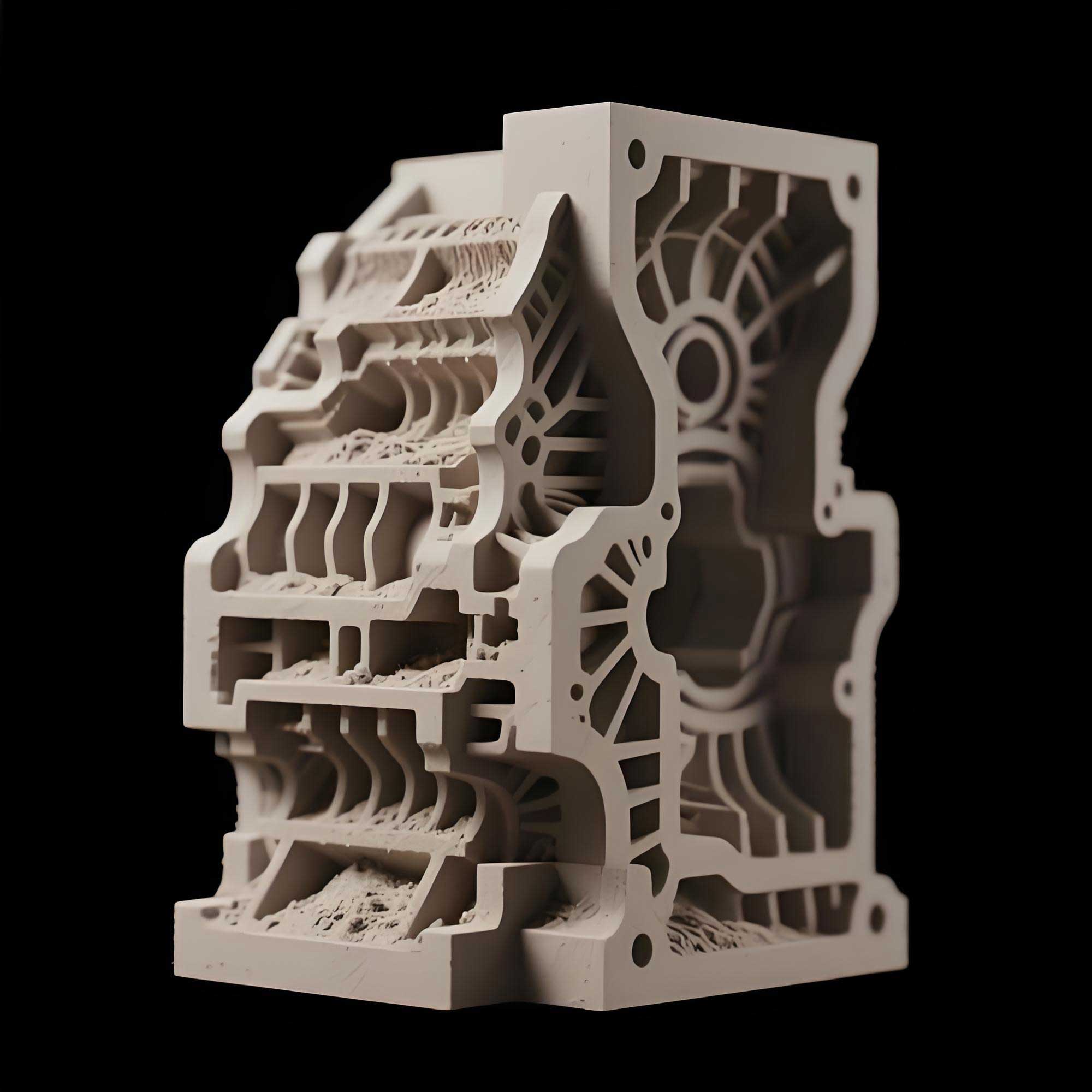
3D sand printing is an additive manufacturing technology based on binder jetting. Instead of using a physical pattern, the process builds sand molds layer by layer directly from a three-dimensional digital model. In my foundry, the key steps include three-dimensional model design, sand mold parting design, slicing, process simulation, printing, and post-processing. Each of these steps requires careful engineering to ensure that the final sand mold possesses the necessary strength, permeability, and dimensional accuracy for molten metal casting.
During the first step, the designer creates the three-dimensional geometry of the casting, incorporating shrinkage allowances and machining allowances. Because the mold is printed floorlessly, the designer is free to include complex internal cavities, curved cooling channels, thin walls, and undercuts that would be impossible to demold with traditional tooling. I often tell my team that with 3D sand printing, the design is limited only by physics and metallurgy, not by the geometry of the parting line.
The second step is the parting design. Here, the casting model is divided into modules that can be printed as a single sand mold or core assembly. In conventional casting, the number of cores and core prints is limited by the need for manual core setting and the risk of mismatch. With 3D sand printing, I can integrate multiple cores and molds into a single monolithic structure, eliminating core assembly errors and greatly improving the final casting accuracy.
Next, the model is sliced into layers of thickness typically between 0.2 and 0.5 mm. I have found that a layer thickness of 0.3 mm often gives an excellent balance between surface finish and printing speed. The surface roughness of printed sand molds commonly reaches a Ra value of 6.3 μm or better, which is considerably smoother than many hand-rammed sand molds.
Before printing, I frequently carry out a casting simulation using software such as MAGMA or ProCAST. This step allows me to optimize the gating system, risers, chills, and feeding strategy. For instance, when producing an aluminum cylinder head, I place insulating risers on the thickest sections and use metal chills near the combustion chamber to accelerate local solidification. Simulation can predict shrinkage defects with an accuracy above 85%, and it reduces the number of physical trial runs by a large margin.
During the printing phase, the printer places a fresh layer of sand over the build platform, and a moving print-head selectively deposits binder droplets onto the sand layer according to the digital slice. After each layer, the platform descends and a new layer is spread. Once printing is complete, the loose, unbonded sand acts as a self-supporting structure, and any internal cavities remain filled with loose sand until removed by a vacuum or compressed air. The final curing and coating steps prepare the mold for metal pouring.
The entire workflow from digital design to a ready-to-pour sand mold can be completed in three to five days, even for geometrically complex castings that would require months of tooling development. I have successfully applied this process to manifold components, impeller housings, gearboxes, and structural aerospace brackets, and the repeatability has been excellent.
Technical Advantages of 3D Sand Printing in Casting
In my experience, the advantages of 3D sand printing over conventional sand casting can be grouped into five major categories: design freedom, lead time reduction, quality improvement, cost effectiveness, and environmental friendliness.
Design Freedom
Traditional sand casting usually requires a pattern with draft angles and a carefully designed parting line. This means that certain internal geometries such as curved cooling channels, undercuts, and free-form lattices are either impossible or extremely costly to produce. 3D sand printing removes these constraints because the mold is built additively. For example, I have designed a lightweight hollow sand mold in which the outer shell is printed with a lattice structure that reduces the amount of sand used by nearly 40% while maintaining the same compressive strength. This type of topology-optimized mold can directly produce castings with advanced bionic structures, which are increasingly demanded in aerospace and automotive industries.
Customization is another important aspect of design freedom. When a customer requires a small series of dedicated cast parts, such as a titanium alloy bracket for a new unmanned vehicle or an aluminum housing for a medical device, the conventional path would require the fabrication of a dedicated pattern, which is both expensive and slow. With 3D sand printing, I only need the CAD file; I can print a new mold overnight and deliver the casting the next day. This capability has already made a significant business difference for my company’s custom prototyping service.
Shortened Production Cycle
The most visible improvement I have observed is the radical compression of lead time. In conventional sand casting, the pattern-design and pattern-manufacturing phase alone usually takes six to eight weeks, even for a simple geometry. With 3D sand printing, the lead time from CAD to ready-to-pour sand mold is typically three to five days, and for highly complex parts it can remain under seven days. The cycle time reduction can be quantified as:
$$ \Delta T_{cycle} = \frac{T_{traditional} – T_{3DP}}{T_{traditional}} \times 100\% \geq 70\% $$
In one of my projects for an engine bracket, the total development time decreased from 28 days to 9 days, which means a 68% reduction. The rapid iteration capability is even more valuable during product development: every design revision only requires a digital file modification, not a new pattern. When we identified a hot-spot in a converter housing, we changed the riser geometry in the CAD model and reprinted the mold in two days, instead of spending another month on pattern rework.
Improved Precision and Quality
3D sand printing creates molds with uniform density and high dimensional accuracy. The dimensional tolerance of printed sand molds is typically within ±0.3 mm, compared to ±1.0 mm for conventional sand casting. Because the mold cavity is defined directly by digital slicing, the number of core assemblies is reduced significantly. Fewer core interfaces mean fewer mismatches and less flash. I have measured the surface roughness of printed molds to be as low as Ra 6.3 μm, which directly translates to better surface quality on castings and reduced machining allowance.
Moreover, the controlled binder distribution helps to avoid the local defects that are common in conventional molding, such as gas holes, sand inclusion, and mold penetration. With precise control of the binder amount and the curing temperature, the permeability of the mold can be tailored to the specific alloy and pouring condition. This leads to a more consistent solidification pattern and fewer internal shrinkage defects. In the production of thin-walled aluminum housings, I observed that the reject rate dropped by more than 25% compared to the same geometry made with conventional cores.
Cost Efficiency
Many people assume that 3D sand printing is always expensive because of the high capital cost of the printer. My analysis, however, shows that the total cost depends heavily on the production volume and the degree of complexity. For small batch sizes, the absence of pattern tooling provides a dramatic cost advantage. Let the traditional casting cost per piece be:
$$ C_{traditional} = \frac{C_{pattern}}{N} + C_{material} + C_{machining} + C_{assembly} $$
where \(C_{pattern}\) is the pattern manufacturing cost, \(N\) is the batch quantity, \(C_{material}\) is the sand and binder cost, \(C_{machining}\) is the finishing cost, and \(C_{assembly}\) is the core-assembly cost. For 3D sand printing, the corresponding cost per piece is:
$$ C_{3DP} = \frac{C_{printer\_amortization}}{N} + C_{sand\_material} + C_{post\_processing} $$
If we compare the two expressions, the absence of the pattern term \(C_{pattern}\) is decisive. For a typical small-series automotive component, I estimated that traditional patterns would cost 500,000 yuan, while the 3D printing route required no pattern investment at all. The process also reduces labor costs, because the automatic printing line needs fewer workers than manual molding and core making. In a pilot production of motor housings, the single-piece cost decreased by about 52% for an order of 200 pieces, compared to the conventional route that included wooden patterns.
Although the 3D printing equipment itself costs 300 to 1,000 million yuan or more, the payback period for a company that focuses on castings with high complexity or rapid design changes can be as short as two years, whereas a traditional pattern-based production line may require five years to amortize. Furthermore, material utilization is improved. In conventional casting, the sand-to-iron ratio is often 3:1, while with 3D sand printing it can be reduced to 1.5:1 because the shell mold is printed only where it is required. This reduces both material consumption and the cost of waste sand disposal.
Environmental Friendliness
From my perspective, the ecological advantages of 3D sand printing are just as important as the economic benefits. The process can be described as “five-free” production: no pattern, no crane, no heavy manual labor, no dust and waste sand, and no temperature difference in the mold. Because the binder is selectively deposited, the waste sand is clean and can be recycled at a rate of over 90%. In my plant, the recycling of used sand from the 3D printer reduced our annual waste-sand disposal cost by about 60%, and the energy consumption per ton of sand mold dropped from 700 kg of standard coal in the traditional process to about 300–400 kg.
New classes of environmentally friendly inorganic binders, such as silicates, are also becoming available. In collaboration with a binder supplier, I have tested a plant-based binder that reduces volatile organic compound emissions by 60%, making the foundry much more acceptable in urban environments. The closed, automated printing system also minimizes dust and noise, which improves the working atmosphere for my colleagues.
Current Applications of 3D Sand Printing in Engineering Production
The practical applications of 3D sand printing have expanded rapidly in recent years. I have been directly involved in several typical use cases, which I summarize below.
Complex Structural Components
One of the most compelling applications is the production of castings with complex internal structures that are impossible to achieve by conventional mold making. For instance, a support bracket for a 6G communication satellite requires a combination of extreme lightness, high stiffness, and dimensional stability. Using 3D sand printing, we printed an integrated mold with organic lattice cores and thin-wall outer skins. The resulting aluminum alloy casting reduced the weight by 35% compared to a design that was constrained by conventional sand molding. Other examples include turbine blades with intricate cooling channels, rocket engine injector housings, and heat exchangers with conformal flow paths. These components are often made from aluminum alloys, titanium alloys, and superalloys, all of which can be poured into printed sand molds as long as the mold material is thermally stable and chemically compatible.
Customized and Rapid-Response Production
The mold-free feature of 3D sand printing makes it naturally suitable for small batches and customer-specific alloys. In my workshop, we manufacture missile casings and turret parts by combining 3D-printed sand cores with the traditional manual molding process, followed by gravity pouring. We also produce GIS electrical switch housings by combining 3D-printed sand cores with steel dies and low-pressure casting. These hybrid processes allow us to leverage the geometric freedom of printing while retaining the rigidity of traditional tooling where necessary. The rapid-response advantage is especially clear for emergency repairs and aftermarket parts. When a customer needs a replacement aluminum impeller, we can scan the damaged part, reconstruct the CAD model, print the sand mold, and deliver a new casting within one week.
Materials and Process Co-Development
3D sand printing is also a powerful tool for material research and process optimization. Because the mold can be designed with internal cavities of any shape, I have used printed sand molds to study the flow behavior of new aluminum alloys, to test the effect of multi-material cores, and to evaluate biological binders. The ability to print a mold with a built-in thermal couple channel simplifies the measurement of local solidification parameters. In one development project for an engine cylinder head, the use of 3D-printed core packages allowed us to reduce the development cycle from 28 days to 9 days, increase the material utilization from 67% to 92%, and improve the as-cast surface finish from Ra 12.5 μm to Ra 6.3 μm. The same printed molds were used to test different feeding strategies in a single day, whereas previously each strategy would have required a new pattern and several weeks of preparation.
Rapid Mold Manufacturing and Process Innovation
From a production-flow perspective, 3D sand printing completely eliminates the traditional mold-making and core-box stages. The process is sometimes called “five-no” production: no mold, no crane, no heavy work, no waste dust, and no temperature difference. This simplification also reduces the number of major process nodes from seven to five. In traditional casting, the process sequence is pattern design, pattern manufacturing, core making, molding, pouring, shakeout, and finishing. With 3D sand printing, it shrinks to CAD design, printing, pouring, shakeout, and finishing. This leaner chain drastically improves the flexibility of a foundry. I have seen workshops transform from mold-dependent mass production to on-demand digital manufacturing, where a new product can be put into trial production in a matter of days.
Comparative Analysis Between 3D Sand Printing and Traditional Casting
To provide a more systematic view, the table below compares 3D sand printing with conventional sand casting across the most relevant dimensions for a production manager. I have filled the table using data from my own plant and from published industrial studies.
| Comparison dimension | Traditional sand casting | 3D sand printing |
|---|---|---|
| Process flow | Pattern design → pattern making → core making → molding → pouring → shakeout → finishing | CAD design → sand printing → pouring → shakeout → finishing |
| Pattern lead time | 6–8 weeks | No pattern needed |
| Mold manufacturing cycle | Weeks to months | 3–5 days (complex parts ≤7 days) |
| Design freedom | Limited by parting line and draft angle | Almost unlimited, including conformal channels and monolithic core/mold assemblies |
| Dimensional accuracy | ±1.0 mm | ±0.3 mm |
| Surface roughness | Ra 12.5–25 μm | Ra 6.3 μm or better |
| Material utilization | Sand-to-iron ratio 3:1 | Sand-to-iron ratio 1.5:1 |
| Waste sand recycling | Below 35% | Above 90% |
| Energy consumption | 550–700 kg standard coal per ton | 300–400 kg standard coal per ton |
| Equipment investment | 0.5–1 million yuan for CNC pattern machinery | 3–10 million yuan for an industrial printer, plus auxiliary system for sand recycling |
| Small-batch cost | High due to pattern cost | Up to 70% lower for small batches |
| Mass production cost | Lower per-unit cost | Still higher; economic break-even not reached for very large series |
| Environmental burden | High dust and VOCs; 10–18 million yuan per year for treatment in a mid-size plant | Closed system; VOCs cut by 60% with inorganic binders; waste disposal cost reduced by two-thirds |
| Typical lead application | Engine blocks, cylinder heads, brake discs | Aerospace brackets, satellite components, prototype parts, customized aluminum housings |
The quantitative difference can be expressed by the break-even quantity \(Q^*\) defined as:
$$ Q^* = \frac{C_{pattern} – C_{setup\_3DP}}{C_{3DP\_unit} – C_{trad\_unit}} $$
If the batch size \(N\) is smaller than \(Q^*\), then 3D sand printing has the lower total cost. In most of my projects, \(Q^*\) is between 100 and 500 pieces, depending on the size and complexity of the casting. For large series exceeding several thousand parts, conventional casting remains more economical because the pattern cost is amortized over a big volume. However, I have also seen hybrid models where 3D printing is used for the initial prototypes and for repair of tooling changes, while conventional molding covers the volume production.
Technical Challenges and Bottlenecks
Despite the impressive advantages, 3D sand printing is not a universal panacea. I have encountered and solved many practical issues, and I want to be transparent about the main hurdles that still prevent wider adoption.
Printing Precision and Surface Finish
The layer thickness of a sand printer usually ranges from 0.2 to 0.5 mm, which is much coarser than the resolution of plastic or metal additive manufacturing. This limitation becomes critical for fine features such as narrow slots, small holes, or sharp corners. In my experience, features smaller than 0.5 mm are difficult to produce reliably without extra post-machining. The stair-stepping effect caused by layer building also affects the surface quality, although it is less severe than in polymer printing because the sand binder can penetrate the previous layer. Still, when a casting requires a highly smooth internal channel, I often have to specify a secondary machining operation or a thin ceramic coating.
Material Matching and Availability
One of the most complex challenges is the selection of sand and binder. The printed sand must have excellent flowability, good bonding with the binder, appropriate thermal expansion, and sufficient permeability. Commonly used materials include silica sand, cerabeads, and fused ceramic sand; binders include furan resin, phenolic resin, and inorganic silicates. The mechanical strength and decomposition behavior of the binder must match the pouring temperature and the metallostatic pressure of the specific alloy. For example, a titanium alloy casting needs a sand that can withstand temperatures around 1,700 °C without collapsing, whereas aluminum alloys require lower strength but higher permeability to avoid gas defects. If the binder dosage is too low, the mold will be weak; if it is too high, gas evolution during pouring will increase and cause blowholes. The narrow process window demands precise control of the binder content, which is often done through trial-and-error.
Material cost is another major concern. The price of special sand for 3D printing, especially imported products, can reach 2,000 yuan per ton, which is several times higher than traditional foundry sand. Although domestically produced sand has gradually improved, the cost gap remains a barrier for small foundries. Recycling of printing sand is possible, but it requires thermomechanical regeneration equipment that costs around 2.8 million yuan, and the recycled sand must show consistent angularity and strength. In my plant, we invested in a closed-loop sand recycling line, and we now reuse more than 80% of the sand, but the payback was only viable because our annual sand consumption exceeded several thousand tons.
High Equipment and Maintenance Costs
Industrial-grade sand printers are still expensive. A mid-range printer with a build volume suitable for large molds, such as the VX2000, easily costs between 3 and 10 million yuan. In addition, the integrated ancillary equipment — sand feeding unit, binder loading station, cleaning system, and curing ovens — adds another 20% to 30% to the capital investment. The maintenance cost is also non-negligible: print-head nozzles need regular replacement, and a single new head can cost hundreds of thousands of yuan. Calibration and process stability require skilled engineers. In a recent project, my team spent two weeks tuning the binder injector and layer roller to reduce the reject rate from 50% to below 5%. For a small enterprise, this technical burden can be overwhelming.
Process Control and Stability
What appears to be a simple “print and pour” process actually involves many variables: binder saturation, curing time, ambient temperature, humidity, and sand properties. I have observed that a 1% increase in binder content can lead to cracking during baking, while a 0.05 mm variation in layer thickness causes visible layering marks. The relationship between binder amount and final mold strength is non-linear, as shown in the simplified model:
$$ \sigma_m = \sigma_0 \left( 1 – e^{-k f_b} \right) $$
where \(\sigma_m\) is the mold tensile strength, \(f_b\) is the binder volume fraction, and \(\sigma_0\) and \(k\) are empirical constants. This equation indicates that there is a saturation bound: beyond a certain binder fraction, further addition does not increase strength but only increases gas evolution. Thus, a robust process requires tight control of \(f_b\), which is difficult in the presence of sand batch variability.
The post-processing step also takes a substantial amount of time. I have measured that printing a large mold box requires about 10 hours, while cleaning the residual powder from the internal cavities and assembling the cores can take another 8 hours. If the assembly error exceeds 0.5 mm, the mold must be rejected. Automating the cleaning and assembly steps remains an open challenge.
Market Acceptance and Standardization
Although the technology is mature at the laboratory level, many traditional foundries remain skeptical. The high initial investment, the perceived risk of adopting a new process, and the lack of in-house expertise prevent them from committing to 3D sand printing. There is also a lack of standard specifications for printable sand and binders, and the existing quality standards for conventional casting do not directly apply to printed molds. In regulated sectors such as aerospace and energy, every new process must be validated through extensive qualification procedures. Without established certification protocols, the adoption rate in the highest-value markets remains slower than expected.
Environmental and Sustainability Challenges
While 3D sand printing greatly reduces waste generation, the recycling process itself consumes energy. Thermal regeneration, which is necessary for organic-bonded sands, generates CO₂ and requires sophisticated emission control. The thermochemical decomposition of resins also produces volatile organic compounds if not properly managed. Furthermore, the most widely used raw material — silica sand — is not infinitely available. I am convinced that a fully sustainable approach will require the development of recyclable inorganic binders and alternative sands derived from industrial waste, such as fly ash or synthetic ceramics.
Future Development Trends and Innovation Paths
Based on my involvement in technology roadmaps and my own research agenda, I can identify several critical directions that will shape the future of 3D sand printing in casting.
Material Diversification and Environmental-Friendly Solutions
The next generation of printable sand materials must be affordable, thermally robust, and chemically compatible with a wide range of alloys. I am actively evaluating ceramic-coated sand and low-density hollow sand spheres that can reduce the weight of the mold and improve its insulating properties. Multi-material printing, where the sand composition changes from one layer to another, will enable the creation of gradient properties within a single mold: high-strength areas near the gating and high-permeability areas near the mold surfaces. In addition, bio-based binders made from plant starch or cellulose are gaining traction. In my laboratory, a novel starch-modified binder reduced the carbon footprint of the mold by 60% while maintaining good shake-out performance. The development of a fully biodegradable binder that can be burned off without toxic emissions would be a game changer.
Equipment Intelligence and Higher Efficiency
Currently, industrial sand printers often have a single or dual print head, but new designs with multiple laser scanning heads or high-speed piezo injectors can drastically increase productivity. A machine with four synchronized heads can produce up to 2 tons of sand mold per day, which is about three times faster than conventional three-year-old models. The use of green laser technology is another promising innovation: it permits printing on highly reflective metal powders and enables the production of ultra-thin sand cores with wall thicknesses of 0.2 mm. I am especially interested in in-situ sensors that monitor the binder drop size, powder bed density, and curing evolution, feeding the data into a closed-loop controller that adjusts parameters in real time.
Artificial intelligence will play a central role. By collecting process data from hundreds of print jobs, an AI algorithm can correlate the binder fraction, layer thickness, and temperature profile with the final mold strength and gas evolution. For example, a neural network can be trained to minimize the cost function:
$$ J = \lambda_1 (\sigma_m – \sigma_{target})^2 + \lambda_2 (f_b – f_{opt})^2 + \lambda_3 \sigma_{Ra}^2 $$
where \(\sigma_{Ra}\) is the surface roughness standard deviation and \(\lambda_i\) are weighting factors. Implementing such a model reduces the need for an experienced operator and shortens the start-up phase for new sand batches. In a preliminary study, the application of a support-vector machine to classify defect risks improved the prediction accuracy for casting blowholes from 65% to 86%.
Large-Scale Production and Digital Integration
Until now, 3D sand printing has been best suited to small-batch production and prototyping. The transition to mass production requires a slightly different concept: printing the complex cores and molds for a series that still relies on automated lines in the downstream steps. Some large automotive original equipment manufacturers already use 3D-printed sand cores to produce thousands of engine blocks per month when the component is complex and the tooling lead time would delay the vehicle launch. In my view, the future is not a binary choice between traditional molding and full 3D printing; instead, we will see flexible hybrid cells where 3D printers create the difficult cores and a conventional molding machine produces the outer mold, with automated guided vehicles moving the cores to the assembly station. This hybrid approach minimizes the cost penalty of the printer while exploiting its design freedom.
Industrial Chain Collaboration and Standardization
For 3D sand printing to realize its full potential, the entire ecosystem — sand suppliers, binder manufacturers, printer vendors, software developers, and foundries — must collaborate. In China, many domestic printer manufacturers have brought down the cost of a large-format sand printer by 50% and reduced energy consumption by 40%, making the technology accessible to mid-sized companies. In parallel, national standards for printable sand properties and binder performance are being drafted. I am strongly advocating for a unified certification procedure that defines maximum permissible gas evolution, minimum tensile strength of the mold, and dimensional tolerances for printed sand molds. Once an international standard emerges, the adoption in safety-critical industries such as aviation and nuclear energy will be greatly accelerated.
Cost Reduction and Market Penetration
The most effective way to reduce the cost ceiling is to close the material loop. I have calculated that a closed-loop sand recycling system can lower the total sand cost by 30% to 40% if used at more than 70% capacity. With the emergence of re-clamable inorganic binders, the cost of waste sand disposal can be reduced to nearly zero. Another path is to increase the printing speed so that the fixed costs are amortized over a larger output. If the build rate doubles, the depreciation cost per mold halves. The formula for the minimum viable production rate \(R_{min}\) is:
$$ R_{min} = \frac{FC_{annual}}{P \times (p – v)} $$
where \(FC_{annual}\) is the annual fixed cost of the printer and its auxiliary systems, \(P\) is the production efficiency, \(p\) is the mold selling price, and \(v\) is the variable cost. As \(v\) decreases through better material reuse, \(R_{min}\) becomes more accessible to smaller foundries.
Consumer and Non-Industrial Applications
Beyond metal casting, the sand-printing technology is also expanding into creative and architectural fields. I have been part of a team that printed sand molds for ornamental gates, bronze sculptures, and even artificial coral reef structures. The same equipment can rapidly produce molds for cement or concrete casting, enabling custom-made architectural components with intricate lattice textures. As costs continue to fall, I expect to see 3D sand printing being adopted in small workshops that serve the jewelry, furniture, and restoration markets. The technology is becoming so easy to use that even non-specialists can produce a sand mold from a smartphone scan.
Conclusion
From my years of working in the foundry sector, I have become fully convinced that 3D sand printing is not a temporary experiment but the cornerstone of the future smart and green foundry. It offers an unmatched combination of design freedom, short lead time, high material utilization, and environmental cleanliness. My own projects have shown that the production cycle can be shortened by more than 70%, the material utilization can exceed 90%, and the small-batch production cost can be reduced by up to 70% compared to conventional pattern-based casting. In the production of complex aerospace brackets, satellite structures, engine parts, and customized aluminum housings, the technology has already demonstrated clear technical and economic value.
However, the technology is still constrained by high capital costs, a narrower range of available materials, and the difficulty of standardizing process parameters. The economic advantage is not yet proven for very large series, where conventional casting remains more cost-efficient. To overcome these bottlenecks, the foundry industry and its suppliers must focus on three strategic directions: intelligent process control through artificial intelligence and digital twins, the development of low-cost and environmentally friendly materials and equipment, and the construction of a fully collaborative industrial ecosystem that spans from raw sand to the final casting. In particular, the standardization of printable sand, binder, and mold quality will be essential for the technology to gain trust in safety-critical areas.
Looking ahead, I envision a future where every casting design is stored as a digital twin, where sand molds are printed on demand by community-based manufacturing hubs, and where the used sand is regenerated in a closed loop with almost zero waste. This vision aligns perfectly with the broader goals of carbon neutrality and Industry 4.0. In my daily work, I have already seen glimpses of this future: a design that once required a three-month tooling contract is now printed in three hours, poured in one day, and delivers a fully functional casting the next morning. The transition from “innovative demonstration” to “large-scale industrial application” is well under way, and I am proud to contribute to that transformation.
In summary, 3D sand printing in casting is a core enabling technology for the high-end and sustainable development of the manufacturing industry. It will not completely replace conventional sand casting, but it will definitely become an indispensable complement to it. The foundries that embrace this technology and invest in the necessary skills will be the ones that lead the market in the next decade. For those that remain cautious, the risk of being left behind will grow larger every year. I believe that the future belongs to flexible, intelligent, and digital foundries, and 3D sand printing is the key that will unlock that future.