
In high-grade ductile iron casting production, shrinkage porosity remains a critical challenge affecting structural integrity and leak-tightness. This article presents systematic solutions developed through case studies on diesel engine cylinder heads, emphasizing practical methodologies for defect prevention while maintaining mechanical properties.
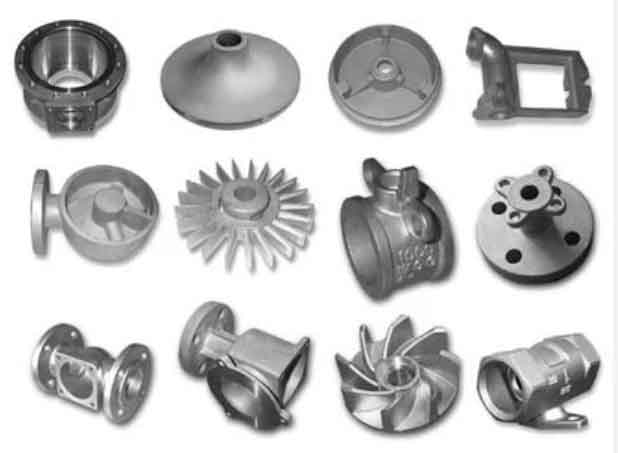
1. Fundamental Principles of Shrinkage Formation
Shrinkage defects in ductile iron casting originate from two-phase solidification characteristics:
$$ \frac{dV}{dt} = \alpha \cdot \Delta T \cdot C_e^{1.5} $$
Where:
α = solidification contraction coefficient (0.015-0.025 for ductile iron)
ΔT = temperature gradient (K)
Ce = carbon equivalent
| Material Property | Gray Iron | Ductile Iron |
|---|---|---|
| Solidification Range | 30-50°C | 60-100°C |
| Shrinkage Tendency | Low-Moderate | High |
| Critical Section Thickness | 15-20mm | 8-12mm |
2. Chilling Strategies for Thermal Management
Effective heat extraction requires precise calculation of chill dimensions. For external chills:
$$ M_c = 0.8 \cdot \frac{V_h \cdot \rho \cdot c_p}{\Delta T \cdot k} $$
Where:
Mc = chill mass (kg)
Vh = hot spot volume (m³)
ρ = metal density (7,200 kg/m³)
cp = specific heat (620 J/kg·K)
| Chill Type | Cooling Efficiency | Defect Reduction |
|---|---|---|
| External Chill | 25-40% | 30-50% |
| Internal Chill | 60-75% | 70-85% |
| Hybrid System | 85-95% | 90-95% |
3. Process Optimization Framework
The thermal equilibrium equation for ductile iron casting systems:
$$ Q_{total} = Q_{casting} + Q_{chills} + Q_{mold} $$
$$ Q_{casting} = m \cdot [c_p \cdot (T_p – T_s) + L_f] $$
Key process parameters for high-grade ductile iron casting:
| Parameter | Optimal Range |
|---|---|
| Pouring Temperature | 1,380-1,420°C |
| CE Value | 3.9-4.1 |
| Mg Residual | 0.03-0.05% |
| Inoculant Addition | 0.6-0.8% |
4. Integrated Defect Prevention Methodology
The defect probability function for ductile iron casting:
$$ P_d = 1 – e^{-\left(\frac{t_{crit}}{t_{solid}}\right)^n} $$
Where:
tcrit = critical solidification time (s)
tsolid = actual solidification time (s)
n = material constant (1.8-2.2)
5. Industrial Validation Results
Implementation of hybrid chilling systems in ductile iron casting demonstrated:
| Metric | Before Optimization | After Optimization |
|---|---|---|
| Leakage Rate | 70% | 3.8% |
| UT Rejection | 45% | 6.2% |
| Production Yield | 68% | 92% |
6. Advanced Solidification Modeling
The modified Niyama criterion for ductile iron casting:
$$ NY_{mod} = \frac{G}{\sqrt{\dot{T}}} \cdot \left(1 + 0.5 \cdot \%Si\right) $$
Critical threshold values:
– Macroporosity: NYmod < 0.75
– Microporosity: 0.75 < NYmod < 1.25
7. Quality Assurance Protocol
Recommended testing matrix for ductile iron casting components:
| Test Type | Frequency | Acceptance Criteria |
|---|---|---|
| X-ray Inspection | 100% | ASTM E505 Level 2 |
| Pressure Test | 100% | 5 bar, <0.5% drop/5min |
| Metallography | Per Heat | Nodularity >85% |
Through systematic optimization of chilling strategies and process parameters, ductile iron casting manufacturers can achieve reliable production of complex components while maintaining stringent quality requirements. The hybrid chilling approach demonstrates particular effectiveness in managing thermal gradients and reducing shrinkage-related defects in critical applications.