
The rapid growth of nuclear power generation has intensified the need for reliable solutions in spent nuclear fuel (SNF) management. As a critical material for SNF storage and transportation containers, ductile iron casting demonstrates unique advantages in radiation shielding, mechanical robustness, and cost-effectiveness. This article systematically explores its chemical design, solidification mechanisms, and performance optimization strategies through advanced metallurgical principles.
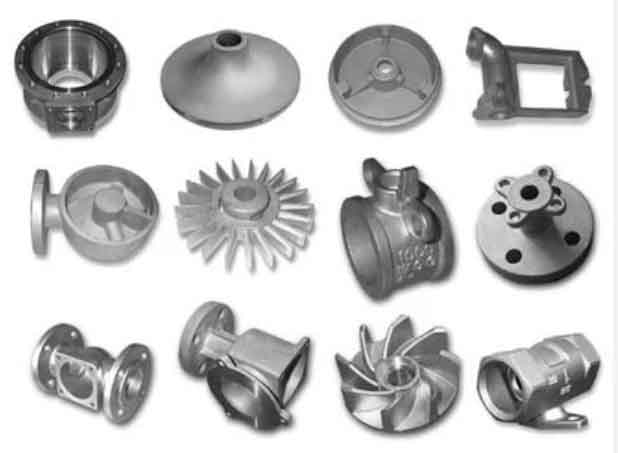
1. Technical Requirements for SNF Containers
Ductile iron casting containers must satisfy stringent performance criteria as per IAEA SSR-6 and GB/T11806-2019 standards:
$$ \text{Mechanical Integrity Condition: } \sigma_y \geq 200\text{MPa}, \sigma_u \geq 300\text{MPa}, \delta \geq 12\% $$
$$ \text{Thermal Resistance: } T_{\text{fire}} = 800^\circ\text{C}, t_{\text{exposure}} \geq 30\text{min} $$
$$ \text{Impact Toughness: } CVN_{-40^\circ C} \geq 4\text{J} $$
| Property | JIS G5504 | Nippon Steel | Siempelkamp |
|---|---|---|---|
| Wall Thickness (mm) | ≤550 | 480 | 630 |
| Tensile Strength (MPa) | ≥300 | ≥300 | ≥360 |
| Yield Strength (MPa) | ≥200 | ≥220 | ≥258 |
| Elongation (%) | ≥12 | ≥10 | ≥9 |
2. Metallurgical Design of Ductile Iron Casting
The chemical composition directly determines graphite morphology and matrix structure in heavy-section ductile iron castings:
$$ \text{Carbon Equivalent: } CE = \%C + 0.33(\%Si) + 0.047(\%Mn) $$
Optimal CE ranges between 4.3-4.6 to prevent carbide formation while ensuring proper graphite nucleation.
| Element | JIS G5504 | Typical Composition |
|---|---|---|
| C | ≥3.0 | 3.60-3.65 |
| Si | ≤2.7 | 1.80-2.01 |
| Mn | ≤0.4 | 0.12-0.27 |
| Mg | – | 0.04-0.065 |
Trace element control follows:
$$ \sum (Cr + V + Mo + Sn + Sb) \leq 0.1\% $$
$$ \sum (Pb + Bi + Te) \leq 0.006\% $$
3. Solidification Dynamics in Heavy-Section Castings
The solidification time (tsolid) for thick-walled ductile iron casting follows Chvorinov’s rule:
$$ t_{\text{solid}} = k \left( \frac{V}{A} \right)^n $$
Where k=1.2-1.5 for sand molds and n=1.5-2.0. For a 500mm wall container:
$$ t_{\text{solid}} \approx 8.2\text{hrs (sand)} \rightarrow 2.1\text{hrs (chilled mold)} $$
Cooling rate significantly affects graphite characteristics:
| Cooling Rate (°C/s) | Graphite Nodules/mm² | Nodule Diameter (μm) |
|---|---|---|
| 0.5 | 80-120 | 80-120 |
| 2.0 | 150-200 | 50-80 |
| 5.0 | 300-400 | 30-50 |
4. Heat Treatment Optimization
The ferritizing annealing process enhances ductility through phase transformation:
$$ \text{Austenitizing: } 900^\circ\text{C} \times 2\text{hr} \rightarrow \text{Furnace Cooling} $$
$$ \text{Resultant Microstructure: } \alpha_{\text{Fe}} \geq 90\%, \text{Graphite Spheroidity} \geq 80\% $$
Mechanical property evolution during annealing:
| Condition | σu (MPa) | σy (MPa) | δ (%) |
|---|---|---|---|
| As-Cast | 420-450 | 280-300 | 8-10 |
| Annealed | 380-400 | 230-250 | 18-22 |
5. Radiation Shielding Performance
The linear attenuation coefficient (μ) for ductile iron casting demonstrates superior gamma-ray shielding:
$$ \mu = \rho \sum w_i \left( \frac{\mu}{\rho} \right)_i $$
Where ρ=7.1g/cm³ and wFe=94%. Comparative shielding thickness at 1MeV:
$$ t_{\text{iron}} = 11\text{cm} \quad vs \quad t_{\text{concrete}} = 33\text{cm} $$
6. Future Development Trends
Emerging research focuses on three key areas for ductile iron casting applications:
- Hybrid composite structures with borated polyethylene inserts
- Additive manufacturing for complex internal cooling channels
- Machine learning-based solidification prediction models
Through continuous innovation in metallurgical design and manufacturing processes, ductile iron casting maintains its position as the most cost-effective and reliable material solution for nuclear waste containment systems. The combination of proven performance and ongoing technological advancements ensures its dominant role in next-generation SNF management infrastructure.