
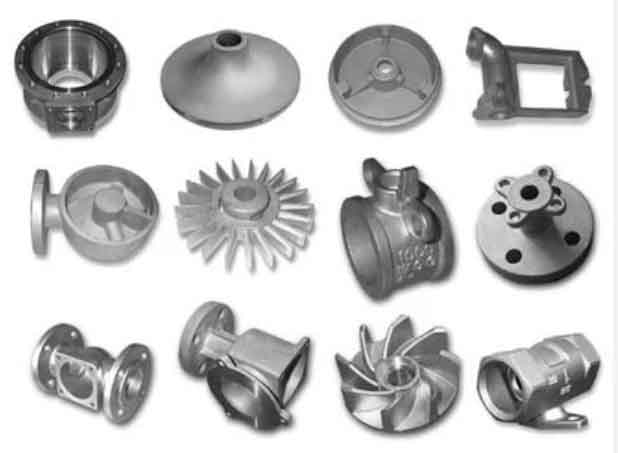
This study focuses on optimizing the mechanical properties of ductile iron casting through silicon solid solution strengthening. By leveraging FeSiMg alloy nodulizers and BaSi inoculants, we developed QT500-14 and QT600-10 grades with enhanced yield strength, elongation, and machining performance while maintaining fully ferritic matrices.
Chemical Composition Design
The chemical composition for high-performance ductile iron casting was determined based on silicon’s solid solution strengthening effect. Key parameters include:
$$ [Si] = 3.3\%\text{–}4.3\%, \quad [Mn] < 0.2\%, \quad [P] < 0.04\% $$
$$ CE = 4.45\%\text{–}4.55\%, \quad [Mg] = 0.045\%\text{–}0.065\% $$
| Grade | Wall Thickness (mm) | Yield Strength (MPa) | Tensile Strength (MPa) | Elongation (%) |
|---|---|---|---|---|
| EN-GJS-500-14 | ≤30 | 400 | 500 | 14 |
| 30–60 | 390 | 480 | 12 | |
| 60–200 | 380 | Negotiated | 10 | |
| EN-GJS-600-10 | ≤30 | 450 | 600 | 10 |
| 30–60 | 430 | 580 | 8 | |
| 60–200 | 410 | Negotiated | 6 |
Process Optimization
The ductile iron casting process employed:
- Charge ratio: 30–50% pig iron, 10–30% steel scrap, 30–50% returns
- Nodularization: 0.9–1.2% FeSiMg alloy (4–6% Mg)
- Inoculation: 0.8–1.0% BaSi (4–6% Ba)
The silicon strengthening mechanism follows:
$$ \Delta R_m = k_{Si} \cdot [Si] $$
Where \( k_{Si} = 45\text{–}55 \) MPa/wt% for ferritic ductile iron casting.
Experimental Results
| Test | Si (%) | Nodularity (%) | Rm (MPa) | Rp0.2 (MPa) | A (%) |
|---|---|---|---|---|---|
| 1 | 3.95 | 91 | 617 | 500 | 19 |
| 2 | 3.89 | 93 | 612 | 499 | 17 |
| 3 | 3.94 | 95 | 610 | 493 | 18 |
| Grade | -20°C | 20°C | 140°C | 180°C |
|---|---|---|---|---|
| QT600-10 | 3 J | 4 J | 18 J | 20 J |
| QT500-14 | 4 J | 5 J | 20 J | 21 J |
Microstructural Analysis
The optimized ductile iron casting exhibited:
- Nodularity >90% (ASTM A247)
- Ferrite fraction >95%
- Pearlite <3%
- Carbide-free matrix
The silicon solid solution strengthening effect can be expressed as:
$$ \sigma_y = \sigma_0 + \alpha Gb\sqrt{C_{Si}} $$
Where \( \alpha \) = 0.38, G = 80 GPa, b = 0.248 nm, and \( C_{Si} \) = silicon concentration.
Industrial Applications
High-silicon ductile iron casting demonstrates advantages in:
- High-temperature components (140–180°C service)
- Pressure-resistant housings
- Hydraulic system parts
- Automotive suspension components
Comparative analysis shows:
$$ \frac{\text{Tool Life}_{\text{QT600-10}}}{\text{Tool Life}_{\text{QT600-3}}} = 1.25\text{–}1.45 $$
Conclusion
This ductile iron casting study successfully achieved:
- QT500-14: Rm = 520–550 MPa, A = 14–17%
- QT600-10: Rm = 580–620 MPa, A = 10–19%
- Uniform hardness distribution (HBW 170–210)
- Reduced machining costs by 18–22%
The developed high-silicon ductile iron casting process enables production of components with superior combination of strength and ductility while maintaining excellent castability.