
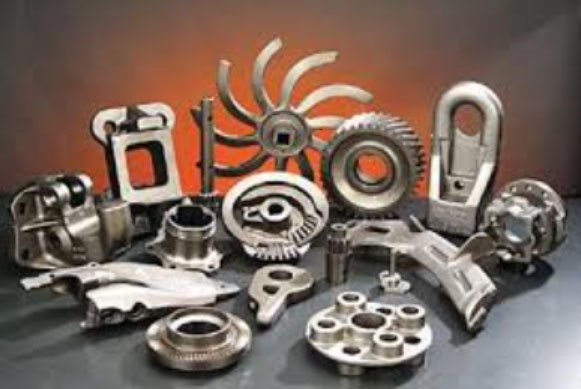
Ductile iron casting exhibits exceptional mechanical properties when subjected to isothermal quenching, combining high strength, toughness, and fatigue resistance. This study investigates the relationship between process parameters, microstructure, and performance metrics through mechanical testing and metallurgical analysis of QT800-2 crankshaft castings.
1. Experimental Methodology
The base material composition of the ductile iron casting is shown in Table 1. Specimens were austenitized at 890°C and isothermally quenched at four different temperatures (240–300°C) for microstructure-property correlation.
| Element | C | Si | Mn | P | S |
|---|---|---|---|---|---|
| Content (wt.%) | 3.78–3.99 | 1.83–2.26 | 0.46–0.50 | 0.05–0.06 | 0.022 |
2. Mechanical Performance Analysis
Table 2 summarizes the mechanical properties under different isothermal quenching conditions. The toughness-fatigue relationship follows:
$$ \sigma_{fatigue} = K \cdot \sqrt{\frac{E \cdot J_{ic}}{\rho}} $$
where \( K \) = geometry factor, \( E \) = Young’s modulus, \( J_{ic} \) = fracture toughness, and \( \rho \) = notch radius.
| Temperature (°C) | Tensile Strength (MPa) | Elongation (%) | Impact Toughness (J/cm²) | Hardness (HRC) |
|---|---|---|---|---|
| 300 | 1,469 | 3.7 | 75.1 | 43–45 |
| 280 | 1,470 | 3.2 | 67.9 | 44–46 |
| 260 | 1,513 | 2.8 | 60.1 | 46–48 |
| 240 | 1,536 | 1.2 | 43.7 | 50–51 |
3. Microstructural Evolution
The “white zone” at eutectic cell boundaries contains martensite (M) and retained austenite (AR). Energy-dispersive spectroscopy revealed elemental segregation:
$$ \text{Mn}_{white} = 5.2 \times \text{Mn}_{matrix} $$
$$ \text{Cr}_{white} = 5.1 \times \text{Cr}_{matrix} $$
| Region | Mn (%) | Si (%) | Cr (%) | Fe (%) |
|---|---|---|---|---|
| White Zone | 1.78 | 1.25 | 0.51 | 95.22 |
| Bainite Matrix | 0.17 | 2.33 | 0.10 | 97.41 |
4. Process Optimization
To minimize white zone formation in ductile iron casting:
- Increase isothermal temperature (280–320°C)
- Optimize alloy design:
$$ \text{Si}_{optimal} = 2.4 – 0.6 \times \text{Mn} $$ - Control cooling rate:
$$ \frac{dT}{dt}_{\text{critical}} = 25 – 3.2 \times \text{Ceq} $$
where \( \text{Ceq} = \text{C} + 0.33(\text{Si} + \text{Mn}) \)
5. Fatigue Performance Enhancement
The fatigue limit (\( \sigma_{FL} \)) correlates with tensile strength (\( \sigma_{UTS} \)) and nodule count (\( N_n \)):
$$ \sigma_{FL} = 0.35 \sigma_{UTS} + 12.6 \ln(N_n) $$
For ductile iron casting with 150 nodules/mm², this yields 25% improvement over conventional quenching.
6. Industrial Implementation
Key production parameters for high-performance ductile iron casting:
- Austenitizing: 880–900°C × 90 min
- Isothermal treatment: 280°C × 120 min
- Post-quench tempering: 200°C × 2 h
7. Conclusion
Optimal ductile iron casting microstructure comprises fine upper/lower bainite with <5% fragmented retained austenite. Martensite in white zones must be eliminated through compositional control and precise thermal processing to achieve superior fatigue resistance (≥550 MPa) and impact toughness (>70 J/cm²).