
This study investigates the sand casting methodology for automotive reducer base components, focusing on process optimization and defect mitigation strategies. As a critical load-bearing element in powertrain systems, reducer bases require dimensional precision and structural integrity to ensure optimal gear alignment and operational stability.
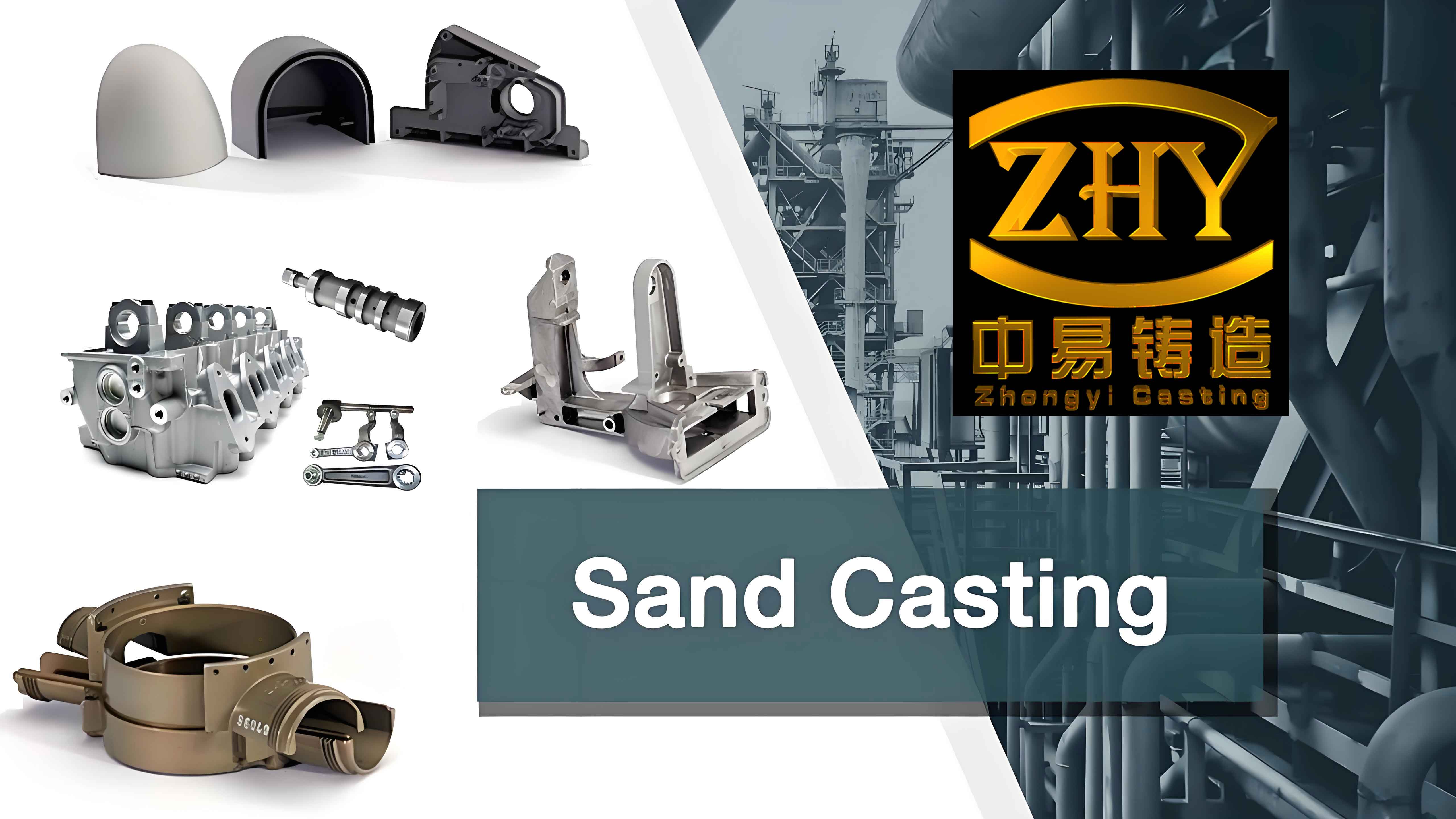
1. Process Design Fundamentals
The sand casting process for reducer bases employs a two-part flask system with top-facing orientation, optimized for thin-walled complex geometries. Key parameters are determined through the following relationships:
Minimum pressure head requirement:
$$ P_{min} = L \cdot \tan\theta $$
where \( L \) = maximum flow distance (mm) and \( \theta \) = recommended pressure angle (6°). For typical reducer bases:
| Parameter | Value |
|---|---|
| Flow distance (L) | 1100 mm |
| Pressure angle (θ) | 6° |
| Minimum pressure head | ≥115 mm |
Pouring time calculation:
$$ t = S \sqrt[3]{G} $$
where \( S \) = empirical coefficient (2.0) and \( G \) = casting weight (kg). Verification through velocity analysis:
$$ v = \frac{C}{t} $$
where \( C \) = total height of casting.
2. Gating System Design
The bottom-gating configuration ensures laminar flow and minimizes turbulence. Choke area calculation follows:
$$ A_{choke} = \frac{G}{0.31\mu t\sqrt{H_p}} $$
| Variable | Description |
|---|---|
| μ | Flow resistance coefficient (0.45-0.55) |
| Hp | Effective metal head |
| G | Total poured mass |
3. Core System Optimization
Modular core design enhances dimensional accuracy for internal cavities. Core assembly parameters:
| Core Section | Position Tolerance | Binder Content |
|---|---|---|
| Main cavity | ±0.8 mm | 2.8-3.2% |
| Oil channels | ±0.5 mm | 3.5-4.0% |
| Mounting features | ±0.3 mm | 4.2-4.8% |
4. Pattern Engineering
Aluminum composite patterns with reinforced ribs achieve 18-22% weight reduction while maintaining dimensional stability. Wall thickness follows:
$$ \gamma = \beta(1 + 0.008D) $$
where \( \beta \) = material factor (5 for cast iron) and \( D \) = average pattern dimension.
5. Defect Analysis and Mitigation
Common sand casting defects in reducer bases and corrective measures:
| Defect Type | Root Cause | Preventive Action |
|---|---|---|
| Gas porosity | Inadequate venting | Increase permeability (GFN 55-65) |
| Sand inclusion | Core erosion | Add 1.5-2.0% zircon additive |
| Misrun | Low pouring temp | Maintain 1520-1550°C |
Gas entrapment prevention requires:
$$ \frac{A_{vent}}{A_{choke}} \geq 1.2 $$
where \( A_{vent} \) = total vent area and \( A_{choke} \) = choke cross-section.
6. Process Validation
Field testing showed 92% dimensional compliance with ISO 8062 CT8 grade. Mechanical properties exceeded ASTM A48 Class 35 requirements:
| Property | Result | Standard |
|---|---|---|
| Tensile Strength | 245 MPa | ≥220 MPa |
| Hardness | 187 HB | 170-220 HB |
| Porosity Density | 0.8/cm² | ≤1.2/cm² |
The optimized sand casting process demonstrates significant advantages in dimensional control and production efficiency for complex automotive components. Continued research focuses on integrating real-time monitoring systems for defect detection during pouring operations.