
This paper presents a comprehensive study on implementing lost foam casting technology for producing thick-walled nodular iron vacuum pump housings. Through systematic process design and computational simulation, we achieved defect-free castings meeting QT600-3 specifications with superior dimensional accuracy and leakage resistance.
1. Process Design Fundamentals
The vacuum pump housing (Ø864 mm × 637 mm, 425 kg) requires precise dimensional control and structural integrity. The lost foam casting process was selected for its advantages in complex geometry replication and reduced machining allowances. Key process parameters were determined through thermal analysis:
$$ t_{fill} = \frac{V_{casting}}{\sum A_{gate} \cdot v_{flow}} $$
Where:
$t_{fill}$ = mold filling time (s)
$V_{casting}$ = casting volume (0.154 m³)
$\sum A_{gate}$ = total gating area (0.0045 m²)
$v_{flow}$ = metal flow velocity (1.2 m/s)
| Process Parameter | Value |
|---|---|
| Pouring Temperature | 1,430-1,450°C |
| Vacuum Pressure | -0.05 to -0.06 MPa |
| Pattern Density | 22 kg/m³ |
| Coating Thickness | 1.2-1.5 mm |
2. Gating System Optimization
The top-gating system with six risers was designed using MAGMA simulation software. The gating ratio was optimized as:
$$ \Sigma F_{sprue} : \Sigma F_{runner} : \Sigma F_{ingate} = 1 : 1.4 : 1.2 $$
Key dimensions:
– Sprue: Ø50 mm
– Runner: 75 × 75 mm
– Ingate: 40 × 140 mm
3. Pattern Fabrication Technology
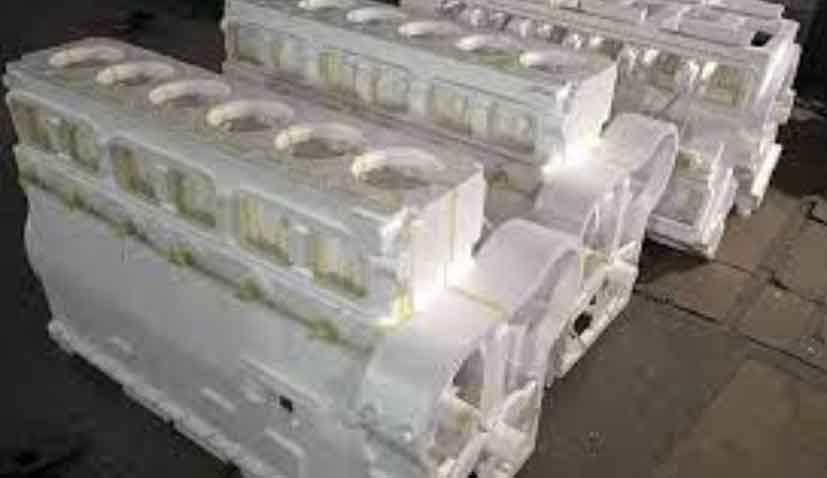
The EPS pattern was CNC-cut into 20 segments (12 body sections + 8 flange sections) for precise assembly. Critical parameters for pattern making:
| Parameter | Value |
|---|---|
| Wire Cutting Speed | 0.8 m/min |
| Kerf Compensation | 0.3 mm |
| Assembly Tolerance | ±0.5 mm |
| Adhesive Thickness | ≤0.2 mm |
4. Metallurgical Control System
The dual-wire feeding process achieved superior nodularization efficiency:
$$ \eta_{Mg} = \frac{W_{Mg(actual)}}{W_{Mg(theoretical)}} \times 100\% $$
Where:
$\eta_{Mg}$ = Magnesium absorption efficiency (%)
$W_{Mg(actual)}$ = 0.045-0.055% (spectral analysis)
$W_{Mg(theoretical)}$ = 0.065% (calculated)
| Element | Composition (%) |
|---|---|
| C | 3.6-3.8 |
| Si | 2.3-2.5 |
| Mn | 0.4-0.6 |
| Mgres | 0.04-0.06 |
5. Solidification Dynamics
The modified Chvorinov’s rule was applied to calculate solidification time:
$$ t_s = B \left( \frac{V}{A} \right)^n $$
Where:
$t_s$ = solidification time (min)
$B$ = mold constant (2.5 for lost foam)
$V/A$ = modulus (0.035 m)
$n$ = exponent (1.8)
| Section | Solidification Time (min) |
|---|---|
| Thick Section (35mm) | 18.2 |
| Riser (120mm) | 42.5 |
| Flange (46mm) | 24.7 |
6. Quality Validation
The final castings demonstrated excellent mechanical properties:
$$ \sigma_b = 641\ MPa,\ \delta = 3.5\% $$
Microstructure analysis revealed:
- Nodularity: 90-92%
- Pearlite: 60-65%
- Carbides: <1%
This study confirms that lost foam casting technology effectively produces complex nodular iron components with tight dimensional tolerances and superior metallurgical quality. The integration of computational simulation with advanced pattern fabrication techniques enables reliable production of thick-section castings for demanding industrial applications.