
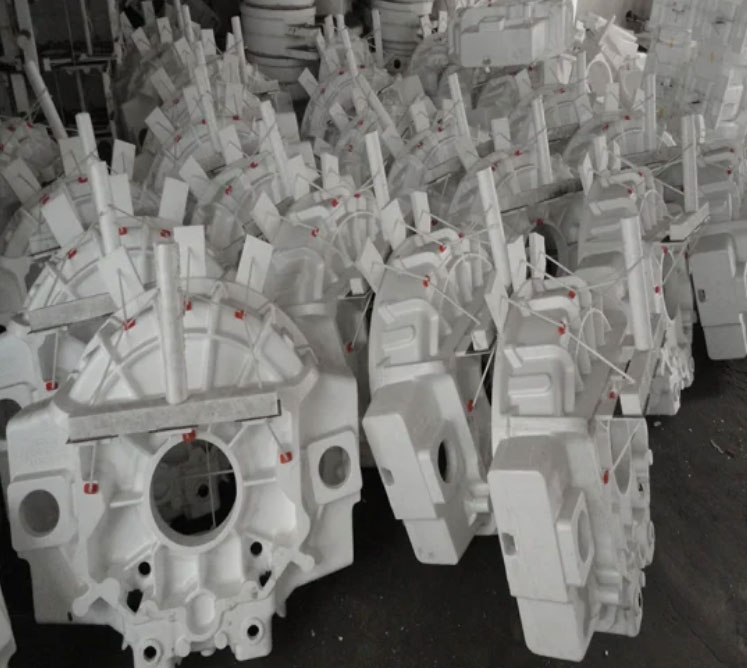
Lost foam casting (LFC) has revolutionized the production of ductile iron components due to its precision and environmental advantages. However, challenges in achieving consistent nodularization efficiency and pearlite formation persist. This article presents a systematic approach to enhance graphite nodule count and pearlite content through optimized treatment processes.
1. Advanced Inoculation Strategy
Three-stage inoculation significantly improves nucleation density while delaying fade. The optimized combination of inoculants achieves:
| Stage | Inoculant Type | Weight % | Key Function |
|---|---|---|---|
| Primary | FeSi75 | 0.15 | Initial nucleation |
| Secondary | Si-Ba | 0.35-0.45 | Graphite refinement |
| Tertiary | Si-Ba-Ca | 0.20-0.40 | Fade resistance |
The total inoculation efficiency can be expressed as:
$$ \eta_{total} = \sum_{i=1}^{3} \eta_i \cdot w_i \cdot e^{-k_i t} $$
Where \( \eta_i \) = efficiency coefficient, \( w_i \) = weight percentage, \( k_i \) = fade rate constant, and \( t \) = processing time.
2. Modified Nodularization Chamber Design
The dam-type treatment ladle with staged reaction zones enhances Mg absorption:
| Layer | Material | Thickness (mm) | Mg Yield (%) |
|---|---|---|---|
| Primary | MgFeSi (7-9%) | 50-60 | 42.5 ± 2.1 |
| Barrier | Steel Plate | 4-6 | – |
| Secondary | MgFeSi (5.5-6.5%) | 30-40 | 37.8 ± 1.8 |
The two-stage reaction mechanism follows:
$$ \frac{d[Mg]}{dt} = k_1(T)A_1C_1 – k_2(T)A_2C_2 $$
Where \( k \) = temperature-dependent rate constants, \( A \) = reaction area, \( C \) = concentration.
3. Temperature Management Protocol
Optimal thermal parameters for lost foam casting:
| Process Stage | Temperature Range (°C) | Holding Time (min) |
|---|---|---|
| Pre-treatment | 1560-1600 | 9-11 |
| Nodularization | 1480-1520 | 1.5-2.5 |
| Pouring | 1420-1450 | < 8 |
The magnesium recovery ratio correlates with temperature as:
$$ \eta_{Mg} = \frac{0.85}{1 + e^{0.012(T-1510)}} $$
4. Process Validation
Implementing these improvements in lost foam casting resulted in:
- Graphite nodule count increase from 30% to 60%
- Pearlite content elevation from 85% to 90%
- Mg utilization efficiency improvement by 22.7%
The final microstructure quality index can be quantified as:
$$ Q_m = 0.6N_g + 0.4P_p $$
Where \( N_g \) = normalized nodule count, \( P_p \) = pearlite percentage.
5. Conclusion
This optimized lost foam casting process demonstrates significant improvements in ductile iron quality through:
- Multi-stage inoculation with fade-resistant alloys
- Controlled sequential nodularization reactions
- Precise thermal management
Future work will focus on further enhancing pearlite formation kinetics while maintaining the ecological benefits of lost foam casting technology.