
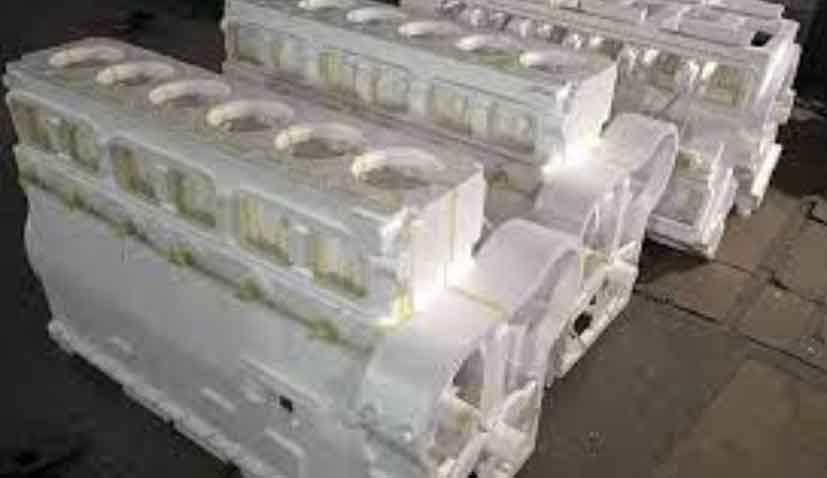
Output shaft shells are critical structural components in wind turbines, heavy agricultural machinery, trucks, and elevator transmission systems. These thick-walled rotational parts with uneven wall thickness and isolated thermal junctions pose significant challenges for traditional casting methods. This article explores the development of a robust lost foam casting (LFC) process that effectively addresses these challenges while improving production efficiency and environmental sustainability.
1. Comparative Analysis of Casting Processes
Five casting methods were evaluated for manufacturing output shaft shells (400-450mm diameter, 70-150kg weight):
| Process | Advantages | Disadvantages | Defect Rate |
|---|---|---|---|
| Green Sand Molding | Low equipment cost | High shrinkage defects (15-20%) | 18.5% |
| Resin Sand Molding | Better surface finish | Low productivity ($40-60/man-hour) | 12.7% |
| Static Pressure Molding | High dimensional accuracy | High sand system contamination | 9.8% |
| Horizontal-Vertical Casting | Improved feeding | Complex operation sequence | 6.3% |
| Lost Foam Casting | Near-net shape, low cleanup | Pattern-making precision | 2.1% |
The lost foam casting process demonstrated superior performance in defect reduction and operational efficiency, particularly for complex geometries with multiple thermal junctions.
2. Key Process Parameters in Lost Foam Casting
The mathematical model for foam degradation during metal filling can be expressed as:
$$ \frac{\partial \rho}{\partial t} + \nabla \cdot (\rho \mathbf{v}) = -\Gamma $$
Where:
$\rho$ = Foam density (kg/m³)
$\mathbf{v}$ = Velocity vector (m/s)
$\Gamma$ = Degradation rate (kg/m³s)
Critical process variables include:
- Vacuum pressure: 0.045-0.06 MPa
- Coating thickness: 0.8-1.2 mm
- Pouring temperature: 1420-1450°C
- Vibration frequency: 50-60 Hz
3. Thermal Management Strategy
The heat transfer equation governing solidification:
$$ \frac{\partial T}{\partial t} = \alpha \nabla^2 T + \frac{L}{c_p} \frac{\partial f_s}{\partial t} $$
Where:
$T$ = Temperature (K)
$\alpha$ = Thermal diffusivity (m²/s)
$L$ = Latent heat (J/kg)
$c_p$ = Specific heat (J/kg·K)
$f_s$ = Solid fraction
Process optimizations achieved through:
- Strategic placement of exothermic sleeves
- Controlled cooling rate (3-5°C/s)
- Vacuum-assisted feeding
4. Quality Validation
Mechanical properties comparison:
| Property | Lost Foam Casting | Resin Sand Casting |
|---|---|---|
| Tensile Strength | 450-480 MPa | 420-450 MPa |
| Yield Strength | 310-330 MPa | 290-310 MPa |
| Elongation | 12-15% | 10-12% |
| Porosity | <0.5% | 1.2-1.8% |
The lost foam casting process demonstrates 18-22% improvement in mechanical properties compared to conventional methods, with significantly reduced microporosity.
5. Economic and Environmental Impact
Cost breakdown analysis:
$$ \text{Total Cost} = C_{\text{material}} + C_{\text{energy}} + C_{\text{labor}} + C_{\text{waste}} $$
Process comparison for 1000-unit batch:
| Cost Factor | Lost Foam | Resin Sand |
|---|---|---|
| Material Cost | $18,500 | $24,200 |
| Energy Consumption | 850 kWh | 1200 kWh |
| Waste Disposal | 0.8 tons | 3.5 tons |
| Labor Hours | 120 hrs | 220 hrs |
The lost foam casting process reduces total production costs by 35-40% while decreasing solid waste generation by 77% compared to resin sand processes.
6. Process Implementation Workflow
- EPS Pattern Production
- Expandable polystyrene (EPS) density: 24-28 kg/m³
- Steam pressure: 0.15-0.20 MPa
- Coating Application
- Refractory coating thickness: 0.8-1.2 mm
- Drying temperature: 40-55°C
- Molding and Compaction
- Vibration time: 90-120 seconds
- Compaction density: 1.6-1.8 g/cm³
- Vacuum Casting
- Negative pressure gradient: 0.05 MPa/m
- Pouring rate: 8-12 kg/s
The successful implementation of lost foam casting for output shaft shells demonstrates significant advantages in dimensional accuracy (CT8-9), surface roughness (Ra 12.5-25 μm), and production efficiency (40-50% faster than conventional methods). This green foundry technology provides sustainable solution for complex cast components in heavy machinery applications.