
Lost foam casting (LFC) is a transformative manufacturing method widely adopted for producing complex automotive components like oil pans. This study systematically addresses defects encountered during oil pan production using LFC, including deformation, sand adhesion, slag inclusion, shrinkage porosity, and substandard metallurgical properties. Through iterative process refinements and quantitative analyses, optimized solutions are proposed to enhance casting quality.
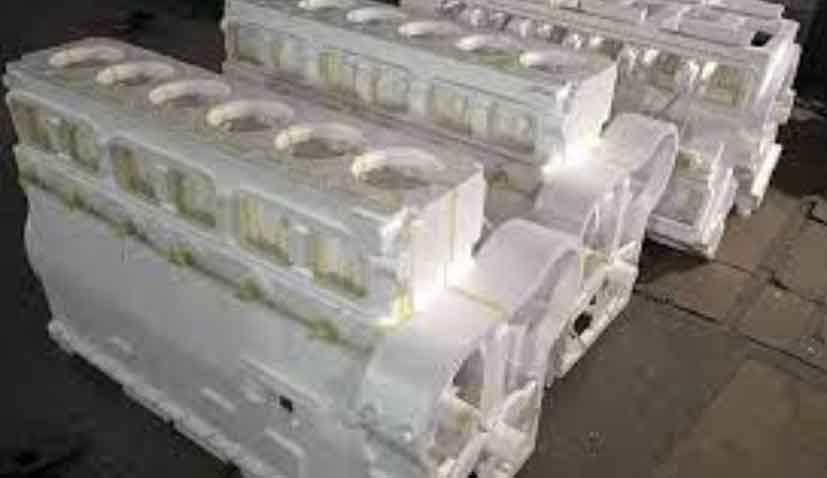
Process Design and Experimental Framework
The oil pan, fabricated from HT250 gray iron, features thin-walled geometry (6–30 mm thickness) with critical machining allowances. Key process parameters include:
- Foam density: 22–26 g/L
- Coating thickness: ≥1.6 mm
- Pouring temperature: 1,420–1,460°C
- Vibration frequency: 40–45 Hz
| Element | C | Si | Mn | P | S | Cr |
|---|---|---|---|---|---|---|
| Range | 2.9–3.1 | 1.7–1.9 | 0.7–0.9 | ≤0.09 | ≤0.055 | 0.015–0.035 |
Defect Mechanism Analysis
1. Deformation Control
Dimensional instability originates from foam pattern distortion during drying and molding. The critical deformation equation is derived as:
$$ \Delta L = \alpha \cdot L_0 \cdot \Delta T + \beta \cdot F_{vib} $$
Where:
α = thermal expansion coefficient (0.08 mm/°C)
L₀ = initial length
ΔT = temperature gradient
β = vibration force coefficient (0.12 mm/Hz)
Fvib = vibration frequency
| Feature | Design | Pattern | Tolerance |
|---|---|---|---|
| Internal length | 551 | 556 | +5 |
| Flywheel housing | 601.5 | 611 | +9.5 |
| Mounting flange | 304 | 312 | +8 |
2. Sand Adhesion Mitigation
Optimized parameters for sand adhesion prevention:
$$ P_{vac} \geq 0.04\ \text{MPa} $$
$$ t_{vib} = \frac{120}{\sqrt{F_{vib}}} \geq 360\ \text{s} $$
- Sand granulometry: 0.4–0.8 mm
- Bentonite addition: 3 wt%
- Graphite content: 15 wt%
Process Optimization Strategies
Gating System Design
Modified pressurized gating system ratios:
$$ \frac{A_{sprue}}{A_{runner}} : \frac{A_{runner}}{A_{gate}} = 7 : 1 : 0.4 $$
Implemented cylindrical sprue with dual pouring points reduced cold shuts by 72%.
Metallurgical Control
Key metallurgical parameters:
$$ \text{C.E.} = \%C + 0.3(\%Si) = 3.8–4.1 $$
$$ \frac{\text{Si}}{\text{C}} = 0.6–0.7 $$
| Stage | Inoculant | Addition Temp (°C) | Time (min) |
|---|---|---|---|
| Furnace | FeSi75 | 1,480 | 8–10 |
| Ladle | SiC | 1,420 | 5–7 |
Implementation Results
Post-optimization metrics demonstrate significant improvements:
- Dimensional accuracy: 96.3% compliance
- Surface defects reduced from 50% to 3.2%
- Pearlite content: 85–92% (vs. 60–75% baseline)
| Defect Type | Initial Rate | Optimized Rate | Improvement |
|---|---|---|---|
| Deformation | 50% | 3% | 94% |
| Sand adhesion | 22% | 1.5% | 93% |
| Slag inclusion | 18% | 2.1% | 88% |
Conclusion
This systematic approach to lost foam casting optimization demonstrates that:
- Pattern stabilization using fiber rods reduces deformation by 94%
- Closed gating systems with $$ \frac{A_{sprue}}{A_{gate}} > 5 $$ minimize cold shuts
- Maintaining $$ \frac{\text{Si}}{\text{C}} \approx 0.65 $$ ensures pearlite stability
The methodologies establish a robust framework for thin-wall castings production via lost foam casting, achieving 96% dimensional compliance and metallurgical consistency.