
In the development of a cast steel convex ring for mining machinery, the structural challenges necessitated a rigorous analysis of lost foam casting (LFC) process design. This study proposes two process schemes, evaluates their performance through numerical simulations, and validates the optimized solution through industrial production. The methodology highlights the synergy between advanced simulation tools and practical process design in achieving defect-free castings.
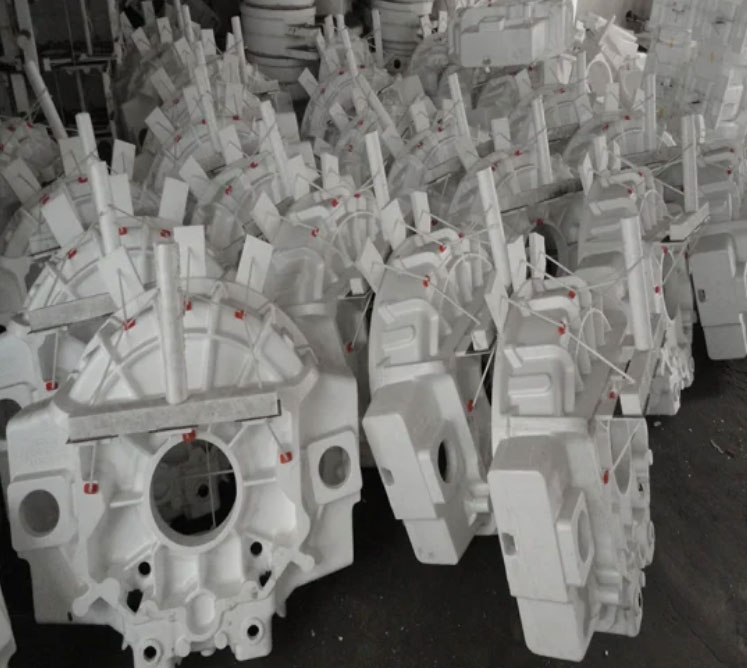
1. Structural Analysis and Process Design
The convex ring features an asymmetric profile with critical functional surfaces requiring superior metallurgical quality. Key parameters include:
| Parameter | Value |
|---|---|
| Outer diameter | Φ435 mm |
| Height range | 21-114 mm |
| Nominal wall thickness | 25 mm |
| Material | ZG50CrMnSiA |
The chemical composition requirements are:
| Element | C | Mn | Si | Cr | S | P |
|---|---|---|---|---|---|---|
| Content (wt%) | 0.45-0.55 | 0.70-1.00 | 0.40-0.60 | 0.80-1.20 | ≤0.020 | ≤0.030 |
Two process schemes were designed based on orientation and feeding principles:
| Scheme | Orientation | Gating System |
|---|---|---|
| 1 | Narrow section upward | Top gating with lateral sprue |
| 2 | Thick section upward | Step gating with direct feeding |
2. Numerical Simulation Framework
The thermal-physical model for lost foam casting incorporates phase change dynamics and gasification effects. The energy conservation equation governs the heat transfer:
$$
\rho c_p \frac{\partial T}{\partial t} = \nabla \cdot (k \nabla T) + Q_{\text{phase}} + Q_{\text{gas}}
$$
where:
$ρ$ = density
$c_p$ = specific heat
$k$ = thermal conductivity
$Q_{\text{phase}}$ = latent heat of solidification
$Q_{\text{gas}}$ = endothermic decomposition of EPS
Material properties for simulation:
| Material | Density (g/cm³) | Thermal Conductivity (W/m·K) | Specific Heat (J/g·K) |
|---|---|---|---|
| ZG50CrMnSiA | 7.6 | 22.015 | 0.828 |
| EPS | 0.025 | 0.15 | 3.7 |
3. Process Simulation and Optimization
Scheme 1 exhibited uneven filling characteristics with potential shrinkage defects:
$$
t_{\text{fill}} = 12.88\ \text{s},\quad \Delta T_{\text{max}} = 228^\circ\text{C}
$$
Scheme 2 demonstrated superior thermal management:
| Parameter | Scheme 1 | Scheme 2 |
|---|---|---|
| Filling time (s) | 12.88 | 12.06 |
| Solidification time (s) | 1,148 | 1,409 |
| Shrinkage volume (%) | 0.42 | 0.18 |
The temperature gradient analysis confirmed Scheme 2’s directional solidification advantage:
$$
G_{\text{scheme2}} = 12.5^\circ\text{C/cm} \text{ vs. } G_{\text{scheme1}} = 8.2^\circ\text{C/cm}
$$
4. Industrial Validation
The optimized lost foam casting process achieved:
- Zero surface defects on functional profiles
- Dimensional accuracy of CT10 grade
- Production yield improvement from 68% to 83%
The success of this lost foam casting project demonstrates the critical role of numerical simulation in modern foundry practice. By integrating thermal analysis with process design, manufacturers can significantly reduce trial iterations while ensuring casting quality.