
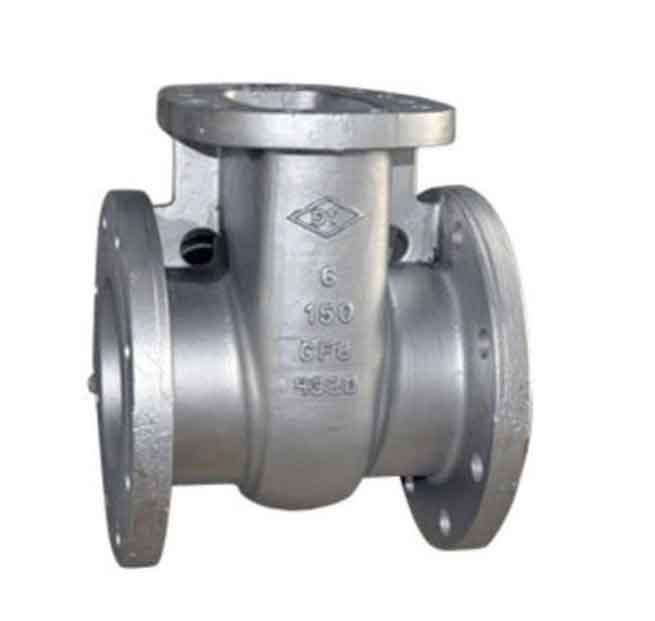
Investment casting, also known as lost-wax casting, represents an advanced near-net-shaping technology capable of producing small metal castings with complex internal cavities, high melting temperatures, high dimensional accuracy, minimal machining requirements, and low surface roughness. This process finds extensive applications in aerospace, automotive, and marine industries. However, its production cycle is lengthy with complex process control, traditionally relying on extensive trial-and-error approaches. As industrial components trend toward larger dimensions, complex geometries, and thin-walled configurations, predicting and mitigating filling and solidification defects has become a critical challenge in valve body casting production.
Numerical simulation technology provides powerful tools for analyzing mold filling and solidification behavior. The governing equations for fluid flow during filling include the continuity equation and Navier-Stokes equations:
$$ \frac{\partial \rho}{\partial t} + \nabla \cdot (\rho \mathbf{v}) = 0 $$
$$ \rho \left( \frac{\partial \mathbf{v}}{\partial t} + \mathbf{v} \cdot \nabla \mathbf{v} \right) = -\nabla p + \mu \nabla^2 \mathbf{v} + \rho \mathbf{g} $$
where $\rho$ represents density, $\mathbf{v}$ velocity vector, $p$ pressure, $\mu$ dynamic viscosity, and $\mathbf{g}$ gravitational acceleration. For solidification prediction, the energy conservation equation is solved:
$$ \rho c_p \frac{\partial T}{\partial t} = \nabla \cdot (k \nabla T) + \rho L \frac{\partial f_s}{\partial t} $$
where $c_p$ is specific heat, $k$ thermal conductivity, $L$ latent heat, and $f_s$ solid fraction. These equations form the foundation for predicting defects in valve body casting processes.
Structural Analysis and Initial Process Design
The bypass valve body casting featured complex geometry with critical thermal zones requiring strategic feeding system design. Initial gating arrangements caused turbulent flow patterns during filling, as demonstrated by velocity distribution simulations:
| Filling Percentage | Maximum Velocity (m/s) | Flow Characteristics |
|---|---|---|
| 10% | 1.5 | Turbulent flow at multiple ingates |
| 30% | 1.7 | Flow reversal at critical junctions |
| 46% | 1.6 | Cold shut formation risk |
Defect prediction algorithms identified high probability regions for porosity and misruns in the valve body casting, particularly at flow convergence zones. The Niyama criterion $N_y$ was employed to predict shrinkage porosity:
$$ N_y = G / \sqrt{\dot{T}} $$
where $G$ denotes temperature gradient and $\dot{T}$ cooling rate. Values below threshold 1.0 K1/2·s1/2/mm indicated shrinkage risk zones.
Process Optimization Strategy
Strategic repositioning of the pouring cup directly above Ingate 2# transformed flow dynamics, achieving laminar filling behavior critical for quality valve body casting production. Optimized parameters included:
| Parameter | Value | Influence on Valve Body Casting |
|---|---|---|
| Pouring Temperature | 1560 ± 10°C | Optimal fluidity with minimal gas dissolution |
| Mold Temperature | 950 ± 10°C | Controlled solidification front progression |
| Pouring Speed | 3 kg/s | Reduced turbulence while preventing premature freezing |
Thermal management was enhanced using insulation wraps at critical sections, modifying the heat transfer coefficient according to:
$$ h_{eff} = \frac{1}{\frac{1}{h_{original}} + \frac{t_{ins}}{k_{ins}}} $$
where $t_{ins}$ is insulation thickness and $k_{ins}$ thermal conductivity of insulation material. Solidification simulation demonstrated sequential progression from casting extremities toward feeders:
| Solid Fraction | Liquid Phase Distribution | Defect Probability |
|---|---|---|
| 64% | Continuous liquid paths maintained | Low shrinkage risk |
| 77% | Liquid retreat to primary feeders | No isolated liquid pools |
| 98% | Final solidification in feeders | Minimal macroporosity |
Production Validation and Quality Assessment
The optimized valve body casting process was implemented with seven-layer ceramic shell construction using zircon flour face coats and molochite backup layers. Critical quality metrics included:
| Element | Required (%) | Measured (%) |
|---|---|---|
| C | ≤0.25 | 0.17 |
| Si | ≤0.60 | 0.56 |
| Mn | ≤1.20 | 1.03 |
Mechanical properties exceeded specifications across all parameters, validating the integrity of the valve body casting:
| Property | Test Condition | Required | Measured |
|---|---|---|---|
| Tensile Strength | Room Temperature | ≥485 MPa | 559 MPa |
| Yield Strength | Room Temperature | ≥275 MPa | 385 MPa |
| Impact Energy | 0°C | ≥40 J | 58-67 J |
Non-destructive evaluation confirmed the absence of internal defects in valve body castings, with surface roughness measurements averaging Ra = 5.8 μm, significantly below the 12.5 μm specification limit. X-ray inspection and sectioning analysis confirmed complete elimination of shrinkage porosity in critical sections, validating the simulation accuracy.
Conclusion
MAGMA-based simulation enables comprehensive optimization of investment casting processes for complex valve body castings. Strategic modification of gating design eliminated turbulent filling while insulation protocols ensured directional solidification. Production validation confirmed defect-free valve body castings with mechanical properties exceeding requirements, demonstrating the critical role of physics-based simulation in modern foundry practice. The methodology establishes a robust framework for manufacturing high-integrity valve body castings with reduced development time and production costs.