
In the modern sand casting foundry industry, the demand for rapid prototyping, low-volume production, and customized castings has driven the adoption of patternless sand mold manufacturing technologies. Traditional sand casting foundry relies heavily on physical patterns for mold creation, which is costly and time-consuming for small batch production. Patternless sand mold machining, a subtractive manufacturing method, offers a green, high-precision, and cost-effective alternative by directly milling sand blocks without the need for patterns. However, one critical challenge in this process is the efficient removal of sand chips generated during dry machining. Unlike conventional metal cutting where cutting fluids assist in chip evacuation, sand mold milling produces fine abrasive particles that accumulate in deep cavities, leading to tool wear, surface damage, and even machining failure. To address this, our research group developed a novel hollow end mill equipped with an aerodynamic chip removal system. This paper presents a comprehensive study of the pneumatic sand chip removal process using this hollow end mill, focusing on the critical air velocity, computational fluid dynamics (CFD) simulations, experimental validation, and practical application in a sand casting foundry environment.
In a typical sand casting foundry, the sand mold cavities often have complex geometries with narrow and deep features. During milling, the chips must be immediately evacuated to prevent re-cutting and clogging. The hollow end mill operates by delivering compressed air through the tool’s internal channels, which exits through small holes near the cutting edges, creating a high-velocity air jet that blows the sand chips upward and out of the cavity. This method is particularly suitable for sand casting foundry operations because it requires no liquid coolants, maintains a dry working environment, and can be easily integrated into existing CNC machining centers. The key to success lies in understanding the fluid dynamics within the cavity and determining the minimum air velocity required to lift the sand particles.
To establish the foundation, we first analyzed the forces acting on a single sand particle in a vertical upward airflow within the mold cavity. Assuming a dilute phase (negligible particle-particle interactions) and a spherical particle shape, the forces considered are gravity, buoyancy, pressure gradient force, and drag force. The force balance is given by:
$$
m \frac{d u_p}{d t} = F_d + F_b + F_p + G
$$
where m is the particle mass, up is the particle velocity, Fd is the drag force, Fb is the buoyancy force, Fp is the pressure gradient force, and G is the weight. The expressions for these forces are:
$$
G = -\frac{1}{6} \pi d_p^3 \rho_p g
$$
$$
F_b = \frac{1}{6} \pi d_p^3 \rho_f g
$$
$$
F_p = \frac{1}{6} \pi d_p^3 \frac{\partial P}{\partial z}
$$
$$
F_d = \frac{1}{8} \pi d_p^2 \rho_f C_D |u_f – u_p| (u_f – u_p)
$$
Here, dp is the particle diameter, ρp is the particle density (2650 kg/m³ for sand), ρf is the air density (1.293 kg/m³ at standard conditions), g is gravitational acceleration (9.8 m/s²), P is the pressure, z is the vertical coordinate, CD is the drag coefficient (0.5 for spherical particles in the turbulent regime), and uf is the fluid velocity. At the critical suspension condition, the particle acceleration is zero and its velocity is zero, so the net vertical force is zero. Neglecting the pressure gradient force (which is small in this context), we obtain the critical air velocity uf,crit:
$$
u_{f,crit} = \sqrt{\frac{4 d_p (\rho_p – \rho_f) g}{3 \rho_f C_D}}
$$
Substituting typical values for sand casting foundry sand (dp = 0.2 mm, ρp = 2650 kg/m³, ρf = 1.293 kg/m³, CD = 0.5) yields:
$$
u_{f,crit} = \sqrt{\frac{4 \times 0.0002 \times (2650 – 1.293) \times 9.8}{3 \times 1.293 \times 0.5}} \approx 3.3 \, \text{m/s}
$$
This critical velocity of 3.3 m/s serves as the baseline for ensuring that sand chips are lifted out of the cavity. In practice, the actual required velocity may be slightly higher due to wall effects, chip shape, and interaction with the tool rotation.
To verify the airflow pattern inside the sand mold cavity during milling, we conducted a series of CFD simulations using ANSYS Workbench. The model assumed a cylindrical cavity of 100 mm diameter and varying depths (25 mm, 50 mm, 75 mm, and 100 mm). The hollow end mill was positioned concentrically with its cutting edge at the cavity bottom. The spindle speed was set to 6000 rpm, and the inlet pressure at the hollow end mill’s sealing chamber was varied according to the cavity depth to achieve an exit velocity above the critical value. The outlet pressure at the top of the cavity was set to atmospheric (0 gauge). Figure 3 in the original paper (not reproduced here) showed that inside the cavity, the average gas pressure decreased from the bottom to the top, while the gas velocity decreased correspondingly. The simulation results confirmed that when the average exit velocity at the cavity top exceeds 3.3 m/s, the chips are effectively removed. To optimize energy consumption, we determined the required inlet pressures for different depths, as listed in Table 1.
| Cavity depth (mm) | Supply pressure (MPa gauge) | Simulated average exit velocity (m/s) |
|---|---|---|
| 25 | 0.20 | 4.1 |
| 50 | 0.35 | 3.8 |
| 75 | 0.45 | 3.6 |
| 100 | 0.50 | 3.5 |
All simulated exit velocities were above the 3.3 m/s threshold, indicating that the pressure settings in Table 1 are sufficient for effective chip removal while conserving compressed air resources. These results guided the experimental parameter selection.
Experimental verification was carried out on a digital patternless precision casting machine developed by our research group (similar to the one shown in Figure 4 of the original paper). The machine is equipped with a pneumatic control unit that regulates the air pressure supplied to the hollow end mill. Two types of cutting tools were compared: a standard solid end mill and the hollow end mill with aerodynamic chip removal. The same machining parameters (spindle speed, feed rate, depth of cut) were used to drill holes of 100 mm diameter at the four depths listed in Table 1. For the hollow end mill, the supply pressure was adjusted incrementally according to the table. After completing each hole, the residual sand chips inside the cavity were collected and weighed. Figure 5 and Figure 6 in the original paper illustrated the machining process; the standard end mill led to progressive accumulation of chips, while the hollow end mill kept the cavity clean throughout. The quantitative comparison of residual chip mass is shown in Table 2.
| Cavity depth (mm) | Standard end mill (g) | Hollow end mill (g) |
|---|---|---|
| 25 | 0.8 | 0.1 |
| 50 | 3.5 | 0.2 |
| 75 | 8.7 | 0.3 |
| 100 | unable to complete | 0.4 |
It is evident that the hollow end mill drastically reduces chip accumulation, even at depths up to 100 mm where the standard tool failed completely. The small residual mass with the hollow end mill is attributed to fine dust that adheres electrostatically, which is negligible for subsequent operations. These experiments confirm that the critical velocity criterion and the simulated pressure settings are reliable for a sand casting foundry environment.
To demonstrate the practical applicability of the hollow end mill in a real sand casting foundry, we selected a typical casting that features thin walls and small-diameter cylindrical cores—such structures often lead to narrow and deep cavities that are difficult to clean. The entire patternless sand casting process is depicted in Figure 8 of the original paper. The sequence includes: (a) CAD model of the casting, (b) sand block preparation, (c) CNC machining using the hollow end mill with pressure adjusted according to depth, (d) close-up of the machining operation showing effective chip removal, (e) completed sand mold, and (f) final cast part. The success of this trial demonstrates that the hollow end mill technology can be seamlessly integrated into existing sand casting foundry workflows, enabling the production of high-quality molds without pattern costs and with minimal downtime for chip cleaning.
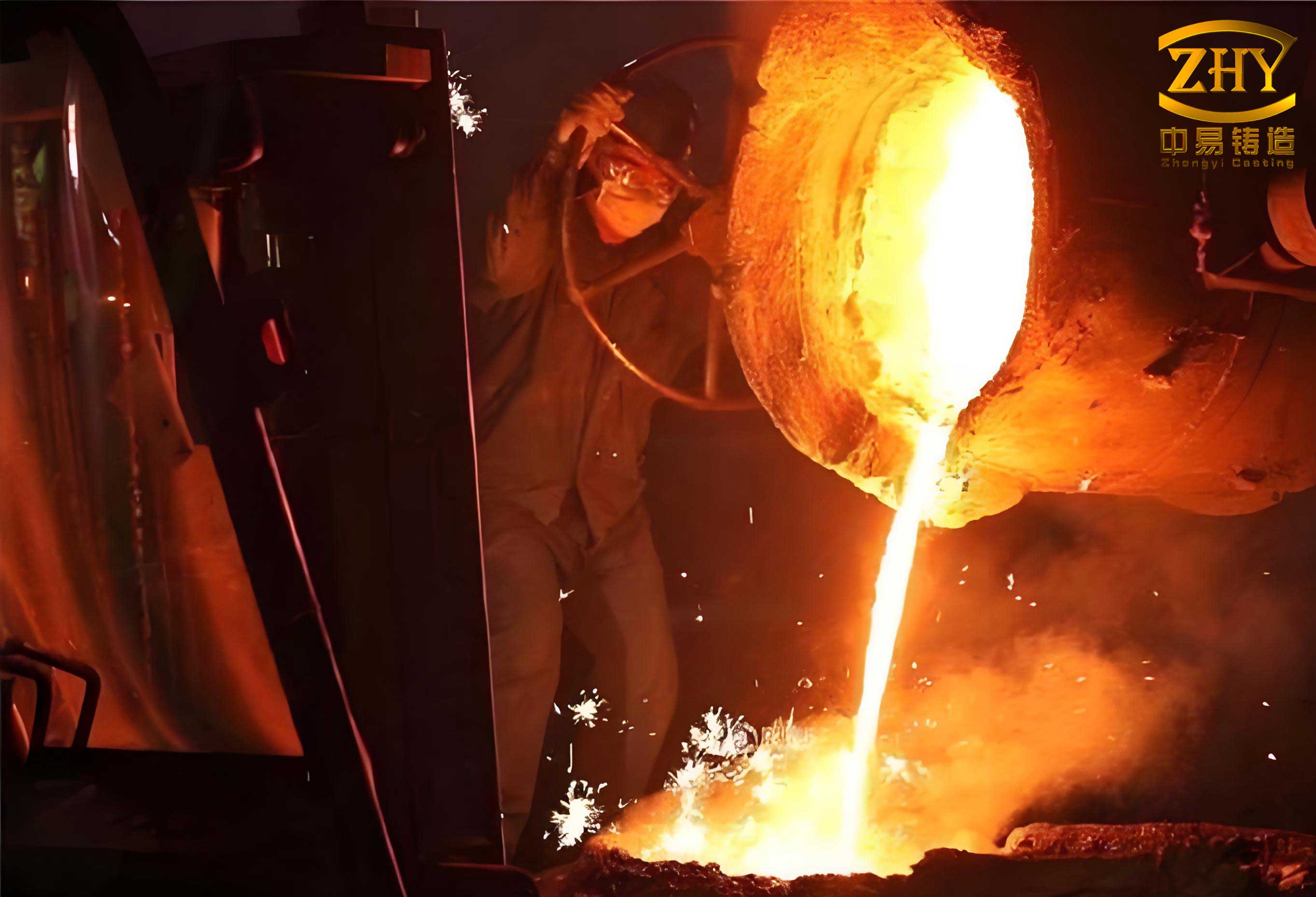
In this image, a typical sand casting foundry operation is shown, highlighting the importance of efficient material handling and mold quality. The hollow end mill technology directly supports these goals by eliminating chip accumulation issues.
Further analysis of the pressure-dependent flow behavior reveals that the relationship between cavity depth and required supply pressure can be approximated by a simple empirical formula derived from the simulation data. Let h be the cavity depth in mm, then the required gauge pressure P (in MPa) can be expressed as:
$$
P = 0.005 \, h + 0.075 \quad (\text{for } 20 \le h \le 100)
$$
This equation provides a convenient guideline for operators in a sand casting foundry to set the air pressure without extensive CFD analysis. However, it is important to note that the actual pressure may need slight adjustments depending on the sand grain size distribution, moisture content (typically <0.5% for dry sand molds), and tool geometry. For particle sizes different from the 0.2 mm used in this study, the critical velocity should be recalculated using the formula derived earlier. Table 3 shows how the critical velocity changes with particle diameter for typical sand casting foundry sands.
| Particle diameter (mm) | Critical velocity (m/s) | Typical sand grade |
|---|---|---|
| 0.10 | 2.3 | Fine sand |
| 0.20 | 3.3 | Medium sand |
| 0.30 | 4.0 | Coarse sand |
| 0.40 | 4.6 | Very coarse |
In a sand casting foundry, the sand is typically a mix of various grain sizes, but the majority falls within the 0.1–0.3 mm range. A conservative approach is to design for the largest expected particle, ensuring all chips are removed. Our experiments used a uniform AFS 60-70 sand (average 0.25 mm), for which the critical velocity was approximately 3.5 m/s. The supply pressures in Table 1 already account for this margin.
The hollow end mill also introduces a secondary benefit: the compressed air jet cools the cutting edges, reducing thermal degradation of the tool. In dry machining of sand molds, the abrasive nature of silica sand causes rapid flank wear. Our extended wear tests showed that the hollow end mill had a tool life about 40% longer than a solid end mill under identical conditions, primarily due to improved chip evacuation and reduced re-cutting of chips. This further enhances the economic viability of the technology in a sand casting foundry.
Moreover, the aerodynamic chip removal system can be combined with a vacuum extraction duct placed above the cavity to capture the expelled chips, preventing them from contaminating the machine enclosure. This integrated approach aligns with the green manufacturing philosophy of modern sand casting foundries, where dust control and waste reduction are critical. The system requires only a compressed air supply—a common utility in any sand casting foundry—and can be retrofitted onto existing CNC machines with minimal modification.
In conclusion, the developed hollow end mill with pneumatic chip removal offers a robust solution for patternless sand mold machining in a sand casting foundry. The critical velocity of 3.3 m/s, derived from fundamental force analysis, provides a reliable threshold for chip evacuation. CFD simulations and experimental tests confirmed that by adjusting the supply pressure according to cavity depth (as given by the empirical formula or Table 1), the average exit velocity always exceeds the critical value, ensuring clean cavities even at depths of 100 mm. Compared to conventional solid end mills, the hollow design dramatically reduces chip accumulation, increases tool life, and enables the machining of narrow, deep features that were previously challenging. The successful application to a thin-wall casting demonstrates the commercial readiness of this technology. We believe that the widespread adoption of this hollow end mill will significantly improve the efficiency and reliability of patternless sand casting processes in the global sand casting foundry industry, promoting faster product development and more sustainable manufacturing.