
In the development of new energy vehicle components, I focused on the production of a three-intermediate-shaft transmission housing using lost foam casting technology. This method, also known as full mold casting, involves creating a foam model coated with refractory material, placing it in dry sand to form a mold, vibrating to compact the sand, and maintaining a negative pressure environment during pouring and solidification. This ensures that gases from the foam’s vaporization and combustion are efficiently expelled through the coating, enhancing mold rigidity and cooling efficiency, allowing molten metal to precisely replace the foam model and form the desired part. Lost foam casting is particularly advantageous for complex geometries like thin-walled and semi-enclosed structures, which are common in transmission housings. The process relies on careful control of material selection and solidification mechanisms, especially for gray iron castings like HT250, where graphite expansion during solidification can compensate for volumetric shrinkage, necessitating a well-designed feeding system to address liquid contraction.
The transmission housing serves as a critical component in commercial vehicle gearboxes, supporting and installing the transmission system, ensuring effective operation, managing lubricating oil, and connecting securely to the vehicle chassis. Based on the structural analysis, the housing has a triangular shape with a front face featuring four shaft holes that divide it into functional zones. Key specifications include a mass of 75 kg,轮廓尺寸 of 544 mm × 518 mm × 552 mm, a main wall thickness of 8 mm, rib width of 10 mm, and a front face thickness of 21 mm, with a total volume of approximately 11,464,230 mm³. Quality standards require the material to be HT250 gray iron, free from internal defects like shrinkage porosity and cavities, and with stringent dimensional tolerances. To achieve this, I employed lost foam casting due to its ability to handle intricate designs, but initial trials revealed challenges with shrinkage defects on the front face, prompting further investigation and optimization.
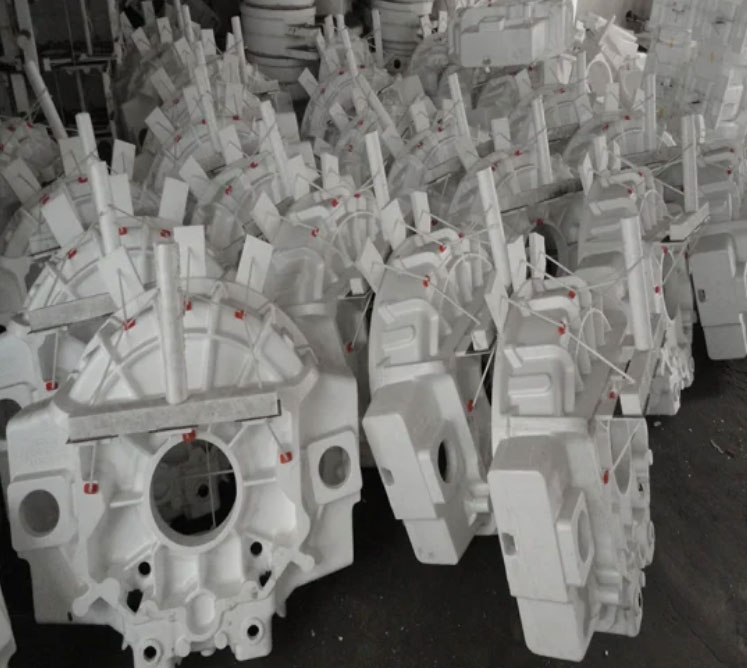
In the initial lost foam casting process, I designed a side-bottom gating system with two ingates at the bottom front face, a cross-gate with a sectional area of 1,050 mm², and a sprue of ϕ41 mm. The front face, being a heat concentration zone, was equipped with four rows of cooling fins, each with an area of 1,250 mm², to act as chillers and promote directional solidification. However, numerical simulation using MAGMA software indicated a high risk of shrinkage porosity and cavities in this area. The simulation parameters included a pouring temperature of 1,500 °C, pouring time under 18 s, silica sand as the mold material, and a sand temperature of 50 °C, ignoring the filling phase effects. The liquid fraction analysis showed that during solidification, the front face formed isolated liquid zones due to overlapping geometric and flow hot spots, leading to premature solidification of the ingates and inadequate feeding. The table below summarizes the key process parameters and simulation results for the initial design:
| Parameter | Value | Description |
|---|---|---|
| Pouring Temperature | 1,500 °C | Temperature of molten metal during pouring |
| Pouring Time | ≤ 18 s | Duration for complete mold filling |
| Mold Material | Silica Sand | Type of sand used in lost foam casting |
| Sand Temperature | 50 °C | Initial temperature of the sand mold |
| Ingate Sectional Area | 560 mm² each | Area of two ingates in the gating system |
| Cross-gate Area | 1,050 mm² | Sectional area of the cross-gate |
| Liquid Fraction at 37.66 s | 70.75% | Percentage of liquid metal remaining at this time |
| Liquid Fraction at 137.9 s | 1.93% | Final liquid fraction indicating solidification completion |
The chemical composition of the HT250 gray iron used in this lost foam casting process is critical for achieving the desired mechanical properties. The table below outlines the alloy elements and their mass fractions, which were controlled within specific ranges to ensure proper solidification behavior and minimize defects:
| Alloy Element | Mass Fraction Range | Role in Casting |
|---|---|---|
| C | 3.1–3.5 | Primary graphite former, affects fluidity and shrinkage |
| Si | 1.5–2.3 | Promotes graphitization, reduces chilling tendency |
| Mn | 0.3–0.85 | Enhances strength and hardenability |
| S | ≤ 0.10 | Minimized to prevent sulfide inclusions |
| P | ≤ 0.10 | Limited to avoid phosphide eutectics and brittleness |
| Cr | 0.20–0.35 | Improves hardness and wear resistance |
| Ni | 0.15–3.0 | Enhances toughness and corrosion resistance |
| Mo | 0.05–1.2 | Increases strength and high-temperature stability |
From the simulation, I derived that the solidification process in lost foam casting can be modeled using thermal dynamics equations. For instance, the rate of heat transfer in the sand mold can be expressed as:
$$ q = -k \frac{\partial T}{\partial x} $$
where \( q \) is the heat flux, \( k \) is the thermal conductivity of the sand, and \( \frac{\partial T}{\partial x} \) is the temperature gradient. In the context of lost foam casting, the negative pressure environment enhances heat extraction, which can be quantified by modifying the heat transfer coefficient. The liquid fraction \( f_l \) during solidification is a key parameter, and it can be estimated using the Scheil equation for non-equilibrium solidification:
$$ f_l = 1 – \left( \frac{T – T_s}{T_l – T_s} \right)^{1/(k-1)} $$
where \( T \) is the current temperature, \( T_l \) is the liquidus temperature, \( T_s \) is the solidus temperature, and \( k \) is the partition coefficient. In the initial design, the front face’s high liquid fraction persistence indicated a risk zone, as the cooling fins were insufficient to overcome the thermal accumulation. This was compounded by the gating design, where the ingates solidified early, cutting off feeding paths. The probability of defect formation \( P_d \) can be related to the local solidification time \( t_s \) and the temperature gradient \( G \) by:
$$ P_d \propto \frac{1}{G \cdot t_s} $$
In practice, for lost foam casting, optimizing these parameters is essential to reduce \( P_d \).
To address the shrinkage issues, I proposed an optimized lost foam casting process based on the “gating as riser” concept. This involved reorienting the casting, increasing the cross-gate area to function like a riser, and positioning the ingates directly at the geometric hot spots on the front face. The new gating system had ingates with a sectional area of 420 mm², cross-gates of 3,650 mm² in varying lengths, and the same sprue size. Additionally, I reinforced the foam model with glass fiber rods to prevent deformation during handling and casting. The MAGMA simulation for this optimized lost foam casting setup showed a significant improvement: the liquid fraction decreased steadily, and by 223.428 s, it reached 3.94%, with no isolated liquid zones on the front face. The table below compares the key aspects of the initial and optimized lost foam casting processes:
| Aspect | Initial Process | Optimized Process |
|---|---|---|
| Gating System | Side-bottom with two ingates | “Gating as riser” with repositioned ingates |
| Ingate Sectional Area | 560 mm² each | 420 mm² each |
| Cross-gate Area | 1,050 mm² | 3,650 mm² |
| Cooling Fins | Four rows, 1,250 mm² each | Not primarily relied upon; integrated into gating |
| Liquid Fraction at Final Stage | 1.93% with front face defects | 3.94% with no defects |
| Defect Risk | High for shrinkage porosity and cavities | Low to none |
The effectiveness of the optimized lost foam casting process was validated through production trials. After implementing the changes, non-destructive testing and machining of the castings confirmed the absence of shrinkage porosity and cavities on the front face. This aligned perfectly with the simulation predictions, demonstrating the reliability of the “gating as riser” approach in lost foam casting. The improved process not only eliminated defects but also enhanced the overall quality and durability of the transmission housing, making it suitable for high-torque applications in new energy vehicles. The success of this optimization underscores the importance of integrating numerical simulation with practical adjustments in lost foam casting to achieve optimal results.
In conclusion, my research on lost foam casting for the three-intermediate-shaft transmission housing highlights the critical role of gating design in mitigating solidification defects. The initial lost foam casting process, with its side-bottom gating and cooling fins, failed to prevent shrinkage due to thermal overlaps and premature solidification. However, by adopting a “gating as riser” strategy in the lost foam casting setup, I successfully reduced the risk of defects, as evidenced by both simulation and production validation. This optimized lost foam casting method proves to be a robust solution for complex castings, ensuring high integrity and performance in demanding automotive applications. Future work could explore further refinements in lost foam casting parameters, such as varying negative pressure levels or incorporating advanced alloy modifications, to push the boundaries of this versatile manufacturing technique.