
In the realm of advanced manufacturing, lost foam casting has emerged as a pivotal technique, particularly the shell variant that integrates the benefits of traditional foam evaporation and investment casting. This method aligns perfectly with the principles of clean, green, and environmentally friendly casting, often referred to as the green casting engineering of the new century. Lost foam shell casting involves a pre-heating process to liquefy and remove the foam, enabling hollow shell pouring, which effectively mitigates issues like slag inclusion, wrinkles, and carbon pickup. This makes it highly suitable for producing high-quality low-carbon steel and stainless steel components. Unlike conventional investment casting, which struggles with larger parts due to mold thickness and cost constraints, lost foam shell casting utilizes specialized coatings to handle large, complex geometries, broadening its application scope. As a green and energy-efficient process, lost foam shell casting holds immense potential for future industrial adoption.
The performance of coatings in lost foam casting is critical, as they form intricate hollow shells after application and firing. These coatings must exhibit sufficient strength to withstand the冲刷 of high-temperature metal fluids while maintaining excellent permeability to facilitate gas escape. These properties are closely tied to the viscosity and rheological behavior of the coatings. Practical experience and research indicate that coating quality is a decisive factor in product outcomes, even under consistent melting and pouring conditions. For instance, studies on magnesium and titanium alloy coatings have highlighted the importance of shear-thinning effects and viscosity adjustments in enhancing casting quality. Similarly, the impact of sodium bentonite content on viscosity and application performance has been explored, with optimization techniques like orthogonal design improving overall coating efficacy. To ensure optimal application, coatings must possess adequate viscosity for thickness build-up during brushing, yet low enough viscosity for smooth flow; post-application, rapid viscosity recovery is desired to prevent dripping and ensure uniform shell thickness. These requirements are directly influenced by the coating’s apparent viscosity and rheological properties, which evolve during mixing and standing periods.
In this study, I focus on the effects of mixing time and standing time on the viscosity and rheological performance of coatings used in lost foam shell casting. Understanding these temporal factors is essential for maintaining coating consistency and performance in industrial settings. Typically, coatings are prepared by mixing powder and liquid components thoroughly before use. The powder consists of refractory fillers like Al2O3 and SiO2, with average particle sizes ranging from 300 to 800 μm, supplemented with minor additives such as iron oxide powder, sodium bentonite, and carboxymethyl cellulose sodium. The liquid component is a water-based solution containing latex, SN thickeners, and other agents, with a pH of 8–9 and a density of 1.2 g/cm³. The mixing process involves adding powder gradually to the liquid in a stirrer at a speed of 800 rpm, followed by viscosity measurements using a rotational viscometer with a No. 3 rotor at varying speeds (e.g., 6, 12, 30, 60 rpm). The experimental setup ensures that all procedures are conducted at ambient temperature (18°C), with samples extracted at intervals to assess viscosity, flow curves, and shear-thinning ratios.
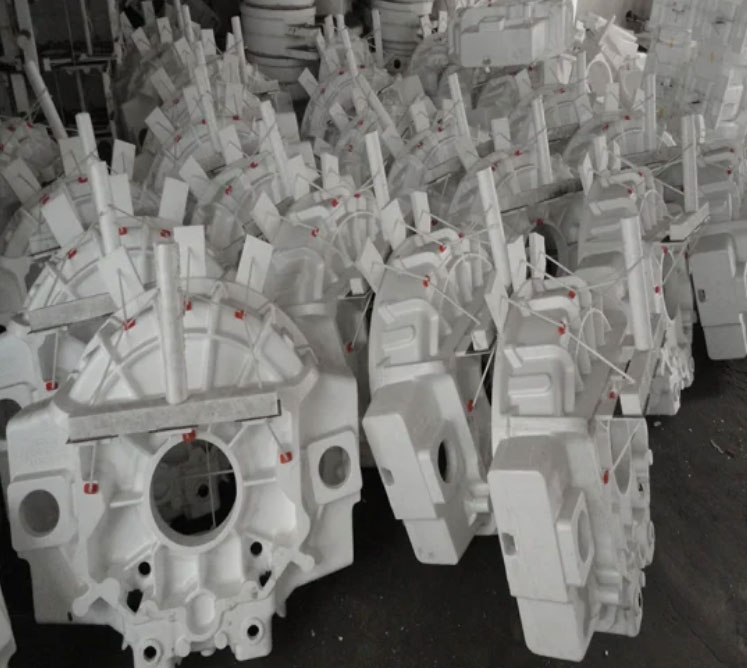
The influence of mixing time on coating viscosity is profound. As mixing duration increases, the viscosity decreases initially and stabilizes after a certain period. This behavior can be modeled using a power-law equation for non-Newtonian fluids: $$\eta = K \dot{\gamma}^{n-1}$$ where $\eta$ is the apparent viscosity, $K$ is the consistency index, $\dot{\gamma}$ is the shear rate, and $n$ is the flow behavior index. For lost foam casting coatings, the decrease in viscosity with mixing time is attributed to the breakdown of internal structures, such as polymer chains and bentonite networks, releasing trapped water and reducing structural viscosity. Table 1 summarizes the viscosity values at different mixing times and rotor speeds, illustrating this trend.
| Mixing Time (min) | 6 rpm | 12 rpm | 30 rpm | 60 rpm |
|---|---|---|---|---|
| 5 | 8500 | 5500 | 3200 | 1900 |
| 15 | 7800 | 5000 | 2900 | 1750 |
| 30 | 7200 | 4600 | 2700 | 1650 |
| 40 | 7000 | 4400 | 2550 | 1600 |
| 50 | 6800 | 4300 | 2500 | 1550 |
| 60 | 6750 | 4250 | 2480 | 1540 |
From the data, it is evident that viscosity stabilizes after approximately 50 minutes of mixing, indicating that prolonged mixing beyond this point yields minimal changes. This stabilization corresponds to the complete homogenization of powder and liquid components, as well as the equilibrium of disrupted internal structures. The rheological curves further support this, showing consistent flow behavior post-50 minutes, which aligns with the viscosity trends. The shear-thinning ratio, defined as the ratio of viscosity at low shear rate to that at high shear rate, is another critical parameter. It can be expressed as: $$R_{st} = \frac{\eta_{\text{low}}}{\eta_{\text{high}}}$$ where $R_{st}$ is the shear-thinning ratio, $\eta_{\text{low}}$ is viscosity at 6 rpm, and $\eta_{\text{high}}$ is viscosity at 60 rpm. For lost foam casting coatings, a higher $R_{st}$ indicates better brushing performance, with values above 4.0 being desirable. As mixing time increases, $R_{st}$ rises initially, peaks around 40 minutes, and then stabilizes, reflecting optimal shear-thinning effects for easy application and quick recovery.
Turning to standing time, the viscosity of lost foam casting coatings exhibits a non-monotonic behavior. After mixing, viscosity increases gradually during initial standing, reaches a maximum, and then declines with prolonged storage. This phenomenon is linked to the reformation of internal networks and subsequent degradation or sedimentation. The viscosity change can be described by a time-dependent model: $$\eta(t) = \eta_0 + A e^{-kt} – B t$$ where $\eta(t)$ is viscosity at time $t$, $\eta_0$ is initial viscosity, $A$ and $B$ are constants related to structure reformation and degradation, and $k$ is a rate constant. Table 2 presents viscosity data at different standing times, highlighting the initial increase and subsequent decrease.
| Standing Time (h) | 6 rpm | 12 rpm | 30 rpm | 60 rpm |
|---|---|---|---|---|
| 1 | 6800 | 4300 | 2500 | 1550 |
| 7 | 7000 | 4500 | 2600 | 1600 |
| 11 | 7200 | 4700 | 2700 | 1650 |
| 28 | 7500 | 4900 | 2800 | 1700 |
| 35 | 7800 | 5100 | 2900 | 1750 |
| 40 | 7600 | 5000 | 2850 | 1720 |
| 47 | 7400 | 4800 | 2750 | 1680 |
| 56 | 7200 | 4600 | 2650 | 1620 |
The data shows that viscosity peaks around 35–40 hours of standing, after which it declines, likely due to component settling or chemical degradation. The rheological curves during standing confirm this trend, with shear stress increasing initially and stabilizing post-40 hours. The shear-thinning ratio remains above 4.0 for most standing periods, indicating that brushing performance is not severely compromised, but the overall viscosity changes necessitate careful timing in industrial applications to maintain consistency in lost foam casting processes.
To elucidate the underlying mechanisms, I consider the structural evolution of the coating. The total viscosity ($\eta_{\text{total}}$) comprises plastic viscosity ($\eta_p$) and structural viscosity ($\eta_s$): $$\eta_{\text{total}} = \eta_p + \eta_s$$ where $\eta_p$ arises from interparticle friction and molecular interactions, and $\eta_s$ from internal networks like polymer chains and bentonite films. During mixing, shear forces disrupt these networks, reducing $\eta_s$ and freeing bound water, as illustrated by the equation: $$\eta_s \propto \frac{1}{\dot{\gamma}^m}$$ where $m$ is a structure breakdown exponent. Upon standing, network reformation occurs, increasing $\eta_s$ initially, but over time, sedimentation and component失效 lead to a decrease. This dynamic is crucial for optimizing lost foam casting, as it affects coating uniformity and shell integrity.
In conclusion, my investigation into lost foam shell casting coatings reveals that mixing time should be at least 50 minutes to achieve stable viscosity and optimal shear-thinning properties, while standing time should not exceed 40 hours to prevent performance degradation. These findings provide practical guidelines for enhancing the efficiency and reliability of lost foam casting operations, reinforcing its position as a sustainable casting solution. Future work could explore the effects of temperature and additive variations to further refine coating performance in this innovative green technology.