
In the production of aluminum alloy housings for medium and light truck automated manual transmissions (AMT) using the lost foam casting process, we often encounter various defects that impact product quality and yield. As a practitioner in this field, I have observed that the inherent complexities of lost foam casting, including foam decomposition, gas evolution, and structural challenges, contribute to issues such as gas holes, cracks, and shrinkage porosity. This article delves into a detailed analysis of these defects, their root causes, and the implemented improvements based on empirical data and theoretical foundations. Through systematic adjustments in process parameters, structural design, and material controls, we have achieved significant enhancements in defect reduction. The following sections provide an in-depth exploration, supported by formulas, tables, and practical insights, to elucidate the mechanisms behind defect formation and the efficacy of corrective measures in lost foam casting.
The lost foam casting process involves creating a foam pattern, coating it with a refractory material, and embedding it in unbonded sand before pouring molten metal. This method is favored for its ability to produce complex shapes with minimal machining, but it is prone to defects due to the decomposition of the foam pattern and the subsequent gas generation. In our experience with AMT housings, the primary defects include gas holes, cracks along parting lines, and shrinkage porosity. These defects not only compromise the structural integrity but also lead to high rejection rates. For instance, initial data indicated internal reject rates of 70,568 ppm and external reject rates of 97,642 ppm, highlighting the urgency for process optimization.
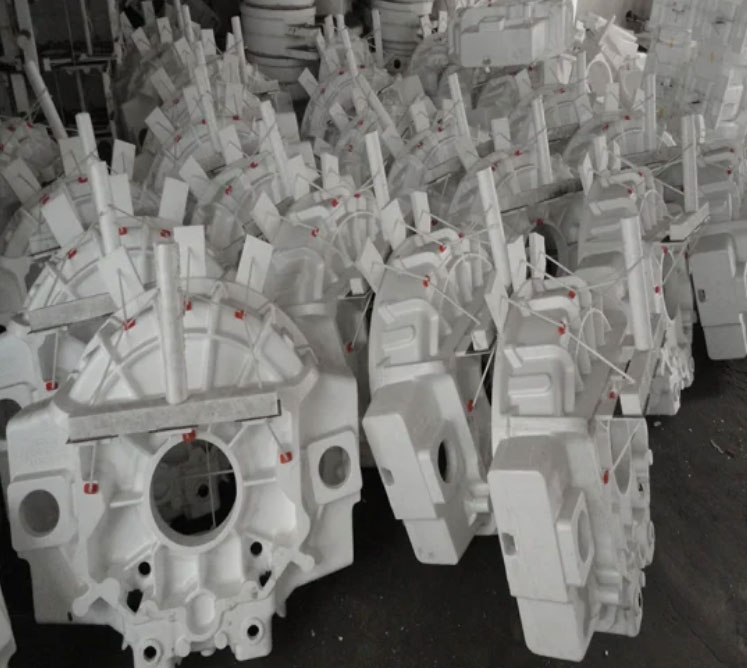
Gas holes, one of the most prevalent defects in lost foam casting, typically manifest as spherical or elongated voids within the cast structure, often located in thick sections or near internal features like machined holes. The formation of gas holes is primarily attributed to the decomposition of the expanded polystyrene (EPS) foam during metal pouring. As the molten aluminum contacts the foam, it undergoes thermal degradation, releasing gases such as hydrogen and hydrocarbons. If these gases are not adequately vented, they become trapped in the solidifying metal, leading to porosity. The ideal gas law can be applied to model the pressure buildup: $$ P V = n R T $$ where \( P \) is the gas pressure, \( V \) is the volume of the cavity, \( n \) is the number of moles of gas produced, \( R \) is the gas constant, and \( T \) is the temperature. In lost foam casting, \( n \) depends on the foam density and decomposition rate, which is influenced by pouring temperature. Higher temperatures accelerate foam degradation, increasing \( n \) and thus \( P \), which can exceed the metal’s ability to vent gases, resulting in defects.
To quantify the relationship between foam density and gas generation, we conducted experiments varying the EPS bead density. The results showed that a density range of 19–20 g/L minimizes gas evolution while maintaining pattern integrity. The gas generation per unit mass of EPS can be expressed as: $$ G = k_d \cdot \rho \cdot A $$ where \( G \) is the gas volume generated, \( k_d \) is a decomposition constant, \( \rho \) is the foam density, and \( A \) is the surface area of the pattern. Controlling \( \rho \) within the specified range reduces \( G \), thereby lowering the risk of gas holes. Additionally, the pouring temperature plays a critical role; we maintain it at \( 750 \pm 10 \,^\circ\text{C} \) to balance fluidity and gas evolution. The fluidity of aluminum alloy, which affects mold filling, can be described by: $$ F = \frac{\mu \cdot v}{T} $$ where \( F \) is a fluidity index, \( \mu \) is the dynamic viscosity, \( v \) is the flow velocity, and \( T \) is the temperature. Excessive temperature increases \( F \) but also raises gas absorption, leading to porosity.
| Defect Type | Percentage (%) | Common Locations |
|---|---|---|
| Shrinkage Porosity | 40 | Thick sections, junctions |
| Cracks along Parting Lines | 35 | Parting seams, rib centers |
| Gas Holes | 25 | Machined holes, internal cavities |
Cracks along parting lines, another significant defect in lost foam casting, often appear as fine, linear discontinuities detected through non-destructive testing like X-ray. These cracks result from incomplete bonding of foam pattern segments during assembly. In our AMT housing production, the parting lines are positioned along the centerlines of ribs and spherical bosses, which complicates pattern assembly. If the adhesive or tape does not fully seal the joints, coating material infiltrates the gaps, creating weak points in the cast structure. The stress concentration at these points can be analyzed using the formula for thermal stress: $$ \sigma = E \cdot \alpha \cdot \Delta T $$ where \( \sigma \) is the stress, \( E \) is the Young’s modulus of the aluminum alloy, \( \alpha \) is the coefficient of thermal expansion, and \( \Delta T \) is the temperature gradient during solidification. In lost foam casting, rapid cooling exacerbates \( \Delta T \), increasing \( \sigma \) and promoting crack initiation. Moreover, the geometry of parting lines—such as sharp corners or thin sections—amplifies stress risers. For instance, ribs with a thickness of 7 mm split into 3.5 mm per pattern half are prone to deformation during demolding, leading to poor adhesion and subsequent cracks.
To address this, we optimized the structural design by increasing fillet radii at parting line intersections and widening ribs to 11 mm to ensure proper tape application. The modified geometry reduces stress concentration factors, which can be calculated as: $$ K_t = 1 + 2 \sqrt{\frac{a}{\rho}} $$ where \( K_t \) is the stress concentration factor, \( a \) is the crack-like defect length, and \( \rho \) is the radius of curvature. By increasing \( \rho \), we lower \( K_t \), thus minimizing crack propensity. Additionally, we improved assembly controls, such as verifying tape adhesion integrity before coating, to prevent coating infiltration. These measures have proven effective in reducing crack-related rejects, as evidenced by post-improvement data.
| Time Period | External Reject Rate (ppm) | Primary Defects |
|---|---|---|
| 2022 (Baseline) | 97,642 | Gas holes, cracks, shrinkage |
| 2023 (Jan-Jul) | 41,944 | Reduced across all types |
Shrinkage porosity in lost foam casting typically occurs in isolated thick sections where liquid metal feeding is inadequate during solidification. This defect manifests as irregular voids and is influenced by the gating system and pouring temperature. In our initial setup, we employed a slit-like gating system without risers, which, combined with high pouring temperatures, led to unstable filling and localized shrinkage. The solidification time, governed by Chvorinov’s rule, is critical: $$ t = k \left( \frac{V}{A} \right)^2 $$ where \( t \) is the solidification time, \( k \) is a mold constant, \( V \) is the volume of the section, and \( A \) is its surface area. Thick regions have a higher \( V/A \) ratio, resulting in longer \( t \) and increased shrinkage risk if not fed properly. By controlling the pouring temperature to \( 750 \pm 10 \,^\circ\text{C} \), we enhance fluidity while reducing turbulence and gas entrapment. The thermal gradient \( \Delta T \) across the casting also affects shrinkage; a steeper gradient promotes directional solidification, which can be optimized using computer simulations to design better gating systems.
Furthermore, we extended the pattern drying time to at least 72 hours in a controlled environment to eliminate residual moisture, which can contribute to gas formation. The diffusion of moisture from the coating can be modeled with Fick’s law: $$ J = -D \frac{\partial C}{\partial x} $$ where \( J \) is the flux, \( D \) is the diffusion coefficient, \( C \) is the concentration gradient, and \( x \) is the distance. Prolonged drying reduces \( C \), minimizing steam generation during pouring. Additionally, we adjusted the foam bead density to 19–20 g/L, as higher densities reduce gas evolution but may compromise pattern strength. The optimal density balances these factors, as shown in our quality metrics post-improvement.
The improvement measures implemented in our lost foam casting process have yielded positive results. For internal rejects, the ppm decreased from 70,568 in 2022 to 23,002 in the first seven months of 2023, surpassing the target of 42,000 ppm. Similarly, external rejects dropped from 97,642 to 41,944 ppm, meeting the goal of below 49,000 ppm. These outcomes underscore the importance of a holistic approach that integrates process control, structural design, and material management. The following table summarizes the key parameters and their optimized values:
| Parameter | Initial Value | Optimized Value | Impact on Defects |
|---|---|---|---|
| Pouring Temperature | Variable, often >760°C | 750 ± 10°C | Reduced gas holes and shrinkage |
| EPS Bead Density | 18–22 g/L | 19–20 g/L | Minimized gas evolution |
| Drying Time | 48–60 hours | ≥72 hours | Lowered moisture-related defects |
| Parting Line Design | Sharp corners, thin ribs | Increased fillets, wider ribs | Decreased crack incidence |
In conclusion, the lost foam casting process for aluminum alloy housings requires meticulous attention to multiple variables to mitigate defects. Through targeted improvements in pouring temperature control, structural optimizations, and strict adherence to material specifications, we have demonstrated that significant quality enhancements are achievable. The formulas and tables presented here provide a framework for understanding the underlying mechanisms, such as gas pressure dynamics and stress distributions, which are pivotal in lost foam casting. Future work could focus on advanced simulation tools to predict defect formation and further optimize the process. Ultimately, the lessons learned from this case can be applied to other products, reinforcing the versatility and potential of lost foam casting in automotive applications.
As we continue to refine our approaches, it is evident that lost foam casting remains a viable method for producing complex components, provided that process parameters are rigorously controlled. The integration of empirical data with theoretical models, as discussed, enables a proactive stance toward defect prevention. For instance, the relationship between foam density and gas generation can be extended to other alloy systems, while structural optimizations can be standardized across similar geometries. In essence, the success in reducing defects hinges on a deep understanding of the lost foam casting process and its interactions with material behavior and design constraints.
To further elaborate on the theoretical aspects, consider the energy balance during foam decomposition in lost foam casting. The heat required to degrade EPS can be expressed as: $$ Q = m \cdot c_p \cdot \Delta T + m \cdot L $$ where \( Q \) is the total heat, \( m \) is the mass of foam, \( c_p \) is the specific heat capacity, \( \Delta T \) is the temperature rise, and \( L \) is the latent heat of decomposition. This energy influences the local cooling rate and gas production, directly impacting defect formation. By controlling pouring parameters, we modulate \( Q \), thereby managing the casting’s integrity. Such insights are crucial for scaling up lost foam casting to high-volume production, as in our AMT housing projects.
In summary, the journey toward improving lost foam casting quality involves continuous iteration and learning. The defects analyzed—gas holes, cracks, and shrinkage porosity—are interconnected through process variables, and their mitigation requires a systems approach. As we advance, we plan to incorporate real-time monitoring and automation to enhance consistency in lost foam casting, ensuring that each cast component meets the stringent demands of the automotive industry. The progress so far validates our strategies and sets a benchmark for future innovations in lost foam casting technology.