
In my experience with lost foam casting, the vibrator table is a critical component that ensures proper compaction of molding sand into the foam pattern cavities. This process directly impacts casting quality, as inadequate vibration can lead to defects like deformation and sand burning-on. Over the years, I have observed that many existing vibrator systems, including those modeled after international designs, struggle with inconsistent sand filling, particularly in horizontal directions. This often necessitates manual interventions, such as pre-packing resin sand into complex foam patterns, which increases production time and costs. Through extensive research and practical applications, my team and I have developed a new vibrator table system that addresses these challenges by enhancing sand fluidity, improving vibration consistency, and controlling filling angles. This article details our approach, including structural improvements, performance testing, and real-world validations, all aimed at optimizing the lost foam casting process for better efficiency and reduced defect rates.
The lost foam casting method relies heavily on the vibrator system to achieve uniform sand density around the foam pattern. Factors influencing vibration effectiveness include sand properties, sand feeding mechanisms, sandbox design, vibrator table characteristics, and control systems. For instance, spherical sand types, like chromite sand, outperform angular sands like silica due to their better flowability. However, the core of the system lies in the sandbox rigidity and the vibrator’s ability to generate consistent excitations. Traditional vibrator tables, such as those with free-floating designs or clamped frames, often exhibit limitations in horizontal filling capabilities. In our initial assessments, we used quartz sand (20-40 mesh) and manual sand feeding methods, with sandbox dimensions of 1450 mm × 1200 mm × 1000 mm. The vibrator table mimicked the GK-style free-floating design but featured motors suspended on both sides. Unfortunately, this setup resulted in significant issues: sand burning-on due to low compaction in dead zones and casting deformation from uneven vibration forces. Measurements revealed amplitude variations of 0.4–0.7 mm and acceleration differences up to threefold across the sandbox, causing sand flow that distorted thin-walled castings and led to high rejection rates.
To tackle these problems, we first focused on improving sandbox rigidity and vibration consistency. The original sandbox consisted of two 8 mm steel plates welded with 20 support sleeves, which often loosened over time, leading to force transmission failures and baseplate deformations of up to 2.3 mm. This exacerbated vertical dimension changes in castings, such as a transmission case where the height deviated by 1.2–4.0 mm from the theoretical 534 mm, resulting in inconsistent machining allowances and a scrap rate of 2.9%. Using finite element analysis (FEA), we simulated deformation under vibration loads. The results indicated maximum deformations of 0.202 mm on the bottom and 0.302 mm on the sides. We redesigned the sandbox by reinforcing the base with #10 channel steel, transforming it into an integral frame that enhanced stiffness and force distribution. The improved design reduced deformations to 0.065 mm (bottom) and 0.095 mm (sides), as summarized in Table 1. This modification minimized support sleeve failures and baseplate distortions, ensuring more reliable vibration transmission.
| Sandbox Structure | Bottom Deformation (mm) | Side Deformation (Length, mm) | Side Deformation (Width, mm) |
|---|---|---|---|
| Original Design | 0.202 | 0.302 | 0.208 |
| Improved Design | 0.065 | 0.095 | 0.072 |
Next, we developed a new vibrator table in collaboration with industry partners, adopting a clamped-frame structure similar to the Vulcan design. This system features four vibration motors (two on each side) and uses eight 45° inclined surfaces to secure the sandbox via hydraulic pressure. The control system incorporates four frequency converters and a PLC to regulate vibration acceleration, amplitude, and angle. By adjusting the phase angles of the motors, we can achieve vibrations in any desired direction within a plane. This programmability allows for precise control over sand flow, enabling uniform filling of complex patterns without foam deformation. The vibration acceleration, for example, can be expressed as: $$a = A \omega^2 \sin(\omega t + \phi)$$ where \(a\) is acceleration, \(A\) is amplitude, \(\omega\) is angular frequency, and \(\phi\) is phase angle. This formula helps in optimizing the vibration parameters for specific casting geometries.
We conducted comprehensive performance tests on the new system, measuring vibration consistency across 18 points in the sandbox at different heights (upper, middle, and lower ribs). For vertical (Z-direction) vibrations at 90° unidirectional mode with 85% intensity and 300 mm sand height, the accelerations showed improved uniformity compared to the old system. Points near clamping areas, such as positions 3 and 12, had slightly lower values, but overall consistency was enhanced. Similarly, for horizontal (Y-direction) vibrations at 0° unidirectional mode, accelerations were higher at the top and decreased toward the bottom, with clamping points exhibiting lower values. The data, summarized in Table 2, highlights the system’s ability to maintain consistent forces, crucial for preventing sand flow-induced distortions in lost foam casting.
| Position Point | Upper Rib Acceleration (m/s²) | Middle Rib Acceleration (m/s²) | Lower Rib Acceleration (m/s²) | Average Acceleration (m/s²) |
|---|---|---|---|---|
| 1 | 12.1 | 12.4 | 12.1 | 12.2 |
| 2 | 8.2 | 8.3 | 7.9 | 8.1 |
| 3 | 7.4 | – | – | 7.4 |
| 4 | 8.5 | 8.6 | 8.9 | 8.7 |
| 5 | 13.1 | 14.4 | 13.4 | 13.6 |
| 6 | 17.9 | 18.6 | 18.3 | 18.3 |
| 7 | 23.5 | 17.8 | 17.3 | 19.5 |
| 8 | 16.7 | 17.9 | 16.9 | 17.2 |
| 9 | 16.4 | 17.0 | 16.8 | 16.7 |
| 10 | 12.5 | 13.4 | 13.5 | 13.1 |
| 11 | 10.7 | 11.7 | 11.3 | 11.2 |
| 12 | 11.3 | – | – | 11.3 |
| 13 | 14.4 | 13.1 | 12.7 | 13.4 |
| 14 | 15.1 | 15.6 | 15.5 | 15.4 |
| 15 | 18.5 | 18.7 | 18.6 | 18.6 |
| 16 | 16.6 | 17.2 | 17.5 | 17.1 |
| 17 | 15.6 | 17.2 | 16.4 | 16.4 |
| 18 | 16.1 | 16.6 | 15.4 | 16.0 |
We also investigated the impact of sandbox-vibrator interface quality on acceleration. Poor contact at the 45° clamping surfaces, characterized by line or minimal surface contact, led to reduced accelerations at adjacent points. After grinding these surfaces to achieve better contact (35–80% surface engagement), we observed significant improvements in acceleration values, except at points 5–8. This underscores the importance of precise machining for optimal performance in lost foam casting systems. Furthermore, we tested the filling capability using a specialized mold with multiple compartments spaced 20 mm apart. By controlling the vibration angle, we achieved horizontal fills of up to 100 mm, as detailed in Table 3. The relationship between filling distance and vibration parameters can be modeled as: $$d = k \cdot \frac{a \cdot \cos(\theta)}{\mu}$$ where \(d\) is filling distance, \(k\) is a constant, \(a\) is acceleration, \(\theta\) is vibration angle, and \(\mu\) is sand friction coefficient. This formula aids in setting parameters for specific pattern geometries.
| Compartment | Filling Effect |
|---|---|
| 1 | Full fill at block and upper right corner |
| 2 | Fill up to 120 mm (diagonal) |
| 3 | Incomplete fill from block to upper right |
| 4 | Incomplete fill at upper left |
| 5 | Fill up to 110 mm (diagonal) |
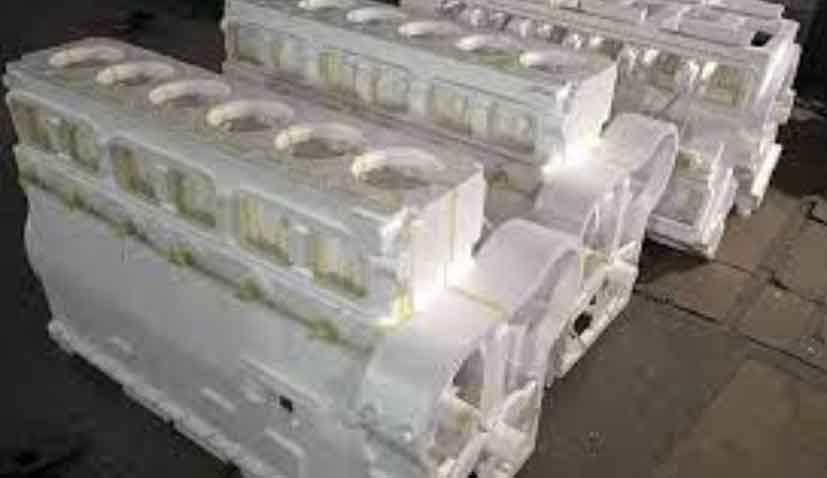
In production validation, we applied the new vibrator table to a flywheel housing casting positioned vertically in the sandbox. Two critical areas required horizontal fills: one at 70 mm and another at 128 mm with a Ø17 mm hole 53 mm from the root. Using optimized vibration sequences—0° reciprocating at 76% intensity for 32 s, followed by 30° unidirectional at 78% for 30 s, and 150° unidirectional at 78% for 30 s—we achieved complete fills without sand burning-on in all 16 test pieces. This reduced the sand burning-on scrap rate from 2.76% to 0.67%. Additionally, we measured dimensional stability on the flywheel housing’s inner diameter. The original process showed a difference of 1.8 mm between transverse and longitudinal diameters, whereas the new system reduced this to 0.5 mm, as shown in Table 4. The Z-direction deformation was minimized, lowering the machining deformation scrap rate from 2.9% to 0.65%. These results demonstrate the efficacy of our innovations in enhancing the lost foam casting process.
| Process | Measurement Direction | Diameter Values (mm) | Average (mm) |
|---|---|---|---|
| Original | Transverse | 506.2, 506.0, 505.9, 506.0, 506.3, 506.0, 506.0, 506.3 | 506.1 |
| Longitudinal | 507.8, 508.2, 507.4, 507.8, 508.0, 507.8, 507.8, 508.4 | 507.9 | |
| New | Transverse | 506.0, 505.8, 505.8, 506.0, 505.6, 505.8, 506.0, 506.0 | 505.9 |
| Longitudinal | 506.4, 506.6, 506.2, 506.6, 506.6, 506.2, 506.3, 506.5 | 506.4 |
In conclusion, our research and application of a new vibrator table for lost foam casting have yielded significant improvements. By leveraging finite element analysis to redesign the sandbox, we enhanced rigidity and vibration consistency. The development of a programmable vibrator system with controlled filling angles enabled horizontal fills up to 100 mm, reducing defects like sand burning-on and deformation. Production validations confirmed these benefits, with scrap rates dropping substantially. This advancement not only optimizes the lost foam casting process but also underscores the importance of integrated design and precise control in achieving high-quality castings. Future work could explore adaptive control algorithms for dynamic vibration adjustments, further pushing the boundaries of lost foam casting efficiency.