
Lost foam casting is widely recognized for its ability to produce components with excellent surface quality, high dimensional accuracy, and improved yield rates. This process is particularly suitable for ductile iron castings, such as gearbox housings, which demand high strength, toughness, wear resistance, and vibration damping properties. The material grade QT450-10 is commonly used for these applications due to its balanced mechanical properties. However, during the production of gearbox housings using lost foam casting, defects like wrinkling and shrinkage cavities often arise, impacting the integrity and performance of the castings. This article investigates the root causes of these defects and presents effective solutions through process optimization, including gating system redesign and innovative cooling techniques.
The gearbox housing studied in this work weighs 112 kg, with wall thicknesses ranging from 14 mm to 54 mm, and features concentrated geometric hot spots. Initially, the lost foam casting process was employed with a top-gating system, as illustrated in the original design. The pouring temperature was maintained between 1,370 °C and 1,440 °C, with a negative pressure of -0.06 to -0.04 MPa during casting, and a pressure holding time of 900 seconds. The chemical composition of the QT450-10 material is summarized in Table 1, which meets the required mechanical properties and nodularity levels of 2–3 grades. Despite this, initial trial productions revealed significant issues with surface wrinkling and shrinkage cavities in the thick sections and geometric hot spots.
| Element | C | Si | Mn | P | S | Mg | RE |
|---|---|---|---|---|---|---|---|
| Content | 3.5–4.0 | 2.0–3.0 | ≤ 0.45 | ≤ 0.05 | ≤ 0.025 | 0.02–0.06 | 0.015–0.04 |
Wrinkling defects in lost foam casting typically manifest as orange-peel-like surfaces on the upper sections or dead zones of the casting, where metal flow is sluggish. This is primarily attributed to the decomposition of the foam pattern, which generates gaseous, liquid, and solid residues. In the original gating design, a top-gating approach was used, leading to turbulent filling where the molten metal acted as a mid-bottom gating system. This caused incomplete pattern vaporization and carbon deposition in the thick upper regions, resulting in wrinkling. The filling behavior can be modeled using fluid dynamics equations, where the Reynolds number (Re) indicates turbulence: $$ Re = \frac{\rho v D}{\mu} $$ Here, \( \rho \) is the density of the molten iron, \( v \) is the flow velocity, \( D \) is the characteristic diameter, and \( \mu \) is the dynamic viscosity. High Re values in the original system confirmed turbulent flow, exacerbating defect formation.
Shrinkage cavities, on the other hand, occurred in the geometric hot spots, such as bolt holes and thick sections, due to inadequate feeding during solidification. The solidification shrinkage of ductile iron, combined with the lack of sequential cooling, led to void formation. The modulus method, commonly used in casting design, highlights the risk in hot spots: $$ M = \frac{V}{A} $$ where \( M \) is the modulus, \( V \) is the volume, and \( A \) is the surface area. Higher modulus values in thick sections increase the susceptibility to shrinkage. In lost foam casting, the absence of effective cooling mechanisms further aggravates this issue.
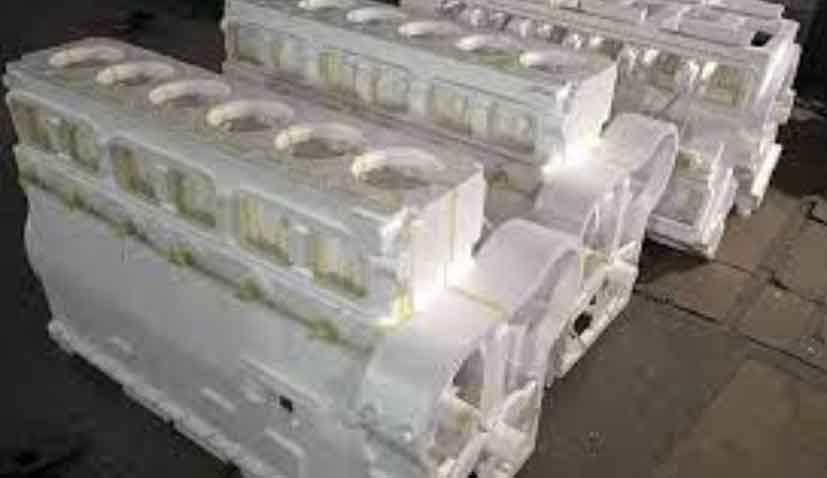
To address wrinkling, the gating system was redesigned from top-gating to a bottom-gating configuration. This modification ensured laminar flow during filling, reducing turbulence and allowing the degraded pattern residues to be carried to the top machining allowances. The pouring time was calculated using the empirical formula: $$ t = S \sqrt{G L} = 24 \, \text{s} $$ where \( S \) is a system constant, \( G \) is the casting weight, and \( L \) is a characteristic length. The average pressure head height \( H_P \) was determined as: $$ H_P = H_0 – \frac{C}{2} = 34 \, \text{cm} $$ with \( H_0 \) being the initial head height and \( C \) a correction factor. The minimum ingate area \( A_g \) was computed to ensure proper flow: $$ A_g = \frac{G}{0.31 t v \sqrt{H_P}} = 3.46 \, \text{cm}^2 $$ Based on practical experience in lost foam casting, the final ingate area was set between 3.5 cm² and 12 cm², with four ingates each measuring 70 mm × 40 mm, providing a total area of 11.2–12.8 cm². The sprue length was designed as 480 mm to maintain a 200 mm head pressure. This bottom-gating system eliminated wrinkling by promoting steady upward filling, as validated in batch productions of 2,000 units.
For shrinkage cavities, a novel heat dissipation technique was developed, involving the attachment of foam pieces, termed “heat sinks,” to the hot spot regions. These heat sinks increase the surface area, reducing the local modulus and enhancing heat extraction through forced convection under negative pressure. The cooling effect can be quantified using the heat transfer equation: $$ Q = h A \Delta T $$ where \( Q \) is the heat flux, \( h \) is the convective heat transfer coefficient, \( A \) is the surface area, and \( \Delta T \) is the temperature difference. In lost foam casting, the negative pressure draws air through the sand mold, facilitating heat exchange around the heat sinks. This creates a controlled cooling zone, mimicking sequential solidification. For the gearbox housing, 12 heat sinks of dimensions 50 mm × 30 mm × 7 mm were attached to the critical areas. This approach resolved shrinkage defects without complicating the process or reducing yield, as demonstrated in large-scale production.
The effectiveness of the optimized lost foam casting process was confirmed through mechanical testing and microstructure analysis. The revised gating system and heat dissipation method collectively improved the quality of ductile iron castings, ensuring compliance with QT450-10 standards. The table below summarizes key parameters before and after optimization:
| Parameter | Original Process | Optimized Process |
|---|---|---|
| Gating System | Top-Gating | Bottom-Gating |
| Pouring Temperature (°C) | 1,370–1,440 | 1,370–1,440 |
| Negative Pressure (MPa) | -0.06 to -0.04 | -0.06 to -0.04 |
| Ingate Area (cm²) | Not Specified | 11.2–12.8 |
| Heat Sinks Used | No | Yes (12 units) |
| Defect Rate | High | Negligible |
In conclusion, the integration of bottom-gating and heat dissipation techniques in lost foam casting effectively mitigates wrinkling and shrinkage defects in ductile iron gearbox housings. The bottom-gating system ensures smooth filling, while the heat sinks enhance local cooling, addressing geometric hot spots. These optimizations underscore the versatility of lost foam casting for complex components, offering a balance between process simplicity and high yield. Future work could explore computational modeling to further refine these methods for other applications in lost foam casting.