
In my extensive experience with lost foam casting processes, particularly for steel castings, I have observed that this method offers significant advantages in producing complex shapes with minimal machining requirements. However, it is prone to specific defects that can compromise the quality of the final product. Lost foam casting, also known as expendable pattern casting, involves using a foam pattern that vaporizes upon contact with molten metal, leaving a precise cavity. Despite its widespread adoption since its invention in the 1950s, challenges such as gas evolution, carbon pickup, and inclusions persist. Through practical applications and research, I have identified key defects and developed strategies to mitigate them. This article delves into these issues, providing detailed analyses and preventive measures, supported by tables and formulas to enhance understanding. The goal is to share insights that can help practitioners optimize their lost foam casting operations for steel components.
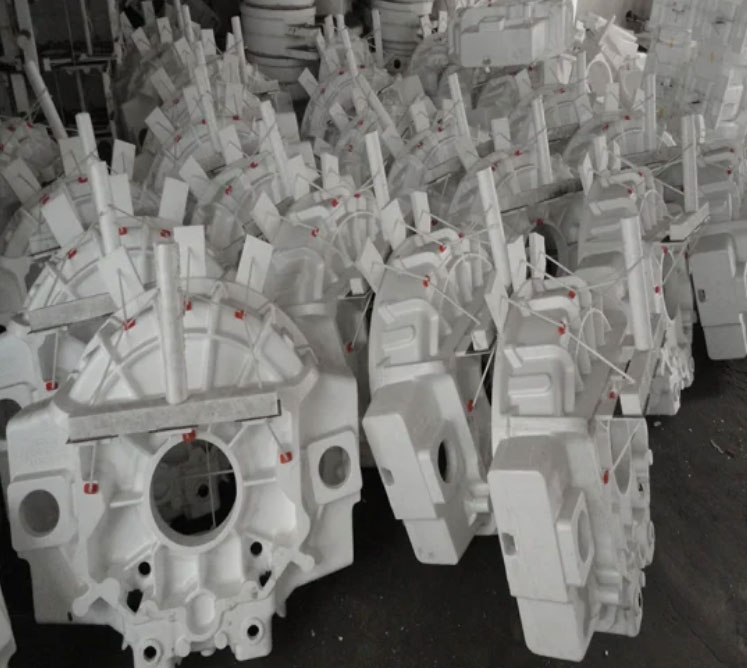
Lost foam casting has evolved from a niche technique to a mainstream manufacturing process, especially in automotive and industrial sectors. However, the decomposition of foam patterns during metal pouring introduces variables that can lead to defects if not properly controlled. In steel castings, the high temperatures exacerbate issues like carbon absorption and gas porosity. Based on my work, I will discuss common defects such as carbon increase, gas holes, slag inclusions, reverse spraying, and negative pressure cutting. Each defect is analyzed with root causes, and I propose practical solutions, including material selections, process adjustments, and quality controls. By integrating theoretical models with empirical data, I aim to provide a comprehensive guide for improving lost foam casting outcomes.
Carbon Increase Defect
One of the most prevalent issues in lost foam casting for steel is carbon increase, where the carbon content of the casting surface rises beyond specifications. This occurs due to the thermal decomposition of the foam pattern, typically made of expanded polystyrene (EPS), which consists primarily of carbon and hydrogen. Upon exposure to molten steel, the foam rapidly breaks down, releasing hydrogen and free carbon. Hydrogen preferentially reacts with oxygen, forming water vapor, while residual carbon infiltrates the steel surface, leading to carburization. In my observations, this defect follows a pattern: it is more pronounced away from the gating system, with minimal effect at the sprue and increasing severity toward remote areas of the casting.
The rate of carbon pickup can be modeled using a diffusion-based approach. For instance, the carbon concentration \( C(x,t) \) at a depth \( x \) from the surface over time \( t \) can be approximated by Fick’s second law: $$ \frac{\partial C}{\partial t} = D \frac{\partial^2 C}{\partial x^2} $$ where \( D \) is the diffusion coefficient of carbon in steel. Solving this with boundary conditions reflective of the lost foam casting environment helps predict carbon distribution. To prevent this, I recommend several strategies. First, select high-quality foam materials with low carbon content and optimal density. A foam density range of 0.015 to 0.020 g/cm³ is ideal, as it reduces the amount of carbon available for reaction. Second, optimize pouring parameters; higher pouring temperatures and controlled pouring speeds accelerate foam vaporization, minimizing carbon residence time. Additionally, enhancing coating permeability and mold vacuum levels facilitates gas escape. Another effective method is strategic riser placement at the farthest points from gates to trap carbon-rich metal, and pre-burning the foam pattern to create a cavity before pouring can also mitigate carbon issues.
| Prevention Measure | Description | Impact |
|---|---|---|
| Foam Selection | Use low-carbon, high-molecular-weight EPS with density 0.015-0.020 g/cm³ | Reduces carbon source |
| Pouring Parameters | Control temperature and speed; improve coating and mold permeability | Enhances vaporization and gas removal |
| Riser Design | Place risers at remote areas to collect contaminated metal | Isolates carbon-rich zones |
| Pre-burning | Burn foam pattern before pouring to form empty cavity | Eliminates in-situ decomposition |
In practice, I have found that combining these approaches in lost foam casting processes significantly reduces carbon defects. For example, by adjusting the vacuum level to -0.030 to -0.045 MPa and ensuring coating thickness of 1.0-2.0 mm, carbon pickup can be controlled within acceptable limits. Regular monitoring of foam quality and process consistency is essential to maintain results.
Gas Hole Defects
Gas holes are another common problem in lost foam casting for steel, arising from entrapped gases during mold filling. Based on my analysis, these defects can be categorized into several types, each with distinct causes. First, gas holes may result from the entrapment of foam decomposition products. When turbulent flow occurs during pouring, portions of the foam can be surrounded by metal, leading to incomplete vaporization and gas entrapment. These holes are typically large, numerous, and lined with carbon deposits. Second, inadequate drying of foam patterns or coatings can introduce moisture, which vaporizes and forms gas pockets. Third, excessive use of pattern adhesives with high gas evolution rates can contribute to this issue. Fourth, air entrapment during pouring, especially if the sprue is not fully filled, can cause gas holes. Finally, dissolved gases in the molten steel from insufficient deoxidation during melting can lead to porosity.
To quantify gas generation, the ideal gas law can be applied to estimate the volume of gas produced from foam decomposition: $$ PV = nRT $$ where \( P \) is pressure, \( V \) is volume, \( n \) is moles of gas, \( R \) is the gas constant, and \( T \) is temperature. For lost foam casting, the moles of gas \( n \) depend on the foam mass and composition. Preventive measures include designing gating systems for laminar flow to avoid turbulence, increasing pouring temperature and vacuum levels to promote gas escape, and ensuring proper drying of patterns and coatings. Using low-gas adhesives and maintaining a full sprue during pouring are also critical. Additionally, steel melting practices must include thorough deoxidation treatments to remove dissolved gases.
| Gas Hole Type | Cause | Prevention Strategy |
|---|---|---|
| Foam Decomposition | Turbulent flow entraps decomposition gases | Optimize gating for laminar flow; increase temperature and vacuum |
| Inadequate Drying | Moisture in patterns or coatings | Ensure complete drying; control foaming agent content |
| Adhesive-Related | High gas evolution from binders | Use low-gas adhesives; minimize adhesive amount |
| Air Entrapment | Sprue not filled, allowing air ingress | Design closed gating systems; maintain full sprue |
| Melting Issues | Insufficient deoxidation in steel | Implement pre- and final deoxidation; purify molten steel |
In my work with lost foam casting, I have implemented these strategies with success. For instance, by maintaining a vacuum of -0.020 to -0.035 MPa and ensuring coating permeability, gas-related defects have been minimized. It is crucial to conduct regular checks on pattern dryness and adhesive application to sustain quality.
Slag Inclusion Defects
Slag inclusions in lost foam casting for steel involve the entrapment of foreign materials such as sand particles, coating fragments, or foam residues within the casting. These defects manifest as white or grayish spots on machined surfaces, with white indicating silica sand and gray representing slag or decomposition by-products. From my experience, the primary cause is the ingress of dry sand or coating materials into the mold cavity, often due to improper gating system sealing or excessive冲刷 during pouring. Factors like pouring head height, temperature, vacuum level, sand grain size, and handling during mold assembly all play roles in this defect.
The probability of slag inclusion can be related to the velocity of metal flow and the integrity of the coating. Using Bernoulli’s principle, the metal velocity \( v \) at a point can be expressed as: $$ v = \sqrt{\frac{2(P_1 – P_2)}{\rho}} $$ where \( P_1 \) and \( P_2 \) are pressures at different points, and \( \rho \) is the metal density. High velocities increase the risk of coating erosion and sand entrainment. To prevent slag inclusions, I advocate for a holistic approach. Start with high-performance coatings that exhibit superior strength, refractoriness, and thermal shock resistance. These coatings should adhere well during drying and pouring, with a thickness of 1.0-2.0 mm. During mold assembly, gentle sand addition and secure sprue sealing are vital to avoid coating damage. Controlling pouring parameters—such as reducing head height and temperature—minimizes冲刷. Optimal vacuum settings between -0.030 and -0.045 MPa help maintain mold integrity without promoting sand ingress. Incorporating slag traps and risers in the gating system can capture inclusions, and steel purification techniques during melting ensure cleaner metal.
| Strategy | Implementation | Expected Outcome |
|---|---|---|
| Coating Quality | Use high-strength, refractory coatings with good adhesion | Prevents coating breakdown and sand entry |
| Mold Assembly | Gentle sand filling; secure sprue closure | Reduces risk of coating cracks and leaks |
| Pouring Control | Lower head height and temperature; use appropriately sized ladles | Decreases冲刷 and erosion |
| Vacuum Management | Set vacuum to -0.030 to -0.045 MPa | Balances gas removal and mold stability |
| Gating Design | Include slag traps and risers | Collects and removes inclusions |
| Steel Purification | Employ degassing and filtration during melting | Enhances metal cleanliness |
Through systematic application of these measures in lost foam casting processes, I have seen a notable reduction in slag defects. For example, by training operators on proper mold handling and using coatings with enhanced thermal properties, inclusion rates have dropped significantly.
Reverse Spraying Defect
Reverse spraying, or backfire, occurs during pouring in lost foam casting when gases from foam decomposition accumulate rapidly and cannot escape, leading to an explosive release that can eject metal or cause fires. This defect is particularly dangerous and can result in scrapped castings. In my observations, it stems from excessive gas generation, often due to high foam density, inadequate drying, or poor venting. The decomposition of EPS foam produces large volumes of gas, and if the mold’s permeability is insufficient, pressure builds up until it vents violently.
The gas generation rate \( \dot{m} \) from foam decomposition can be modeled as: $$ \dot{m} = A e^{-E_a / RT} $$ where \( A \) is a pre-exponential factor, \( E_a \) is the activation energy, \( R \) is the gas constant, and \( T \) is temperature. This highlights the sensitivity to temperature and foam properties. To prevent reverse spraying, I recommend several actions. First, control foam density to 0.015-0.020 g/cm³ and ensure thorough drying of patterns and coatings to reduce moisture and gas content. Second, select coatings with high permeability and maintain a thickness of 1.0-2.0 mm to facilitate gas escape. Third, optimize sand properties and vacuum levels; a vacuum of -0.020 to -0.035 MPa helps create an oxygen-deficient environment that reduces combustion and gas evolution. Additionally, adjust pouring temperature and speed to balance heat input and gas release. Designing gating systems for smooth, rapid filling ensures that decomposition gases are steadily evacuated.
| Factor | Prevention Method | Rationale |
|---|---|---|
| Foam Quality | Use low-density, dry EPS patterns | Minimizes gas generation |
| Coating Permeability | Apply high-permeability coatings; control thickness | Enhances gas venting |
| Mold Conditions | Optimize sand grain size and vacuum settings | Improves gas flow and reduces pressure buildup |
| Pouring Parameters | Adjust temperature and speed; design for balanced filling | Controls decomposition rate and gas evolution |
In practice, I have implemented these steps in lost foam casting operations, resulting in safer pouring processes. For instance, by monitoring foam moisture content and using vacuum systems to maintain steady gas removal, incidents of reverse spraying have been virtually eliminated.
Negative Pressure Cutting Defect
Negative pressure cutting is a unique defect in lost foam casting where high vacuum levels cause air to be drawn into the mold through cracks or weak points, leading to erosion of the solidifying metal. This appears as cut-like features on the casting surface and is often due to excessive vacuum, thin coatings, or prolonged pressure maintenance after pouring. From my experience, this issue arises when the vacuum exceeds the mold’s integrity, typically at levels above -0.035 MPa, combined with coating thickness below 1.0 mm or extended holding times.
The erosion mechanism can be described using fluid dynamics, where the pressure differential \( \Delta P \) across the coating drives gas flow: $$ \Delta P = P_{\text{outside}} – P_{\text{inside}} $$ If \( \Delta P \) is too high, it can force air through coatings, causing localized cooling and metal penetration. To prevent this, I advise controlling vacuum within -0.020 to -0.035 MPa, ensuring coating thickness of 1.0-2.0 mm, and limiting post-pouring vacuum time to 3-7 minutes. Additionally, ladle positioning should be close to the sprue to minimize turbulence and air entrainment during pouring.
| Parameter | Recommended Range | Effect |
|---|---|---|
| Vacuum Level | -0.020 to -0.035 MPa | Prevents excessive air ingress and erosion |
| Coating Thickness | 1.0-2.0 mm | Provides adequate barrier against gas penetration |
| Holding Time | 3-7 minutes after pouring | Reduces exposure to vacuum-induced flows |
| Pouring Height | Minimize distance between ladle and sprue | Decreases turbulence and air inclusion |
By adhering to these guidelines in lost foam casting, I have observed improved surface quality and reduced defects. Regular inspections of coating integrity and vacuum system calibration are essential for consistency.
Conclusion
In summary, lost foam casting for steel castings presents both opportunities and challenges, with defects like carbon increase, gas holes, slag inclusions, reverse spraying, and negative pressure cutting being common hurdles. Through my involvement in this field, I have learned that a systematic approach—combining material science, process engineering, and rigorous quality control—is key to success. By selecting appropriate foams, optimizing coatings, controlling pouring parameters, and implementing preventive designs, these defects can be significantly mitigated. Lost foam casting continues to evolve, and with continued research and practical refinements, it holds great potential for producing high-quality steel components. I encourage practitioners to focus on training and process monitoring to harness the full benefits of this innovative method.