
In the field of metal casting, sand casting remains one of the most widely used methods due to its versatility, cost-effectiveness, and applicability to a broad range of materials, including steel. As a researcher focused on improving casting quality, I have extensively studied the sand casting process for steel components, particularly complex geometries like shells, which are prone to defects such as porosity, inclusions, misruns, shrinkage cavities, and micro-shrinkage. These issues often lead to low yield rates and increased production costs. To address this, I employed numerical simulation techniques to analyze and optimize key process parameters, including pouring temperature and velocity, in sand casting operations. This approach allows for virtual experimentation, reducing the need for physical trials and shortening development cycles. In this article, I present a detailed investigation into the sand casting process for a steel shell, highlighting how computer simulations can guide工艺优化. I will discuss the design of multiple casting schemes, the impact of varying parameters on defect formation, and the use of orthogonal experiments to identify optimal conditions. Throughout, I emphasize the importance of sand casting as a foundational method in manufacturing, and I incorporate tables and formulas to summarize critical data and relationships. The goal is to provide a comprehensive resource that enhances understanding and application of sand casting for similar components.
Sand casting involves creating a mold from sand mixtures, into which molten metal is poured to form a desired shape. For steel castings, such as the shell component studied here, the process must carefully balance thermal dynamics and fluid flow to minimize defects. The shell casting, with a mass of approximately 392.93 kg and dimensions of 812 mm × 525 mm × 356 mm, features an average wall thickness of 8 mm and internal surfaces requiring high quality. Common challenges in sand casting include inadequate filling and shrinkage-related defects, which can compromise mechanical properties. To tackle these, I designed three distinct pouring schemes for the sand casting process. The first scheme positioned the ingates at the base of the casting, while the second placed them along the cylindrical section. Both initial schemes resulted in misruns at the top regions, as revealed by simulations. Consequently, I developed a third scheme with adjusted ingate locations and the addition of risers to improve feeding and reduce defects. This iterative design process underscores the value of simulation in sand casting optimization.
The foundation of this study lies in the chemical composition of the steel used, ZG270-500, which offers a balance of strength, toughness, and machinability. Its composition includes carbon (0.4–0.5%), manganese (0.7–0.8%), phosphorus (≤0.04%), sulfur (≤0.05%), and the remainder iron. This alloy typically exhibits an austenitic and ferritic microstructure, contributing to its performance in demanding applications. In sand casting, such material properties interact with process parameters to influence final quality. For instance, the pouring temperature and velocity directly affect fluidity and solidification patterns. To quantify these effects, I used ProCAST simulation software, which models the entire casting process, including mold filling, solidification, and defect prediction. The software’s capabilities allow for precise analysis of temperature fields and porosity distribution, enabling data-driven decisions in sand casting工艺设计.
In designing the gating system for sand casting, I adopted an open-type configuration to ensure smooth filling and minimize turbulence, which reduces oxide formation. The pouring time was calculated based on the mold cavity volume and average pouring rate. Using the formula for pouring time:
$$ t = \frac{G_L}{N n q} $$
where \( t \) is the pouring time, \( G_L \) is the mass of molten steel in the mold (450 kg), \( N \) is the number of ladles (1), \( n \) is the number of pouring holes per ladle (1), and \( q \) is the average pouring rate (27 kg/s), I derived a pouring time of approximately 16.7 seconds. To verify this, I checked the rise velocity of the molten steel in the mold using:
$$ v = \frac{C}{t} $$
where \( v \) is the rise velocity and \( C \) is the height of the casting in the mold (356 mm). This yielded a rise velocity of 21.3 mm/s, which is within acceptable limits for sand casting to prevent defects. The gating system ratios were set as \( \sum A_{\text{choke}} : \sum A_{\text{sprue}} : \sum A_{\text{runner}} : \sum A_{\text{ingate}} = 1 : 1.8–2.0 : 1.8–2.0 : 2.0–2.5 \). For a ladle nozzle diameter of 40 mm, the calculated areas were \( \sum A_{\text{choke}} = 1256 \, \text{mm}^2 \), \( \sum A_{\text{ingate}} = 2763 \, \text{mm}^2 \), and \( \sum A_{\text{sprue}} = 2386 \, \text{mm}^2 \), corresponding to a sprue diameter of 55 mm. These calculations are essential for designing an efficient sand casting system that promotes defect-free outcomes.
Prior to simulation, I performed meshing in ProCAST with a grid step size of 30 mm, resulting in 12,722 surface elements and 45,906 volume elements. The mesh was checked for cracks, overlaps, and other imperfections to ensure accuracy. Material settings included ZG270-500 for the casting and silica sand for the mold and cores, with an initial mold temperature of 25°C and a heat transfer coefficient of 1000 W/(m²·K). Boundary conditions accounted for gravity and cooling methods, providing a realistic environment for analyzing the sand casting process. The simulations focused on filling and solidification stages, with particular attention to temperature distribution and defect formation. For example, in the first two schemes, misruns occurred at the top of the cylindrical section, indicating inadequate filling. This led to the incorporation of risers in the third scheme, which significantly improved results by enhancing thermal gradients and feeding mechanisms.
The filling process in sand casting is critical for avoiding defects like cold shuts and inclusions. In the optimized third scheme, molten metal entered the mold cavity through the ingates, filling the lower and right sections simultaneously before progressing upward. This bottom-up approach facilitated gas expulsion, reducing the likelihood of gas porosity. Temperature profiles during filling showed that the base regions cooled faster, while the cylindrical sections retained higher temperatures, with minimum temperatures around 1100°C at the end of filling. This thermal behavior is characteristic of sand casting, where heat dissipation varies with geometry. The solidification process, analyzed over a longer duration, revealed that thin walls solidified first, followed by thicker sections. By placing risers in late-solidifying areas, I ensured adequate compensation for shrinkage, minimizing porosity. The simulated results demonstrated a substantial reduction in defect volume, validating the effectiveness of the third scheme in sand casting.
To further optimize the sand casting process, I conducted an orthogonal experiment focusing on pouring temperature and pouring velocity. These parameters are pivotal in controlling fluidity, solidification rate, and最终缺陷 in sand casting. The factors and levels are summarized in Table 1.
| Level | Pouring Temperature (°C) | Pouring Velocity (m/s) |
|---|---|---|
| 1 | 1530 | 1.3 |
| 2 | 1560 | 1.6 |
| 3 | 1590 | 1.9 |
The orthogonal array comprised nine experimental groups, with porosity volume as the response variable. The results, along with range analysis, are presented in Table 2. In range analysis, \( K_i \) represents the sum of results for level \( i \), and \( R \) is the range, calculated as \( R = \max(K_1, K_2, K_3) – \min(K_1, K_2, K_3) \). This analysis helps identify the significance of each factor in sand casting.
| Group No. | Pouring Temperature (°C) | Pouring Velocity (m/s) | Porosity Volume (cm³) |
|---|---|---|---|
| 1 | 1530 | 1.3 | 2.368 |
| 2 | 1530 | 1.6 | 2.201 |
| 3 | 1530 | 1.9 | 2.503 |
| 4 | 1560 | 1.3 | 1.553 |
| 5 | 1560 | 1.6 | 1.416 |
| 6 | 1560 | 1.9 | 1.818 |
| 7 | 1590 | 1.3 | 1.984 |
| 8 | 1590 | 1.6 | 2.066 |
| 9 | 1590 | 1.9 | 2.206 |
| Sum for Levels | |||
| K1 | 7.072 | 5.905 | – |
| K2 | 4.782 | 5.683 | – |
| K3 | 6.256 | 6.527 | – |
| R | 2.290 | 0.844 | – |
The range values indicate that pouring temperature (R = 2.290) has a greater influence on porosity volume than pouring velocity (R = 0.844) in sand casting. As pouring temperature increases, porosity volume initially decreases and then rises, with an optimal point at 1560°C. Similarly, pouring velocity shows a minimal effect, with the best results at 1.6 m/s. Thus, the optimal parameters for sand casting are a pouring temperature of 1560°C and a pouring velocity of 1.6 m/s, resulting in a minimum porosity volume of 1.416 cm³. This optimization led to a yield rate improvement from 81% to 96%, demonstrating the efficacy of simulation-driven approaches in sand casting.
The solidification process in sand casting involves complex heat transfer phenomena, which can be modeled using Fourier’s law of heat conduction. The general heat equation for a casting system is:
$$ \frac{\partial T}{\partial t} = \alpha \nabla^2 T $$
where \( T \) is temperature, \( t \) is time, and \( \alpha \) is the thermal diffusivity. In sand casting, the boundary conditions at the mold-metal interface play a crucial role. The heat flux can be expressed as:
$$ q = h (T_{\text{metal}} – T_{\text{mold}}) $$
where \( h \) is the heat transfer coefficient, set to 1000 W/(m²·K) in our simulations. This model helps predict solidification fronts and shrinkage behavior. For instance, in the optimized scheme, the temperature gradients ensured directional solidification toward the risers, reducing isolated liquid pools and associated defects. The porosity volume, \( V_p \), can be related to process parameters through empirical relationships, such as:
$$ V_p = k \cdot \Delta T \cdot v^{-n} $$
where \( k \) and \( n \) are constants, \( \Delta T \) is the superheat, and \( v \) is the pouring velocity. This underscores the interplay between thermal and flow dynamics in sand casting.
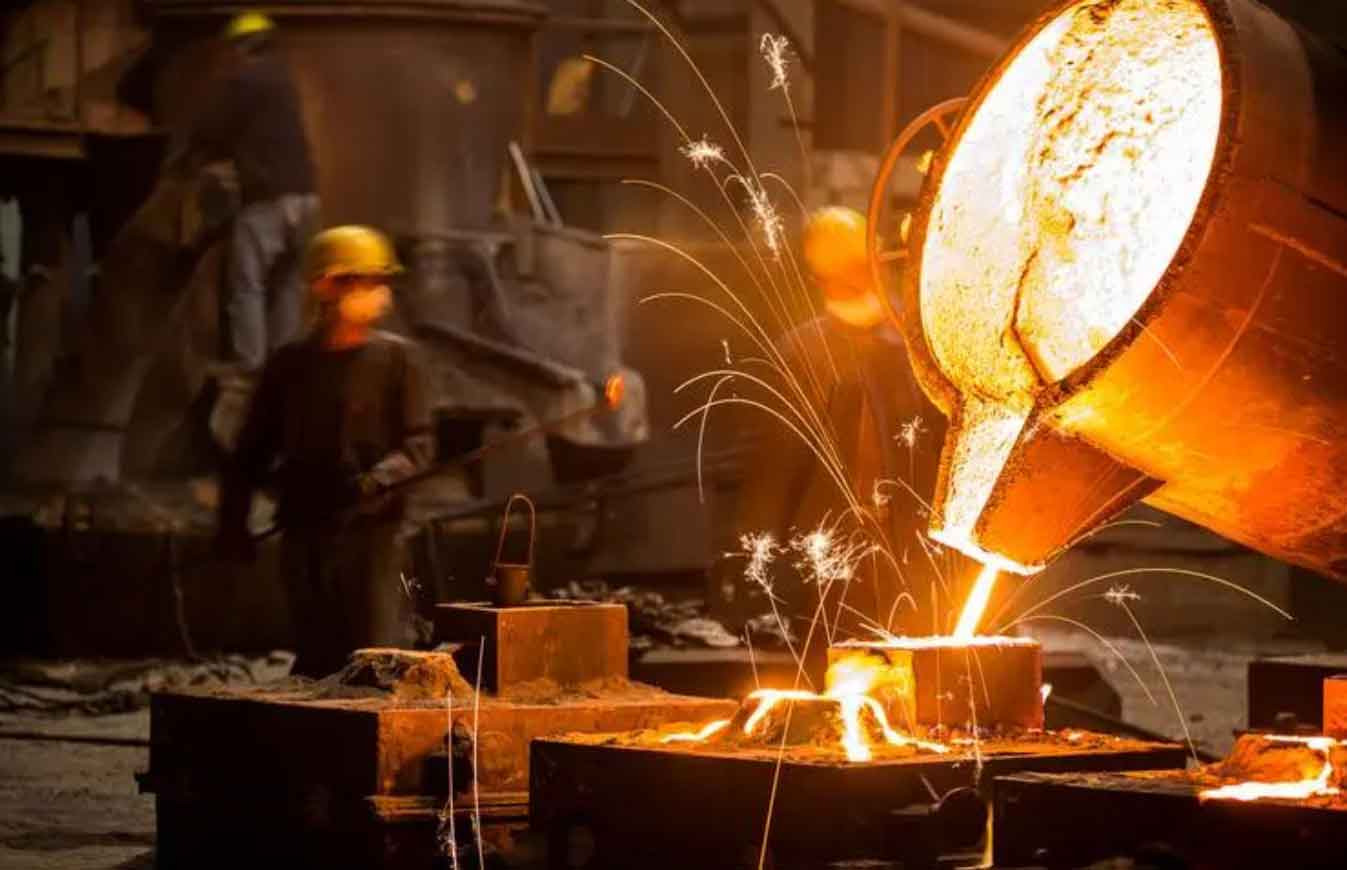
In industrial applications, sand casting is favored for its adaptability to large and complex shapes, such as the shell component discussed here. The use of numerical simulation in sand casting not only reduces material waste but also enhances product quality by identifying potential defects early. For example, the ProCAST software enabled me to visualize filling patterns and solidification sequences, guiding the placement of risers and gating elements. In the third scheme, the addition of two cylindrical risers (diameter 110 mm, height 350 mm) and two stepped risers (lower diameter 200 mm, height 32.5 mm; upper diameter 135 mm, height 330 mm) provided effective feeding paths, eliminating misruns and minimizing shrinkage. The overall process yield in sand casting improved significantly, highlighting the economic benefits of optimization.
Moreover, the mechanical properties of the cast steel, such as tensile strength and hardness, are influenced by the sand casting process parameters. For ZG270-500, the typical tensile strength ranges from 500 to 700 MPa, depending on the cooling rate and microstructure development. In sand casting, slower cooling rates in thicker sections can lead to coarser grains, potentially reducing strength. However, with proper工艺设计, such as controlled pouring temperatures and velocities, these issues can be mitigated. The optimized sand casting process resulted in a homogeneous microstructure with fine austenitic and ferritic phases, meeting the required specifications. This aligns with industry standards where sand casting is used for critical components in mining, transportation, and machinery sectors.
To generalize the findings, I derived a formula for estimating the optimal pouring time in sand casting based on casting geometry and material properties. The relationship can be expressed as:
$$ t_{\text{opt}} = \frac{\rho V}{A v \rho_m} $$
where \( \rho \) is the density of molten steel, \( V \) is the volume of the casting, \( A \) is the cross-sectional area of the gating system, \( v \) is the pouring velocity, and \( \rho_m \) is the metal density. This formula helps in standardizing sand casting processes for similar components. Additionally, the defect propensity in sand casting can be quantified using a shrinkage sensitivity index, \( S \), defined as:
$$ S = \int_{0}^{t_s} \left( \frac{\partial T}{\partial x} \right)^2 dt $$
where \( t_s \) is the solidification time and \( \frac{\partial T}{\partial x} \) is the temperature gradient. Higher values of \( S \) indicate a greater risk of shrinkage defects, emphasizing the need for careful thermal management in sand casting.
In conclusion, the numerical simulation and optimization of the sand casting process for steel shells have demonstrated significant improvements in quality and efficiency. By designing three pouring schemes and using ProCAST software, I identified that the third scheme, with adjusted ingates and risers, effectively reduced defects such as porosity and misruns. The orthogonal experiment revealed that pouring temperature is the most influential parameter, with an optimal value of 1560°C combined with a pouring velocity of 1.6 m/s minimizing porosity volume to 1.416 cm³. This approach not only increased the yield rate to 96% but also ensured that the microstructure and mechanical properties met requirements. The integration of simulation tools in sand casting provides a robust framework for addressing common challenges, reducing trial cycles, and lowering production costs. As sand casting continues to evolve, further research could explore the effects of coating layers and residual stresses, expanding the applicability of this method to a wider range of industrial components. Overall, this study underscores the transformative potential of simulation-driven optimization in advancing sand casting technology.