
In recent years, the escalating emission of greenhouse gases, primarily carbon dioxide, due to intensified industrialization has become a global concern. As the world’s largest emitter, accounting for approximately 29% of global carbon emissions in 2019, China has implemented policies such as the “Carbon Peak Action Plan by 2030” and the “14th Five-Year Plan for Industrial Green Development” to address this issue. The traditional manufacturing sector, particularly sand casting, which serves as a foundational process in industries like automotive and wind power, is a significant contributor to resource consumption and environmental pollution. With energy utilization rates as low as 15–25% and waste emissions exceeding those of developed countries by over tenfold, sand casting presents substantial potential for carbon reduction. This paper proposes a carbon emission calculation model for sand casting processes by integrating input-output and process analysis methods, based on life cycle assessment theory. The model quantitatively analyzes material and energy consumption, as well as waste generation, across various production stages, enabling the allocation of carbon emissions to individual castings in mass production. An application to a wind power locking disk casting demonstrates the model’s practicality, providing a theoretical basis for reducing carbon emissions in sand casting from material and energy perspectives.
The sand casting process is a widely used manufacturing method for producing metal components, involving multiple stages such as molding, melting, recycling, and machining. Each stage contributes to carbon emissions through material consumption, energy use, and waste handling. To accurately quantify these emissions, I define the system boundaries for sand casting to include direct emissions from on-site processes and indirect emissions from material production and energy generation. The carbon sources in sand casting are categorized into three types: material-related emissions from consumed resources like resin sand and molten metal ingredients; energy-related emissions from equipment operation, such as mixers and furnaces; and waste-related emissions from the treatment of by-products like dust and slag. By applying life cycle assessment principles, I develop a hybrid model that combines the macro-level insights of input-output analysis with the detailed process-specific data of process analysis, ensuring a comprehensive evaluation of carbon footprints for individual sand castings.
The carbon emission calculation model for sand casting is structured around three core components: material carbon emissions, energy carbon emissions, and waste carbon emissions. Each component is derived using specific formulas that account for variables such as casting weight, material ratios, and equipment efficiency. For material carbon emissions, I distinguish between variable emissions, which depend on process parameters like sand-to-metal ratio and recycling rates, and fixed emissions, which are allocated based on output quantities. The general formula for the total carbon emissions of a casting d in sand casting is given by:
$$ C_d = CM_d + CE_d + CU_d $$
where \( CM_d \) represents material carbon emissions, \( CE_d \) denotes energy carbon emissions, and \( CU_d \) signifies waste carbon emissions. These are further broken down into sub-formulas for each production stage, as detailed in the following sections.
Material Carbon Emissions in Sand Casting
Material carbon emissions in sand casting arise from the consumption of resources such as resin sand, refractory coatings, and molten metal ingredients. These emissions are calculated by multiplying the consumption quantity by the respective carbon emission coefficients. I classify material emissions into variable and fixed categories. Variable emissions depend on process-specific factors, such as the sand-to-metal ratio and recycling efficiency, while fixed emissions are proportionally allocated based on the total output of castings. For the molding stage, the variable carbon emissions for casting d are determined by the resin sand usage, which is influenced by the sand-to-metal ratio and recycling rate. The formula is:
$$ C1_{VR,d} = M_d \times R^1 \times (1 – \eta) \times f_b $$
where \( M_d \) is the weight of casting d, \( R^1 \) is the sand-to-metal ratio, \( \eta \) is the resin sand recycling rate, and \( f_b \) is the carbon emission coefficient of resin sand. The sand-to-metal ratio \( R^1 \) is derived from the sand volume and casting volume, as shown in:
$$ R^1 = \frac{\rho_b \times V_x}{V_d} $$
Here, \( \rho_b \) is the density of resin sand, \( V_x \) is the mold box volume, and \( V_d \) is the casting volume. Fixed carbon emissions in the molding stage are calculated by分摊 the total consumption of fixed materials over the output of castings:
$$ C1_{ST,d} = \sum_{c=1}^{c_0} \frac{I^1_c}{O_d} \times f_c $$
where \( I^1_c \) is the consumption of fixed material c in the molding stage over a period, \( O_d \) is the output of casting d, and \( f_c \) is the carbon emission coefficient of material c. The total material carbon emissions for the molding stage are then:
$$ CM^1_d = M_d \times R^1 \times (1 – \eta) \times f_b + \sum_{c=1}^{c_0} \frac{I^1_c}{O_d} \times f_c $$
For the melting stage, material carbon emissions are primarily from molten metal ingredients like scrap steel, pig iron, and additives. These are considered variable emissions and are computed as:
$$ CM^2_d = M_d \times (1 + MIR) \times \sum_{g=1}^{g_0} R^2_g \times f_g $$
where \( MIR \) is the ratio of pouring excess to casting weight, \( R^2_g \) is the proportion of ingredient g in the molten metal, and \( f_g \) is its carbon emission coefficient. The recycling and machining stages involve fixed material emissions, given by:
$$ CM^3_d = \sum_{c=1}^{c_0} \frac{I^3_c}{O_d} \times f_c $$
and
$$ CM^4_d = \sum_{c=1}^{c_0} \frac{I^4_c}{O_d} \times f_c $$
respectively. The overall material carbon emissions for sand casting of casting d are summarized as:
$$ CM_d = M_d \times R^1 \times (1 – \eta) \times f_b + M_d \times (1 + MIR) \times \sum_{g=1}^{g_0} R^2_g \times f_g + \sum_{a=1}^{4} \sum_{c=1}^{c_0} \frac{I^a_c}{O_d} \times f_c $$
This approach ensures that all material-related carbon emissions in sand casting are accurately captured and allocated to individual castings.
Energy Carbon Emissions in Sand Casting
Energy carbon emissions in sand casting result from electricity consumption by equipment such as mixers, furnaces, cranes, and recycling lines. These emissions are calculated using the power rating method, where the energy consumption is multiplied by the carbon emission coefficient of electricity. For each stage in sand casting, I derive specific formulas based on equipment power and operation time. In the molding stage, energy carbon emissions come from sand mixers and cranes:
$$ CE^1_d = \left( \sum_{l=1}^{l_0} \frac{p_l \times M_d \times R^1}{v_l} + \sum_{m_1=1}^{m_1^0} \frac{p_{m_1} \times s_{m_1}}{v_{m_1}} \right) \times f_e $$
where \( p_l \) is the power of mixer l, \( v_l \) is its mixing efficiency, \( p_{m_1} \) is the power of crane m1, \( s_{m_1} \) is the搬运 distance, \( v_{m_1} \) is the speed, and \( f_e \) is the carbon emission coefficient of electricity. Similarly, for the melting stage, emissions from furnaces and cranes are:
$$ CE^2_d = M_d \times (1 + MIR) \times E_n \times f_e + \sum_{m_2=1}^{m_2^0} \frac{p_{m_2} \times s_{m_2}}{v_{m_2}} \times f_e $$
where \( E_n \) is the energy consumption per ton of molten metal for furnace n. The recycling stage involves sand treatment lines and cranes:
$$ CE^3_d = M_d \times R^1 \times E_o \times f_e + \sum_{m_3=1}^{m_3^0} \frac{p_{m_3} \times s_{m_3}}{v_{m_3}} \times f_e $$
with \( E_o \) as the energy per ton of resin sand processed. Finally, the machining stage includes shot blasting machines and cranes:
$$ CE^4_d = \left( \sum_{u=1}^{u_0} p_u \times t_u + \sum_{m_4=1}^{m_4^0} \frac{p_{m_4} \times s_{m_4}}{v_{m_4}} \right) \times f_e $$
where \( p_u \) is the power of shot blasting machine u and \( t_u \) is its operation time. The total energy carbon emissions for sand casting of casting d are:
$$ CE_d = \left( \sum_{l=1}^{l_0} \frac{p_l \times M_d \times R^1}{v_l} + \sum_{m_1=1}^{m_1^0} \frac{p_{m_1} \times s_{m_1}}{v_{m_1}} \right) \times f_e + M_d \times (1 + MIR) \times E_n \times f_e + M_d \times R^1 \times E_o \times f_e + \left( \sum_{u=1}^{u_0} p_u \times t_u + \sum_{m_4=1}^{m_4^0} \frac{p_{m_4} \times s_{m_4}}{v_{m_4}} \right) \times f_e $$
This detailed calculation accounts for all significant energy uses in sand casting, enabling precise carbon emission tracking.
Waste Carbon Emissions in Sand Casting
Waste carbon emissions in sand casting originate from the treatment of by-products such as dust, fumes, and slag generated during various stages. These emissions are computed based on the energy consumed by waste handling equipment, like dust collectors and transport devices. For each production stage in sand casting, I formulate emissions considering the type and quantity of waste. In the molding stage, waste carbon emissions mainly involve dust from sand mixing and volatile organic compounds:
$$ CU^1_d = M_d \times M^1_{U1} \times \sum_{w_1=1}^{w_1^0} \frac{p_{w_1}}{v_{w_1}} \times f_e $$
where \( M^1_{U1} \) is the amount of gaseous waste per ton of casting, \( p_{w_1} \) is the power of dust collector w1, and \( v_{w_1} \) is its treatment speed. For the melting stage, emissions include fumes from furnaces and solid slag:
$$ CU^2_d = M_d \times M^2_{U1} \times \sum_{w_2=1}^{w_2^0} \frac{p_{w_2}}{v_{w_2}} \times f_e + M_d \times M^2_{U2} \times \sum_{i_2=1}^{i_2^0} \frac{p_{i_2} \times s_{i_2}}{v_{i_2} \times M_{i_2}} \times f_e $$
Here, \( M^2_{U1} \) and \( M^2_{U2} \) are the amounts of gaseous and solid waste per ton of casting, respectively, and \( p_{i_2} \), \( s_{i_2} \), \( v_{i_2} \), and \( M_{i_2} \) are the power, distance, speed, and capacity of transport device i2. The recycling and machining stages focus on dust from sand processing and shot blasting:
$$ CU^3_d = M_d \times M^3_{U1} \times \sum_{w_3=1}^{w_3^0} \frac{p_{w_3}}{v_{w_3}} \times f_e $$
and
$$ CU^4_d = M_d \times M^4_{U1} \times \sum_{w_4=1}^{w_4^0} \frac{p_{w_4}}{v_{w_4}} \times f_e $$
The total waste carbon emissions for sand casting of casting d are:
$$ CU_d = \sum_{a=1}^{4} \left( M_d \times M^a_{U1} \times \sum_{w_a=1}^{w_a^0} \frac{p_{w_a}}{v_{w_a}} \times f_e \right) + M_d \times M^2_{U2} \times \sum_{i_2=1}^{i_2^0} \frac{p_{i_2} \times s_{i_2}}{v_{i_2} \times M_{i_2}} \times f_e $$
This comprehensive approach ensures that all waste-related carbon emissions in sand casting are quantified and attributed to individual castings.
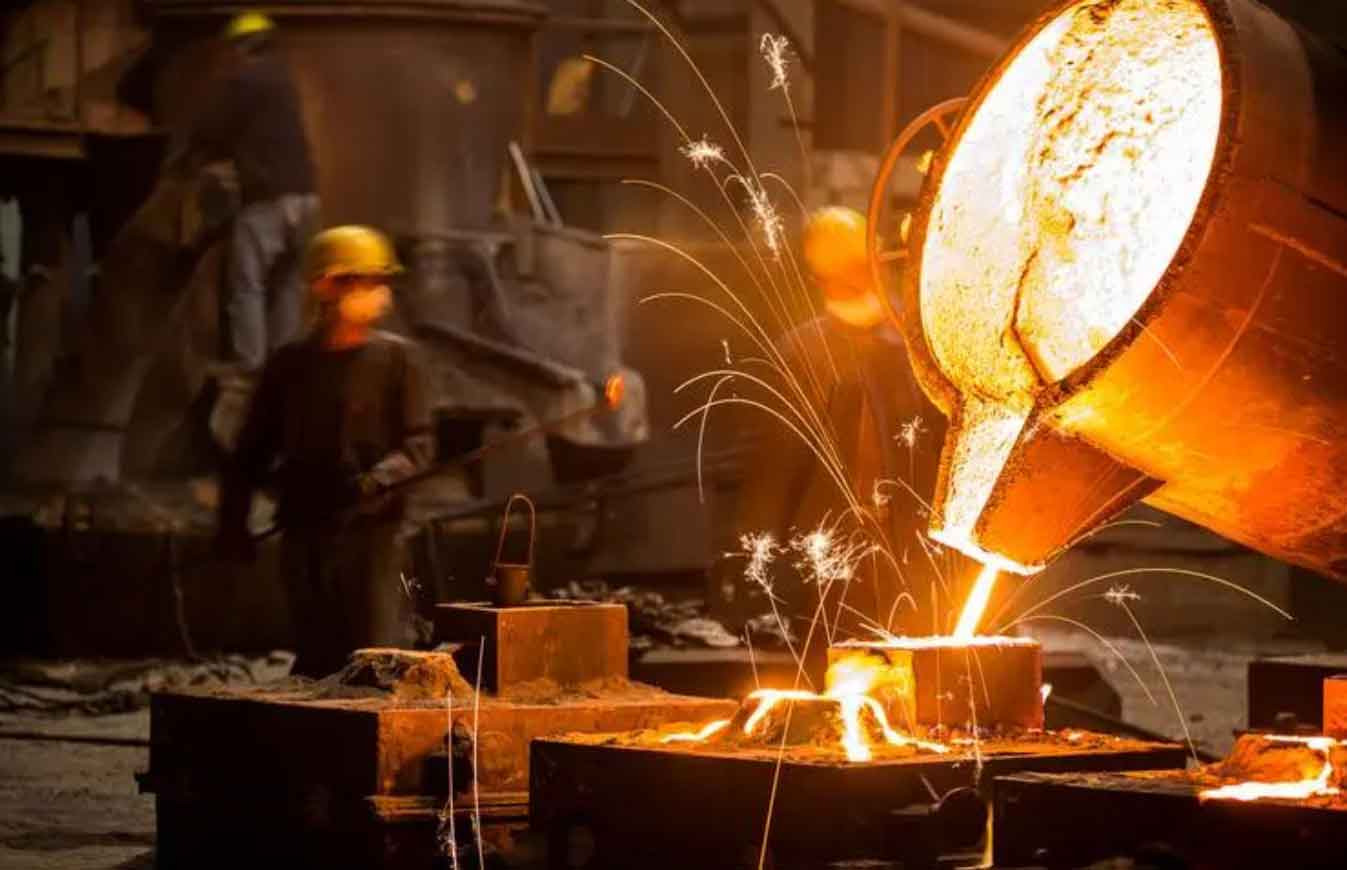
Application to a Wind Power Locking Disk Casting
To validate the carbon emission calculation model for sand casting, I apply it to a real-world example: an 11 MW locking disk component produced using sand casting. The casting is made of ductile iron QT500-14 with a weight of 6,932 kg. Key parameters for the sand casting process include a sand-to-metal ratio of 8.25, a resin sand recycling rate of 93%, and a pouring excess ratio of 0.1. The molten metal composition consists of scrap steel, pig iron, returns, carburizer, silicon carbide, and ferrosilicon, with proportions as listed in Table 1. Carbon emission coefficients for materials and energy are derived from literature and industry data, as shown in Table 2.
| Ingredient | Symbol | Proportion (%) |
|---|---|---|
| Scrap Steel | 1 | 58.19 |
| Pig Iron | 2 | 24.69 |
| Returns | 3 | 14.26 |
| Carburizer | 4 | 2.20 |
| Silicon Carbide | 5 | 0.49 |
| Ferrosilicon | 6 | 0.17 |
| Material/Energy | Coefficient | Unit |
|---|---|---|
| Resin Sand | 0.02543 | kg CO₂/kg |
| Refractory Coating | 6.0232 | kg CO₂/kg |
| Methanol | 2.5 | kg CO₂/kg |
| Scrap Steel | 8.2 | kg CO₂/kg |
| Pig Iron | 2.13 | kg CO₂/kg |
| Returns | 2.67 | kg CO₂/kg |
| Carburizer | 4.2 | kg CO₂/kg |
| Silicon Carbide | 14.68 | kg CO₂/kg |
| Ferrosilicon | 2.3 | kg CO₂/kg |
| Electricity | 0.93 | kg CO₂/kWh |
Using the formulas for material carbon emissions, I calculate the contributions from each stage in sand casting. For the locking disk, the material carbon emissions are computed as:
$$ CM_d = 6932 \times 8.25 \times (1 – 0.93) \times 0.02543 + \sum \frac{I_c}{O_d} \times f_c + 6932 \times (1 + 0.1) \times \sum R^2_g \times f_g $$
After substituting values, the total material carbon emissions amount to 44,791.79 kg CO₂. Energy carbon emissions are derived from equipment power and operation data. For instance, the melting stage energy consumption is 500 kWh per ton of molten metal, and sand processing energy is 0.0119 kWh per ton of resin sand. The total energy carbon emissions are:
$$ CE_d = \left( \sum \frac{11.5 \times 6932 \times 8.25}{6.2855} + \sum \frac{20.5 \times s_{m_a}}{16} \right) \times 0.93 + 6932 \times 1.1 \times 500 \times 0.93 + 6932 \times 8.25 \times 0.0119 \times 0.93 + \left( 80 \times 20 + \sum \frac{20.5 \times s_{m_4}}{16} \right) \times 0.93 $$
This results in 4,234.82 kg CO₂. Waste carbon emissions are based on waste generation rates per ton of casting, as listed in Table 3, and treatment equipment power. The total waste carbon emissions are:
$$ CU_d = \sum_{a=1}^{4} \left( 6932 \times M^a_{U1} \times \sum \frac{7.5}{14.2515} \times 0.93 \right) + 6932 \times M^2_{U2} \times \sum \frac{p_{i_2} \times s_{i_2}}{v_{i_2} \times M_{i_2}} \times 0.93 $$
yielding 14.55 kg CO₂. The overall carbon emissions for the locking disk in sand casting are 49,041.16 kg CO₂, with material emissions dominating at over 91% of the total. This analysis highlights the melting stage as the largest contributor, suggesting that optimizing material usage and ingredient proportions in sand casting can significantly reduce carbon footprints.
| Waste Type | Stage | Amount (kg/ton) |
|---|---|---|
| Gaseous Waste | Molding | 0.586 |
| Gaseous Waste | Melting | 0.500 |
| Gaseous Waste | Recycling | 1.050 |
| Gaseous Waste | Machining | 0.011 |
| Solid Waste | Melting | 0.054 |
Conclusion
In this paper, I develop a quantitative carbon emission calculation model for sand casting processes by integrating input-output and process analysis methods within a life cycle assessment framework. The model effectively allocates carbon emissions to individual castings by considering material consumption, energy use, and waste generation across molding, melting, recycling, and machining stages. Through the application to a wind power locking disk casting, I demonstrate that material-related emissions, particularly from the melting stage, constitute the majority of the carbon footprint in sand casting. This insight underscores the importance of optimizing material ratios and reducing pouring excess to minimize emissions. The model provides a practical tool for manufacturers to quantify and mitigate carbon emissions in sand casting, supporting the transition towards greener manufacturing practices. Future work could explore dynamic adjustments for real-time carbon management and extend the model to other casting methods, further enhancing its applicability in sustainable industrial development.