
In the field of metal casting, sand casting remains one of the most versatile and widely used methods due to its adaptability for complex geometries and cost-effectiveness for various production volumes. As a design engineer specializing in casting processes, I have encountered numerous challenges in developing dies for intricate components, particularly those with stringent quality requirements. This article delves into the comprehensive design of a sand casting die for a complex turbine cover, focusing on structural analysis, process optimization, and模具 design to achieve high-quality castings. The turbine cover, with its intricate features and need for internal soundness, demanded an innovative approach to sand casting die design, incorporating elements like false boxes, metal cores, and external chills to mitigate defects. Throughout this discussion, I will emphasize the principles of sand casting, as it forms the foundation of this work, and I will use tables and equations to summarize key aspects, ensuring clarity and depth.
The turbine cover, as illustrated in the provided context, is a critical component in hydraulic systems, requiring airtight integrity and freedom from internal defects such as shrinkage porosity. Its structure includes a spiral shell with varying wall thicknesses, a downward-facing flange, a straight pipe, and internal trumpet-like features, all contributing to its complexity. In sand casting, the die must accommodate these elements while facilitating proper metal flow and solidification. I began by analyzing the铸件’s geometry and material properties, which involved assessing wall thickness variations, hot spots, and potential stress concentrations. This analysis guided the selection of sand casting as the optimal method, given its ability to handle such complexities through customizable molds and cores.
To provide a systematic overview, let me first outline the铸件’s key structural characteristics in a table. This will help in understanding the design challenges and the subsequent solutions implemented in the sand casting die.
| Feature | Description | Challenge in Sand Casting |
|---|---|---|
| Uniform Wall Thickness | 4 mm overall, with local variations up to 14 mm | Risk of shrinkage defects due to differential cooling |
| Spiral Shell | Gradual curve in height, forming a蜗壳 shape | Complex parting surface requiring precise mold separation |
| Flange and Straight Pipe | Downward-facing flange and parallel straight pipe | Need for multiple cores to form internal passages |
| Internal Trumpet Structure | Wall thickness渐变, acting as a hot spot | Requirement for targeted cooling to prevent porosity |
| Convex Platforms | 8 evenly distributed凸台 on the bottom | Localized thick sections prone to solidification issues |
From this analysis, it became evident that the sand casting process needed careful planning to address these challenges. The material, a wide freezing-range aluminum alloy, tends toward volumetric solidification, increasing the likelihood of dispersed microporosity. In sand casting, this is exacerbated by the insulating properties of the sand mold, which can lead to prolonged solidification times in thick sections. To quantify this, I considered the solidification behavior using Chvorinov’s rule, which estimates the solidification time based on the volume-to-surface area ratio:
$$ t = B \left( \frac{V}{A} \right)^2 $$
Here, \( t \) is the solidification time, \( V \) is the volume of the section, \( A \) is its surface area, and \( B \) is a constant dependent on the mold material and casting conditions. For the turbine cover, sections like the internal trumpet and凸台 have high \( V/A \) ratios, leading to longer solidification times and higher risk of defects. In sand casting, this necessitates the use of chills and optimized riser design to promote directional solidification.
Moving to the casting process analysis, I focused on the placement of the铸件 in the mold, the design of the gating and risering system, and the incorporation of auxiliary elements like chills. The铸件 was oriented with the 8凸台 facing downward to facilitate feeding from the top. Machining allowances of 3 mm were applied to critical surfaces, and risers were strategically placed: a top riser for the upper flange, a blind riser for the flange盘, and a side riser for the straight pipe end. For the internal trumpet, a metal core was employed not only to form the shape but also to act as a chill, accelerating cooling in this hot spot. Additionally, external chills were designed for the凸台 to achieve simultaneous solidification and eliminate shrinkage porosity.
The following table summarizes the key process parameters and their roles in the sand casting setup:
| Process Element | Design Consideration | Role in Sand Casting |
|---|---|---|
| Parting Surface | Curved and渐变, simplified using false box | Ensures easy mold separation and accurate geometry |
| Cores | Multiple sand cores and one metal core | Forms internal features and aids in heat dissipation |
| Risers | Top, blind, and side risers | Provides molten metal feed to compensate for shrinkage |
| Chills | External chills for凸台, metal core for trumpet | Enhances cooling rate in hot spots to prevent defects |
| Gating System | Designed for laminar flow and minimal turbulence | Reduces inclusions and ensures complete mold filling |
In sand casting, the gating system design is critical for achieving sound castings. I used principles of fluid dynamics to optimize the runner and gate dimensions, ensuring that the molten metal fills the mold cavity smoothly. The flow rate can be described by Bernoulli’s equation, adapted for casting:
$$ \frac{P}{\rho g} + \frac{v^2}{2g} + h = \text{constant} $$
Where \( P \) is pressure, \( \rho \) is density, \( v \) is velocity, \( g \) is gravity, and \( h \) is height. By balancing these factors, I minimized turbulence, which is essential in sand casting to avoid sand erosion and gas entrapment.
Now, let’s delve into the die design itself. The sand casting die for the turbine cover comprised several components: the pattern for forming the mold cavity, the core boxes for making sand cores, a false box for handling the complex parting surface, and additional elements like metal cores and external chills. Each component was designed with manufacturability and functionality in mind.
Starting with the pattern design, the goal was to ensure that all sections could be withdrawn from the mold along the parting plane. The最大投影 area was identified at the spiral shell’s parting line, and the straight pipe section was incorporated using a sand core to simplify the pattern. This involved splitting the pattern into multiple segments joined by定位销, allowing for easy disassembly. The pattern’s geometry was optimized to minimize draft angles while ensuring smooth ejection from the sand mold—a common consideration in sand casting to reduce defects like tearing.
For the false box, it was essential to handle the curved and渐变 parting surface of the spiral shell. In sand casting, a false box acts as a temporary mold half that shapes the lower part of the parting surface. I designed it to match the contour of the pattern, enabling the creation of a precise曲面分型 without the need for manual cutting or digging. This not only improved accuracy but also reduced molding time, which is crucial in sand casting for maintaining production efficiency.
The core design was particularly challenging due to the铸件’s internal complexity. I employed three sand cores and one metal core to form the internal passages. Sand Core I shaped the spiral shell’s interior, Sand Core II formed the trumpet and straight pipe, and Sand Core III created the lower external surface of the straight pipe. The metal core, made of steel, served dual purposes: forming the internal trumpet and acting as a chill to accelerate solidification. The cores were designed with异形定位 features to ensure accurate assembly within the mold. For instance, the metal core had conical surfaces and threaded holes for easy handling and venting—a vital aspect in sand casting to prevent gas defects.
To illustrate the core assembly, consider the positioning关系, which can be represented using a coordinate system. Suppose the centers of the spiral shell, straight pipe, and凸台 are defined by vectors in 3D space. The relative positions must satisfy certain constraints to maintain铸件 integrity:
$$ \vec{r}_{\text{shell}} + \vec{r}_{\text{pipe}} = \vec{r}_{\text{convex}} $$
Where \( \vec{r} \) denotes position vectors. This ensured that the cores aligned correctly during mold assembly, a critical step in sand casting to avoid mismatches and ensure dimensional accuracy.
External chills were designed as steel inserts with shapes matching the 8凸台. These were placed in the mold during patterning and remained embedded during pouring. In sand casting, chills work by increasing the local heat transfer coefficient, which can be modeled using Fourier’s law of heat conduction:
$$ q = -k \nabla T $$
Here, \( q \) is the heat flux, \( k \) is the thermal conductivity, and \( \nabla T \) is the temperature gradient. By using steel chills with higher \( k \) compared to sand, I achieved faster heat extraction, reducing the solidification time in these areas and minimizing shrinkage risks.
Next, I focused on the core box design for producing the sand cores. Sand Core I was manufactured using a shooting machine, which involved a heated mold with movable components to facilitate core ejection. The design included features like heating holes for curing the furan resin sand and排气槽 for gas escape. The core box for Sand Core I comprised an upper base, pillars, upper and lower molds, a lower mold core with a lever mechanism, and springs for automatic resetting. This automated approach is advantageous in sand casting for consistent core quality and high production rates.
For Sand Cores II and III, which were smaller, I opted for manual core boxes with split molds along horizontal and vertical planes. These included guide pins and销 for precise alignment, ensuring that the cores were formed accurately. The core-making process involved injecting furan resin sand into the closed molds, baking them to harden the sand, and then demolding the cores. This hands-on method is common in sand casting for low-to-medium volume production, as it offers flexibility and lower tooling costs.
The following table compares the core designs and their manufacturing methods:
| Core Type | Manufacturing Method | Key Features | Role in Sand Casting |
|---|---|---|---|
| Sand Core I | Machine shooting with heating | Movable lower core, lever for ejection | Forms complex spiral interior with high precision |
| Sand Core II | Manual molding with split molds | Horizontal and vertical parting, guide pins | Creates trumpet and straight pipe sections |
| Sand Core III | Manual molding with multiple cores | Combination of upper and lower cores | Shapes lower external surface of straight pipe |
| Metal Core | Machined from steel | Threaded holes for handling, acts as chill | Accelerates cooling in hot spot and forms internal feature |
The工作过程 of the core boxes involved several steps. For the machine-made Sand Core I, the mold was preheated, resin sand was shot into the cavity, and after hardening, the upper and lower molds were separated. A lever was used to retract the lower core, releasing the sand core, and springs automatically reset the core for the next cycle. In sand casting, this automation reduces labor and improves repeatability. For manual cores, the process included closing the molds, filling with sand, baking, and demolding—a straightforward yet effective approach for sand casting applications.
Now, let’s explore the overall sand casting process for the turbine cover. This involved a sequence of steps from mold preparation to finishing, each critical for achieving the desired铸件 quality. The process began with mixing molding materials—typically silica sand with binders like clay or resin—to form the型砂 and芯砂. In sand casting, the composition of these materials affects the mold’s strength, permeability, and collapsibility. I optimized the sand mixture based on empirical data, often represented by the following equation for green strength:
$$ S_g = k \cdot \frac{C}{W} $$
Where \( S_g \) is the green strength, \( k \) is a constant, \( C \) is the clay content, and \( W \) is the water content. This ensured that the mold could withstand the metallostatic pressure during pouring while allowing gases to escape.
The molding process used the pattern and false box to create the sand mold in multiple boxes. After shaping the lower half with the false box, the pattern was assembled, and the upper mold half was formed. Cores were then placed in the mold cavity, including the external chills and metal core. The mold was closed, and molten aluminum was poured through the gating system. During solidification, the risers and chills functioned as planned, promoting directional solidification and feeding to compensate for shrinkage.
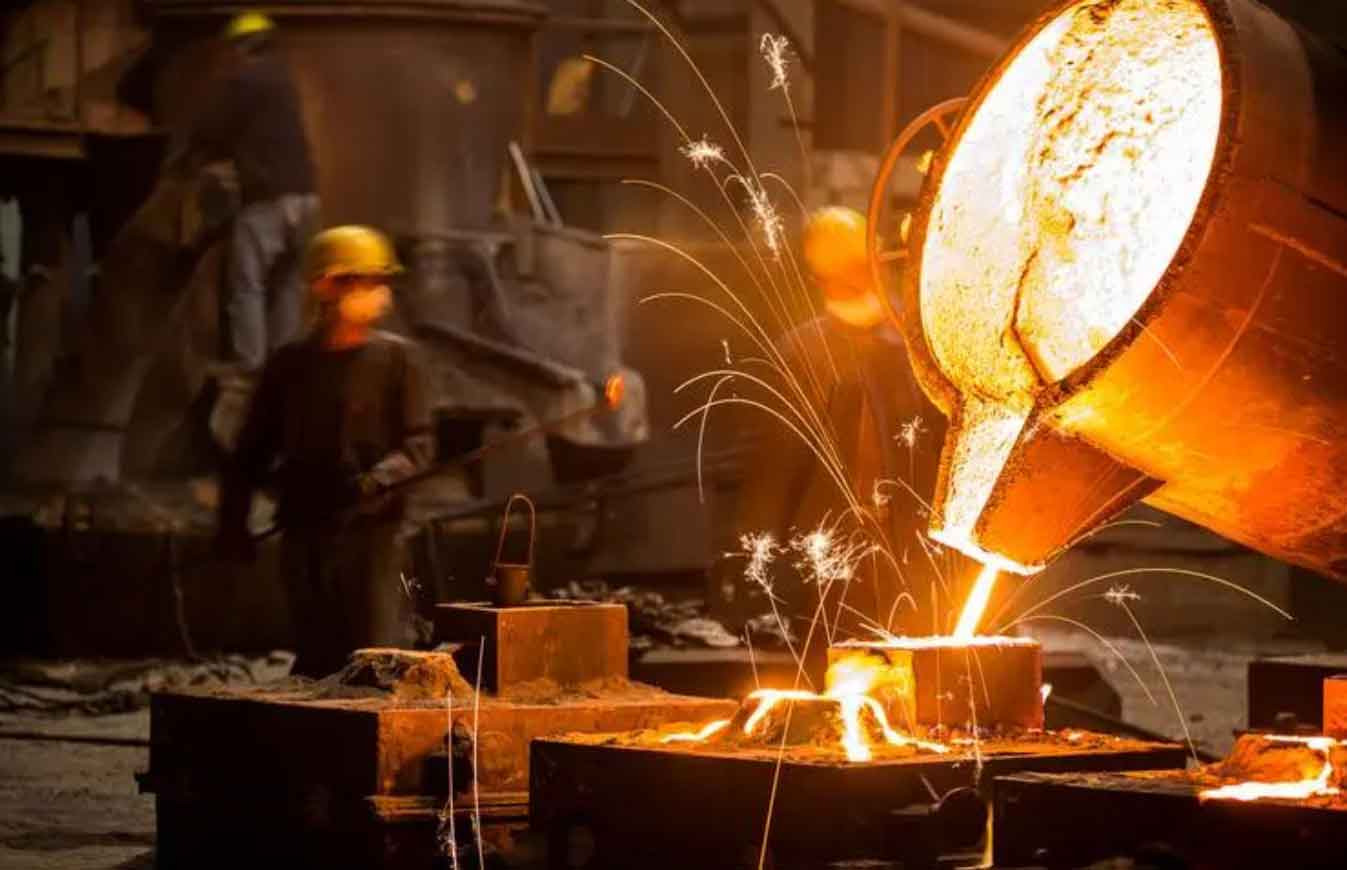
To visualize this process, I include the following image, which illustrates a typical sand casting setup, though not specific to this project, it represents the essence of sand casting manufacturing:
After pouring, the铸件 was allowed to cool before shakeout, where the sand mold was broken away. The铸件 then underwent cleaning—removing gates, risers, and any residual sand—followed by inspection for defects using methods like pressure testing for airtightness. In sand casting, post-casting processes are vital for ensuring that the final product meets specifications, and for this turbine cover, the design successfully passed all quality checks.
In conclusion, the sand casting die design for the complex turbine cover demonstrated how innovative approaches can overcome challenges in producing intricate castings. By integrating false boxes, multiple cores, metal cores, and external chills, I achieved a robust sand casting process that minimized defects and ensured high铸件 quality. The use of automated and manual core-making methods balanced efficiency and flexibility, making it suitable for batch production. This project underscores the versatility of sand casting, as it allowed for the economic production of a complex component with stringent requirements. The success of this design has been validated through production runs, resulting in castings that fully comply with technical standards and customer expectations. As I reflect on this work, it reinforces the importance of detailed analysis and creative problem-solving in sand casting die design, paving the way for future advancements in the field.