
In the field of advanced manufacturing, lost foam casting, also known as EPC (Evaporative Pattern Casting), has gained significant attention due to its ability to produce high-quality castings with reduced costs, shorter production cycles, and minimal environmental impact. As a researcher focused on optimizing this process, I have investigated the critical role of coating permeability in ensuring successful casting outcomes. The permeability of coatings used in lost foam casting directly influences the balance between metal filling, gas evolution, and pattern degradation, which are essential for preventing defects such as cold shuts, gas porosity, and carbon inclusions. In this article, I will delve into the methods for enhancing coating permeability, drawing from experimental studies that examine factors like particle size distribution and additive incorporation. By employing tables and mathematical formulations, I aim to provide a comprehensive analysis that can benefit practitioners in the EPC industry. Throughout this discussion, I will emphasize the importance of lost foam casting and EPC techniques, as they are central to achieving efficient and reliable production.
The lost foam casting process involves the use of expandable polystyrene (EPS) patterns that are coated with a refractory material before being embedded in unbonded sand. During pouring, the molten metal causes the EPS pattern to vaporize, generating gases that must escape through the coating to avoid defects. If the gas evolution rate exceeds the permeability of the coating, it can lead to backpressure, slowing metal flow and causing imperfections. Conversely, if permeability is too high, it may result in mold collapse. Thus, achieving an optimal balance is crucial. In my research, I have focused on how coating composition affects permeability, particularly through the use of quartz flour and expanded perlite additives. This aligns with the broader goals of lost foam casting, where process stability is key to reducing scrap rates and improving product quality.
To begin, I will outline the experimental methodology used to assess coating permeability. The setup included a standardized permeability measurement apparatus, which consisted of a STZ-type permeability tester, a tubular resistance furnace capable of reaching 1000°C, and a temperature controller. This system allowed for precise evaluation under simulated casting conditions. The permeability (K) was calculated using the formula: $$K = \frac{C_T \times V_0 \times \delta}{P \times F \times t}$$ where \(C_T\) is the temperature compensation factor, \(V_0\) is the volume of gas, \(\delta\) is the coating thickness, \(P\) is the pressure, \(F\) is the effective area, and \(t\) is the time. This equation highlights the inverse relationship between time and permeability, emphasizing the need for coatings that facilitate rapid gas escape in lost foam casting applications.
For sample preparation, I designed a specialized coating disc assembly that ensured consistent thickness and integrity. The discs were made with dimensions of 16 mm in diameter and 1.2 mm in thickness, using a mixture of refractory fillers, binders, and suspending agents. The materials included quartz flour as the primary filler, along with propylene emulsion, white glue, bentonite, carboxymethyl cellulose (CMC), and water as the carrier fluid. This composition is typical in EPC coatings, but I varied the parameters to study their impact. The coatings were applied and dried under controlled conditions to prevent shrinkage and cracking, which could skew permeability measurements. Below is a table summarizing the baseline coating formulation used in the experiments:
| Material | Quantity (kg) |
|---|---|
| Quartz Flour | 45 |
| Propylene Emulsion | 0.8 |
| White Glue | 1.0 |
| Bentonite | 0.8 |
| CMC | 0.5 |
| Emulsifier | 0.5 |
One of the key factors I investigated was the effect of quartz flour particle size distribution on coating permeability. In lost foam casting, the fineness and uniformity of the filler can significantly influence gas transport. I prepared multiple batches of coatings with quartz flour having mesh sizes concentrated between 220 and 240, but with varying degrees of concentration—specifically, 50%, 60%, 70%, and 80% of particles within this range. The permeability was measured for each batch, and the results demonstrated a clear trend: as the concentration increased, permeability improved. This is because a more uniform particle size reduces interstitial spaces, allowing for better gas flow. The relationship can be expressed mathematically as: $$K \propto \frac{1}{\text{Particle Size Dispersion}}$$ where lower dispersion (higher concentration) leads to higher permeability. The following table illustrates the data collected:
| Quartz Flour Concentration (%) | Permeability (cm²/(kPa·min)) |
|---|---|
| 50 | 30 |
| 60 | 40 |
| 70 | 55 |
| 80 | 65 |
Building on this, I examined how quartz flour concentration affects pouring rates in actual lost foam casting scenarios. For a standardized test casting—a DN500×45 pipe fitting—I maintained constant conditions such as vacuum level (-0.05 MPa), coating thickness (0.5 mm), and gating system design. The pouring speed was measured for each concentration level, revealing that higher permeability correlated with faster metal flow. This is critical in EPC processes, as it reduces the risk of defects like cold shuts. The data is summarized below:
| Quartz Flour Concentration (%) | Pouring Speed (kg/s) |
|---|---|
| 60 | 6.0 |
| 70 | 7.5 |
| 80 | 8.0 |
However, achieving high quartz flour concentration in industrial settings is challenging due to limitations in milling equipment, which often results in inconsistent particle size distributions. To address this, I explored the addition of expanded perlite powder to the coating mixture. Expanded perlite, known for its lightweight and porous structure, can enhance gas permeability without compromising coating integrity. I conducted tests with varying percentages of perlite added to the base quartz flour coating, and measured the resulting pouring speeds. The findings showed a steady improvement in permeability and casting performance. The relationship between perlite content and pouring speed can be modeled as: $$v_p = v_0 + k \cdot P_p$$ where \(v_p\) is the pouring speed with perlite, \(v_0\) is the baseline speed, \(k\) is a constant, and \(P_p\) is the perlite percentage. The experimental data is presented in the table below:
| Expanded Perlite Content (%) | Pouring Speed (kg/s) |
|---|---|
| 0 | 8.0 |
| 5 | 9.5 |
| 10 | 11.0 |
| 15 | 12.5 |
| 20 | 13.0 |
The incorporation of expanded perlite not only boosted permeability but also stabilized coating performance, reducing variability in lost foam casting operations. This is particularly important in EPC applications where process consistency directly impacts product quality. For instance, in production trials, the defect rate due to cold shuts and gas-related issues dropped from 6% to below 0.5% after implementing perlite-modified coatings. Moreover, the hydraulic pressure test pass rates improved significantly—from 75% to 97% for larger castings (e.g., DN600 and above) and from 65% to 94% for smaller ones (e.g., DN500 and below). These outcomes underscore the value of optimizing coating formulations in lost foam casting.
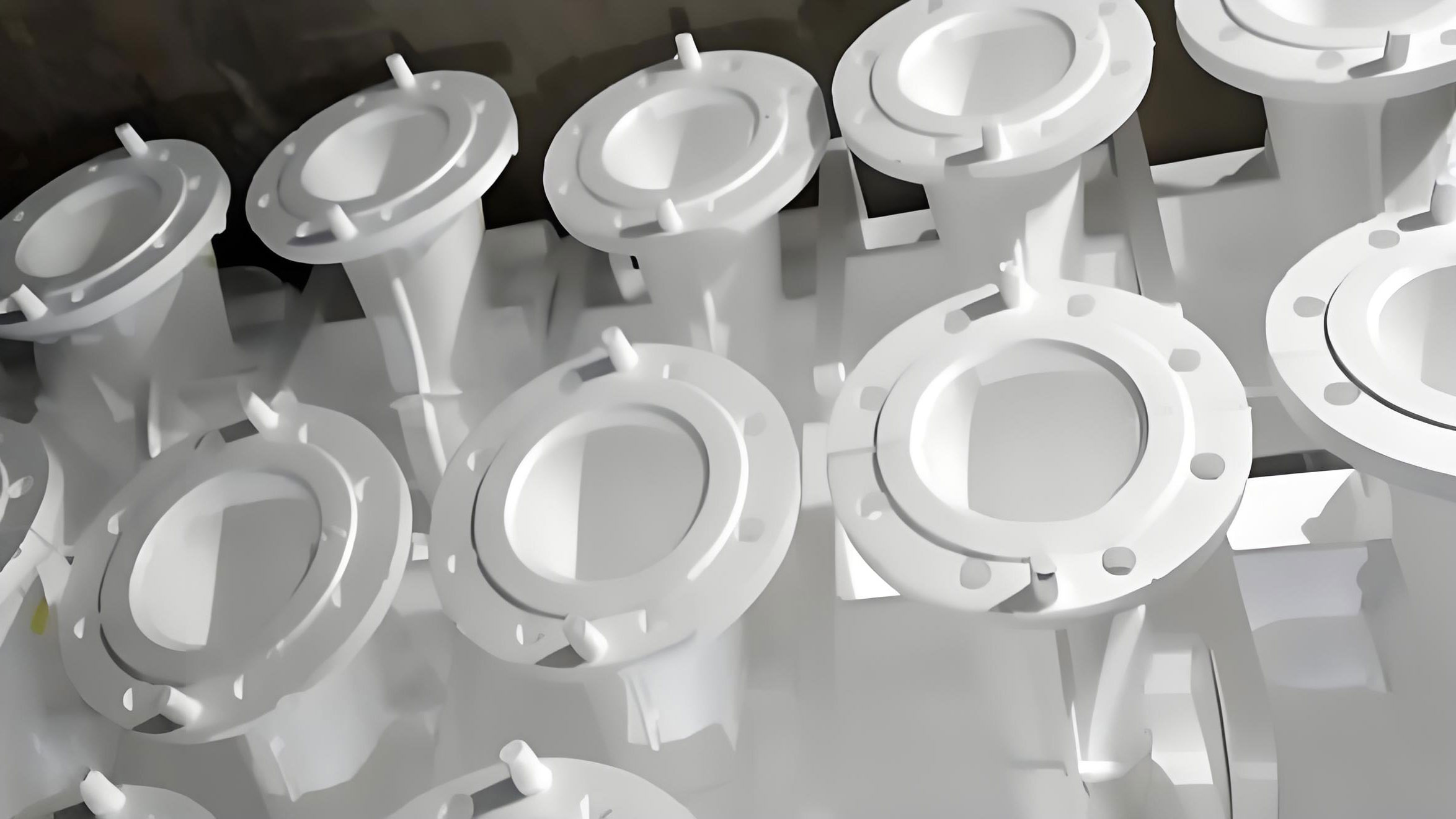
In addition to particle size and additives, I considered the role of coating viscosity and density. As perlite content increased, I observed a decrease in both viscosity and density, which further facilitated gas escape during the EPC process. This can be described by the empirical formula: $$\mu = \mu_0 – \alpha \cdot C_p$$ where \(\mu\) is the viscosity, \(\mu_0\) is the initial viscosity, \(\alpha\) is a coefficient, and \(C_p\) is the perlite concentration. Similarly, density reductions followed a linear trend, contributing to enhanced permeability. These properties are crucial for maintaining coating stability during application and drying, ensuring that the coating does not crack or peel off in lost foam casting setups.
To provide a holistic view, I integrated these findings into a discussion on the mechanisms behind permeability enhancement. In lost foam casting, the coating acts as a barrier that must allow gases from the decomposing EPS pattern to escape while supporting the mold structure. The addition of expanded perlite introduces microporosity, which creates pathways for gas diffusion. This aligns with the Darcy’s law for flow through porous media: $$Q = \frac{K \cdot A \cdot \Delta P}{\mu \cdot L}$$ where \(Q\) is the flow rate, \(A\) is the cross-sectional area, \(\Delta P\) is the pressure difference, \(\mu\) is the viscosity, and \(L\) is the thickness. By increasing \(K\) (permeability) through additive incorporation, the overall efficiency of the lost foam casting process improves.
In conclusion, my research demonstrates that enhancing coating permeability is vital for advancing lost foam casting technology. While increasing the concentration of quartz flour particles within a specific mesh range can improve permeability, practical constraints often limit its consistency. Alternatively, the addition of expanded perlite powder offers a reliable method to boost and stabilize permeability, leading to faster pouring speeds and reduced defect rates in EPC operations. These insights not only contribute to the scientific understanding of coating behavior but also provide actionable strategies for industries relying on lost foam casting. Future work could explore other additives or composite materials to further optimize EPC coatings, ensuring that lost foam casting remains a competitive and sustainable manufacturing option.