
In the evolving landscape of mechanical engineering, the demand for high-quality machine tools has intensified, placing greater emphasis on the internal and external integrity of machine tool castings. As part of our efforts to enhance casting processes, we transitioned to a dual-row large-spacing tuyere system in cupola furnaces, achieving molten iron temperatures between 1380°C and 1420°C, with pouring temperatures around 1360°C. While this improved the internal quality of machine tool castings, it inadvertently led to severe sand burning defects, resulting in significant scrap rates. Traditional graphite powder coatings proved insufficient in mitigating these issues, prompting us to innovate by adopting quartz powder as a refractory material—a departure from conventional practices in iron casting. By incorporating sodium alginate as a suspending agent, we developed a cost-effective, thixotropic coating that has revolutionized the handling of machine tool castings, earning acclaim for its efficiency in reducing labor intensity during cleaning operations.
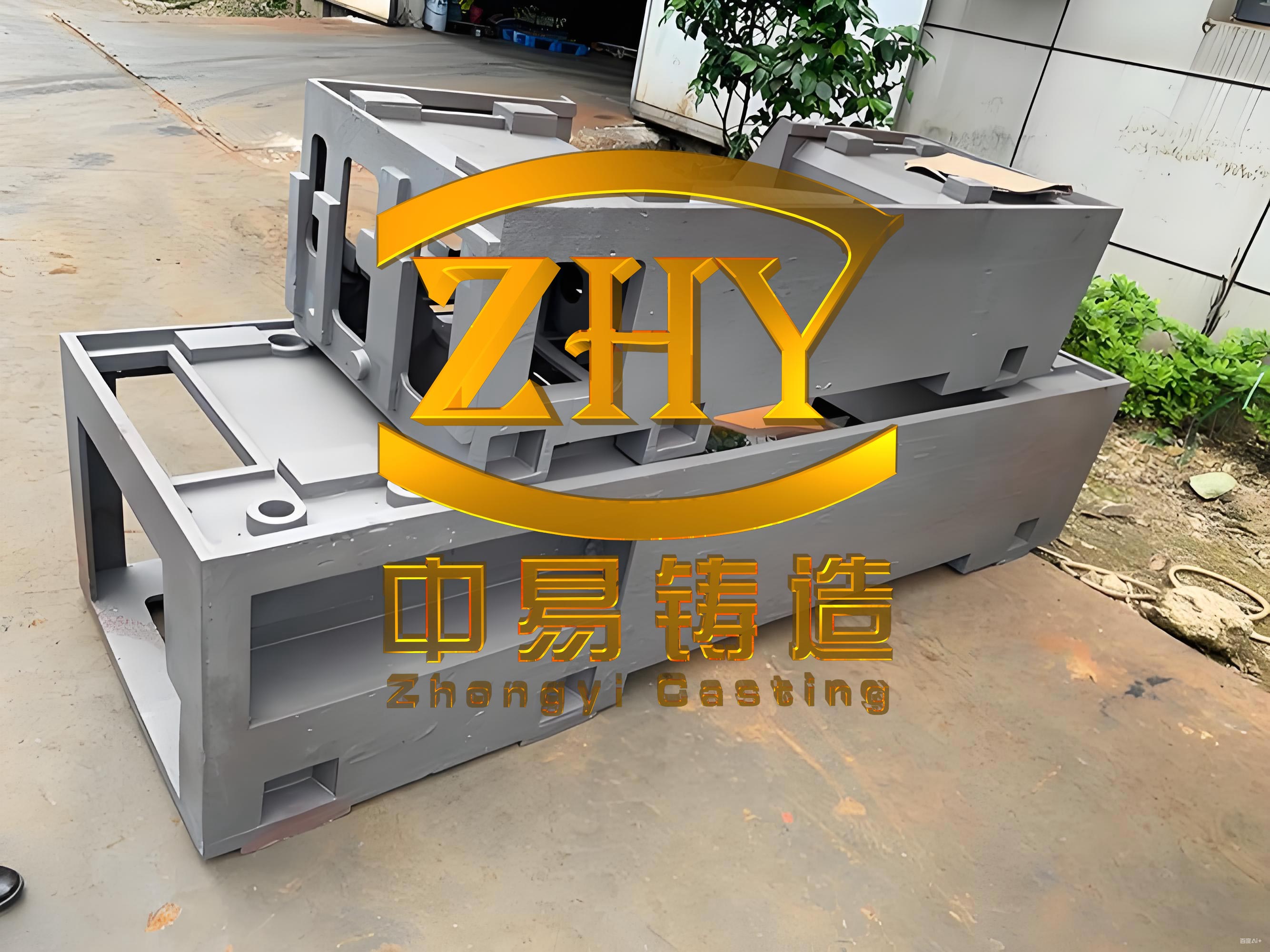
The quartz powder coating exhibits exceptional properties that make it ideal for machine tool castings. Its suspension stability is remarkable, with no stratification or sedimentation observed even after 24 hours of stillness. The coating applies evenly and uniformly, ensuring consistent coverage on complex geometries of machine tool castings. Under rapid heating conditions, it demonstrates high resistance to cracking and peeling, which is critical for maintaining the integrity of machine tool castings during pouring. Additionally, the low gas evolution minimizes the risk of porosity defects, while its anti-burning characteristics yield smooth, sand-free surfaces post-casting. These attributes collectively enhance the durability and finish of machine tool castings, supporting the production of high-precision components.
To quantify the performance of quartz powder coatings, we can model key parameters. The suspension stability can be expressed in terms of the settling velocity $$ v_s $$, given by Stokes’ law for a particle in a fluid: $$ v_s = \frac{2}{9} \frac{(\rho_p – \rho_f) g r^2}{\eta} $$, where $$ \rho_p $$ is the particle density (approximately 2.65 g/cm³ for quartz), $$ \rho_f $$ is the fluid density, $$ g $$ is gravity, $$ r $$ is the particle radius, and $$ \eta $$ is the dynamic viscosity. For our coating, $$ \eta $$ is controlled to ensure $$ v_s \approx 0 $$ over 24 hours, indicating optimal suspension. The coating’s thermal resistance during rapid heating can be described by the thermal stress parameter $$ \sigma_t = E \alpha \Delta T $$, where $$ E $$ is the Young’s modulus, $$ \alpha $$ is the coefficient of thermal expansion, and $$ \Delta T $$ is the temperature change. Our formulation minimizes $$ \sigma_t $$, preventing cracks in machine tool castings.
| Property | Description | Value Range |
|---|---|---|
| Suspension Stability | No separation after 24 hours | 100% homogeneous |
| Coating Coverage | Uniform thickness application | 0.1–0.3 mm |
| Thermal Crack Resistance | No cracking under rapid heating | Up to 1400°C |
| Gas Evolution | Low gas generation | < 10 mL/g |
| Anti-Burning Effect | Sand-free surface after casting | 100% effective |
Quartz powder coatings are primarily applied to dry clay sand molds and cores used in machine tool castings. After preparing the molds and cores, the coating is brushed on as a first layer, typically followed by a graphite powder coating for enhanced performance. This two-layer approach allows for easy inspection due to the contrast between the white quartz coating and dark cores, ensuring complete coverage and adequate thickness. The drying process is critical; for clay sand molds, we use a double-chamber gas-fired drying kiln with a specific curve to achieve a drying depth of 40–50 mm in critical areas like guide rails. Similarly, large solid clay cores, such as those for bed frames and headstocks, are dried to a depth of at least 30 mm, with full dryness required for surfaces in contact with molten iron. Defects like surface loosening or cracking necessitate rejection.
| Component | Drying Environment | Temperature Profile | Drying Depth (mm) |
|---|---|---|---|
| Clay Sand Molds | Double-chamber kiln, gas-fired | Ramp to 350°C in 4 h, hold for 8 h | 40–50 |
| Clay Cores (Large) | Double-chamber kiln, gas-fired | Ramp to 300°C in 3 h, hold for 10 h | ≥30 |
The composition of the coating is centered on quartz powder (SiO₂), an acidic refractory material with high temperature resistance suitable for machine tool castings. Its chemical stability at elevated temperatures and cost-effectiveness make it ideal. Sodium alginate acts as a suspending agent, calcium bentonite as a binder and suspender, and molasses as an additional binder. The quartz powder used has a specific particle size distribution and chemical composition, as detailed in the table below, ensuring compatibility with the high demands of machine tool castings.
| Parameter | Specification | Chemical Composition (%) |
|---|---|---|
| Particle Size | >200 mesh (74 μm) | SiO₂: >98 |
| Fineness | >95% passing 200 mesh | Al₂O₃: <1.0 |
| Moisture Content | <0.5% | Fe₂O₃: <0.5 |
| Impurities | Minimal | Others: <0.5 |
The formulation of the quartz powder coating involves a precise ratio of components to achieve the desired properties for machine tool castings. The table below outlines the standard recipe, which we optimize based on specific casting requirements. The mixing process is methodical: calcium bentonite is soaked in water for 24 hours with light stirring, sodium alginate is similarly soaked for 24 hours, and then all ingredients—quartz powder, molasses, and the soaked mixtures—are combined in a coating mixer. Water is added to adjust consistency, and the blend is stirred until homogeneous. The final coating should have a density between 1.6 and 1.7 g/cm³, measured with a hydrometer, a viscosity of approximately 15 seconds using a standard viscosity cup (4 mm orifice), and a pH of 8.0–9.0. These parameters ensure optimal performance in machine tool castings, with the density relation expressed as $$ \rho = \frac{m}{V} $$, where $$ m $$ is mass and $$ V $$ is volume, and viscosity modeled as $$ \eta = k t $$ for efflux time $$ t $$ and constant $$ k $$.
| Component | Percentage by Weight (%) | Function |
|---|---|---|
| Quartz Powder | 85–90 | Refractory base |
| Calcium Bentonite | 3–5 | Binder and suspender |
| Sodium Alginate | 1–2 | Suspending agent |
| Molasses | 2–3 | Binder |
| Water | Balance | Diluent |
Economically, the adoption of quartz powder coating has yielded substantial benefits in the production of machine tool castings. Previously, sand burning defects led to monthly scrap rates of up to 10 bed frame castings, each weighing 2 tons and valued at approximately $5,000 per ton, resulting in annual losses exceeding $1 million. Since implementing the coating in early 2024, we have eliminated such scrap, saving at least $1 million annually while improving the working conditions in cleaning departments. The reduction in manual labor has been profound, freeing workers from arduous tasks. Moreover, we are exploring applications in cold-set furan resin sand molds and cores for machine tool castings, with promising initial results that warrant further refinement. The cost-effectiveness can be summarized by the savings equation: $$ S = N \times W \times C $$, where $$ S $$ is annual savings, $$ N $$ is the number of saved castings, $$ W $$ is weight per casting, and $$ C $$ is cost per unit weight.
In conclusion, the development and application of quartz powder coating represent a significant advancement in the foundry industry, particularly for machine tool castings. Its superior suspension, coverage, thermal stability, and anti-burning properties address critical challenges in high-temperature casting environments. By integrating this coating into our processes, we have not only enhanced the quality and efficiency of producing machine tool castings but also achieved notable economic and ergonomic improvements. Future work will focus on optimizing the formulation for broader use, including in resin-bonded systems, to further elevate the standards for machine tool castings. The success of this innovation underscores the importance of material science in advancing manufacturing capabilities for precision components like machine tool castings.