
In the production of medium-sized machine tool castings, gray iron is commonly used due to its favorable properties for applications requiring high hardness and stability. These machine tool castings are typically manufactured in small to medium batches, with a primary focus on ensuring casting quality, including minimal defects like shrinkage porosity, gas holes, and thermal cracks. However, traditional casting processes often face challenges, such as complex mold assembly and inefficient solidification control, leading to increased costs and reduced productivity. As a casting engineer, I have explored optimization strategies using simulation software to address these issues, aiming to achieve high-quality, efficient, and cost-effective production for machine tool castings.
The conventional approach for producing machine tool castings involves placing the large working surface downward in the mold. While this can enhance surface hardness, it often results in difficulties like hot tearing at thin sections, inadequate feeding for shrinkage defects, and complicated sand core placement. For instance, in medium machine tool castings, the uneven thickness distribution—such as 15 mm ribs and thicker base areas—can lead to non-uniform solidification, causing defects. Through my analysis, I identified that reversing the orientation, with the large plane facing upward, could simplify the process and improve solidification control. This paper details my first-person investigation into optimizing the sand casting process for machine tool castings, utilizing simulation tools to compare different gating systems and solidification behaviors.
To begin, I focused on the filling and solidification characteristics of two primary gating system designs: bottom gating (large plane downward) and top gating (large plane upward). Using casting simulation software, similar to HuaZhu CAE, I modeled the fluid flow, temperature distribution, and defect formation. The key parameters included filling time, fluid velocity, and shrinkage analysis. For machine tool castings, achieving directional solidification—where thicker sections solidify last to allow proper feeding—is critical. The modulus method, often used in casting design, can be expressed as: $$ M = \frac{V}{A} $$ where \( M \) is the modulus, \( V \) is the volume, and \( A \) is the surface area. This helps in determining the solidification sequence and optimizing riser placement for machine tool castings.
| Parameter | Bottom Gating (Large Plane Down) | Top Gating (Large Plane Up) |
|---|---|---|
| Filling Time (s) | 8.67 | 8.72 |
| Average Fluid Velocity (cm/s) | 50 | 40 |
| Peak Fluid Velocity (cm/s) | 100 | 100 |
| Shrinkage Defects | High in top sections | Moderate in middle/top sections |
| Process Complexity | Low (simple core placement) |
In the bottom gating system, the filling process was smooth, with metal entering the mold cavity gradually from the bottom. The simulation showed a filling time of approximately 8.67 seconds, which aligned with the design expectations. However, the fluid velocity reached up to 100 cm/s in localized areas, potentially causing minor erosion in sand molds. More importantly, the solidification analysis revealed significant shrinkage defects in the upper regions of the machine tool castings, as thicker sections solidified last without adequate feeding. This is consistent with Chvorinov’s rule for solidification time: $$ t = k \left( \frac{V}{A} \right)^2 $$ where \( t \) is the solidification time, \( V \) is the volume, \( A \) is the surface area, and \( k \) is a constant dependent on the mold material. For machine tool castings with varying thicknesses, this can lead to hot spots and defects if not managed properly.
Conversely, the top gating system exhibited a slightly longer filling time of 8.72 seconds but maintained a lower average fluid velocity of 40 cm/s, reducing the risk of mold erosion. The filling process was stable, with no signs of air entrapment or cold shuts. However, shrinkage analysis indicated that the middle and top sections of the machine tool castings were prone to porosity due to slower solidification. To address this, I incorporated chill plates and open risers in the optimization. The use of chills accelerates solidification in specific areas, promoting directional solidification. The heat transfer equation for a chill can be simplified as: $$ Q = h A (T_m – T_c) $$ where \( Q \) is the heat flux, \( h \) is the heat transfer coefficient, \( A \) is the area, \( T_m \) is the metal temperature, and \( T_c \) is the chill temperature. By strategically placing chills at the bottom of the mold, I ensured that solidification progressed upward, allowing risers to feed the thicker sections effectively.
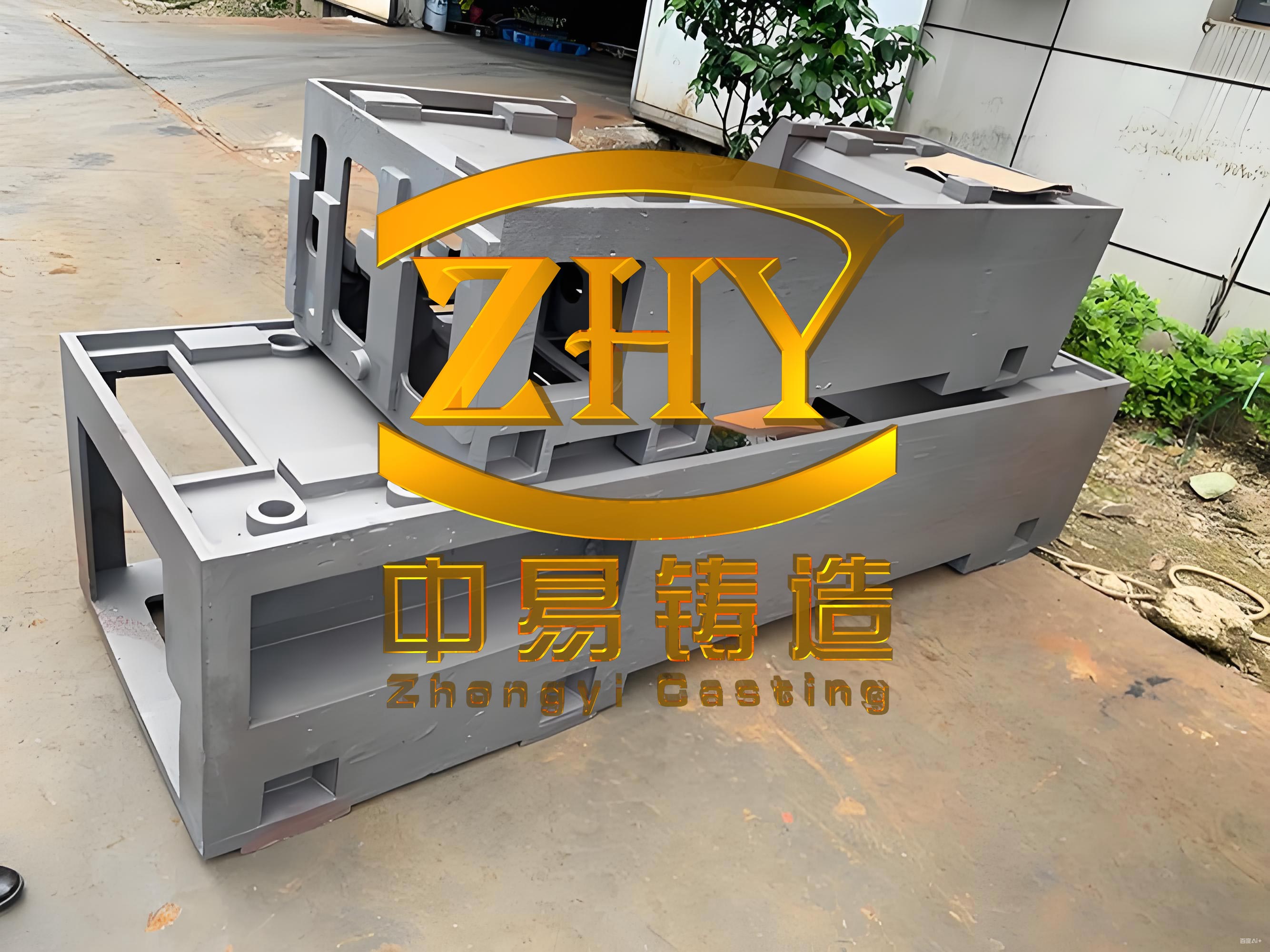
Further analysis involved evaluating the temperature gradients and thermal stresses during solidification. For machine tool castings, thermal cracks can occur due to uneven cooling, particularly in sections with abrupt thickness changes. I used the Fourier heat conduction equation to model temperature distribution: $$ \frac{\partial T}{\partial t} = \alpha \nabla^2 T $$ where \( T \) is temperature, \( t \) is time, and \( \alpha \) is the thermal diffusivity. In the bottom gating design, simulations showed high thermal stresses near the 15 mm ribs, increasing the risk of hot tearing. In contrast, the top gating design with chills reduced these gradients, minimizing stress concentrations. Additionally, the inclusion of open risers not only facilitated feeding but also allowed for gas escape, reducing the likelihood of gas holes in the machine tool castings.
Based on the simulation results, I optimized the casting process by adopting the top gating system with integrated chill plates and risers. The final design, as illustrated in the figure, features the large working surface facing upward, enabling a straightforward mold assembly and core placement. The risers are positioned at the top thick sections to ensure adequate feeding, while chills at the bottom promote rapid initial solidification. This setup achieves directional solidification, as described by the equation for solidification rate: $$ \frac{dS}{dt} = \frac{k}{\sqrt{t}} $$ where \( S \) is the solidified thickness, and \( k \) is a constant. For machine tool castings, this results in a controlled solidification front moving from the bottom to the top, effectively eliminating shrinkage defects.
| Component | Specification | Role in Optimization |
|---|---|---|
| Gating System | Top gating with multiple ingates | Ensures smooth filling and reduces turbulence |
| Risers | Open risers at top sections | Provides feeding for shrinkage and vents gases |
| Chill Plates | Placed at bottom thick areas | Accelerates solidification for directional control |
| Mold Material | Sand mold with virtual mold simulation | Reduces computational errors and mimics real conditions |
The benefits of this optimized process for machine tool castings are multifold. Firstly, it simplifies operational steps, as workers can easily handle core placement and mold closing without complex吊芯 techniques. This reduces labor costs and training requirements. Secondly, the improved solidification control minimizes defects, leading to a higher yield and reduced scrap rates. For example, the porosity index, which can be estimated using the Niyama criterion: $$ G / \sqrt{R} $$ where \( G \) is the temperature gradient and \( R \) is the cooling rate, showed values within acceptable limits in the optimized design, indicating low shrinkage risk. Thirdly, the use of simulation tools allowed for virtual testing, saving time and resources compared to physical trials. In practice, this approach has been validated through actual casting trials, where machine tool castings produced with the top gating system exhibited no significant defects and met hardness specifications.
In conclusion, the optimization of the sand casting process for medium machine tool castings demonstrates the importance of integrating simulation-based design with practical considerations. By adopting a top gating orientation combined with chills and risers, I achieved directional solidification that prevents common defects like shrinkage porosity and thermal cracks. This method not only enhances the quality of machine tool castings but also boosts efficiency and cost-effectiveness in small to medium batch production. Future work could focus on further refining the gating design or exploring alternative materials to expand the applications of machine tool castings in various industrial sectors. Overall, this optimized process serves as a reliable framework for producing high-performance machine tool castings, aligning with the evolving demands of the manufacturing industry.