
In my experience with industrial applications, high manganese steel casting plays a critical role in producing durable components like liners for grinding mills. Traditional methods often involve large risers to compensate for the significant shrinkage of high manganese steel, but this leads to challenges such as difficulty in cutting and increased material waste. Through extensive experimentation and practical application, I have developed and implemented a no-riser casting process that leverages the unique properties of high manganese steel, such as its low melting point and high fluidity. This approach not only simplifies production but also enhances efficiency and reduces costs. In this article, I will detail the feasibility, key process steps, and outcomes of this innovative method, supported by tables and formulas to provide a comprehensive understanding.
High manganese steel, known for its excellent wear resistance and toughness, is widely used in abrasive environments like mining equipment. However, its high shrinkage rate and low thermal conductivity pose significant challenges in casting. Traditionally, large risers are employed to feed the solidifying metal, but this increases the risk of defects like cracks and columnar structures. By adopting a no-riser casting process, I have addressed these issues through controlled cooling and vacuum-assisted lost foam casting. This method ensures simultaneous solidification, minimizing the formation of shrinkage porosity in critical areas. Over years of application, this technique has proven effective in producing liners that meet operational demands while improving economic returns.
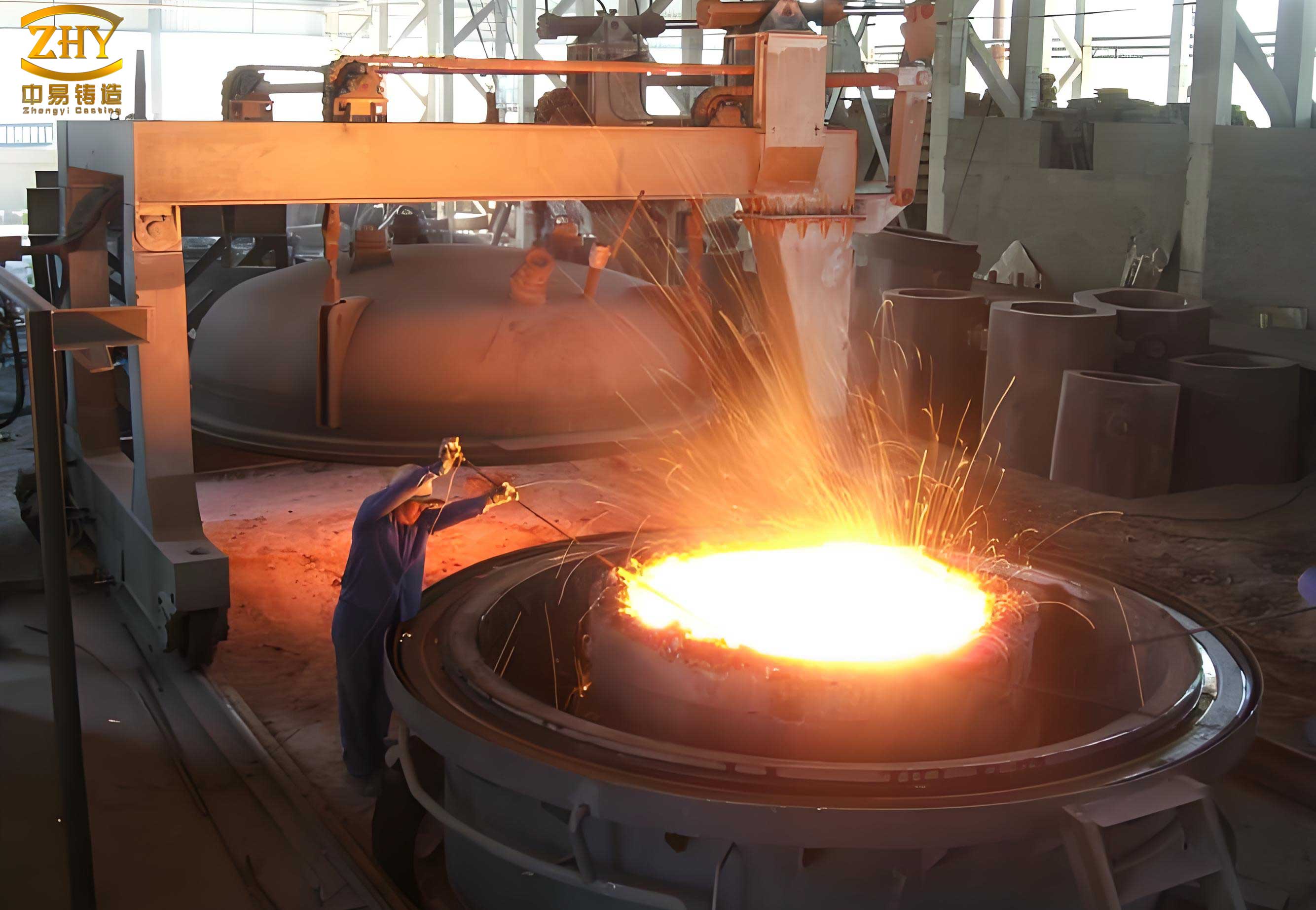
The feasibility of no-riser casting for high manganese steel components stems from the material’s inherent characteristics. High manganese steel has a melting point of approximately 1340°C, allowing for lower pouring temperatures that reduce liquid contraction. In lost foam vacuum casting, the mold filling and solidification can be controlled to achieve uniform cooling. Although a central axis of slight porosity may form in thicker sections, this does not compromise the liner’s performance in service, as wear typically reduces the wall thickness before the porous zone becomes critical. To quantify this, I consider the solidification shrinkage, which can be expressed using the formula for volume change: $$\Delta V = V_0 \cdot \beta \cdot (T_p – T_s)$$ where $\Delta V$ is the volume shrinkage, $V_0$ is the initial volume, $\beta$ is the coefficient of thermal expansion for high manganese steel, $T_p$ is the pouring temperature, and $T_s$ is the solidus temperature. For high manganese steel casting, $\beta$ is typically around $2.5 \times 10^{-5} \, \text{K}^{-1}$, and by maintaining $T_p$ between 1420°C and 1430°C, the shrinkage is minimized.
In practice, I have observed that liners subjected to impact and abrasion in grinding mills do not fail due to minor internal porosity. This is because the wear mechanism involves surface removal, and the component is replaced once the wall thickness reaches a certain limit, often before any porosity is exposed. The table below summarizes key parameters that justify the no-riser approach for high manganese steel casting:
| Parameter | Value | Justification |
|---|---|---|
| Melting Point | 1340°C | Enables low-temperature pouring to reduce shrinkage |
| Thermal Conductivity | Low (~15 W/m·K) | Promotes gradual cooling in lost foam process |
| Fluidity | High | Facilitates complete mold filling without risers |
| Typical Shrinkage | 5-7% | Controlled by simultaneous solidification |
Moving to the process details, the success of high manganese steel casting without risers relies heavily on the preparation of the foam pattern and coating. The foam density must exceed 18 kg/m³ to ensure dimensional stability and resistance to deformation during handling. After drying, the pattern dimensions are adjusted based on the foam quality to account for shrinkage, using a scaling factor derived from empirical data. The coating, applied in two layers, must exhibit excellent adhesion and permeability. I have formulated a proprietary coating mixture consisting of fused magnesia powder as the base, supplemented with additives like white latex, lithium-based bentonite, water-soluble phenolic resin, CMC, and sodium hexametaphosphate. This composition ensures a uniform layer thickness of over 2 mm, which is crucial for preventing metal penetration and facilitating gas escape during casting.
The drying process is meticulously controlled to avoid defects. The first coating layer requires at least 6 hours of drying, while the second layer needs 8 hours or more. Incomplete drying can lead to gas-related issues in the final high manganese steel casting. For molding, I use a sandbox measuring 1500 mm × 1500 mm × 1300 mm with vacuum extraction from five sides. The dry sand employed is washed quartz sand, which provides good compaction and thermal stability. The filling process involves layering the sand in 300 mm increments, each compacted thoroughly before adding the next, to ensure uniform support and avoid voids. The gating system is designed with careful attention to the connections, sealed with refractory clay to prevent metal leakage. The following formula helps in determining the optimal vacuum pressure for the process: $$P_v = P_a – \Delta P_f$$ where $P_v$ is the vacuum pressure in the sandbox, $P_a$ is atmospheric pressure, and $\Delta P_f$ is the pressure drop due to flow resistance, typically maintained at 0.45–0.5 MPa for high manganese steel casting.
In terms of molten metal handling, the high manganese steel casting composition must adhere to strict standards. Using a 5-ton electric arc furnace, I melt the steel to achieve a chemical composition within the range specified for ZGMn13-2. The table below outlines the target composition and its role in the material properties:
| Element | Content (%) | Function |
|---|---|---|
| C | 0.90–1.50 | Enhances hardness and wear resistance |
| Mn | 10.0–15.0 | Promotes austenitic structure and toughness |
| Si | 0.30–1.0 | Improves fluidity and deoxidation |
| S | ≤0.05 | Minimizes hot shortness |
| P | ≤0.10 | Reduces brittleness |
Pouring is conducted with an 8-ton ladle, and the temperature control is critical. I ensure the metal is held in the ladle for at least 6 minutes to allow for slag separation and temperature homogenization. The pouring temperature is maintained between 1420°C and 1430°C, as measured by thermocouple. To monitor this without advanced instruments, I use a simple method involving a steel rod: inserting a Φ12 mm rod into the molten metal for a few seconds and observing the adherence of metal, which indicates the temperature range. The vacuum pump is activated 3 minutes before pouring to establish a stable vacuum environment, and the pouring process must be continuous to avoid turbulence and defects. The heat transfer during solidification can be modeled using Fourier’s law: $$q = -k \frac{dT}{dx}$$ where $q$ is the heat flux, $k$ is the thermal conductivity of high manganese steel, and $\frac{dT}{dx}$ is the temperature gradient. In no-riser casting, this gradient is minimized to promote uniform cooling.
Post-casting, the high manganese steel casting undergoes heat treatment to achieve the desired microstructure and mechanical properties. Water quenching, or water toughening, is essential to transform the brittle as-cast carbide structure into a tough austenitic matrix. The process involves heating the castings at a controlled rate of 100°C per hour to a temperature between 1080°C and 1100°C, holding for 4 hours based on the section thickness and furnace load, and then quenching in water. The quenching temperature must not fall below 960°C to avoid carbide precipitation. The water volume in the quenching tank should be at least 10 times the weight of the castings, and the initial water temperature is kept below 35°C to ensure rapid cooling. After 40 minutes in water, the castings are removed, allowed to dry naturally, and inspected before dispatch. The kinetics of this transformation can be described by the Avrami equation for phase change: $$X = 1 – \exp(-k t^n)$$ where $X$ is the fraction transformed, $k$ is a rate constant, $t$ is time, and $n$ is an exponent dependent on the transformation mechanism. For high manganese steel casting, this ensures optimal hardness and impact resistance.
The economic and operational benefits of this no-riser high manganese steel casting process are substantial. By eliminating risers, the yield improvement exceeds 20%, reducing material consumption and machining efforts. Additionally, the absence of riser cutting lowers labor intensity and minimizes the risk of thermal cracks. In multiple production runs for industrial clients, the liners have demonstrated excellent performance over extended periods, with no reported failures. This validates the process reliability and underscores its potential for broader adoption in foundries dealing with high manganese steel components. The overall efficiency gain can be quantified using a simple cost-benefit analysis, where the savings in material and labor offset the initial setup costs within a short timeframe.
In conclusion, the no-riser approach to high manganese steel casting represents a significant advancement in foundry technology. Through careful control of process parameters, material composition, and heat treatment, I have achieved consistent production of high-quality liners that meet stringent operational requirements. The integration of lost foam vacuum casting with low-temperature pouring and precise thermal management ensures that the inherent challenges of high manganese steel are effectively mitigated. This method not only enhances product quality but also contributes to sustainable manufacturing by reducing waste and energy consumption. As industries continue to demand more efficient and durable components, this process stands out as a viable and profitable solution for high manganese steel casting applications.