
In my experience with high manganese steel casting, the lost foam process has revolutionized the production of wear-resistant components like mill liners. High manganese steel, known for its exceptional work-hardening properties and impact resistance, presents unique challenges in traditional casting due to its high shrinkage and tendency to form carbides. However, by adopting a riserless approach in lost foam casting, we have achieved significant improvements in efficiency and quality. This method leverages the simultaneous solidification characteristics of the lost foam process, effectively mitigating shrinkage defects while eliminating the need for bulky risers that complicate cutting and increase costs. Throughout this article, I will delve into the operational conditions, process rationale, and detailed production steps, supported by tables and formulas to encapsulate key aspects of high manganese steel casting.
The working conditions of high manganese steel liners in grinding mills involve severe abrasive and impact loads. In typical applications, such as in a φ2.7 m × 5 m mill, multiple liners are arranged in circular patterns and secured with bolts to the inner wall of a rotating cylinder. As the mill rotates, ore is lifted and dropped, subjecting the liners to continuous凿削磨损. This passive wear mechanism means that even if minor internal porosity exists, it does not compromise performance until the liner thickness reduces to a critical point. For instance, in a φ2.1 m × 4 m mill, similar dynamics apply, where the liners endure cyclical impacts. The homogeneity in wall thickness of these components makes them ideal for lost foam casting, as it promotes uniform cooling and reduces the risk of hot spots that could lead to cracking or segregation in high manganese steel casting.
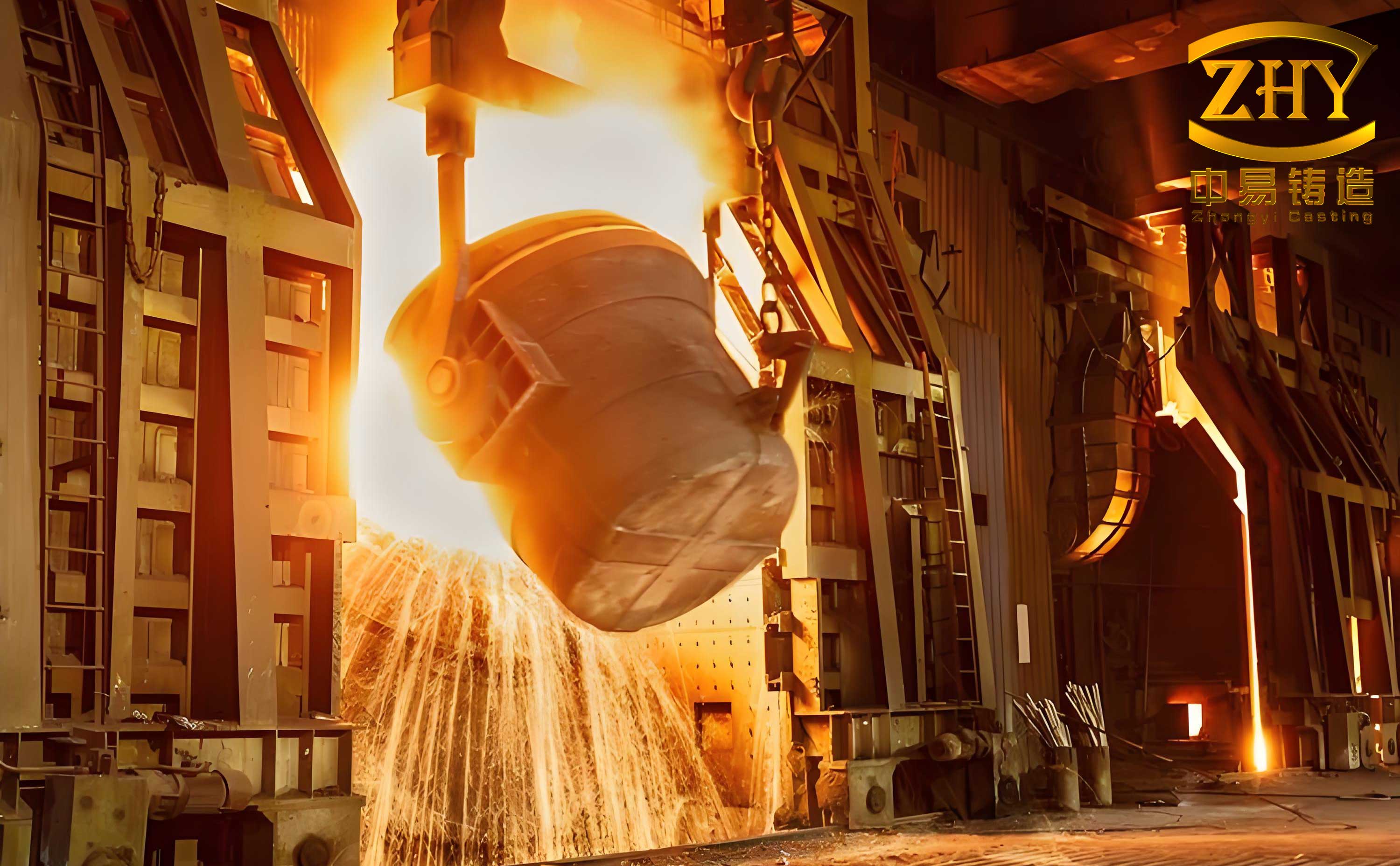
From a process perspective, the decision to eliminate risers in high manganese steel casting stems from the material’s inherent properties. High manganese steel has a relatively low melting point of approximately 1340°C and excellent fluidity, allowing for casting at lower temperatures. This reduces液态收缩, which is a major contributor to shrinkage porosity. In lost foam casting, the vacuum environment ensures that the mold fills completely and solidifies simultaneously, minimizing the formation of轴线疏松带. The key lies in controlling the solidification dynamics to prevent defects. For example, the thermal conductivity of high manganese steel is low, around 12–15 W/m·K, which can be modeled using Fourier’s law of heat conduction: $$q = -k \nabla T$$ where \(q\) is the heat flux, \(k\) is the thermal conductivity, and \(\nabla T\) is the temperature gradient. By maintaining a shallow gradient through controlled cooling, we achieve a sound casting without risers. Additionally, the absence of risers simplifies post-casting processes, as high manganese steel’s brittleness in the as-cast state makes mechanical cutting difficult and risky.
In the production of high manganese steel casting via lost foam, several critical steps ensure quality. First, the foam patterns must have a density exceeding 18 kg/m³ to provide adequate strength and minimize gas evolution during pouring. These patterns undergo drying to reduce moisture, which could otherwise cause defects. The coating applied to the patterns plays a vital role in permeability and surface finish. A typical coating composition includes refractory materials like fused magnesia, binders such as white emulsion and water-soluble phenolic resin, and additives like lithium-based bentonite and CMC. The coating thickness should be at least 2 mm to withstand the thermal shock of molten steel. After dipping, the patterns are dried—6 hours for the first coat and 8 hours for the second—to ensure complete dehydration before molding.
| Component | Function | Typical Proportion (%) |
|---|---|---|
| Fused Magnesia Powder | Refractory Base | 60–70 |
| White Emulsion | Binder | 10–15 |
| Lithium-Based Bentonite | Suspension Agent | 5–10 |
| Water-Soluble Phenolic Resin | Strength Enhancer | 5–8 |
| CMC | Thickener | 2–4 |
| Sodium Hexametaphosphate | Dispersant | 1–2 |
Molding involves using a sandbox of dimensions 1500 mm × 1500 mm × 1300 mm with vacuum applied on five sides. The dry sand, typically washed quartz sand, is layered and compacted in stages—every 300 mm—to ensure uniform density and avoid voids. The gating system is designed to facilitate smooth metal flow, with refractory paste sealing joints to prevent metal penetration. The vacuum level is maintained between -0.45 MPa and -0.5 MPa during pouring, which helps draw the molten metal into the mold and reduce turbulence. This is crucial for high manganese steel casting, as entrapped air or gases can lead to porosity or inclusions.
Melting and pouring are performed in a 5-ton electric arc furnace, with the chemical composition tailored to meet ZGMn13-2 standards. The ladle is allowed to settle for at least 6 minutes to promote slag separation and temperature uniformity. Pouring temperature is critical; we control it between 1420°C and 1430°C, measured with a thermocouple. To assess fluidity, a simple test involves inserting a φ12 steel rod into the ladle and observing the adhesion—a quick, practical check for proper superheat. The relationship between temperature and fluidity can be approximated by the Vogel-Fulcher-Tammann equation for viscosity: $$\eta = A \exp\left(\frac{B}{T – T_0}\right)$$ where \(\eta\) is viscosity, \(T\) is temperature, and \(A\), \(B\), and \(T_0\) are constants specific to high manganese steel. Lower pouring temperatures reduce液态收缩, which is quantified by the volumetric shrinkage coefficient: $$\beta = \frac{\Delta V}{V_0} \times 100\%$$ where \(\beta\) is typically 4–6% for high manganese steel casting. By minimizing this through low-temperature pouring, we effectively compensate for shrinkage without risers.
| Element/Parameter | Specification | Role in Casting |
|---|---|---|
| C (%) | 0.90–1.50 | Enhances Hardness and Wear Resistance |
| Mn (%) | 10.0–15.0 | Promotes Austenite Stability and Toughness |
| Si (%) | 0.30–1.0 | Deoxidizer and Fluidity Improver |
| S (%) | ≤0.05 | Minimizes Hot Tearing |
| P (%) | ≤0.10 | Reduces Brittleness |
| Pouring Temperature (°C) | 1420–1430 | Balances Fluidity and Shrinkage Control |
| Vacuum Level (MPa) | -0.45 to -0.5 | Ensures Mold Filling and Reduces Gas Defects |
| Pattern Density (kg/m³) | Provides Structural Integrity |
Heat treatment is essential for developing the desired microstructure in high manganese steel casting. After shakeout and shot blasting, the castings undergo water quenching (water toughening) to dissolve carbides and retain austenite. The heating rate is controlled below 100°C/h to avoid thermal stresses, with soaking at 1080°C–1100°C for about 4 hours, depending on section thickness. The quenching water must be at least 10 times the casting weight in volume, with an initial temperature below 35°C to achieve rapid cooling. The入水温度 should be no lower than 960°C to prevent pearlite formation. The cooling process can be modeled using the heat transfer equation: $$\frac{\partial T}{\partial t} = \alpha \nabla^2 T$$ where \(\alpha\) is the thermal diffusivity. This treatment ensures a fine, homogeneous structure that maximizes impact toughness in high manganese steel casting.
The application of this riserless lost foam process has yielded substantial benefits in real-world scenarios. Over two years of production and use in multiple mill setups, the liners have demonstrated full compliance with operational demands, showing no premature failures or performance issues. The elimination of risers has increased the yield by over 20%, reducing material waste and lowering energy consumption. Moreover, it bypasses the labor-intensive riser cutting step, which is particularly advantageous for high manganese steel casting due to its hardness in the as-cast state. This approach not only enhances economic efficiency but also aligns with sustainable manufacturing practices by minimizing scrap.
In conclusion, the integration of lost foam casting without risers for high manganese steel components represents a significant advancement in foundry technology. By leveraging the material’s fluidity and optimizing process parameters, we have overcome traditional limitations associated with shrinkage and cutting difficulties. The repeated emphasis on high manganese steel casting throughout this discussion underscores its centrality to achieving durable, cost-effective wear parts. As we continue to refine these methods, the potential for broader applications in other high-performance alloys looks promising, driven by the principles of simultaneous solidification and precise thermal management.