
High manganese steel casting, commonly referred to as Hadfield steel, is renowned for its exceptional wear resistance and toughness under high-stress and high-impact conditions. This material is extensively utilized in industries such as mining, crushing, excavation, and rail transport due to its unique ability to maintain ductility while undergoing work hardening. The as-cast microstructure of high manganese steel casting typically consists of an austenitic matrix, carbide networks along grain boundaries, and minor pearlitic regions, which collectively impair its toughness and plasticity. To address these limitations, heat treatment processes like water toughening and aging are employed to optimize the microstructure and enhance mechanical properties. This study investigates the influence of water toughening and aging parameters on the evolution of microstructure and hardness in high manganese steel casting, providing insights for industrial applications such as semi-autogenous mill liners.
The chemical composition of the high manganese steel casting used in this research is detailed in Table 1. The material was melted in a medium-frequency furnace, with careful control of critical elements like chromium and manganese to minimize segregation. The casting process involved pouring at approximately 1450°C, and spectroscopic analysis confirmed uniform distribution of alloying elements across the specimen, as illustrated in the composition distribution analysis. This homogeneity is crucial for consistent heat treatment responses and performance in high manganese steel casting components.
| Element | Content |
|---|---|
| C | 1.0–1.1 |
| Si | 0.4–0.6 |
| Mn | 10.0–11.0 |
| Cr | 0.3–0.5 |
| S | < 0.005 |
| P | < 0.005 |
| Fe | Balance |
In the as-cast condition, the microstructure of high manganese steel casting exhibits coarse austenitic grains with an average size of approximately 600 μm. The grain boundaries are decorated with continuous carbide networks, and the interior of the grains contains blocky regions of pearlite, which display a lamellar morphology under higher magnification. This microstructure results from the relatively slow cooling rates in sand casting, where secondary carbides precipitate at austenite grain boundaries, followed by eutectoid transformation to pearlite at lower temperatures. The presence of these hard phases contributes to the high hardness of the as-cast material, with an average Vickers hardness of HV 461.6. However, this comes at the expense of reduced ductility and toughness, limiting the direct application of as-cast high manganese steel casting in demanding environments.
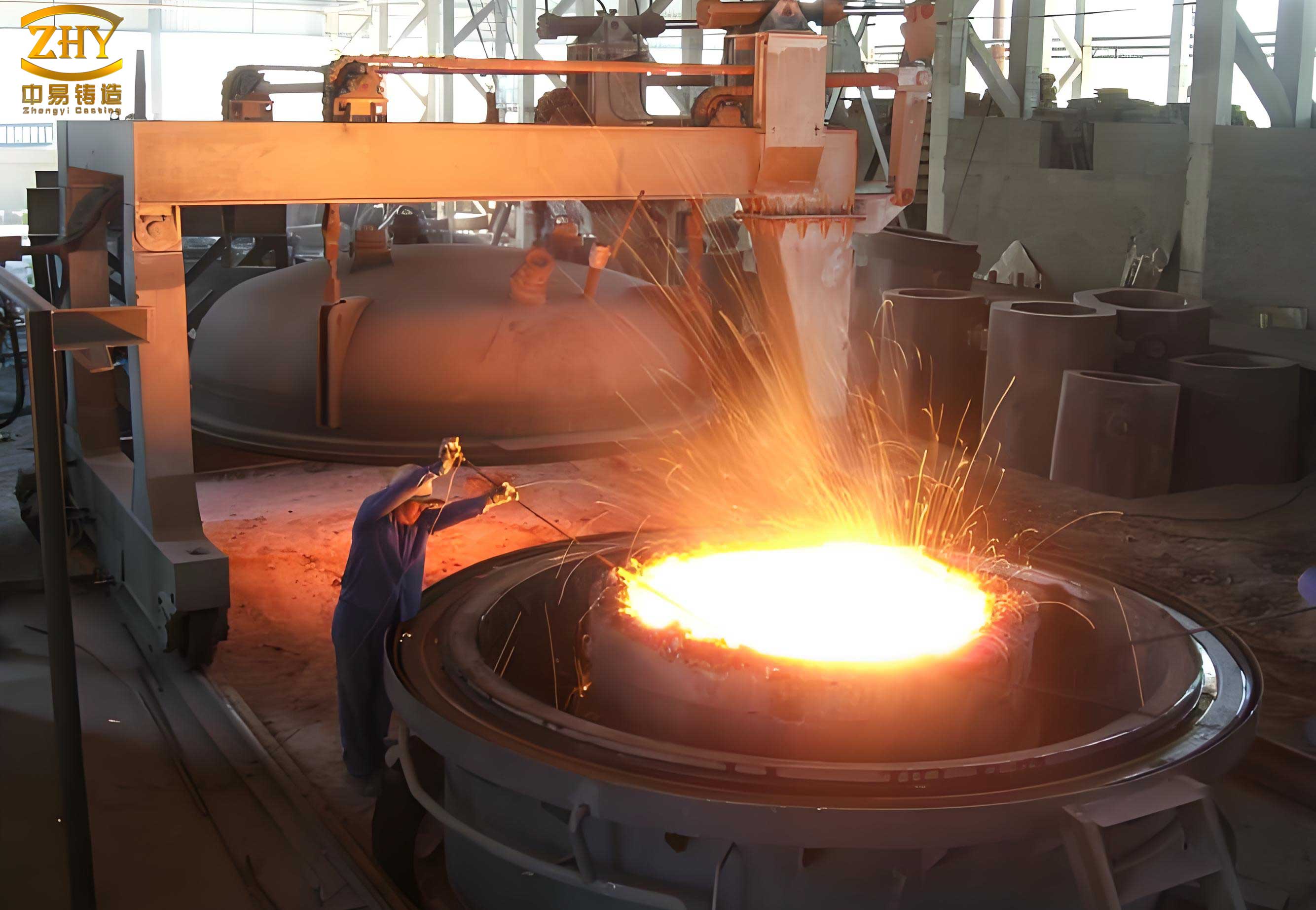
To improve the properties, water toughening treatment was applied, involving heating to 650°C to minimize thermal stresses and prevent cracking, followed by soaking at 1100°C to dissolve carbides and pearlite into the austenitic matrix. The specimens were then rapidly quenched in water to retain a supersaturated solid solution. The water toughening parameters are summarized in Table 2, where variations in holding times were explored to assess their impact on microstructure and hardness. The rapid cooling is critical to suppress carbide re-precipitation, and the water temperature was maintained below 60°C to ensure adequate quenching efficiency for high manganese steel casting.
| Process ID | Parameters |
|---|---|
| SR1 | 650°C/1 h + 1100°C/2 h |
| SR2 | 650°C/1 h + 1100°C/4 h |
| SR3 | 650°C/3 h + 1100°C/2 h |
| SR4 | 650°C/3 h + 1100°C/4 h |
After water toughening, the microstructure of high manganese steel casting transforms significantly. The carbide networks and pearlitic regions dissolve into the austenite, resulting in a homogeneous matrix with minor particulate carbides. X-ray diffraction (XRD) analysis confirms that the primary phase is austenite (γ-Fe), with no detectable carbides or pearlite, indicating successful solid solution treatment. The dissolution process can be described by the diffusion-controlled equation for carbide dissolution: $$ \frac{dc}{dt} = D \nabla^2 c $$ where \( c \) is the carbon concentration, \( t \) is time, and \( D \) is the diffusion coefficient. Prolonged holding at 1100°C promotes complete dissolution, but excessive times lead to austenite grain growth, as observed in specimens with longer soaking periods. The hardness values after water toughening are presented in Table 3, showing a substantial reduction to around HV 210–230 due to the elimination of hard secondary phases. This softening is desirable for enhancing toughness in high manganese steel casting, making it suitable for impact-resistant applications.
| Specimen | Hardness (HV) |
|---|---|
| SR1 | 215.8 |
| SR2 | 229.9 |
| SR3 | 223.8 |
| SR4 | 211.8 |
To further tailor the properties, aging treatment was conducted on water-toughened specimens (selected based on optimal hardness and microstructure, e.g., SR2). The aging parameters included temperatures ranging from 300°C to 500°C and holding times of 1 h and 3 h, as detailed in Table 4. The aging process aims to precipitate fine carbides within the austenitic matrix, thereby increasing hardness without significantly compromising toughness. The kinetics of carbide precipitation during aging can be modeled using the Avrami equation: $$ X = 1 – \exp(-kt^n) $$ where \( X \) is the fraction of precipitated phase, \( k \) is the rate constant, \( t \) is time, and \( n \) is the Avrami exponent. This equation helps predict the transformation behavior in high manganese steel casting under various thermal conditions.
| Process ID | Aging Temperature (°C) | Holding Time (h) |
|---|---|---|
| SX300/1 | 300 | 1 |
| SX300/3 | 300 | 3 |
| SX350/1 | 350 | 1 |
| SX350/3 | 350 | 3 |
| SX400/1 | 400 | 1 |
| SX400/3 | 400 | 3 |
| SX450/1 | 450 | 1 |
| SX450/3 | 450 | 3 |
| SX500/1 | 500 | 1 |
| SX500/3 | 500 | 3 |
The microstructural evolution during aging treatment of high manganese steel casting reveals a sequence of carbide precipitation. At lower aging temperatures (300°C and 350°C), the microstructure remains predominantly austenitic with minimal carbide formation, primarily at grain boundaries. As the temperature increases to 400°C and above, needle-like carbides nucleate at grain boundaries and grow into the grain interior. Concurrently, particulate carbides form along the boundaries, and with extended holding times, these carbides coalesce into continuous networks. This precipitation behavior is critical for controlling the mechanical properties of high manganese steel casting, as the morphology and distribution of carbides directly influence hardness and ductility.
The hardness measurements after aging treatment, summarized in Table 5, demonstrate a progressive increase with rising temperature and extended holding time. At 300°C and 350°C, the hardness values are similar to those after water toughening, indicating limited precipitation. However, at 400°C and beyond, a sharp increase in hardness occurs, correlating with the extensive precipitation of needle-like carbides. The relationship between aging temperature and hardness can be expressed using an empirical formula: $$ H = H_0 + A \exp\left(-\frac{Q}{RT}\right) $$ where \( H \) is the hardness, \( H_0 \) is the base hardness, \( A \) is a constant, \( Q \) is the activation energy for precipitation, \( R \) is the gas constant, and \( T \) is the absolute temperature. This equation highlights the thermally activated nature of carbide precipitation in high manganese steel casting.
| Specimen | Hardness (HV) |
|---|---|
| SX300/1 | 228.1 |
| SX300/3 | 228.7 |
| SX350/1 | 234.7 |
| SX350/3 | 231.3 |
| SX400/1 | 240.0 |
| SX400/3 | 352.7 |
| SX450/1 | 333.3 |
| SX450/3 | 359.3 |
| SX500/1 | 344.7 |
| SX500/3 | 367.5 |
Further analysis of the aging kinetics in high manganese steel casting involves considering the diffusion of carbon and alloying elements. The rate of carbide growth can be described by the parabolic growth law: $$ r^2 = k_p t $$ where \( r \) is the carbide radius, \( k_p \) is the parabolic rate constant, and \( t \) is time. This model accounts for the observed increase in carbide size with prolonged aging, particularly at higher temperatures. Additionally, the effect of chromium on carbide stability in high manganese steel casting can be quantified using thermodynamic calculations, such as the solubility product: $$ [C][Cr] = K \exp\left(-\frac{\Delta G}{RT}\right) $$ where \( [C] \) and \( [Cr] \) are the concentrations of carbon and chromium, \( K \) is a constant, and \( \Delta G \) is the Gibbs free energy change. This relationship explains the role of alloying elements in modulating precipitation behavior.
In practical terms, for industrial components like semi-autogenous mill liners made from high manganese steel casting, the heat treatment parameters must be optimized to balance hardness and toughness. Excessive aging temperatures or times can lead to the formation of continuous carbide networks, which embrittle the material. Therefore, based on this study, aging at moderate temperatures (e.g., 400°C) for shorter durations is recommended to achieve a favorable combination of properties. The insights gained from this research on high manganese steel casting contribute to the development of more durable and efficient wear-resistant parts in mining and other heavy industries.
In conclusion, the heat treatment processes of water toughening and aging profoundly influence the microstructure and hardness of high manganese steel casting. Water toughening effectively dissolves carbides and pearlite, resulting in a soft austenitic matrix, while aging induces carbide precipitation that enhances hardness. The control of temperature and time parameters is crucial to avoid detrimental microstructural features like grain growth or continuous carbide networks. Future work could explore the impact of additional alloying elements or advanced heat treatment techniques on the performance of high manganese steel casting in specific applications.