
In my extensive experience with industrial projects, the design and implementation of a resin sand casting production line present unique challenges and opportunities. This article details the key innovations from a recent project where I was involved in the total contracting of a resin sand casting workshop. The goal was to replace traditional clay sand processes with modern resin sand casting techniques, enhancing efficiency and product quality. After over a year of effort, the production line was successfully commissioned and has been operating normally, receiving positive feedback for its design features. Below, I elaborate on the design characteristics, incorporating technical details, formulas, and tables to provide a comprehensive overview of the resin sand casting system.
The foundation of this resin sand casting project was leveraging existing infrastructure and equipment to minimize costs and accelerate timelines. We utilized three existing L124B knockout machines, repositioned on the foundation of an old L128 machine, and repurposed a 9m x 2dm clay sand processing structure to house a 10 t/h sand regeneration system. This approach saved significant civil engineering expenses and expedited the project, meeting tight deadlines. The layout capitalizes on original pits and concrete platforms, demonstrating how adaptive reuse can benefit resin sand casting upgrades. The overall system, as shown in the layout diagram, integrates multiple components to handle hot sand efficiently, a critical aspect in resin sand casting due to the high sand-to-metal ratio and elevated temperatures post-casting.
One of the core design principles was incorporating large-capacity intermediate sand storage hoppers, tailored to domestic conditions. In resin sand casting, managing sand temperature and ensuring continuous flow are paramount. We installed three old sand storage hoppers between key equipment—such as between the knockout machines and crusher, crusher and regenerator, and regenerator and sand temperature conditioner—with a total capacity of around 200 tons. This allows for operational flexibility; for instance, during maintenance of one unit, others can continue running without disruption. Additionally, an intermediate storage hopper after the sand temperature conditioner holds 40-50 tons, addressing sudden sand demands at the start of shifts for multiple mixers. The temperature dynamics can be modeled using a simple heat transfer formula: $$ \Delta T = \frac{Q}{m \cdot c} $$ where $\Delta T$ is the temperature change, $Q$ is the heat loss, $m$ is the sand mass, and $c$ is the specific heat capacity. With this setup, sand exiting the temperature conditioner is typically 2–3°C above the usage point temperature, compensating for cooling during conveyance. Over six months of production, this configuration proved ideal for production organization in resin sand casting, reducing reliance on expensive chillers in northern regions by naturally cooling sand from 250°C to around 30°C through multiple transfers and dust removal points.
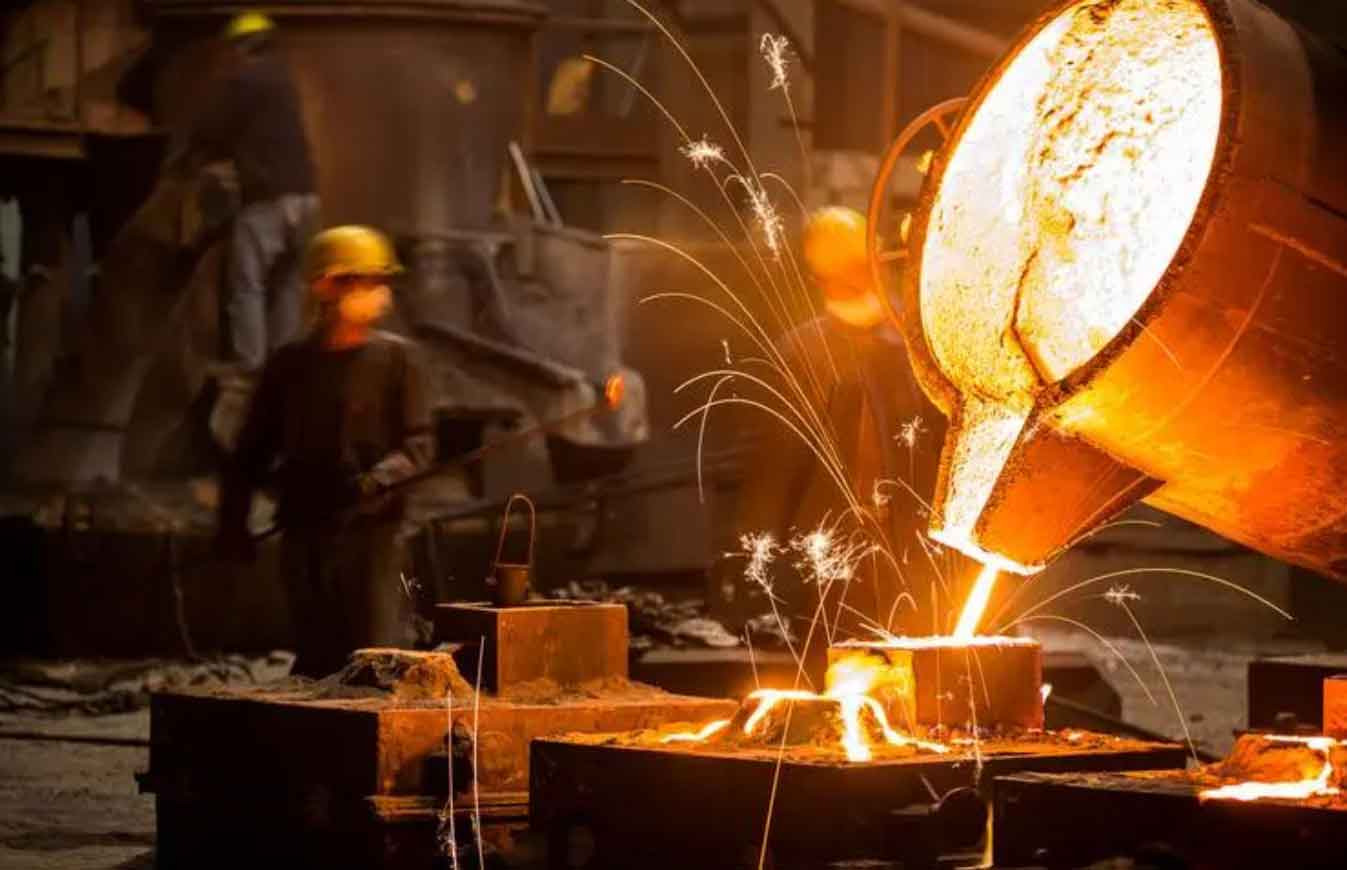
Handling hot sand in resin sand casting is a significant challenge, as sand temperatures can reach 300°C shortly after casting. To address this, we selected high-temperature resistant conveyor belts for hot sand transport. Traditional heat-resistant belts only endure up to 100°C, often failing within weeks. We used 650 mm wide belts made from special fiber cores and synthetic rubber with high-temperature additives, capable of withstanding 280–320°C. These belts have operated reliably for months without blistering or burn marks, even with sand temperatures of 200–250°C. The conveyor system’s capacity was oversized to prevent clogging; for example, vibrating chutes at 800 mm width and belt conveyors at 650 mm width ensure smooth flow from three knockout machines. The conveyance rate can be expressed as: $$ \text{Flow Rate} = A \cdot v \cdot \rho $$ where $A$ is the cross-sectional area, $v$ is the velocity, and $\rho$ is the sand density. This design choice enhances reliability in resin sand casting lines, where downtime from blockages can be costly.
The vibration screen is another critical component in resin sand casting for removing debris and ensuring sand quality. Dissatisfied with commercially available options, we developed a custom vibration screen with several innovative features. Its compact structure minimizes vibration transmission to foundations, and it includes a feed port with a distribution mechanism to prevent sand pile-up that could damage the screen mesh. The screen uses a pre-tensioning system for easy mesh replacement without halting production—a vital advantage in continuous resin sand casting operations. The screen’s efficiency can be quantified by the screening efficiency formula: $$ E = \frac{M_s}{M_f} \times 100\% $$ where $E$ is the efficiency, $M_s$ is the mass of sand passing through the screen, and $M_f$ is the total feed mass. This design has reduced maintenance downtime and improved sand consistency in our resin sand casting process.
The layout of the resin sand casting production line was optimized for practicality and cost-effectiveness. For instance, we relocated the magnetic separator to a trench, lowering the height of a bucket elevator and saving structural costs. Separating the air classifier from the sand temperature conditioner allowed for better adjustment and avoided interference with overhead crane lines, resulting in savings of 30,000–50,000 CNY. The air classifier plays a key role in removing dust and resin films, but it can clog with impurities like stones or ropes. To mitigate this, we installed level sensors to alert operators before overfilling occurs, preventing equipment jams. The system includes multiple bucket elevators, and we recommend adding speed sensors to detect slippage and stop upstream feeders, avoiding blockages. These layout tweaks enhance the robustness of resin sand casting systems, as summarized in the table below comparing key equipment parameters:
| Equipment | Function | Capacity (t/h) | Key Feature |
|---|---|---|---|
| Knockout Machines (L124B) | Sand removal from castings | 3 units combined | Reused existing base |
| Sand Regenerator | Old sand processing | 10 | Integrated into old structure |
| High-Temperature Conveyor Belt | Hot sand transport | Designed for overload | Resists up to 320°C |
| Vibration Screen | Debris removal | Matches system flow | Custom design with easy maintenance |
| Air Classifier | Dust and film removal | 10 | Relocated for accessibility |
| Sand Temperature Conditioner | Cooling sand | 20 | Uses intermediate hopper for stability |
Thermal airflow drying was implemented for new sand, integrating drying, lifting, and dust removal into one system. This method is particularly effective for fine sands common in resin sand casting, as it reduces moisture and removes dust efficiently. We designed a volumetric damping discharger to replace traditional cyclone dischargers, minimizing wear in elbows and pipes. The system uses a boiler-induced draft fan; during winter, preheating air with a coke stove reduces fan load and prevents motor trips. Noise reduction was achieved by enclosing the high-pressure fan with silencers. The drying process can be described by the mass transfer equation: $$ \frac{dm}{dt} = k \cdot A \cdot (P_s – P_a) $$ where $dm/dt$ is the drying rate, $k$ is the mass transfer coefficient, $A$ is the surface area, and $P_s$ and $P_a$ are the vapor pressures at the sand surface and in the air, respectively. However, we encountered issues with plastic debris from sand bags clogging the sand temperature conditioner; adding a fixed screen at the conveyor head solved this, highlighting the need for preprocessing in resin sand casting material handling.
Dust control is essential in resin sand casting to maintain air quality and equipment longevity. Our system includes a knockout dust removal system with semi-enclosed mobile hoods, reducing dust and noise during operation. Additional box-type dust collectors are placed at key points, such as bucket elevators and sand hoppers. The total dust removal capacity is 50,000 m³/h for the knockout area and 4,000 m³/h for the regeneration system. Measurements showed effective dust suppression, with concentrations below 10 mg/m³ at most points. The dust removal efficiency $\eta$ can be calculated as: $$ \eta = \left(1 – \frac{C_o}{C_i}\right) \times 100\% $$ where $C_i$ and $C_o$ are the inlet and outlet dust concentrations. This system ensures a cleaner environment, crucial for sustainable resin sand casting operations. The table below summarizes dust levels at various points:
| Measurement Point | Air Velocity (m/s) | Dust Concentration (mg/m³) |
|---|---|---|
| Vibration Knockout Area | 0.15 | 6.1 |
| Vibration Screen | 0.09 | 6 |
| Bucket Elevator | 0.16 | Not measured |
| Crusher | 0.08 | 21 |
| Conveyor Belt P-3 | 0.08 | 5.7 |
The electrical control system for this resin sand casting line is advanced and reliable, featuring remote centralized control with local manual options for maintenance. A large 2m x 1.4m mimic panel dynamically displays operational status, and a programmable logic controller (PLC) automates or semi-automates the entire line. The sand temperature conditioner’s temperature readings are displayed digitally in the control room and adjusted automatically, ensuring precise control for resin sand casting quality. The control logic can be represented by a state equation: $$ \frac{dT}{dt} = -k(T – T_{\text{set}}) $$ where $T$ is the sand temperature, $T_{\text{set}}$ is the setpoint, and $k$ is a constant. This integration of automation enhances the efficiency and consistency of the resin sand casting process, reducing human error and optimizing resource use.
In conclusion, the design innovations in this resin sand casting workshop have proven highly effective. The use of large intermediate hoppers, high-temperature conveyor belts, custom vibration screens, and optimized layouts addresses common challenges in resin sand casting, such as hot sand handling, equipment maintenance, and continuous production. The thermal airflow drying and comprehensive dust control systems further enhance performance. These features collectively contribute to a robust resin sand casting operation, suitable for domestic industrial contexts. Future improvements could focus on integrating IoT sensors for real-time monitoring, but the current setup serves as a model for upgrading traditional foundries to modern resin sand casting systems. The success of this project underscores the importance of tailored design in advancing resin sand casting technology.
To further elaborate on the technical aspects, let’s consider the energy balance in the sand temperature conditioner, a critical component in resin sand casting. The heat exchange process can be modeled using: $$ Q = U \cdot A \cdot \Delta T_{lm} $$ where $Q$ is the heat transfer rate, $U$ is the overall heat transfer coefficient, $A$ is the surface area, and $\Delta T_{lm}$ is the log mean temperature difference. This ensures sand is cooled to the optimal 28–30°C range for resin sand casting. Additionally, the regeneration efficiency in resin sand casting can be expressed as: $$ \text{Regeneration Efficiency} = \frac{\text{Mass of Reusable Sand}}{\text{Total Old Sand Mass}} \times 100\% $$ which typically exceeds 90% in well-designed systems. The integration of these formulas into control algorithms enhances the precision of resin sand casting processes, leading to higher quality castings and reduced waste.
Another key aspect is the economic impact of these design choices in resin sand casting. By reusing existing structures and optimizing equipment placement, the project achieved significant cost savings. The table below compares traditional vs. innovative approaches in resin sand casting workshop design:
| Aspect | Traditional Design | Innovative Design (This Project) |
|---|---|---|
| Sand Storage | Small hoppers, frequent stoppages | Large intermediate hoppers, continuous flow |
| Hot Sand Conveyance | Vibrating trays or low-temperature belts | High-temperature belts (up to 320°C resistance) |
| Screening System | Off-the-shelf screens with high maintenance | Custom vibration screens with easy mesh replacement |
| Dust Control | Basic collectors, higher emissions | Integrated systems with hoods and multiple points |
| Layout Flexibility | Fixed, costly modifications | Adaptive, using existing infrastructure |
This comparison highlights how thoughtful design can revolutionize resin sand casting operations. Moreover, the environmental benefits of efficient dust control and sand regeneration align with sustainable practices in modern resin sand casting. The reduction in waste and energy consumption can be quantified using life-cycle assessment formulas, such as: $$ \text{Carbon Footprint} = \sum (\text{Energy Use} \times \text{Emission Factor}) $$ which tends to be lower in optimized resin sand casting systems due to reduced sand disposal and lower cooling demands.
In summary, the innovations detailed here—from hopper design to automation—form a holistic approach to resin sand casting workshop design. The repeated emphasis on resin sand casting throughout this article underscores its centrality to the project’s success. As the industry evolves, these principles can guide future installations, ensuring that resin sand casting remains a competitive and efficient manufacturing method. The integration of formulas, tables, and practical insights provides a blueprint for engineers and designers working in the field of resin sand casting, promoting continuous improvement and innovation.