
In my extensive experience with resin sand casting, I have come to appreciate the intricate interplay of various factors that determine the success of this manufacturing method. Resin sand casting, a widely adopted process in foundries, relies on the careful selection and control of sand properties, resin systems, hardeners, and process parameters. Through this discussion, I aim to delve deep into these elements, providing insights that can optimize the resin sand casting process for enhanced efficiency and quality.
The foundation of resin sand casting lies in the granular material used—typically silica sand. The characteristics of sand grains, such as their size distribution, shape, and surface properties, profoundly influence the performance of the resin-bonded molds. Let me start by examining the impact of sand grain size. Finer sands have a larger specific surface area, which requires more resin to coat effectively. Conversely, coarser sands reduce resin consumption but must balance with the desired surface finish of castings. For instance, in resin sand casting, the grain size distribution is often controlled to minimize fines below 200 mesh, as these can increase resin demand and degrade strength.
To quantify this, consider the specific surface area (SSA) of sand, which relates to resin coverage. The SSA can be approximated using the formula for spherical particles: $$SSA = \frac{6}{\rho \cdot d}$$ where $\rho$ is the density and $d$ is the average diameter. However, real sands are irregular, so adjustments are needed. In practice, I recommend using tables to summarize optimal grain size ranges for different casting applications. Below is a table outlining typical grain size distributions for resin sand casting:
| Mesh Size | Percentage Retained (%) | Role in Resin Sand Casting |
|---|---|---|
| 50-100 | 10-20 | Provides backbone strength |
| 100-200 | 60-80 | Balances strength and surface finish |
| Below 200 | <5 | Minimized to reduce resin usage |
Beyond size, the surface characteristics of sand are critical in resin sand casting. The presence of impurities like clay and moisture can adversely affect the bonding mechanism. For example, clay content above 0.5% tends to absorb resin, reducing effective coating and strength. Moisture, if not controlled below 0.2%, can interfere with the curing reaction by diluting hardeners and inhibiting water evaporation during cross-linking. The acid demand value (ADV) of sand is another key parameter; sands with ADV between 2 and 6 are ideal for resin sand casting, as they provide a neutral to slightly acidic environment that promotes proper hardening without excessive hardener consumption.
In my work, I have observed that the shape of sand grains also plays a role. Angular grains offer better mechanical interlocking but may increase resin need due to higher surface area, while rounded grains improve flowability but require careful resin selection. Therefore, in resin sand casting, it is essential to choose sands with high SiO2 content and low impurities, often achieved through washing or flotation processes.
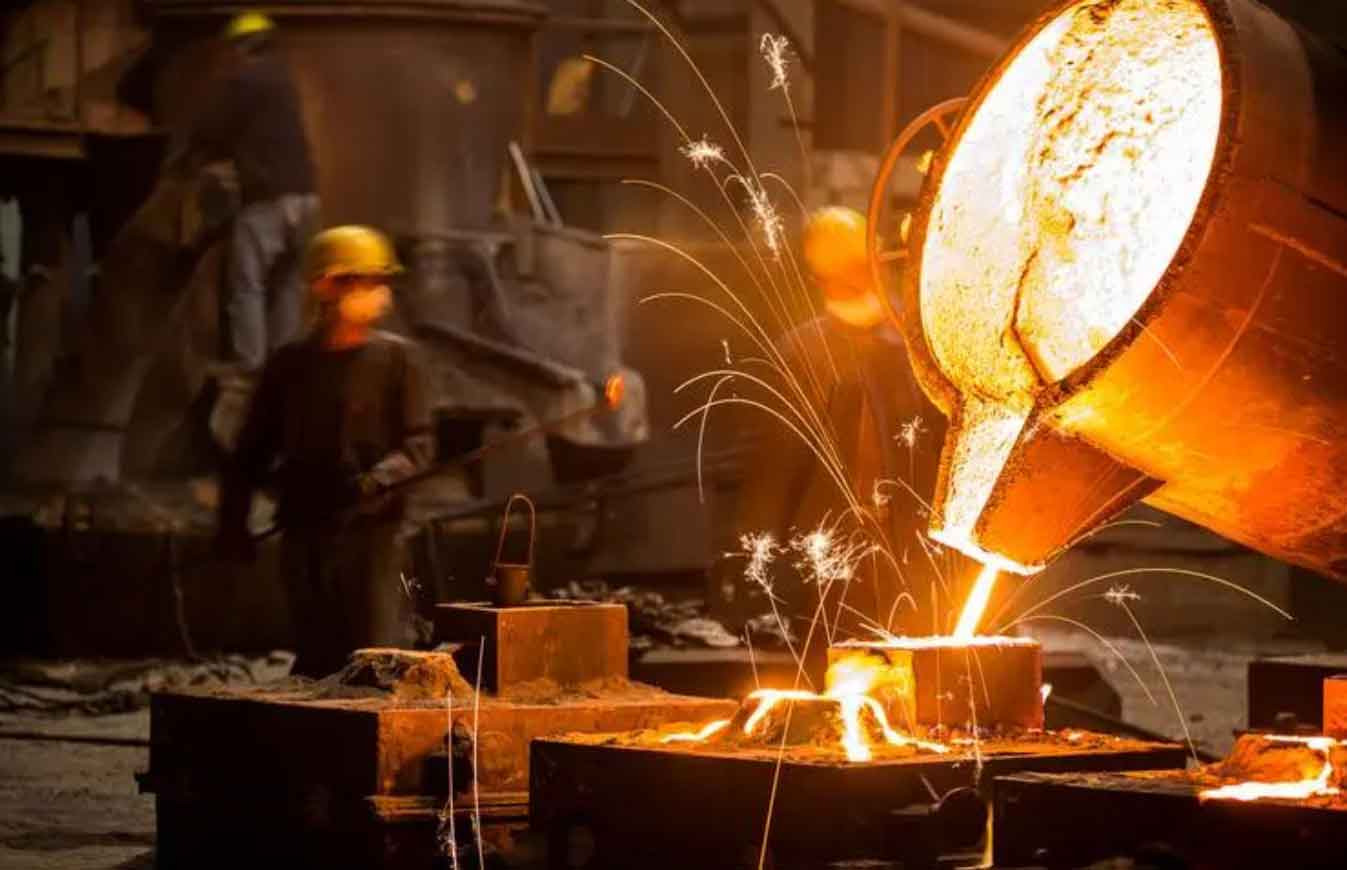
Moving on to resins, they serve as the binder in resin sand casting. The most common types are furan, phenolic, and urethane resins, with furan resins being popular due to their balanced properties. The viscosity of the resin affects its wettability on sand surfaces. Lower viscosity resins, typically below 500 mPa·s, spread more evenly, reducing the required addition amount. The cross-linking density, governed by active groups like -CH2OH, determines the strength of the resin film. In resin sand casting, optimizing resin composition is crucial; for instance, higher furfuryl alcohol content in furan resins enhances strength, but excess can shorten shelf life.
I often use the following formula to estimate resin demand based on sand surface area: $$R = k \cdot SSA \cdot C$$ where $R$ is the resin addition (in % of sand weight), $k$ is a constant depending on resin type, $SSA$ is the specific surface area, and $C$ is a correction factor for sand cleanliness. For furan resins in resin sand casting, $k$ typically ranges from 0.1 to 0.3. Coupling agents like silanes can be added to improve adhesion between the resin and sand, further reducing resin usage by up to 10% in some cases.
Hardeners are indispensable in resin sand casting, especially for self-curing systems. Organic sulfonic acids, such as p-toluene sulfonic acid (PTSA), are commonly used due to their controllable reactivity. The amount of hardener added is sensitive; too little delays curing, while too much causes brittle bonds. From my experiments, the optimal hardener addition for furan resin sand casting is around 30-50% of the resin weight, but it is better expressed as a percentage of sand weight for consistency. The curing kinetics can be modeled with an Arrhenius-type equation: $$t_c = A \cdot e^{\frac{E_a}{RT}}$$ where $t_c$ is the curing time, $A$ is a pre-exponential factor, $E_a$ is activation energy, $R$ is the gas constant, and $T$ is temperature. This highlights the temperature dependence in resin sand casting.
Let me now discuss key process parameters in resin sand casting. New sand addition is necessary to compensate for losses, but excessive use increases costs. In advanced resin sand casting setups, new sand is kept below 5% of total sand usage, aiming for a closed-loop system. Resin and hardener additions are tailored based on the required strip time and final strength. For iron castings, resin addition averages 1.0-1.2%, while for steel, it is 1.2-1.5% in resin sand casting. Hardeners are added at 0.3-0.5% of sand weight to achieve a strip time of 15-30 minutes.
The loss on ignition (LOI) of reclaimed sand is a critical metric in resin sand casting, indicating residual resin film. High LOI leads to gas defects. Control is achieved through sand-to-metal ratio (S/M) and efficient regeneration. The S/M ratio, ideally below 3:1, determines the resin film burnout rate during pouring. The relationship can be expressed as: $$\eta_b = \frac{Q_m \cdot \Delta T}{m_s \cdot C_p}$$ where $\eta_b$ is the burnout efficiency, $Q_m$ is metal heat, $\Delta T$ is temperature change, $m_s$ is sand mass, and $C_p$ is specific heat. Lower S/M ratios improve $\eta_b$, reducing LOI.
Sand regeneration is vital in resin sand casting for reusing sand and controlling LOI. Mechanical regeneration removes spent resin films, but its efficiency depends on the initial LOI. After multiple cycles, LOI stabilizes, as shown in experimental data. Below is a table summarizing LOI targets for resin sand casting:
| Casting Type | Target LOI (%) | Regeneration Passes |
|---|---|---|
| Iron Castings | 2.0-3.0 | 1-2 |
| Steel Castings | 1.5-2.5 | 2-3 |
Now, integrating these parameters, the overall performance of resin sand casting can be described through a set of equations that I have derived and refined over time. The primary equation links new sand addition, resin usage, LOI, and regeneration efficiency: $$N = \frac{R_0 – R_r \cdot (1 – \eta_r)}{1 – \eta_b}$$ where $N$ is the new sand addition rate (%), $R_0$ is the initial resin addition (%), $R_r$ is the residual resin in reclaimed sand (%), $\eta_r$ is the regeneration efficiency, and $\eta_b$ is the burnout efficiency. This formula underscores the interdependence in resin sand casting.
Another useful equation focuses on the effective resin coverage: $$E = \frac{R_a \cdot SSA}{\rho_s \cdot d_{avg}}$$ where $E$ is the coating efficiency, $R_a$ is the actual resin added, $\rho_s$ is sand density, and $d_{avg}$ is average grain diameter. In resin sand casting, aiming for $E > 0.8$ ensures adequate bonding.
Furthermore, the hardening curve in resin sand casting can be approximated by a logistic function: $$S(t) = \frac{S_{max}}{1 + e^{-k(t-t_0)}}$$ where $S(t)$ is strength at time $t$, $S_{max}$ is maximum strength, $k$ is the curing rate constant, and $t_0$ is the inflection point. This helps in predicting strip times.
In practice, I recommend monitoring these parameters through statistical process control. For instance, regular testing of sand properties, resin viscosity, and hardened strength can preempt issues in resin sand casting. The use of design of experiments (DOE) can optimize multiple variables simultaneously, such as resin type, hardener amount, and sand grain distribution.
To elaborate, let’s consider a case study in resin sand casting for automotive components. By adjusting the sand mix to include 40% reclaimed sand with LOI of 2.5%, and using a furan resin at 1.1% with PTSA hardener at 0.4%, we achieved a strip time of 20 minutes and a final strength of 1.5 MPa. The S/M ratio was maintained at 2.5:1, resulting in low gas defects and high dimensional accuracy. This exemplifies how holistic parameter management enhances resin sand casting outcomes.
Additionally, environmental aspects cannot be overlooked in modern resin sand casting. Emissions from resin decomposition, such as formaldehyde, require ventilation and filtration systems. Closed-loop sand systems minimize waste, aligning with sustainable practices. In my designs, I incorporate sand coolers and dust collectors to maintain a clean working environment.
Looking ahead, advancements in resin sand casting include the development of bio-based resins and smart sensors for real-time monitoring. These innovations promise to reduce environmental impact and improve consistency. However, the core principles remain: understanding sand-resin interactions, precise hardener dosing, and rigorous process control.
In conclusion, resin sand casting is a complex but rewarding process when mastered. Through careful attention to sand characteristics, resin selection, hardener optimization, and integrated parameter control, foundries can achieve high-quality castings with economic efficiency. I hope this detailed exploration provides valuable insights for practitioners in the field of resin sand casting.
To further aid implementation, here is a summary table of key recommendations for resin sand casting:
| Parameter | Optimal Range | Impact on Resin Sand Casting |
|---|---|---|
| Sand Grain Size (AFS) | 50-100 mesh dominant | Reduces resin usage, maintains strength |
| Clay Content | <0.5% | Prevents resin absorption |
| Moisture Content | <0.2% | Ensures proper curing |
| Resin Addition (Furan) | 1.0-1.5% of sand | Balances strength and cost |
| Hardeners (PTSA) | 0.3-0.5% of sand | Controls strip time and strength |
| Sand-to-Metal Ratio | <3:1 | Minimizes LOI and gas defects |
| LOI of Reclaimed Sand | <3.0% for iron, <2.5% for steel | Reduces casting defects |
| Regeneration Efficiency | >80% | Maintains sand quality |
By adhering to these guidelines and continuously refining processes, the potential of resin sand casting can be fully realized, driving innovation in metal casting industries worldwide.